
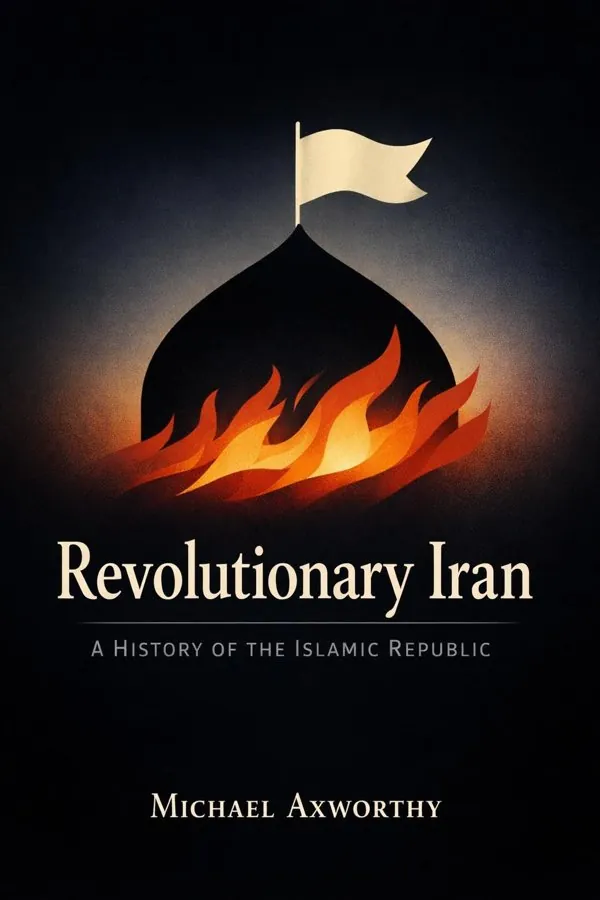
Revolutionary Iran: A History of the Islamic Republic: Summary & Key Insights
 10 min13 chaptersAudio available
What Is Revolutionary Iran: A History of the Islamic Republic About?
Revolutionary Iran: A History of the Islamic Republic by Michael Axworthy is a world_history book spanning 13 pages. This book offers a comprehensive history of Iran since the 1979 Islamic Revolution, tracing the country's political, social, and cultural transformations under the Islamic Republic. Michael Axworthy examines the revolution’s origins, the rise of Ayatollah Khomeini, the Iran-Iraq War, and the evolution of Iran’s domestic and foreign policies. The work provides insight into the complexities of Iranian society and the enduring impact of revolutionary ideology on its governance and global relations.
This FizzRead summary covers all 13 key chapters of Revolutionary Iran: A History of the Islamic Republic in approximately 10 minutes, distilling the most important ideas, arguments, and takeaways from Michael Axworthy's work. Also available as an audio summary and Key Quotes Podcast.
Revolutionary Iran: A History of the Islamic Republic
This book offers a comprehensive history of Iran since the 1979 Islamic Revolution, tracing the country's political, social, and cultural transformations under the Islamic Republic. Michael Axworthy examines the revolution’s origins, the rise of Ayatollah Khomeini, the Iran-Iraq War, and the evolution of Iran’s domestic and foreign policies. The work provides insight into the complexities of Iranian society and the enduring impact of revolutionary ideology on its governance and global relations.
Who Should Read Revolutionary Iran: A History of the Islamic Republic?
This book is perfect for anyone interested in world_history and looking to gain actionable insights in a short read. Whether you're a student, professional, or lifelong learner, the key ideas from Revolutionary Iran: A History of the Islamic Republic by Michael Axworthy will help you think differently.
- ✓Readers who enjoy world_history and want practical takeaways
- ✓Professionals looking to apply new ideas to their work and life
- ✓Anyone who wants the core insights of Revolutionary Iran: A History of the Islamic Republic in just 10 minutes
Want the full summary?
Get instant access to this book summary and 100K+ more with Fizz Moment.
Get Free SummaryAvailable on App Store • Free to download
Key Chapters
Every revolution springs from a fertile bed of discontent, and Iran’s was no exception. The postwar Pahlavi monarchy under Mohammad Reza Shah pursued modernization at a dizzying pace. The White Revolution promised land reform, women’s rights, and industrial growth, yet beneath these glossy reforms lay deep fractures. The Shah’s methods were authoritarian; his modernization was selective. Rural Iranians were displaced in droves, traditional merchants and the clerical class were marginalized, and the social fabric began to unravel. The Shah desired a state modeled on Western efficiency, but in doing so he alienated the cultural soul of his nation.
The opposition that emerged was diverse: liberals yearning for constitutionalism, Marxists calling for social justice, and clerics reaffirming the primacy of Islamic identity. They were united less by ideology than by a shared sense of betrayal — the feeling that Iran’s destiny had been appropriated by materialism and foreign interests. American influence was pervasive; British oil interests lingered. And in the bazaars and mosques, whispers of spiritual renewal began to rise. The revolution’s roots thus intertwined politics, culture, and religion. It was a revolt against a regime that spoke of progress but silenced the very voices it claimed to uplift. In this climate, the idea of an Islamic alternative gained power, not as a regression but as a reclamation of authenticity.
Khomeini’s emergence as the revolution’s ideological center was not instantaneous. For years he had been a relatively obscure cleric, his teachings focused on theology and ethics rather than politics. But in exile, his thought deepened into a powerful doctrine of resistance. He began articulating the concept of velayat-e faqih — the guardianship of the jurist — arguing that in the absence of the Hidden Imam, Islamic scholars should govern to preserve moral order. This was no mere theological abstraction; it was a political manifesto.
Through cassette tapes smuggled back into Iran, Khomeini’s sermons reached homes and hearts across the nation. His language blended faith with justice, spirituality with defiance. He called the Shah’s government anti-Islamic, condemned its westernized elites, and invoked Iran’s ancient traditions of martyrdom and resistance. By the late 1970s, his message had become the ideological core binding disparate groups under one banner. Where Marxists spoke of class struggle, Khomeini spoke of divine duty. Where liberals advocated democracy, he envisioned moral leadership. His genius lay not in compromise but in synthesis — forging a revolution that was simultaneously modern and archaic, pragmatic and utopian.
+ 11 more chapters — available in the FizzRead app
All Chapters in Revolutionary Iran: A History of the Islamic Republic
About the Author
Michael Axworthy (1962–2019) was a British historian and author specializing in Iranian history and politics. He served as head of the Iran Section at the UK Foreign and Commonwealth Office and later lectured at the University of Exeter. His works, including 'Empire of the Mind' and 'Revolutionary Iran,' are recognized for their accessible and scholarly treatment of Iran’s modern history.
Get This Summary in Your Preferred Format
Read or listen to the Revolutionary Iran: A History of the Islamic Republic summary by Michael Axworthy anytime, anywhere. FizzRead offers multiple formats so you can learn on your terms — all free.
Available formats: App · Audio · PDF · EPUB — All included free with FizzRead
Download Revolutionary Iran: A History of the Islamic Republic PDF and EPUB Summary
Key Quotes from Revolutionary Iran: A History of the Islamic Republic
“Every revolution springs from a fertile bed of discontent, and Iran’s was no exception.”
“Khomeini’s emergence as the revolution’s ideological center was not instantaneous.”
Frequently Asked Questions about Revolutionary Iran: A History of the Islamic Republic
Revolutionary Iran: A History of the Islamic Republic by Michael Axworthy is a world_history book that explores key ideas across 13 chapters. This book offers a comprehensive history of Iran since the 1979 Islamic Revolution, tracing the country's political, social, and cultural transformations under the Islamic Republic. Michael Axworthy examines the revolution’s origins, the rise of Ayatollah Khomeini, the Iran-Iraq War, and the evolution of Iran’s domestic and foreign policies. The work provides insight into the complexities of Iranian society and the enduring impact of revolutionary ideology on its governance and global relations.
More by Michael Axworthy
You Might Also Like
The Age of Capital
Eric Hobsbawm
10 min
The Gulag Archipelago
Aleksandr Solzhenitsyn
10 min
Jerusalem: The Biography
Simon Sebag Montefiore
10 min
The Anglo-Saxons
James Campbell
10 min
The Boer War
Thomas Pakenham
10 min
The Industrial Revolutionaries: The Making of the Modern World 1776–1914
Gavin Weightman
10 minBrowse by Category
Ready to read Revolutionary Iran: A History of the Islamic Republic?
Get the full summary and 100K+ more books with Fizz Moment.