
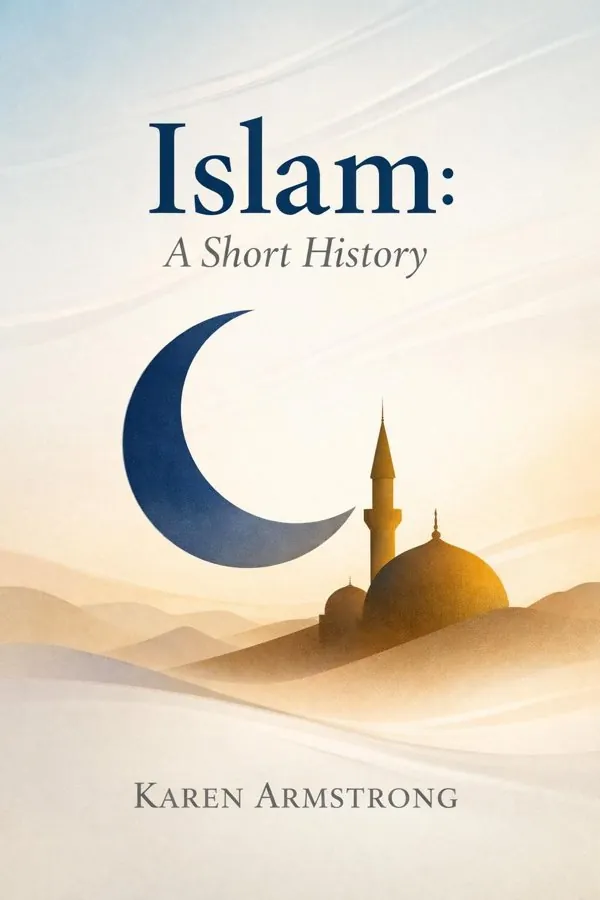
Islam: A Short History: Summary & Key Insights
 10 min6 chaptersAudio available
What Is Islam: A Short History About?
Islam: A Short History by Karen Armstrong is a world_history book spanning 6 pages. This book offers a concise and accessible overview of the history of Islam, tracing its origins from the life of the Prophet Muhammad through its development into a global faith. Armstrong explores the spiritual, cultural, and political dimensions of Islam, providing readers with a balanced understanding of its evolution and influence.
This FizzRead summary covers all 6 key chapters of Islam: A Short History in approximately 10 minutes, distilling the most important ideas, arguments, and takeaways from Karen Armstrong's work. Also available as an audio summary and Key Quotes Podcast.
Islam: A Short History
This book offers a concise and accessible overview of the history of Islam, tracing its origins from the life of the Prophet Muhammad through its development into a global faith. Armstrong explores the spiritual, cultural, and political dimensions of Islam, providing readers with a balanced understanding of its evolution and influence.
Who Should Read Islam: A Short History?
This book is perfect for anyone interested in world_history and looking to gain actionable insights in a short read. Whether you're a student, professional, or lifelong learner, the key ideas from Islam: A Short History by Karen Armstrong will help you think differently.
- ✓Readers who enjoy world_history and want practical takeaways
- ✓Professionals looking to apply new ideas to their work and life
- ✓Anyone who wants the core insights of Islam: A Short History in just 10 minutes
Want the full summary?
Get instant access to this book summary and 100K+ more with Fizz Moment.
Get Free SummaryAvailable on App Store • Free to download
Key Chapters
To understand Islam’s beginnings, we must return to the Arabian Peninsula in the early seventh century — a land caught between empires and spiritual restlessness. Arabia was dominated by tribal loyalties, where kinship was the bedrock of identity and survival. There was no overarching state, no unifying ideology; rather, society was organized around blood ties and the constant negotiation of honor and vengeance. Economically, the Hejaz, with Mecca at its heart, had grown into a bustling hub of trade between Byzantium and the Indian Ocean. The Ka‘ba, already a revered sanctuary, was the spiritual and commercial center of this world.
The religious landscape of Arabia was deeply pluralistic but also fragmented. Arabs worshipped tribal gods, yet many had heard of the monotheistic traditions of Jews and Christians living on the peninsula. These interactions created a sense of moral and religious longing. People were conscious that the world was changing — that the old gods offered little solace in the face of growing inequality and tribal warfare. It was in this context that Muhammad ibn Abdullah was born — into the Quraysh tribe, in a milieu in which longing for social justice, unity, and divine order was palpable.
The key to understanding the emergence of Islam lies in recognizing how the Prophet’s message responded to these needs. Islam would preserve what was vital in Arabian culture — its emphasis on community, loyalty, and courage — but transform it under a new vision of monotheism that transcended tribe and race. The stage was set for a revolution both spiritual and social.
Muhammad’s life marks a turning point in world history. Orphaned early, he knew both the hardship and the integrity of Meccan life. His reputation for honesty earned him the title 'al-Amin' — the trustworthy. Yet beneath the outward security of Meccan prosperity, he witnessed cruelty toward the poor, neglect of widows, and a sharp moral decline. Like many seekers before and after him, Muhammad turned inward, withdrawing to the cave of Hira, where he meditated in solitude. It was there, around the year 610, that he first encountered the divine voice that commanded, 'Recite!'
This moment of revelation was the seed of Islam — the surrender (*islam*) to the will of one God. For Muhammad, this was not a call to found a new religion but to restore an ancient truth shared by prophets before him. Yet his message of monotheism, equality, and social responsibility profoundly challenged Mecca’s tribal order. The Quraysh elite saw in it a direct threat to their economic dominance and spiritual authority. Persecution followed, but Muhammad’s leadership, sustained by faith and compassion, held his small community together.
The turning point came with the Hijra — the migration to Medina in 622. This was more than a flight from persecution; it was the birth of a new kind of community (*ummah*), bound not by tribe but by shared faith. In Medina, Muhammad combined the roles of prophet, statesman, and social reformer, crafting a polity based on consultation, pluralism, and justice. The Qur’an revealed in this period stressed compassion, fairness, and mercy over coercion. Through struggle and negotiation, the Prophet bound formerly hostile tribes into a moral community centered on submission to God and ethical responsibility toward one another.
When Muhammad passed away in 632, he left no appointed successor, no empire, and no wealth — only the Qur’an and his example (*sunnah*). His legacy was not one of authority but of moral and spiritual guidance.
+ 4 more chapters — available in the FizzRead app
All Chapters in Islam: A Short History
About the Author
Karen Armstrong is a British author and scholar known for her writings on comparative religion. A former nun, she has written extensively on Christianity, Judaism, and Islam, emphasizing interfaith understanding and the historical contexts of religious traditions.
Get This Summary in Your Preferred Format
Read or listen to the Islam: A Short History summary by Karen Armstrong anytime, anywhere. FizzRead offers multiple formats so you can learn on your terms — all free.
Available formats: App · Audio · PDF · EPUB — All included free with FizzRead
Download Islam: A Short History PDF and EPUB Summary
Key Quotes from Islam: A Short History
“To understand Islam’s beginnings, we must return to the Arabian Peninsula in the early seventh century — a land caught between empires and spiritual restlessness.”
“Muhammad’s life marks a turning point in world history.”
Frequently Asked Questions about Islam: A Short History
Islam: A Short History by Karen Armstrong is a world_history book that explores key ideas across 6 chapters. This book offers a concise and accessible overview of the history of Islam, tracing its origins from the life of the Prophet Muhammad through its development into a global faith. Armstrong explores the spiritual, cultural, and political dimensions of Islam, providing readers with a balanced understanding of its evolution and influence.
More by Karen Armstrong
You Might Also Like
The Age of Capital
Eric Hobsbawm
10 min
The Gulag Archipelago
Aleksandr Solzhenitsyn
10 min
Jerusalem: The Biography
Simon Sebag Montefiore
10 min
The Anglo-Saxons
James Campbell
10 min
The Boer War
Thomas Pakenham
10 min
The Industrial Revolutionaries: The Making of the Modern World 1776–1914
Gavin Weightman
10 minBrowse by Category
Ready to read Islam: A Short History?
Get the full summary and 100K+ more books with Fizz Moment.