
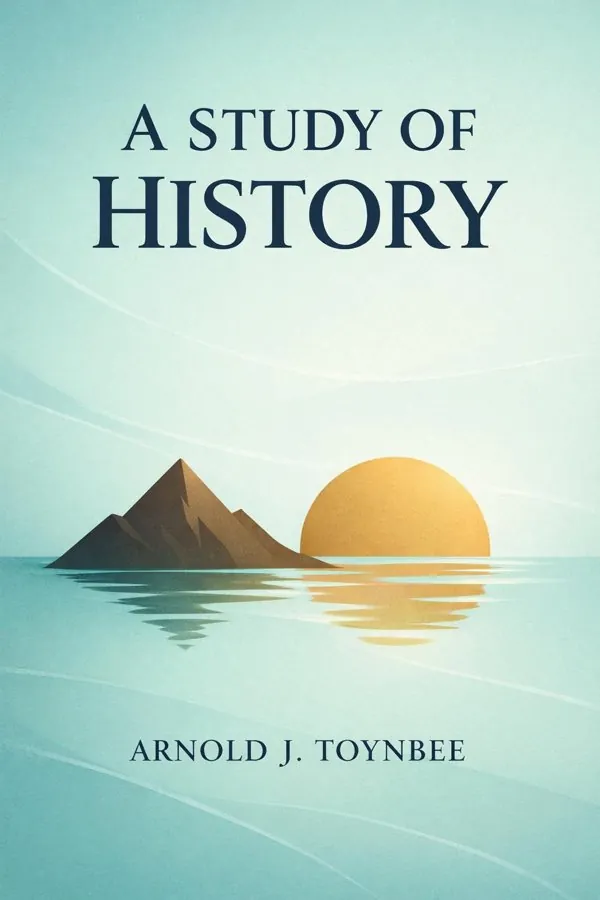
A Study of History: Summary & Key Insights
 10 min10 chaptersAudio available
Key Takeaways from A Study of History
A nation may dominate headlines, but Toynbee argues that civilizations shape the deepest currents of history.
Civilizations do not grow because life is easy; they grow because difficulty provokes creativity.
History changes when a minority creates what the majority later chooses to follow.
A civilization’s real growth is not measured first by territory, wealth, or technology, but by its increasing capacity for self-direction.
Civilizations usually do not collapse because an enemy suddenly destroys them; they begin to break down when their own leaders lose the ability to inspire.
What Is A Study of History About?
A Study of History by Arnold J. Toynbee is a civilization book spanning 12 pages. What if the fate of civilizations follows recognizable patterns rather than random accidents? In A Study of History, Arnold J. Toynbee attempts one of the boldest projects in modern historical thought: to explain why civilizations arise, grow, break down, and disappear. Instead of treating nations as the main units of history, Toynbee compares entire civilizations across centuries, searching for recurring rhythms in human development. His central claim is striking: societies do not advance simply because of race, geography, or material power, but because creative minorities successfully respond to severe challenges. The work is immense in scope. Originally published in twelve volumes and later abridged by D.C. Somervell, it ranges from the ancient world to the modern West, linking political institutions, religion, culture, war, and spiritual life into one sweeping interpretation. Toynbee was exceptionally well placed to attempt such a synthesis. A British historian educated at Oxford, he combined scholarly breadth with first-hand exposure to diplomacy and international affairs. Whether one agrees with all of his conclusions or not, his book remains a landmark because it teaches readers to look beyond events and ask the larger question: what makes a civilization truly live or die?
This FizzRead summary covers all 10 key chapters of A Study of History in approximately 10 minutes, distilling the most important ideas, arguments, and takeaways from Arnold J. Toynbee's work. Also available as an audio summary and Key Quotes Podcast.
A Study of History
What if the fate of civilizations follows recognizable patterns rather than random accidents? In A Study of History, Arnold J. Toynbee attempts one of the boldest projects in modern historical thought: to explain why civilizations arise, grow, break down, and disappear. Instead of treating nations as the main units of history, Toynbee compares entire civilizations across centuries, searching for recurring rhythms in human development. His central claim is striking: societies do not advance simply because of race, geography, or material power, but because creative minorities successfully respond to severe challenges.
The work is immense in scope. Originally published in twelve volumes and later abridged by D.C. Somervell, it ranges from the ancient world to the modern West, linking political institutions, religion, culture, war, and spiritual life into one sweeping interpretation. Toynbee was exceptionally well placed to attempt such a synthesis. A British historian educated at Oxford, he combined scholarly breadth with first-hand exposure to diplomacy and international affairs. Whether one agrees with all of his conclusions or not, his book remains a landmark because it teaches readers to look beyond events and ask the larger question: what makes a civilization truly live or die?
Who Should Read A Study of History?
This book is perfect for anyone interested in civilization and looking to gain actionable insights in a short read. Whether you're a student, professional, or lifelong learner, the key ideas from A Study of History by Arnold J. Toynbee will help you think differently.
- ✓Readers who enjoy civilization and want practical takeaways
- ✓Professionals looking to apply new ideas to their work and life
- ✓Anyone who wants the core insights of A Study of History in just 10 minutes
Want the full summary?
Get instant access to this book summary and 100K+ more with Fizz Moment.
Get Free SummaryAvailable on App Store • Free to download
Key Chapters
A nation may dominate headlines, but Toynbee argues that civilizations shape the deepest currents of history. His first major move is methodological: instead of writing history as a sequence of states, dynasties, or empires, he studies larger cultural wholes such as the Hellenic, Indic, Islamic, Western, and Orthodox civilizations. This shift matters because nations are often temporary political forms, while civilizations endure across centuries and express a more profound unity of religion, culture, memory, and social organization.
Toynbee’s comparative method seeks patterns rather than isolated facts. He treats civilizations as dynamic societies that can be born, grow, break down, and disintegrate. Unlike crude biological analogies, this does not mean they are literally organisms. It means they display recurring processes that become visible only when we compare many cases. By widening the lens, Toynbee challenges narrow historical narratives that assume one civilization, especially the modern West, is the universal model for all others.
This perspective has practical value today. It helps readers interpret global affairs more clearly. Conflicts in the modern world often involve not just states but deeper civilizational assumptions about religion, authority, identity, and meaning. It also cautions leaders against mistaking temporary military or economic superiority for enduring vitality.
For organizations and individuals, the lesson is equally useful: do not judge long-term health by short-term success. A company, institution, or culture may look powerful while internally losing purpose and creativity. Toynbee invites us to ask larger questions about what sustains a living society beneath its formal structures.
Actionable takeaway: when analyzing any major historical or contemporary issue, look beyond governments and events to the deeper civilizational values and patterns shaping them.
Civilizations do not grow because life is easy; they grow because difficulty provokes creativity. This is Toynbee’s most famous idea. He rejects the view that civilizations are determined primarily by race or environment. Geography matters, but not mechanically. Hardship can stimulate development only when it is severe enough to demand a response, yet not so overwhelming that it crushes a society outright.
Toynbee calls this process “challenge and response.” A challenge may come from a harsh landscape, foreign pressure, internal disorder, moral crisis, or social fragmentation. A civilization advances when a creative response transforms adversity into new forms of organization, belief, and action. Ancient societies facing difficult river systems, frontier threats, or political instability often developed institutions and ideas that became the foundation of larger civilizational growth.
The concept is powerful because it applies far beyond ancient history. A business may innovate because competition exposes complacency. A community may become more cohesive after disaster. A person may mature through grief, failure, or responsibility. In each case, growth depends not on the challenge alone but on the quality of the response.
Toynbee also warns that comfort can be dangerous. Societies that stop responding creatively to new conditions begin to stagnate. Success can become a trap if it encourages imitation of old formulas rather than adaptation. The same principle appears in modern institutions that continue repeating yesterday’s solutions while the environment changes around them.
Challenge and response remains one of Toynbee’s most durable insights because it links historical development with moral and imaginative effort. Progress is never automatic. It demands leadership, flexibility, and a willingness to change.
Actionable takeaway: when facing pressure, ask not “Why is this happening?” but “What creative response does this challenge require from me or my community?”
History changes when a minority creates what the majority later chooses to follow. Toynbee believes civilizations are born and expanded not by masses acting spontaneously, but by “creative minorities” who discover effective responses to major challenges. These groups do not merely command power; they generate new forms of life that others imitate voluntarily because they appear meaningful, capable, and inspiring.
This distinction is crucial. A ruling elite is not automatically a creative minority. It becomes creative only when it leads by example and attracts genuine allegiance. In the early stages of a civilization, such minorities shape institutions, moral visions, artistic forms, and social practices that give coherence to a society. Their authority rests less on force than on mimesis, Toynbee’s term for the imitation they evoke in others.
But creativity is fragile. Once a successful minority begins to rely on habit, prestige, or coercion instead of fresh insight, it ceases to be creative. It may remain dominant, but it no longer leads in the true sense. This is one of Toynbee’s most relevant observations for modern life. Organizations, governments, universities, and religious communities often decline not because they lack structure, but because their leaders stop deserving imitation.
Consider a company founded by people who solved a real problem with imagination and integrity. Over time, if leadership becomes bureaucratic and defensive, employees may comply without believing. The outward form survives, but the animating spirit fades. Toynbee sees the same pattern in civilizations.
For readers today, the idea raises a searching question: what kind of leadership creates loyalty without compulsion? The answer lies in example, imagination, and service rather than mere control.
Actionable takeaway: if you lead others, focus less on authority and more on becoming the kind of person or institution others freely want to emulate.
A civilization’s real growth is not measured first by territory, wealth, or technology, but by its increasing capacity for self-direction. Toynbee argues that growth is primarily spiritual, cultural, and institutional. External expansion may accompany development, but it is not the essence of it. The deeper mark of progress is what he calls “etherialization,” the movement from crude, material, and rigid forms toward greater subtlety, inwardness, and mastery.
In practical terms, this means a society grows when it learns to solve problems with less brute force and more intelligence, discipline, and moral depth. Institutions become more refined, art more expressive, religion more inward, and political life more capable of integrating differences. This is why external success can be misleading. An empire may conquer vast lands while already declining internally. Conversely, a society under pressure may still be growing if it is developing stronger cultural and spiritual resources.
Toynbee’s insight also applies at the personal level. Growth often looks less like accumulation and more like simplification, discipline, and perspective. A mature person usually handles conflict with more restraint and creativity than an immature one. A healthy organization develops better judgment and coordination, not just bigger budgets.
This idea is especially useful in an age obsessed with measurable expansion. Economic growth, military capacity, and technological scale are important, but they do not by themselves indicate civilizational health. Without inner development, outward success may hollow a culture rather than strengthen it.
Toynbee asks readers to judge societies by the quality of their responses, the depth of their values, and the vitality of their institutions. The same standard can be used in daily life: look for signs of increasing wisdom, not just increasing reach.
Actionable takeaway: measure progress by improved character, adaptability, and depth of purpose, not only by size, output, or visible achievements.
Civilizations usually do not collapse because an enemy suddenly destroys them; they begin to break down when their own leaders lose the ability to inspire. For Toynbee, breakdown starts when a formerly creative minority hardens into a merely dominant minority. Instead of responding imaginatively to new problems, it clings to inherited privileges, demands obedience, and substitutes force for example.
This failure of leadership creates internal division. The wider society no longer feels represented by its rulers, institutions, or traditions. People may still conform outwardly, but inward loyalty weakens. The result is what Toynbee describes as schism in the body social. The bond between leaders and led fractures, and a civilization loses the moral energy that once sustained it.
Toynbee’s analysis is especially sharp because he insists breakdown is not the same as immediate destruction. A society may continue to display great power, wealth, and administrative sophistication while already entering a period of decline. That helps explain why highly organized systems can still be deeply unstable. Their structures remain, but their legitimacy and creativity fade.
This pattern appears in modern institutions all the time. A university, church, company, or political movement may begin with a clear mission and trusted leadership. Later, as conditions change, leaders may defend procedures instead of purpose. Members become cynical, disengaged, or rebellious. The institution survives on inertia, but its center no longer holds.
Toynbee’s point is uncomfortable but practical: decline often starts from within, in the loss of imaginative moral authority. External threats become fatal only after internal vitality has weakened.
Actionable takeaway: regularly test whether your leadership, team, or institution still solves real problems creatively, or whether it now relies mainly on hierarchy, habit, and control.
When breakdown deepens, civilization enters a longer and more painful process Toynbee calls disintegration. At this stage, social division becomes structured. The old creative minority has become a dominant minority that rules without genuine allegiance. Beneath it emerges an “internal proletariat,” the excluded or spiritually alienated population within the civilization, while beyond its borders stands an “external proletariat,” neighboring peoples shaped by the civilization’s power but not fully integrated into it.
These terms are not limited to economic class. Toynbee uses them to describe spiritual and social estrangement. The internal proletariat consists of those who feel the civilization no longer serves them or represents a meaningful moral order. The external proletariat includes outsider groups that may admire, resent, imitate, or eventually invade the declining civilization.
This framework helps explain why collapsing societies often produce both revolt from within and pressure from without. The dominant minority tightens control, the internal proletariat seeks alternative meaning, and the external proletariat gathers strength at the margins. The civilization becomes increasingly brittle.
Toynbee’s model has contemporary resonance. Modern societies can generate internal groups who feel abandoned by political, cultural, or economic elites, while external pressures arise through migration, geopolitical rivalry, or peripheral actors empowered by the very system they challenge. The point is not to force every event into Toynbee’s scheme, but to recognize how estrangement undermines social cohesion.
Disintegration also produces opportunities for spiritual renewal. Alienated groups may become the carriers of new religious or moral visions that survive the old order. What looks like marginality can become the seedbed of the future.
Actionable takeaway: watch for growing estrangement inside institutions and societies; unresolved alienation is often a stronger sign of decline than visible conflict alone.
One of Toynbee’s most original insights is that late civilizations often seek unity in two different forms: political consolidation and spiritual reorientation. As disintegration advances, a “universal state” may emerge, bringing order over a large area through imperial administration. At the same time, a “universal church” may arise, offering moral meaning to those disillusioned with the old political and social order.
The universal state appears to solve chaos, but Toynbee sees it less as a sign of renewed vitality than as a terminal stabilization. Rome in the ancient world is his classic example: impressive, orderly, and durable, yet created after the creative energies of Hellenic civilization had already waned. The universal state freezes conflict, but it does not restore the spiritual dynamism that once drove growth.
By contrast, the universal church often emerges from the internal proletariat and points beyond the dying civilization. Christianity within the late classical world becomes Toynbee’s major case. While empires preserve bodies, religions can preserve souls and transmit meaning into the next historical era.
This distinction remains useful today. Periods of fragmentation often create a desire for centralized order, but administrative unity alone cannot heal moral exhaustion. Societies also need narratives, communities, and transcendent commitments capable of restoring purpose. In organizational terms, a crisis may produce tighter management, but without a renewed mission people remain disengaged.
Toynbee thus asks us to distinguish between order and life. Stability can be necessary, but it is not identical with renewal. Lasting regeneration requires something deeper than control.
Actionable takeaway: in times of disorder, value structure and stability, but do not mistake administrative unity for genuine cultural or spiritual renewal.
Renewal often begins not in the center of power but in retreat from it. Toynbee observes a recurring pattern in history that he calls “withdrawal and return.” Creative individuals or groups frequently step back from the pressures, corruption, or distractions of ordinary social life, gain new spiritual or intellectual insight, and then return with transformed energy that can reshape their civilization.
This pattern appears in religious founders, philosophers, reformers, and innovators. Withdrawal is not escapism when it serves preparation. It creates the distance necessary for reflection, discipline, and reorientation. Return is equally essential. The new vision must re-enter social life and address collective problems, or it remains private rather than civilizational.
Toynbee sees this rhythm in everything from monastic movements to prophetic religion and philosophical schools. The same logic applies at smaller scales. Professionals often need strategic distance from daily busyness to rethink purpose. Communities in conflict may need pauses for reflection before real reconciliation becomes possible. Leaders who never withdraw risk becoming reactive; those who never return become irrelevant.
The modern world often celebrates nonstop engagement, constant visibility, and immediate reaction. Toynbee offers a counterpoint: some of the most important advances come from disciplined interiority before public action. Creativity requires intervals of silence, study, and self-command.
This idea is especially practical for anyone facing burnout or confusion. Sometimes the right response to crisis is not instant activity but purposeful retreat that makes wiser action possible. Yet the retreat must be temporary and directed toward service.
Actionable takeaway: build deliberate periods of reflection, study, or rest into your work so that when you act, you return with greater clarity, depth, and usefulness.
For Toynbee, the highest significance of history is spiritual rather than political. Civilizations matter, but they are not ultimate ends in themselves. Their deepest role may be to create the conditions through which higher religious insight develops. In this sense, religion is not just one institution among others; it is the sphere in which the human search for meaning reaches beyond the rise and fall of temporal orders.
This is one reason Toynbee gives such importance to universal churches. While civilizations break down, religious traditions can gather the moral and spiritual achievements of an age, transform them, and transmit them forward. The decline of a civilization is therefore not simply loss. It may also be part of a larger drama in which spiritual truth becomes clearer as political forms fail.
Toynbee does not mean that every religion automatically improves humanity, nor that history unfolds neatly. His point is subtler: material success and political dominance are too shallow to serve as final measures of human achievement. A civilization may be brilliant yet spiritually barren, or politically broken yet religiously fertile. The most enduring legacy of a society may lie not in its armies or monuments but in its moral imagination.
This perspective challenges modern assumptions. It asks readers to consider whether prosperity without purpose is sustainable, and whether crisis can open paths to deeper understanding. Even in secular settings, the underlying lesson remains powerful: societies need transcendent values, not just systems of production and power.
Toynbee’s emphasis on religion may not persuade every reader in its original form, but his broader claim still resonates. Meaning is not a decorative extra; it is central to collective survival.
Actionable takeaway: strengthen the moral and spiritual foundations of your life or community, because no amount of external success can compensate for the loss of meaning.
Toynbee does not treat Western civilization as exempt from the patterns that governed earlier societies. In fact, one of the boldest implications of A Study of History is that the modern West may also face breakdown if it cannot answer its own challenges creatively. Industrial power, scientific achievement, and global influence do not guarantee permanence. Like other civilizations, the West can stagnate if its institutions become mechanized, its elites lose legitimacy, and its people surrender moral purpose.
Toynbee pays close attention to encounters between civilizations, because no civilization develops in total isolation. Borrowing, conflict, imitation, and misunderstanding all shape historical outcomes. The modern West’s expansion placed it in contact with nearly every other civilization on earth, creating unprecedented opportunities and dangers. Military and technological superiority could impose forms from outside, but not necessarily win spiritual allegiance.
This diagnosis remains strikingly current. Contemporary Western societies wrestle with polarization, cultural exhaustion, inequality, technological disruption, and declining trust in institutions. Toynbee would likely see these as challenges demanding responses deeper than policy adjustments alone. The issue is whether a civilization can renew its creative minority, restore meaningful social cohesion, and orient power toward humane ends.
Importantly, Toynbee is not simply pessimistic. Because growth always depends on response, decline is never purely predetermined. Renewal remains possible where humility, creativity, and spiritual seriousness survive. The future is shaped less by inherited advantage than by the moral quality of present action.
For readers today, this final lesson widens into a personal one. Every community, institution, and life faces moments when old formulas stop working. Survival belongs to those who can answer a new challenge without betraying their deepest values.
Actionable takeaway: treat present crises as tests of renewal, and ask what moral, cultural, and institutional changes are needed to keep vitality from hardening into decline.
All Chapters in A Study of History
About the Author
Arnold Joseph Toynbee (1889–1975) was a British historian, philosopher of history, and one of the twentieth century’s most ambitious interpreters of world civilization. Educated at Balliol College, Oxford, he went on to teach and to work in public and international affairs, experiences that broadened his perspective beyond conventional national history. He is best known for A Study of History, his monumental multi-volume examination of how civilizations emerge, develop, and decline. Toynbee’s comparative approach, especially his theories of challenge and response and creative minorities, made him internationally influential, even as they sparked debate among scholars. Though later historians often criticized his sweeping generalizations, Toynbee remains a major figure in civilizational studies for his bold effort to understand history as a global, patterned, and deeply moral process.
Get This Summary in Your Preferred Format
Read or listen to the A Study of History summary by Arnold J. Toynbee anytime, anywhere. FizzRead offers multiple formats so you can learn on your terms — all free.
Available formats: App · Audio · PDF · EPUB — All included free with FizzRead
Download A Study of History PDF and EPUB Summary
Key Quotes from A Study of History
“A nation may dominate headlines, but Toynbee argues that civilizations shape the deepest currents of history.”
“Civilizations do not grow because life is easy; they grow because difficulty provokes creativity.”
“History changes when a minority creates what the majority later chooses to follow.”
“A civilization’s real growth is not measured first by territory, wealth, or technology, but by its increasing capacity for self-direction.”
“Civilizations usually do not collapse because an enemy suddenly destroys them; they begin to break down when their own leaders lose the ability to inspire.”
Frequently Asked Questions about A Study of History
A Study of History by Arnold J. Toynbee is a civilization book that explores key ideas across 10 chapters. What if the fate of civilizations follows recognizable patterns rather than random accidents? In A Study of History, Arnold J. Toynbee attempts one of the boldest projects in modern historical thought: to explain why civilizations arise, grow, break down, and disappear. Instead of treating nations as the main units of history, Toynbee compares entire civilizations across centuries, searching for recurring rhythms in human development. His central claim is striking: societies do not advance simply because of race, geography, or material power, but because creative minorities successfully respond to severe challenges. The work is immense in scope. Originally published in twelve volumes and later abridged by D.C. Somervell, it ranges from the ancient world to the modern West, linking political institutions, religion, culture, war, and spiritual life into one sweeping interpretation. Toynbee was exceptionally well placed to attempt such a synthesis. A British historian educated at Oxford, he combined scholarly breadth with first-hand exposure to diplomacy and international affairs. Whether one agrees with all of his conclusions or not, his book remains a landmark because it teaches readers to look beyond events and ask the larger question: what makes a civilization truly live or die?
You Might Also Like
The Structure of Scientific Revolutions
Thomas S. Kuhn
10 min
Genius
Harold Bloom
10 min
A Cultural History of the Medieval Age
Various Editors
10 min
A History of God: The 4,000-Year Quest of Judaism, Christianity and Islam
Karen Armstrong
10 min
A History of the World in 10½ Chapters
Julian Barnes
10 min
A Short History of Progress
Ronald Wright
10 minBrowse by Category
Ready to read A Study of History?
Get the full summary and 100K+ more books with Fizz Moment.