
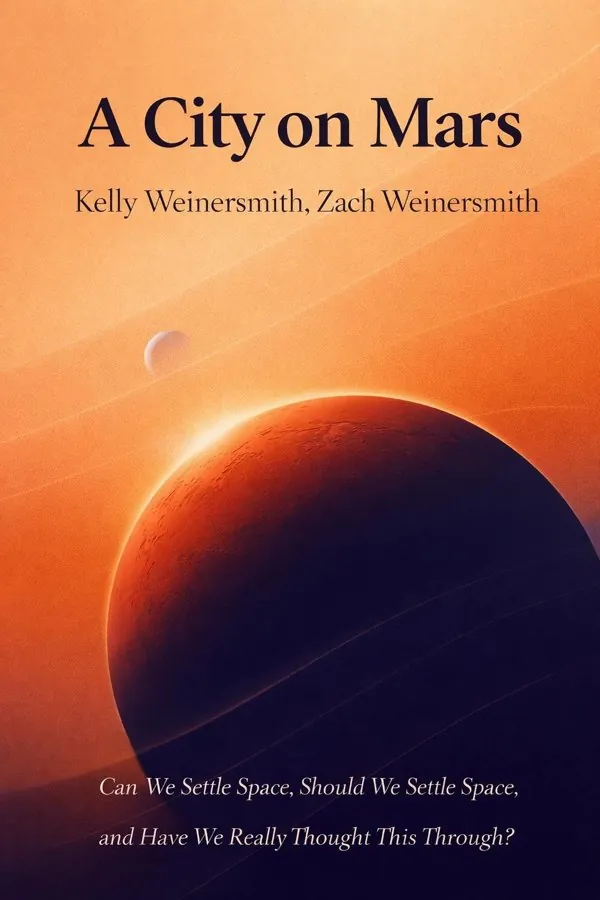
A City on Mars: Can We Settle Space, Should We Settle Space, and Have We Really Thought This Through?: Summary & Key Insights
by Kelly Weinersmith, Zach Weinersmith
 10 min8 chaptersAudio available
What Is A City on Mars: Can We Settle Space, Should We Settle Space, and Have We Really Thought This Through? About?
A City on Mars: Can We Settle Space, Should We Settle Space, and Have We Really Thought This Through? by Kelly Weinersmith, Zach Weinersmith is a popular_sci book spanning 8 pages. A City on Mars explores the scientific, ethical, and practical challenges of human settlement beyond Earth. The authors, Kelly and Zach Weinersmith, combine humor and research to examine whether humanity is ready for life on Mars or other celestial bodies, addressing issues of biology, law, sustainability, and social organization in space colonization.
This FizzRead summary covers all 8 key chapters of A City on Mars: Can We Settle Space, Should We Settle Space, and Have We Really Thought This Through? in approximately 10 minutes, distilling the most important ideas, arguments, and takeaways from Kelly Weinersmith, Zach Weinersmith's work. Also available as an audio summary and Key Quotes Podcast.
A City on Mars: Can We Settle Space, Should We Settle Space, and Have We Really Thought This Through?
A City on Mars explores the scientific, ethical, and practical challenges of human settlement beyond Earth. The authors, Kelly and Zach Weinersmith, combine humor and research to examine whether humanity is ready for life on Mars or other celestial bodies, addressing issues of biology, law, sustainability, and social organization in space colonization.
Who Should Read A City on Mars: Can We Settle Space, Should We Settle Space, and Have We Really Thought This Through??
This book is perfect for anyone interested in popular_sci and looking to gain actionable insights in a short read. Whether you're a student, professional, or lifelong learner, the key ideas from A City on Mars: Can We Settle Space, Should We Settle Space, and Have We Really Thought This Through? by Kelly Weinersmith, Zach Weinersmith will help you think differently.
- ✓Readers who enjoy popular_sci and want practical takeaways
- ✓Professionals looking to apply new ideas to their work and life
- ✓Anyone who wants the core insights of A City on Mars: Can We Settle Space, Should We Settle Space, and Have We Really Thought This Through? in just 10 minutes
Want the full summary?
Get instant access to this book summary and 100K+ more with Fizz Moment.
Get Free SummaryAvailable on App Store • Free to download
Key Chapters
When we trace the story of space colonization, we meet a timeline woven from imagination, ideology, and aspiration. The idea that humans would one day live beyond Earth predates rockets by centuries. It belongs not just to scientists, but to storytellers. From H.G. Wells and Konstantin Tsiolkovsky to the pulp magazines of the mid-20th century, space cities were first conceived as utopias—refuges where humanity could escape its own mess. By the time NASA astronauts set foot on the Moon, these visions became geopolitical tools: space not as home, but as victory. The Cold War made exploration a competition, not a settlement plan.
After Apollo, ambition faded for a time. Then new dreamers arrived: private billionaires, tech utopians, and futurist movements like Mars One, all promising to finish what governments never did. But as we examined these projects, their common thread wasn’t readiness—it was confidence. Each proposal, whether from entrepreneurs or enthusiasts, assumed that logistics would naturally bend to willpower. Yet the real record of space history shows something else: every step into orbit was a triumph born of staggering difficulty and cost. There was never a smooth, self-sustaining frontier—only fleeting visits made possible by thousands of coordinated minds and endless systems of support from Earth.
In reviewing this history, we realized something crucial: for all the talk of progress, our actual capacity to live off-world hasn’t advanced as much as imagination pretends. The foundations of long-term settlement—self-sufficient life support, radiation protection, governance frameworks—remain closer to speculative fiction than functioning systems. The history of space settlement isn’t a story of inevitability; it’s a story of perpetual aspiration amid persistent limitations. And that pattern sets the stage for every hard truth the rest of the book explores.
As a biologist, I couldn’t help starting with the human body, that fragile, gravity-trained system that evolved under one atmosphere and a magnetic shield. Space, to it, is poison. Microgravity weakens bones and muscles; it rewires the cardiovascular system; it alters gene expression in ways we are only beginning to understand. Astronauts experience fluid redistribution that clouds vision and causes swelling in the head. Radiation? That’s another monster entirely—cosmic rays that slice through DNA, increasing cancer risk, mutation rates, and potentially long-term neurological consequences. On Mars, despite its romantic hue, the surface radiation levels are hundreds of times greater than on Earth.
In orbit, we can mitigate some of these threats with technology: shielding, exercise regimens, monitoring. But colonization changes the timeline. A settlement implies generations—a population, not a mission. That distinction makes biology the limiting factor. We have never tested whether mammalian reproduction, gestation, or even basic immune function can sustain across multiple generations in partial gravity. We don’t know what low-G does to children or to developing brains. The more we looked, the clearer it became that human space settlement, in biological terms, is a massive, uncontrolled experiment on our own species.
It’s easy to imagine that increasing medical technology will solve these problems. But each countermeasure adds complexity, cost, and dependencies that undermine the fantasy of independence. A Martian colony, for example, could quickly find itself as oxygen-dependent on Earth as we are now on oil. The settlement dream assumes human adaptability is boundless. Biology says otherwise—it demands ecosystems, feedback loops, microbes, and gravity itself. When the body rebels against the environment, no amount of optimism will make it thrive. That, perhaps, is the starkest truth the dream of running away to Mars has yet to face.
+ 6 more chapters — available in the FizzRead app
All Chapters in A City on Mars: Can We Settle Space, Should We Settle Space, and Have We Really Thought This Through?
About the Authors
Kelly Weinersmith is a biologist and researcher known for her work in behavioral ecology. Zach Weinersmith is a cartoonist and writer best known for the webcomic 'Saturday Morning Breakfast Cereal'. Together, they co-authored 'Soonish' and 'A City on Mars', blending science communication with humor and accessible storytelling.
Get This Summary in Your Preferred Format
Read or listen to the A City on Mars: Can We Settle Space, Should We Settle Space, and Have We Really Thought This Through? summary by Kelly Weinersmith, Zach Weinersmith anytime, anywhere. FizzRead offers multiple formats so you can learn on your terms — all free.
Available formats: App · Audio · PDF · EPUB — All included free with FizzRead
Download A City on Mars: Can We Settle Space, Should We Settle Space, and Have We Really Thought This Through? PDF and EPUB Summary
Key Quotes from A City on Mars: Can We Settle Space, Should We Settle Space, and Have We Really Thought This Through?
“When we trace the story of space colonization, we meet a timeline woven from imagination, ideology, and aspiration.”
“As a biologist, I couldn’t help starting with the human body, that fragile, gravity-trained system that evolved under one atmosphere and a magnetic shield.”
Frequently Asked Questions about A City on Mars: Can We Settle Space, Should We Settle Space, and Have We Really Thought This Through?
A City on Mars: Can We Settle Space, Should We Settle Space, and Have We Really Thought This Through? by Kelly Weinersmith, Zach Weinersmith is a popular_sci book that explores key ideas across 8 chapters. A City on Mars explores the scientific, ethical, and practical challenges of human settlement beyond Earth. The authors, Kelly and Zach Weinersmith, combine humor and research to examine whether humanity is ready for life on Mars or other celestial bodies, addressing issues of biology, law, sustainability, and social organization in space colonization.
More by Kelly Weinersmith, Zach Weinersmith
You Might Also Like
Structures: Or Why Things Don"t Fall Down
J.E. Gordon
10 min
The Road to Wigan Pier
George Orwell
10 min
Bonk: The Curious Coupling of Science and Sex
Mary Roach
10 min
First Bite: How We Learn to Eat
Bee Wilson
10 min
In Pursuit Of The Unknown: 17 Equations That Changed The World
Ian Stewart
10 min
Napoleon's Buttons: 17 Molecules That Changed History
Penny Le Couteur and Jay Burreson
10 minFeatured In
Browse by Category
Ready to read A City on Mars: Can We Settle Space, Should We Settle Space, and Have We Really Thought This Through??
Get the full summary and 100K+ more books with Fizz Moment.