
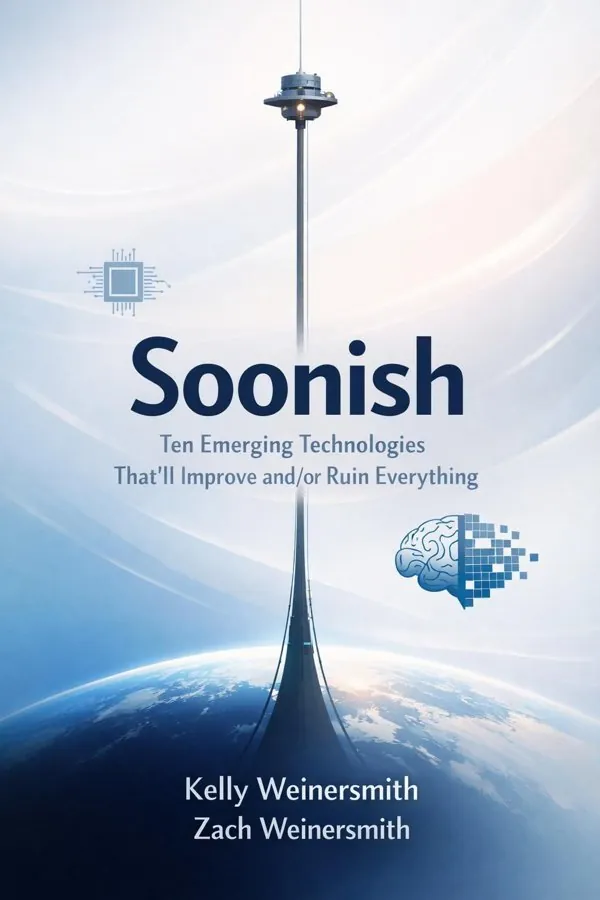
Soonish: Ten Emerging Technologies That'll Improve and/or Ruin Everything: Summary & Key Insights
by Kelly Weinersmith, Zach Weinersmith
 10 min10 chaptersAudio available
What Is Soonish: Ten Emerging Technologies That'll Improve and/or Ruin Everything About?
Soonish: Ten Emerging Technologies That'll Improve and/or Ruin Everything by Kelly Weinersmith, Zach Weinersmith is a popular_sci book spanning 10 pages. In this witty and insightful book, biologist Dr. Kelly Weinersmith and cartoonist Zach Weinersmith explore ten emerging technologies that could dramatically change our future. From space elevators and fusion power to programmable matter and brain-computer interfaces, the authors combine scientific rigor with humor to examine how these innovations might improve—or ruin—everything.
This FizzRead summary covers all 10 key chapters of Soonish: Ten Emerging Technologies That'll Improve and/or Ruin Everything in approximately 10 minutes, distilling the most important ideas, arguments, and takeaways from Kelly Weinersmith, Zach Weinersmith's work. Also available as an audio summary and Key Quotes Podcast.
Soonish: Ten Emerging Technologies That'll Improve and/or Ruin Everything
In this witty and insightful book, biologist Dr. Kelly Weinersmith and cartoonist Zach Weinersmith explore ten emerging technologies that could dramatically change our future. From space elevators and fusion power to programmable matter and brain-computer interfaces, the authors combine scientific rigor with humor to examine how these innovations might improve—or ruin—everything.
Who Should Read Soonish: Ten Emerging Technologies That'll Improve and/or Ruin Everything?
This book is perfect for anyone interested in popular_sci and looking to gain actionable insights in a short read. Whether you're a student, professional, or lifelong learner, the key ideas from Soonish: Ten Emerging Technologies That'll Improve and/or Ruin Everything by Kelly Weinersmith, Zach Weinersmith will help you think differently.
- ✓Readers who enjoy popular_sci and want practical takeaways
- ✓Professionals looking to apply new ideas to their work and life
- ✓Anyone who wants the core insights of Soonish: Ten Emerging Technologies That'll Improve and/or Ruin Everything in just 10 minutes
Want the full summary?
Get instant access to this book summary and 100K+ more with Fizz Moment.
Get Free SummaryAvailable on App Store • Free to download
Key Chapters
We start with what is perhaps the grandest dream of all: escaping Earth’s gravity without blowing up metric tons of explosive fuel. A space elevator sounds like a fantasy of silver-age science fiction, but it’s actually an engineering problem we could, in principle, solve. The idea is simple: tether a long, super-strong cable from the Earth’s surface to a point in geostationary orbit. Climb it, rather than launch from it, and the cost to reach orbit could drop by orders of magnitude. The difficulty, as we discovered while researching this chapter, is everything else.
Cables of that length need to be stronger than any known material—stronger than steel, tougher than Kevlar, far exceeding what carbon nanotubes can do today. The atmosphere’s winds, the Coriolis forces, and the impact of micrometeoroids make it an engineer’s nightmare. Yet even if the physics is harsh, the economic implications are dazzling. Cheap access to orbit could make space tourism, asteroid mining, and even solar power stations truly feasible. But like every miracle technology, it could also collapse markets, shift geopolitics, and lead to entirely new military vulnerabilities. We learned that the space elevator, as breathtaking as it is, ultimately serves as a metaphor for technological ambition itself: you aim for the stars, but you hang everything on a thread that’s not yet strong enough to hold you.
Of all the technologies humanity has pursued, fusion—harnessing the process that powers the Sun—might be the purest expression of optimism. It offers essentially limitless clean energy, no greenhouse emissions, minimal waste, and a poetic symmetry: we would be bottling the fire that gives life to every living thing on Earth. And yet, fusion research has been the butt of the same joke for half a century: it’s always thirty years away.
Writing this chapter, we dug into why it remains so hard. The problem isn’t ignorance, but precision. To sustain a fusion reaction, you must heat hydrogen plasma to hundreds of millions of degrees and confine it long enough for nuclei to collide. The devices that achieve this, called tokamaks and stellarators, are extraordinary feats of engineering. However, keeping the plasma stable is akin to holding a sun in a magnetic bottle—the tiniest instabilities can unravel it. Despite that, the field is accelerating, with private startups and national labs experimenting with new designs, materials, and magnetic systems.
If fusion succeeds, the world changes in ways we can only half predict. Energy abundance could eliminate scarcity-driven conflict, or it could drive unsustainable consumption to new heights. As we wrote, fusion symbolizes the paradox of progress: the capacity to liberate humanity from limits, coupled with our knack for creating new problems the moment we solve old ones.
+ 8 more chapters — available in the FizzRead app
All Chapters in Soonish: Ten Emerging Technologies That'll Improve and/or Ruin Everything
About the Authors
Kelly Weinersmith is a biologist and researcher known for her work in behavioral ecology. Zach Weinersmith is the creator of the popular webcomic 'Saturday Morning Breakfast Cereal'. Together, they bring science and humor to complex topics in technology and innovation.
Get This Summary in Your Preferred Format
Read or listen to the Soonish: Ten Emerging Technologies That'll Improve and/or Ruin Everything summary by Kelly Weinersmith, Zach Weinersmith anytime, anywhere. FizzRead offers multiple formats so you can learn on your terms — all free.
Available formats: App · Audio · PDF · EPUB — All included free with FizzRead
Download Soonish: Ten Emerging Technologies That'll Improve and/or Ruin Everything PDF and EPUB Summary
Key Quotes from Soonish: Ten Emerging Technologies That'll Improve and/or Ruin Everything
“We start with what is perhaps the grandest dream of all: escaping Earth’s gravity without blowing up metric tons of explosive fuel.”
“Of all the technologies humanity has pursued, fusion—harnessing the process that powers the Sun—might be the purest expression of optimism.”
Frequently Asked Questions about Soonish: Ten Emerging Technologies That'll Improve and/or Ruin Everything
Soonish: Ten Emerging Technologies That'll Improve and/or Ruin Everything by Kelly Weinersmith, Zach Weinersmith is a popular_sci book that explores key ideas across 10 chapters. In this witty and insightful book, biologist Dr. Kelly Weinersmith and cartoonist Zach Weinersmith explore ten emerging technologies that could dramatically change our future. From space elevators and fusion power to programmable matter and brain-computer interfaces, the authors combine scientific rigor with humor to examine how these innovations might improve—or ruin—everything.
More by Kelly Weinersmith, Zach Weinersmith

You Might Also Like

Structures: Or Why Things Don"t Fall Down
J.E. Gordon
10 min
The Road to Wigan Pier
George Orwell
10 min
Bonk: The Curious Coupling of Science and Sex
Mary Roach
10 min
First Bite: How We Learn to Eat
Bee Wilson
10 min
In Pursuit Of The Unknown: 17 Equations That Changed The World
Ian Stewart
10 min
Napoleon's Buttons: 17 Molecules That Changed History
Penny Le Couteur and Jay Burreson
10 minBrowse by Category
Ready to read Soonish: Ten Emerging Technologies That'll Improve and/or Ruin Everything?
Get the full summary and 100K+ more books with Fizz Moment.