
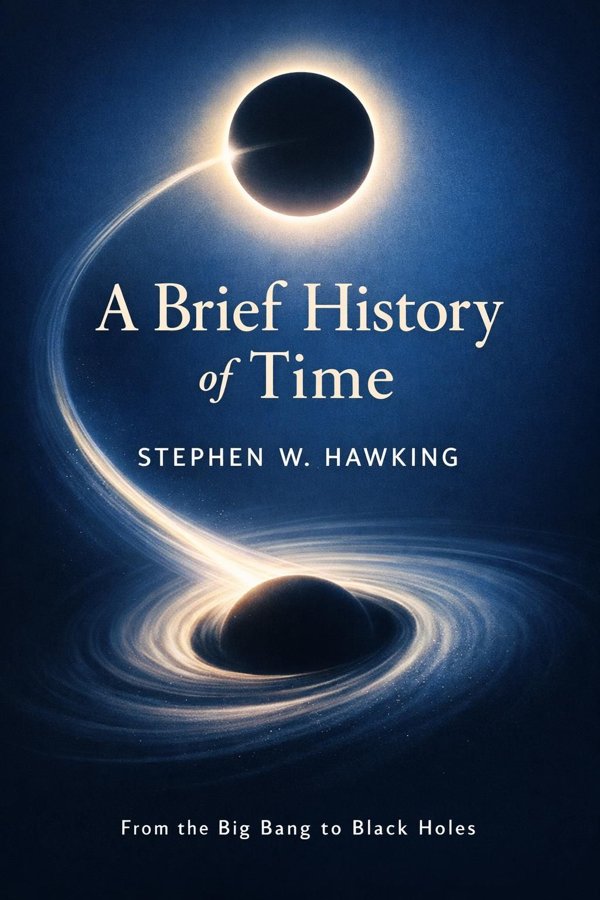
A Brief History of Time: From the Big Bang to Black Holes: Summary & Key Insights
 10 min10 chaptersAudio available
Key Takeaways from A Brief History of Time: From the Big Bang to Black Holes
Every age believes it finally understands the universe, yet history shows that each worldview is only a stepping stone.
What feels separate to us in daily life—space here, time now—is, at a deeper level, part of a single structure.
A static universe may feel intuitive, but the evidence points to a cosmos in motion.
The deepest laws of nature do not always deliver certainty; sometimes they define the limits of what can be known.
Behind the visible complexity of the universe lies a surprisingly small set of ingredients and interactions.
What Is A Brief History of Time: From the Big Bang to Black Holes About?
A Brief History of Time: From the Big Bang to Black Holes by Stephen W. Hawking is a popular_sci book spanning 10 pages. Stephen W. Hawking’s A Brief History of Time is one of the rare science books that changed public culture. It takes some of the biggest questions human beings can ask—How did the universe begin? What is time? What happens inside a black hole? Can the laws of nature be unified?—and turns them into a guided tour through modern cosmology. Hawking does not assume the reader is a physicist. Instead, he translates ideas from relativity, quantum mechanics, and astronomy into vivid, approachable explanations that invite ordinary readers into extraordinary territory. What makes the book matter is not only the scale of its subject but also the clarity of its ambition. Hawking shows that science is not just a collection of facts; it is a method for asking better questions about reality itself. He also writes with unique authority. As one of the world’s leading theoretical physicists, Hawking made major contributions to our understanding of black holes, singularities, and the early universe. This book distills that expertise into a deeply human exploration of curiosity, uncertainty, and discovery. It is both a map of the cosmos and a reminder that understanding begins with wonder.
This FizzRead summary covers all 10 key chapters of A Brief History of Time: From the Big Bang to Black Holes in approximately 10 minutes, distilling the most important ideas, arguments, and takeaways from Stephen W. Hawking's work. Also available as an audio summary and Key Quotes Podcast.
A Brief History of Time: From the Big Bang to Black Holes
Stephen W. Hawking’s A Brief History of Time is one of the rare science books that changed public culture. It takes some of the biggest questions human beings can ask—How did the universe begin? What is time? What happens inside a black hole? Can the laws of nature be unified?—and turns them into a guided tour through modern cosmology. Hawking does not assume the reader is a physicist. Instead, he translates ideas from relativity, quantum mechanics, and astronomy into vivid, approachable explanations that invite ordinary readers into extraordinary territory.
What makes the book matter is not only the scale of its subject but also the clarity of its ambition. Hawking shows that science is not just a collection of facts; it is a method for asking better questions about reality itself. He also writes with unique authority. As one of the world’s leading theoretical physicists, Hawking made major contributions to our understanding of black holes, singularities, and the early universe. This book distills that expertise into a deeply human exploration of curiosity, uncertainty, and discovery. It is both a map of the cosmos and a reminder that understanding begins with wonder.
Who Should Read A Brief History of Time: From the Big Bang to Black Holes?
This book is perfect for anyone interested in popular_sci and looking to gain actionable insights in a short read. Whether you're a student, professional, or lifelong learner, the key ideas from A Brief History of Time: From the Big Bang to Black Holes by Stephen W. Hawking will help you think differently.
- ✓Readers who enjoy popular_sci and want practical takeaways
- ✓Professionals looking to apply new ideas to their work and life
- ✓Anyone who wants the core insights of A Brief History of Time: From the Big Bang to Black Holes in just 10 minutes
Want the full summary?
Get instant access to this book summary and 100K+ more with Fizz Moment.
Get Free SummaryAvailable on App Store • Free to download
Key Chapters
Every age believes it finally understands the universe, yet history shows that each worldview is only a stepping stone. Hawking begins by reminding us that cosmology is not just the story of stars and galaxies; it is also the story of changing human ideas. Ancient thinkers such as Aristotle imagined a finite, ordered cosmos centered on Earth. Ptolemy built an elaborate system of circles to explain planetary motion. Later, Copernicus, Kepler, Galileo, and Newton replaced this Earth-centered picture with a universe governed by mathematical laws.
This intellectual shift matters because it shows how progress happens. We move forward not by clinging to familiar explanations but by testing them against observation. Newton’s laws once seemed to explain everything, yet Einstein later revealed their limits. Even Einstein’s theories, powerful as they are, do not fully reconcile gravity with quantum mechanics. Science advances by refining models, not by discovering final certainty in one step.
A practical lesson emerges here. In everyday life, we also build models of reality: how markets work, how people behave, how our own bodies respond to stress or sleep. These models help us navigate the world, but they are always provisional. The willingness to update them in light of better evidence is a scientific habit with broad value.
Hawking’s larger point is that the universe becomes more intelligible as our questions improve. Rather than seeing science as cold or abstract, he presents it as a deeply human tradition of curiosity and correction. Actionable takeaway: treat your beliefs as working models, not permanent truths, and strengthen them by seeking evidence that could prove them incomplete.
What feels separate to us in daily life—space here, time now—is, at a deeper level, part of a single structure. One of Hawking’s central achievements is helping readers grasp Einstein’s revolutionary insight that space and time are woven together into spacetime. We do not live in a static cosmic stage where events simply occur. Instead, matter, energy, motion, and gravity shape the geometry of the universe itself.
In Newton’s view, time flowed uniformly for everyone. Einstein overturned that intuition. According to special relativity, observers moving at different speeds can measure different times and distances. According to general relativity, gravity is not just a force pulling objects together; it is the curvature of spacetime caused by mass and energy. Planets orbit the sun not because they are tugged by an invisible string, but because they follow curved paths through warped spacetime.
This can sound abstract, yet its consequences are real. GPS systems must account for relativistic effects because clocks on satellites and clocks on Earth do not run at exactly the same rate. Without these corrections, navigation would quickly become inaccurate. In other words, a theory that sounds philosophical helps your phone tell you where you are.
Hawking uses this idea to show that the universe is stranger than common sense suggests. Time is not universal, and geometry is not merely a feature of shapes on paper; it is the architecture of reality. Actionable takeaway: when confronting complex problems, question the assumptions that feel most obvious—especially the ones that everyday experience has taught you to treat as absolute.
A static universe may feel intuitive, but the evidence points to a cosmos in motion. Hawking explains that one of the great discoveries of modern astronomy is that the universe is expanding. Observations by Edwin Hubble showed that distant galaxies are moving away from us, and the farther they are, the faster they recede. This does not mean Earth occupies a special central position. Rather, space itself is stretching, carrying galaxies apart like dots on the surface of an inflating balloon.
This discovery transformed cosmology. If the universe is expanding now, then in the past it must have been denser, hotter, and more compressed. That reasoning leads directly to the Big Bang model: not an explosion into empty space, but the rapid expansion of space from an unimaginably extreme early state. The cosmic microwave background radiation later provided compelling evidence that the young universe was once intensely hot.
Hawking shows why this matters beyond astronomy. Expansion means the universe has a history. It changes, cools, forms structure, and may ultimately follow different long-term destinies depending on its total mass-energy and physical laws. The night sky is therefore not a still image but a snapshot in an ongoing story.
There is a practical mindset hidden in this cosmic fact. Systems that seem stable—a career, a city, an ecosystem, a technology—may actually be dynamic and evolving underneath. Understanding them requires looking for direction, rate, and history, not just current appearance.
Hawking invites readers to think historically about reality itself. Actionable takeaway: whenever something appears fixed, ask what long-term process produced it and where that process may be heading next.
The deepest laws of nature do not always deliver certainty; sometimes they define the limits of what can be known. Hawking introduces quantum mechanics through Heisenberg’s uncertainty principle, which states that certain pairs of properties—such as a particle’s position and momentum—cannot both be measured with perfect precision at the same time. This is not a failure of instruments. It is a feature of reality at very small scales.
The uncertainty principle changed physics by replacing rigid predictability with probabilities. In the quantum world, particles do not behave like tiny billiard balls following neat, fully knowable paths. They behave in ways that can only be described statistically. Vacuum space is not truly empty but alive with fleeting fluctuations, where virtual particles can briefly appear and vanish.
This concept has dramatic implications for cosmology. It helps explain why the early universe may have exhibited tiny irregularities that later grew into galaxies and large-scale structures. It also plays a key role in Hawking’s later argument that black holes can emit radiation. What seems like randomness at one level can give rise to order at another.
In everyday life, we often resist uncertainty and confuse incomplete knowledge with failure. Hawking’s treatment offers a healthier frame: uncertainty can be fundamental, and progress does not require perfect prediction. Meteorologists, investors, doctors, and engineers all work with probabilities rather than certainty.
The lesson is not to give up on understanding, but to refine how understanding works. Good science often means making the best possible predictions within real limits. Actionable takeaway: when certainty is impossible, focus on probabilities, ranges, and informed decisions instead of waiting for perfect information.
Behind the visible complexity of the universe lies a surprisingly small set of ingredients and interactions. Hawking explains that all matter is built from elementary particles, and these particles interact through fundamental forces. In broad terms, physics seeks to identify the basic building blocks of reality and the rules that govern their behavior. The four known fundamental forces are gravity, electromagnetism, the strong nuclear force, and the weak nuclear force.
Each force has a distinct role. Gravity dominates at large scales, shaping stars, planets, galaxies, and the evolution of the cosmos. Electromagnetism governs light, chemistry, electricity, and much of everyday experience. The strong force binds protons and neutrons inside atomic nuclei, while the weak force is involved in radioactive decay and nuclear processes in stars. The dream of physics is to show that these apparently different forces are aspects of a deeper underlying unity.
Hawking makes this idea accessible by connecting it to the universe we know. The stars shine because nuclear forces operate in their cores. Our bodies exist because electromagnetic interactions hold atoms and molecules together. Planetary orbits, tides, and black holes depend on gravity. The laws of particle physics are not remote abstractions; they are the hidden grammar of everything around us.
This way of thinking has practical value. Complex outcomes often arise from a few simple rules interacting over time. Whether you are studying biology, economics, or software systems, it helps to identify the basic components and the forces driving change between them.
Hawking’s insight is that simplicity may exist beneath apparent chaos. Actionable takeaway: when facing complexity, ask what the fundamental elements are and what interactions between them generate the patterns you observe.
A black hole is not just a strange object in space; it is a challenge to our understanding of matter, gravity, and information. Hawking explains black holes as regions where gravity becomes so strong that nothing, not even light, can escape once it crosses the event horizon. These objects can form when massive stars collapse under their own gravity. General relativity predicts that this collapse may lead to a singularity, a point where density and curvature become extreme and known physics breaks down.
Black holes matter because they test the limits of theory. They reveal where Einstein’s general relativity is enormously successful and where it seems incomplete. At the event horizon, we confront questions about what can be observed, what can be inferred, and whether information is truly lost from the universe. Hawking turns black holes into a gateway for thinking about the deepest puzzles in physics.
There are also practical analogies here. In organizations and personal life, we sometimes encounter “event horizons” of another kind: thresholds beyond which recovery, communication, or transparency becomes much harder. A debt spiral, a failing health condition, or an escalating conflict can behave like a system approaching a point of no easy return. Studying black holes reminds us that extreme conditions reveal hidden rules.
Rather than presenting black holes as mere cosmic curiosities, Hawking uses them to teach how science advances at the edges of understanding. The most fruitful questions often appear where established theories begin to strain. Actionable takeaway: pay close attention to edge cases and extreme situations—they often expose the assumptions and weaknesses of your current model.
One of Hawking’s most famous insights begins with a paradox: if black holes trap everything, how can they fit into a quantum universe full of fluctuations? His answer was revolutionary. By combining ideas from quantum mechanics and general relativity, Hawking argued that black holes can emit radiation. Near the event horizon, quantum effects can produce particle pairs, with one particle escaping while the other falls inward. To a distant observer, the black hole appears to radiate energy. Over immense timescales, it can even lose mass and evaporate.
This idea shattered the old picture of black holes as one-way cosmic prisons. It also linked thermodynamics, gravity, and quantum theory in a profound way. If black holes radiate, they must have temperature. If they have temperature, they also have entropy, suggesting that even these extreme objects obey deep informational and thermodynamic principles.
Why should a non-physicist care? Because this is a model example of breakthrough thinking. Hawking did not solve a problem by staying within one framework. He brought together theories that usually operate in different domains and discovered a result neither framework alone would have predicted. Innovation often works this way in business, medicine, design, and policy: major progress occurs when separate fields are combined.
Hawking radiation also shows that “impossible” assumptions deserve review. A black hole that emits radiation sounds contradictory, yet nature often transcends our categories. Actionable takeaway: when a problem seems locked, try combining tools or perspectives from different disciplines—breakthroughs often come from the intersection, not the center, of established knowledge.
When we ask where the universe came from, we are really asking whether time, space, and physical law themselves have a starting point. Hawking explores the origin and fate of the universe through the Big Bang, singularity theorems, and competing cosmological models. If the universe is expanding today, tracing that expansion backward suggests an initial state of extraordinary density and temperature. Under classical general relativity, this points to a singular beginning.
Yet Hawking does not stop there. He pushes readers toward harder questions: Did time itself begin at the Big Bang? What happened “before” it, if “before” even makes sense? Could the universe eventually stop expanding and collapse, or continue expanding forever? These possibilities depend on the balance between gravitational attraction and cosmic expansion, as well as on the deeper laws of nature.
The significance of this discussion is philosophical as well as scientific. It reframes ancient creation questions in terms of evidence, equations, and models. It also humbles us. The universe may have a beginning, but that does not mean the human mind can easily picture it using everyday intuition.
On a practical level, this chapter encourages long-term thinking. The present moment is easier to misread when stripped from deep history and future consequences. Whether considering climate, institutions, or personal habits, origins and trajectories matter.
Hawking’s cosmic perspective asks us to see reality not as a fixed condition but as a process with a past and a future. Actionable takeaway: to understand any system well, study both how it began and the forces likely to shape where it ends.
Time feels obvious because we experience it constantly, yet Hawking shows that its direction is one of the deepest mysteries in science. Why do we remember the past but not the future? Why do eggs break but not spontaneously reassemble? Why did the universe begin in a state of such remarkable order? Hawking addresses these questions through the idea of the arrow of time.
He distinguishes among several arrows. The thermodynamic arrow points in the direction in which entropy, or disorder, increases. The psychological arrow is the direction in which we experience time and remember events. The cosmological arrow is tied to the expansion of the universe. Hawking explores why these arrows appear aligned and what that alignment says about the structure of reality.
This matters because it connects everyday experience to deep physics. The reason you can stir cream into coffee but cannot easily unstir it is related to statistical laws governing huge numbers of particles. The reason memory works in one direction is linked to physical processes that themselves depend on entropy. Time’s flow is not merely a feeling; it is connected to the conditions of the universe.
There is also a practical insight here. Irreversibility is real in many domains. Trust can be broken faster than restored. Opportunities can expire. Neglect accumulates. Entropy is not just a physics term; it is a reminder that order requires energy and maintenance.
Hawking helps readers see time as both intimate and cosmic. Actionable takeaway: respect irreversible processes by acting early—whether in health, relationships, or work, prevention is often easier than reversal.
The ultimate scientific ambition is breathtakingly simple to state and extraordinarily difficult to achieve: find a single framework that explains all physical phenomena. Hawking ends with the search for a unified theory, one that would reconcile general relativity, which describes gravity and the large-scale universe, with quantum mechanics, which governs the microscopic world. At present, each theory is stunningly successful in its own domain, yet they resist complete combination.
This tension matters because the most extreme places in the universe—the Big Bang, black holes, perhaps the earliest moments of cosmic history—require both gravity and quantum effects to be understood together. A theory that unifies them would not merely tidy up physics textbooks. It could reveal the deepest rules from which all cosmic structure emerges.
Hawking presents this quest with both ambition and humility. He suggests that if such a theory were found, it would represent a triumph of human reason. Yet he also emphasizes that understanding the equations would still leave room for profound questions: Why does this universe exist? Why do these laws hold? Scientific explanation may advance dramatically without exhausting mystery.
The broader lesson is that fragmentation is often temporary. In many fields, separate models explain parts of reality well but fail at the boundaries between them. Progress comes from integration—finding principles broad enough to connect isolated successes into a coherent whole.
Hawking turns the search for unity into an intellectual ideal. Actionable takeaway: in your own thinking, look for bridges between isolated ideas; the most powerful understanding often comes from synthesis rather than specialization alone.
All Chapters in A Brief History of Time: From the Big Bang to Black Holes
About the Author
Stephen William Hawking (1942–2018) was a British theoretical physicist, cosmologist, and bestselling author whose work reshaped modern understanding of black holes and the origins of the universe. Educated at Oxford and Cambridge, he later held the prestigious Lucasian Professorship of Mathematics at the University of Cambridge, a chair once held by Isaac Newton. Hawking made foundational contributions to singularity theorems, quantum cosmology, and black hole thermodynamics, including the prediction now known as Hawking radiation. Diagnosed with ALS at a young age, he continued his scientific career with extraordinary determination despite severe physical limitations. Through books such as A Brief History of Time, he brought complex scientific ideas to millions of readers and became one of the most influential public intellectuals of the twentieth and twenty-first centuries.
Get This Summary in Your Preferred Format
Read or listen to the A Brief History of Time: From the Big Bang to Black Holes summary by Stephen W. Hawking anytime, anywhere. FizzRead offers multiple formats so you can learn on your terms — all free.
Available formats: App · Audio · PDF · EPUB — All included free with FizzRead
Download A Brief History of Time: From the Big Bang to Black Holes PDF and EPUB Summary
Key Quotes from A Brief History of Time: From the Big Bang to Black Holes
“Every age believes it finally understands the universe, yet history shows that each worldview is only a stepping stone.”
“What feels separate to us in daily life—space here, time now—is, at a deeper level, part of a single structure.”
“A static universe may feel intuitive, but the evidence points to a cosmos in motion.”
“The deepest laws of nature do not always deliver certainty; sometimes they define the limits of what can be known.”
“Behind the visible complexity of the universe lies a surprisingly small set of ingredients and interactions.”
Frequently Asked Questions about A Brief History of Time: From the Big Bang to Black Holes
A Brief History of Time: From the Big Bang to Black Holes by Stephen W. Hawking is a popular_sci book that explores key ideas across 10 chapters. Stephen W. Hawking’s A Brief History of Time is one of the rare science books that changed public culture. It takes some of the biggest questions human beings can ask—How did the universe begin? What is time? What happens inside a black hole? Can the laws of nature be unified?—and turns them into a guided tour through modern cosmology. Hawking does not assume the reader is a physicist. Instead, he translates ideas from relativity, quantum mechanics, and astronomy into vivid, approachable explanations that invite ordinary readers into extraordinary territory. What makes the book matter is not only the scale of its subject but also the clarity of its ambition. Hawking shows that science is not just a collection of facts; it is a method for asking better questions about reality itself. He also writes with unique authority. As one of the world’s leading theoretical physicists, Hawking made major contributions to our understanding of black holes, singularities, and the early universe. This book distills that expertise into a deeply human exploration of curiosity, uncertainty, and discovery. It is both a map of the cosmos and a reminder that understanding begins with wonder.
More by Stephen W. Hawking
You Might Also Like

Structures: Or Why Things Don"t Fall Down
J.E. Gordon
10 min
The Road to Wigan Pier
George Orwell
10 min
Bonk: The Curious Coupling of Science and Sex
Mary Roach
10 min
First Bite: How We Learn to Eat
Bee Wilson
10 min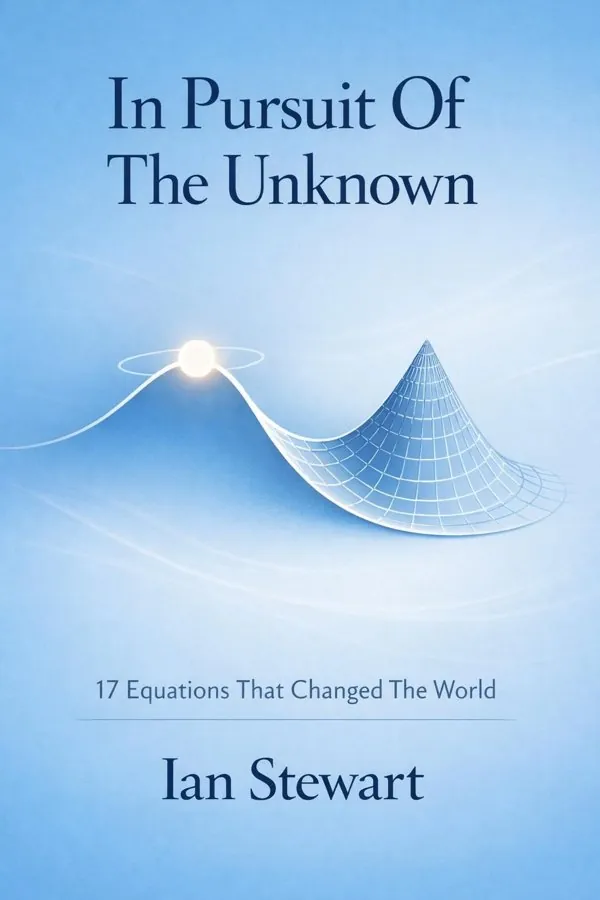
In Pursuit Of The Unknown: 17 Equations That Changed The World
Ian Stewart
10 min
Napoleon's Buttons: 17 Molecules That Changed History
Penny Le Couteur and Jay Burreson
10 minFeatured In
Browse by Category
Ready to read A Brief History of Time: From the Big Bang to Black Holes?
Get the full summary and 100K+ more books with Fizz Moment.