
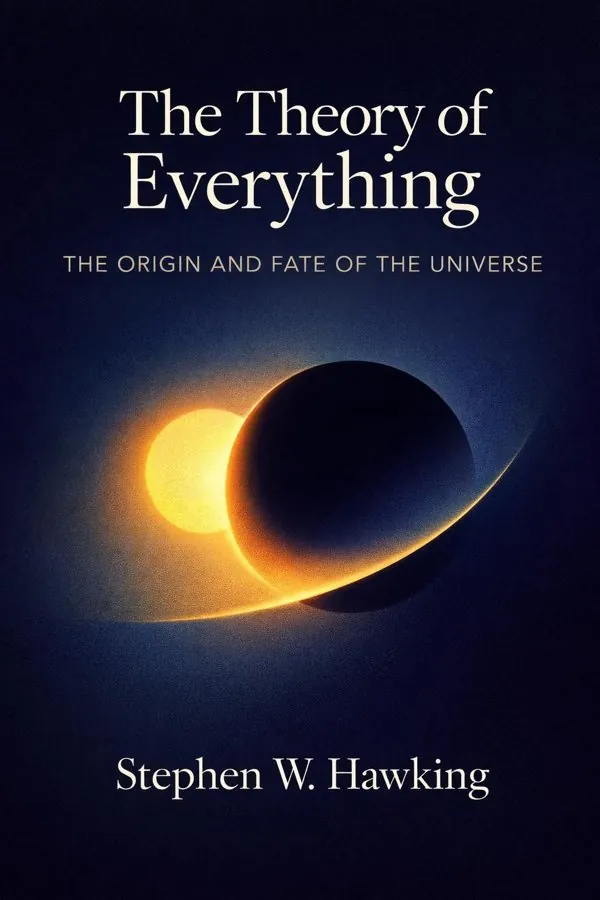
The Theory of Everything: The Origin and Fate of the Universe: Summary & Key Insights
 10 min9 chaptersAudio available
What Is The Theory of Everything: The Origin and Fate of the Universe About?
The Theory of Everything: The Origin and Fate of the Universe by Stephen W. Hawking is a popular_sci book spanning 9 pages. This book is a collection of seven lectures by Stephen Hawking that explore the history and development of our understanding of the universe. It covers topics from Aristotle and Newton to Einstein’s theories of relativity, the Big Bang, black holes, and the search for a unified theory that explains everything in the cosmos.
This FizzRead summary covers all 9 key chapters of The Theory of Everything: The Origin and Fate of the Universe in approximately 10 minutes, distilling the most important ideas, arguments, and takeaways from Stephen W. Hawking's work. Also available as an audio summary and Key Quotes Podcast.
The Theory of Everything: The Origin and Fate of the Universe
This book is a collection of seven lectures by Stephen Hawking that explore the history and development of our understanding of the universe. It covers topics from Aristotle and Newton to Einstein’s theories of relativity, the Big Bang, black holes, and the search for a unified theory that explains everything in the cosmos.
Who Should Read The Theory of Everything: The Origin and Fate of the Universe?
This book is perfect for anyone interested in popular_sci and looking to gain actionable insights in a short read. Whether you're a student, professional, or lifelong learner, the key ideas from The Theory of Everything: The Origin and Fate of the Universe by Stephen W. Hawking will help you think differently.
- ✓Readers who enjoy popular_sci and want practical takeaways
- ✓Professionals looking to apply new ideas to their work and life
- ✓Anyone who wants the core insights of The Theory of Everything: The Origin and Fate of the Universe in just 10 minutes
Want the full summary?
Get instant access to this book summary and 100K+ more with Fizz Moment.
Get Free SummaryAvailable on App Store • Free to download
Key Chapters
The story begins with the thinkers of ancient Greece — men like Aristotle and Ptolemy — who sought to explain the heavens through reason rather than myth. From their perspective, the Earth sat immobile at the center of everything, surrounded by perfect spheres carrying the planets and stars. This geocentric model was not merely scientific; it was philosophical, reflecting humanity’s conviction that it occupied a privileged position in the cosmos. To them, celestial motion was flawless, eternal, and divine — in stark contrast to the imperfect terrestrial realm below.
Aristotle proposed that heavenly bodies obeyed their own laws, moving in circles because the circle was the most perfect shape. He imagined a universe that had no beginning or end, one that existed forever in this harmonious rotation. Ptolemy later refined these ideas into an intricate mathematical scheme — epicycles layered upon circles — that could predict planetary positions with impressive accuracy for its time. Though fundamentally false, the Ptolemaic model endured for more than fifteen centuries, a testament to its intuitive appeal and the authority of its philosophical vision.
What dominated this era was not observation but coherence — the model needed to fit an idea of cosmic perfection, not the data. That mindset kept humanity’s understanding of the universe fixed within Earth’s narrow perspective. Yet, even then, the seeds of scientific skepticism had been planted. Some Greek philosophers — particularly Aristarchus of Samos — quietly proposed that the Earth might revolve around the Sun. Their voices were largely ignored, buried beneath centuries of intellectual conformity, but they represented the first flicker of the truth that would later transform our vision of the cosmos.
What I want you to see in this first stage is simple: our understanding of the universe is deeply shaped by our philosophical assumptions. The ancients were brilliant, but they were also limited by a belief in cosmic harmony derived from human perception. Science began as philosophy, and only by challenging those inherited ideas could it evolve into the empirical discipline that ultimately revealed reality as it is, not as we wish it to be.
The shift from Earth-centered to Sun-centered thinking was one of the most profound revolutions in human thought. Copernicus dared to suggest that the Earth was not the static center but rather one of several planets in motion around the Sun. This simple yet radical proposal shattered the ancient illusion of cosmic centrality. It was not just a change in geometry; it was a change in worldview.
Galileo brought this revolution to life with his telescope, unveiling mountains on the Moon, phases of Venus, and the moons of Jupiter — observations that no Earth-centered system could explain. By doing so, he transformed astronomy from speculation into direct observation. But Galileo’s insistence on truth, even in the face of institutional resistance, signified something deeper: that nature’s laws are independent of human authority.
Isaac Newton completed this transformation. Through his laws of motion and universal gravitation, he united the heavens and the Earth under the same physical principles. The apple falling to the ground and the Moon circling the Earth followed identical laws. Suddenly, the cosmos was not a mystery of divine spheres, but a vast, predictable system governed by mathematical order.
In Newton’s framework, space and time were absolute — a calm stage upon which matter and energy played their roles. Gravity was a force acting instantaneously across that stage, binding planets and stars into elegant motion. His achievement was more than scientific brilliance; it was a triumph of human reason. For the first time, the universe could be described with equations that applied everywhere, from the mechanics of a pendulum to the orbits of the planets.
This was the dawn of modern science. It showed that we could comprehend the cosmos through logic and experiment rather than philosophy. Yet, as powerful as Newton’s theory was, it carried within it the seeds of its own limitation. It assumed absolute space and time, a framework that would eventually be challenged by the next great mind in our story — Albert Einstein.
+ 7 more chapters — available in the FizzRead app
All Chapters in The Theory of Everything: The Origin and Fate of the Universe
About the Author
Stephen William Hawking (1942–2018) was a British theoretical physicist, cosmologist, and author. He was the Lucasian Professor of Mathematics at the University of Cambridge and made groundbreaking contributions to the understanding of black holes, cosmology, and quantum gravity. His popular science works, including 'A Brief History of Time,' brought complex scientific ideas to a wide audience.
Get This Summary in Your Preferred Format
Read or listen to the The Theory of Everything: The Origin and Fate of the Universe summary by Stephen W. Hawking anytime, anywhere. FizzRead offers multiple formats so you can learn on your terms — all free.
Available formats: App · Audio · PDF · EPUB — All included free with FizzRead
Download The Theory of Everything: The Origin and Fate of the Universe PDF and EPUB Summary
Key Quotes from The Theory of Everything: The Origin and Fate of the Universe
“The story begins with the thinkers of ancient Greece — men like Aristotle and Ptolemy — who sought to explain the heavens through reason rather than myth.”
“The shift from Earth-centered to Sun-centered thinking was one of the most profound revolutions in human thought.”
Frequently Asked Questions about The Theory of Everything: The Origin and Fate of the Universe
The Theory of Everything: The Origin and Fate of the Universe by Stephen W. Hawking is a popular_sci book that explores key ideas across 9 chapters. This book is a collection of seven lectures by Stephen Hawking that explore the history and development of our understanding of the universe. It covers topics from Aristotle and Newton to Einstein’s theories of relativity, the Big Bang, black holes, and the search for a unified theory that explains everything in the cosmos.
More by Stephen W. Hawking
You Might Also Like

Structures: Or Why Things Don"t Fall Down
J.E. Gordon
10 min
The Road to Wigan Pier
George Orwell
10 min
Bonk: The Curious Coupling of Science and Sex
Mary Roach
10 min
First Bite: How We Learn to Eat
Bee Wilson
10 min
In Pursuit Of The Unknown: 17 Equations That Changed The World
Ian Stewart
10 min
Napoleon's Buttons: 17 Molecules That Changed History
Penny Le Couteur and Jay Burreson
10 minBrowse by Category
Ready to read The Theory of Everything: The Origin and Fate of the Universe?
Get the full summary and 100K+ more books with Fizz Moment.