
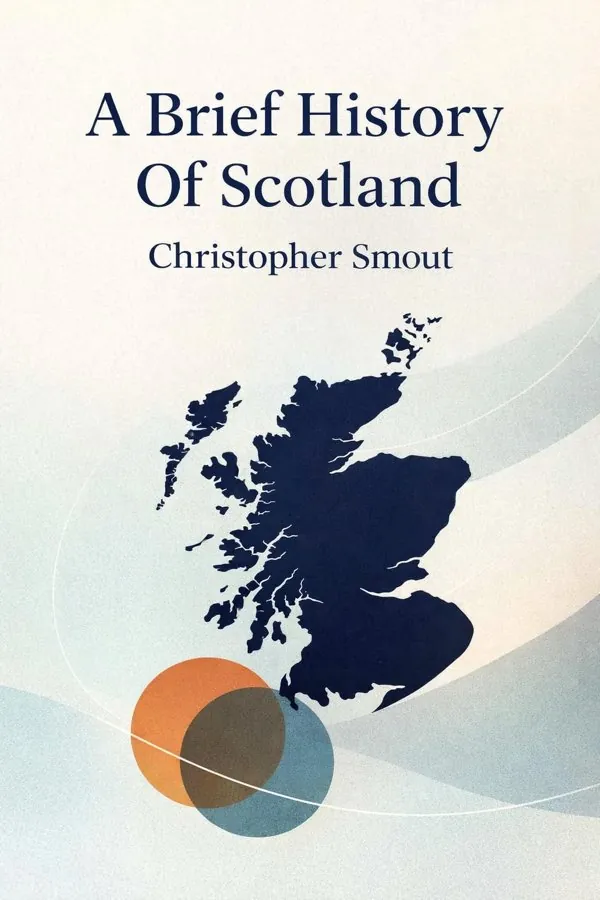
A Brief History Of Scotland: Summary & Key Insights
 10 min9 chaptersAudio available
Key Takeaways from A Brief History Of Scotland
A nation often begins as an environment before it becomes an idea.
National origins are usually messier than patriotic myths suggest.
Power in medieval Scotland was less a possession than a continuous negotiation.
Sometimes a nation becomes most conscious of itself when it is threatened.
Religious change is never only about belief; it alters education, politics, morality, and daily life.
What Is A Brief History Of Scotland About?
A Brief History Of Scotland by Christopher Smout is a world_history book spanning 11 pages. A Brief History Of Scotland is a compact but richly illuminating account of how a small northern nation developed a remarkably durable identity across centuries of political upheaval, economic reinvention, religious conflict, and cultural change. In this accessible survey, Christopher Smout traces Scotland from its prehistoric settlements and early kingdoms to the medieval wars of independence, the Reformation, the Union with England, industrial expansion, imperial involvement, and the complex realities of modern devolution. What makes the book especially valuable is that it does not treat Scotland as a side note to British history. Instead, it shows Scotland as a historical actor in its own right, shaped by geography, local institutions, global trade, faith, war, and the choices of ordinary people as much as kings and ministers. Smout writes with the authority of one of Scotland’s most respected historians, widely known for his work on economic, social, and environmental history. The result is a concise narrative that helps readers understand not only what happened in Scotland, but why those developments still matter for questions of identity, statehood, class, memory, and nationhood today.
This FizzRead summary covers all 9 key chapters of A Brief History Of Scotland in approximately 10 minutes, distilling the most important ideas, arguments, and takeaways from Christopher Smout's work. Also available as an audio summary and Key Quotes Podcast.
A Brief History Of Scotland
A Brief History Of Scotland is a compact but richly illuminating account of how a small northern nation developed a remarkably durable identity across centuries of political upheaval, economic reinvention, religious conflict, and cultural change. In this accessible survey, Christopher Smout traces Scotland from its prehistoric settlements and early kingdoms to the medieval wars of independence, the Reformation, the Union with England, industrial expansion, imperial involvement, and the complex realities of modern devolution. What makes the book especially valuable is that it does not treat Scotland as a side note to British history. Instead, it shows Scotland as a historical actor in its own right, shaped by geography, local institutions, global trade, faith, war, and the choices of ordinary people as much as kings and ministers. Smout writes with the authority of one of Scotland’s most respected historians, widely known for his work on economic, social, and environmental history. The result is a concise narrative that helps readers understand not only what happened in Scotland, but why those developments still matter for questions of identity, statehood, class, memory, and nationhood today.
Who Should Read A Brief History Of Scotland?
This book is perfect for anyone interested in world_history and looking to gain actionable insights in a short read. Whether you're a student, professional, or lifelong learner, the key ideas from A Brief History Of Scotland by Christopher Smout will help you think differently.
- ✓Readers who enjoy world_history and want practical takeaways
- ✓Professionals looking to apply new ideas to their work and life
- ✓Anyone who wants the core insights of A Brief History Of Scotland in just 10 minutes
Want the full summary?
Get instant access to this book summary and 100K+ more with Fizz Moment.
Get Free SummaryAvailable on App Store • Free to download
Key Chapters
A nation often begins as an environment before it becomes an idea. Smout starts with the physical world of Scotland: mountains, islands, glens, forests, rivers, and difficult coastlines. Long before there was a kingdom called Scotland, people were adapting to these conditions as hunters, fishers, herders, and farmers. Geography did not determine everything, but it set the limits and opportunities within which early societies formed. Fertile lowlands supported settlement and agriculture, while uplands and islands produced communities that were more scattered, resilient, and locally organized.
This early history matters because it explains why regional diversity became one of Scotland’s permanent features. Highland and Lowland differences, coastal trade, clan loyalties, and uneven patterns of political control all have roots in these early adaptations to place. Smout also reminds readers that history is not only made by rulers. Archaeology, farming patterns, and settlement remains reveal how ordinary people built lives in challenging conditions and slowly transformed the land around them.
A practical way to read this chapter is to notice how often modern political or cultural divisions reflect older environmental realities. Why did some regions urbanize faster? Why were some harder to govern? Why did certain identities endure? The answers often begin with landscape.
Actionable takeaway: When studying any nation’s history, start with geography. Ask how land, climate, and resources shaped where people lived, how they worked, and what kinds of power could realistically emerge.
National origins are usually messier than patriotic myths suggest. Smout treats the formation of the Scottish kingdom not as a single heroic founding moment, but as a gradual convergence of peoples and powers. Picts, Scots from Dalriada, Britons, Angles, Norse settlers, and others interacted through war, intermarriage, religion, and political bargaining. Kenneth MacAlpin appears in tradition as a founder, yet Smout places him within a longer process rather than presenting him as the sole creator of the nation.
The kingdom of Alba emerged because political consolidation became possible and useful. External threats, especially from Vikings and rival kingdoms, encouraged cooperation and stronger kingship. Christianity also mattered. The church offered literacy, legitimacy, networks of influence, and a language of authority that could bind scattered regions into a more coherent realm. Over time, a looser mosaic of communities became a kingdom with expanding institutions and a stronger sense of shared rule.
This idea has modern relevance because it challenges simplistic notions of ethnic purity or national essence. Scotland was not born from one tribe or one language. It was assembled from diversity. That makes Scottish identity historically inclusive as well as contested.
You can apply this insight beyond Scotland by questioning origin stories that seem too neat. Nations are usually layered constructions, built through fusion rather than uniformity.
Actionable takeaway: When you encounter a national founding myth, look for the longer process underneath it. Ask which groups were involved, what institutions helped unify them, and what pressures made unity necessary.
Power in medieval Scotland was less a possession than a continuous negotiation. As the kingdom matured, its rulers tried to expand authority over a land still marked by strong local interests, regional customs, and uneven administration. Smout shows that medieval Scotland was not a primitive prelude to modernity, but a developing political society with evolving law, church organization, feudal relationships, burghs, and royal ambitions.
Kings sought to strengthen their rule through land grants, alliances with nobles, church patronage, and the encouragement of towns. Burghs became especially important because they concentrated trade, taxation, and administrative activity. They also connected Scotland to wider European networks. At the same time, royal authority remained vulnerable. Succession disputes, noble resistance, and regional fragmentation repeatedly exposed the limits of centralized power.
This period helps readers see that state formation is always unfinished. Even when institutions exist on paper, their real strength depends on whether local elites cooperate, whether laws can be enforced, and whether people see authority as legitimate. Medieval Scotland developed many of the structures of a kingdom, but these structures remained fragile enough to be tested by internal and external crises.
A useful application is to compare medieval Scotland with any emerging state today: institutions grow unevenly, center and periphery clash, and legitimacy matters as much as coercion.
Actionable takeaway: To understand political stability, do not only ask who ruled. Ask how authority was enforced locally, who benefited from it, and what institutions made power durable beyond a single ruler’s lifetime.
Sometimes a nation becomes most conscious of itself when it is threatened. The Wars of Independence occupy a central place in Scottish memory, and Smout treats them as both dramatic events and formative political experiences. English intervention in Scottish succession disputes after the death of Alexander III and the collapse of dynastic certainty triggered a struggle that was about sovereignty as much as military survival. Figures like William Wallace and Robert the Bruce became enduring symbols, but Smout places them within broader patterns of resistance, elite politics, and institutional continuity.
The significance of these wars lies in how they clarified Scotland’s status as a separate kingdom. Documents such as the Declaration of Arbroath expressed a political language of collective freedom and legitimate kingship that outlived the battles themselves. Victory did not create perfect unity, nor did it solve social tensions, but it reinforced the principle that Scotland was not merely a region to be absorbed by a stronger neighbor.
This chapter is especially useful for understanding how memory works. Modern nationalism often draws heavily on moments of resistance, simplifying them into moral stories. Smout’s account is more careful: heroes mattered, but so did diplomacy, noble interests, church support, and persistence.
In practical terms, this invites readers to distinguish between national myth and national significance. A story can be symbolically powerful without being simple.
Actionable takeaway: When reflecting on patriotic history, ask two questions at once: what really happened, and why did later generations choose to remember it this way?
Religious change is never only about belief; it alters education, politics, morality, and daily life. Smout shows that the Scottish Reformation was a deep restructuring of society, not just a theological dispute. The break with Catholicism in the sixteenth century transformed church governance, transferred wealth and influence, and reshaped relations between crown, clergy, nobles, and ordinary worshippers. Under the Stewart dynasty, religion became inseparable from struggles over authority.
The new Protestant order encouraged literacy because believers were expected to engage with scripture. Kirk discipline also extended into family life, sexual conduct, Sabbath observance, and local morality. This meant religion became embedded in the routines of communities, not confined to elite doctrine. At the same time, conflict persisted. Scotland remained divided by competing religious visions, and these tensions fed civil wars, resistance movements, and constitutional arguments about whether rulers could impose belief from above.
Smout’s treatment helps explain why Scotland developed such a strong tradition of education, moral seriousness, and argumentative public culture. The kirk could be restrictive, but it also fostered habits of reading, debate, and organized local oversight.
A practical application is to recognize how institutional religion can shape a society long after personal belief has declined. Educational patterns, social expectations, and public rhetoric often preserve those legacies.
Actionable takeaway: When evaluating religious history, look beyond doctrine. Ask how faith changed schools, family norms, political authority, and the everyday behavior expected of ordinary people.
Political union does not automatically erase national distinctiveness. Smout treats the Union of the Crowns in 1603 and the Union of Parliaments in 1707 as major turning points, but not as the end of Scotland’s story. When James VI of Scotland inherited the English throne, Scotland and England shared a monarch while retaining separate institutions. The 1707 parliamentary union went further, merging the legislatures, yet Scotland preserved key features of its own system, including law, church, and education.
Why did union happen? Smout points to a mixture of economic pressures, dynastic calculation, strategic concerns, and the limits of Scotland’s independent state power. For many Scots, the union was controversial, even bitter. Yet over time it opened access to larger markets, imperial opportunities, and political stability that some groups used to great advantage. Crucially, however, the survival of distinct institutions allowed Scottish identity to continue developing within Britain rather than disappearing into it.
This is one of the book’s most relevant arguments for modern readers. It helps explain how people can be simultaneously Scottish and British, and why constitutional debates in Scotland are so persistent. Identity is not a simple reflection of state structure.
You can apply this idea more broadly in thinking about federations, multinational states, or supranational unions. Shared governance and separate identity often coexist.
Actionable takeaway: When analyzing unions between nations, separate political integration from cultural absorption. Ask which institutions were merged, which were preserved, and how that shaped long-term identity.
Economic modernization often arrives wearing the language of improvement, but improvement has winners and losers. In eighteenth-century Scotland, landlords, reformers, ministers, and intellectuals increasingly embraced the idea that society could be made more productive, orderly, and prosperous. Agriculture was reorganized, estates were rationalized, roads expanded, and commercial thinking spread. This was also the era of the Scottish Enlightenment, when thinkers such as Adam Smith and David Hume helped make Scotland intellectually influential far beyond its size.
Smout shows that this transformation was not merely abstract. New methods of farming, changes in tenancy, and market integration altered how people worked and where they lived. Traditional patterns of communal life weakened in some areas as profit, efficiency, and planned development gained prestige. Improvement could mean better yields, stronger trade, and rising urban centers, but it could also mean displacement, harsher landlord power, and the erosion of older social bonds.
The strength of Smout’s account is that he resists both nostalgia and triumphalism. He neither romanticizes the old order nor treats modernization as purely beneficial. Instead, he asks readers to see historical change as uneven and morally mixed.
A practical lesson here is relevant to contemporary policy debates. Whenever reform is promoted as modernization, we should ask who pays the cost and who defines success.
Actionable takeaway: Use the language of “improvement” carefully. In any era, test claims of progress by examining whose lives actually became more secure, more prosperous, or more precarious.
Industrialization does not just create factories; it creates new classes, new cities, and new ways of imagining the future. Smout gives major attention to the Industrial Revolution because it transformed Scotland more dramatically than almost any earlier development. Coal, iron, shipbuilding, engineering, and textiles turned parts of the country, especially the Central Belt, into engines of production. Glasgow in particular became a major imperial and industrial city.
This economic growth generated wealth, technical innovation, and international influence. Scottish migrants, merchants, engineers, and professionals participated in the wider British Empire and global trade networks. Yet industrial success came with severe social costs. Urban overcrowding, poor sanitation, labor exploitation, inequality, and cycles of unemployment shaped working-class life. The same nation that celebrated enterprise also contained tenements, dangerous work, and profound social insecurity.
Smout’s broader point is that industrial Scotland cannot be understood through economics alone. Industrialization changed family structures, gender roles, political organization, education, and public health. It also deepened class consciousness, contributing to trade unionism, reform movements, and demands for state intervention.
The modern application is immediate. Whenever a society experiences rapid economic change, cultural and political institutions must adapt too. Growth without social planning produces instability.
Actionable takeaway: When assessing economic development, look beyond output and profits. Ask how work, housing, health, and political power changed for ordinary people living through the transformation.
The twentieth century forced Scotland to rethink itself in the shadow of both decline and reinvention. Smout traces how the world wars, the contraction of heavy industry, changing imperial roles, migration, welfare politics, and cultural revival all reshaped Scottish life. The industries that had once symbolized strength became vulnerable, and many communities built around shipyards, mines, and manufacturing faced unemployment and social dislocation. Economic decline was not just statistical; it altered confidence, local identity, and generational expectations.
Yet Smout does not present modern Scotland as a story of collapse. He also highlights resilience: the growth of public institutions, new educational opportunities, literature and artistic revival, political mobilization, and renewed reflection on what Scotland was within the United Kingdom. By the late twentieth century, debates over representation and self-government intensified, culminating in devolution and the establishment of a Scottish Parliament. This did not settle constitutional questions, but it marked a significant reassertion of democratic national agency.
The important insight is that nations survive by adapting their narratives as much as their economies. Scotland moved from warrior kingdom to union partner to industrial powerhouse to post-industrial polity without ceasing to debate who belongs and what the nation stands for.
For today’s reader, this chapter offers a framework for thinking about identity in times of transition. Decline in one sector does not mean the end of a society’s story.
Actionable takeaway: In periods of national change, pay attention not only to economic losses but also to cultural renewal, political reform, and the stories communities tell about their future.
All Chapters in A Brief History Of Scotland
About the Author
Christopher Smout, usually cited as T. C. Smout, is a leading Scottish historian born in 1933. He has had a distinguished academic career and is particularly known for his work on Scotland’s economic, social, and environmental history. Smout served as Historiographer Royal in Scotland, a role that reflects his stature in the field, and his scholarship has helped broaden understanding of Scottish history beyond kings and battles to include land use, class, institutions, and everyday life. His writing is valued for combining depth of research with unusual clarity, making complex historical developments accessible to general readers. In A Brief History Of Scotland, Smout brings that wide-ranging expertise to a concise national history that is both authoritative and engaging.
Get This Summary in Your Preferred Format
Read or listen to the A Brief History Of Scotland summary by Christopher Smout anytime, anywhere. FizzRead offers multiple formats so you can learn on your terms — all free.
Available formats: App · Audio · PDF · EPUB — All included free with FizzRead
Download A Brief History Of Scotland PDF and EPUB Summary
Key Quotes from A Brief History Of Scotland
“A nation often begins as an environment before it becomes an idea.”
“National origins are usually messier than patriotic myths suggest.”
“Power in medieval Scotland was less a possession than a continuous negotiation.”
“Sometimes a nation becomes most conscious of itself when it is threatened.”
“Religious change is never only about belief; it alters education, politics, morality, and daily life.”
Frequently Asked Questions about A Brief History Of Scotland
A Brief History Of Scotland by Christopher Smout is a world_history book that explores key ideas across 9 chapters. A Brief History Of Scotland is a compact but richly illuminating account of how a small northern nation developed a remarkably durable identity across centuries of political upheaval, economic reinvention, religious conflict, and cultural change. In this accessible survey, Christopher Smout traces Scotland from its prehistoric settlements and early kingdoms to the medieval wars of independence, the Reformation, the Union with England, industrial expansion, imperial involvement, and the complex realities of modern devolution. What makes the book especially valuable is that it does not treat Scotland as a side note to British history. Instead, it shows Scotland as a historical actor in its own right, shaped by geography, local institutions, global trade, faith, war, and the choices of ordinary people as much as kings and ministers. Smout writes with the authority of one of Scotland’s most respected historians, widely known for his work on economic, social, and environmental history. The result is a concise narrative that helps readers understand not only what happened in Scotland, but why those developments still matter for questions of identity, statehood, class, memory, and nationhood today.
You Might Also Like
The Age of Capital
Eric Hobsbawm
10 min
The Gulag Archipelago
Aleksandr Solzhenitsyn
10 min
Jerusalem: The Biography
Simon Sebag Montefiore
10 min
The Anglo-Saxons
James Campbell
10 min
The Boer War
Thomas Pakenham
10 min
The Industrial Revolutionaries: The Making of the Modern World 1776–1914
Gavin Weightman
10 minFeatured In
Browse by Category
Ready to read A Brief History Of Scotland?
Get the full summary and 100K+ more books with Fizz Moment.