
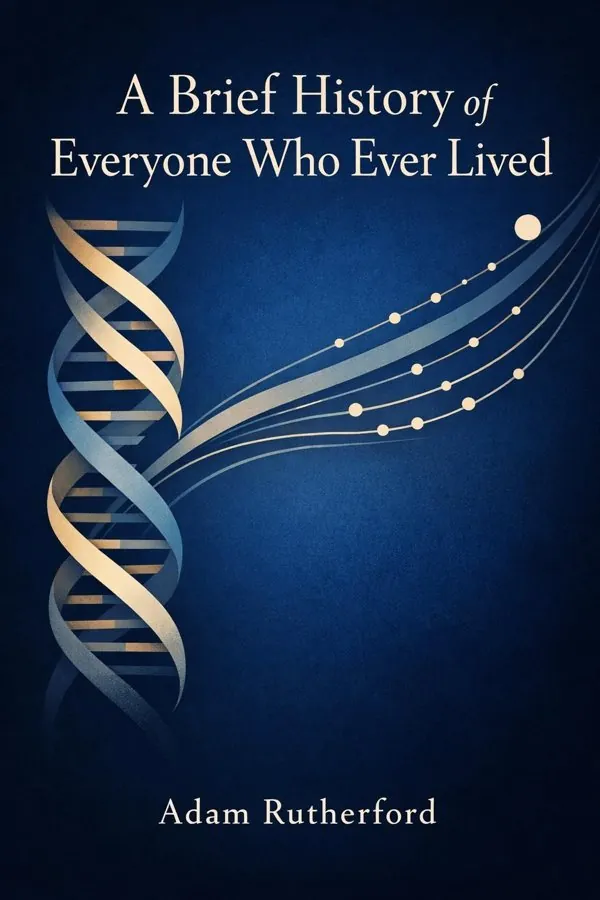
A Brief History of Everyone Who Ever Lived: The Human Story Retold Through Our Genes: Summary & Key Insights
 10 min11 chaptersAudio available
What Is A Brief History of Everyone Who Ever Lived: The Human Story Retold Through Our Genes About?
A Brief History of Everyone Who Ever Lived: The Human Story Retold Through Our Genes by Adam Rutherford is a popular_sci book spanning 11 pages. A Brief History of Everyone Who Ever Lived is a popular science book that explores the story of humanity through the lens of genetics. Adam Rutherford explains how DNA reveals our shared ancestry, migration patterns, and the myths surrounding race and identity. The book combines scientific insight with historical narrative to show how genetic research reshapes our understanding of human evolution and diversity.
This FizzRead summary covers all 11 key chapters of A Brief History of Everyone Who Ever Lived: The Human Story Retold Through Our Genes in approximately 10 minutes, distilling the most important ideas, arguments, and takeaways from Adam Rutherford's work. Also available as an audio summary and Key Quotes Podcast.
A Brief History of Everyone Who Ever Lived: The Human Story Retold Through Our Genes
A Brief History of Everyone Who Ever Lived is a popular science book that explores the story of humanity through the lens of genetics. Adam Rutherford explains how DNA reveals our shared ancestry, migration patterns, and the myths surrounding race and identity. The book combines scientific insight with historical narrative to show how genetic research reshapes our understanding of human evolution and diversity.
Who Should Read A Brief History of Everyone Who Ever Lived: The Human Story Retold Through Our Genes?
This book is perfect for anyone interested in popular_sci and looking to gain actionable insights in a short read. Whether you're a student, professional, or lifelong learner, the key ideas from A Brief History of Everyone Who Ever Lived: The Human Story Retold Through Our Genes by Adam Rutherford will help you think differently.
- ✓Readers who enjoy popular_sci and want practical takeaways
- ✓Professionals looking to apply new ideas to their work and life
- ✓Anyone who wants the core insights of A Brief History of Everyone Who Ever Lived: The Human Story Retold Through Our Genes in just 10 minutes
Want the full summary?
Get instant access to this book summary and 100K+ more with Fizz Moment.
Get Free SummaryAvailable on App Store • Free to download
Key Chapters
When we speak of genetics today, we often forget how astonishingly recent it all is. Barely a century ago, Gregor Mendel’s pea plants hinted that inheritance followed patterns, but the molecule responsible — DNA — remained an enigma. From the discovery of its double helix in 1953 to the completion of the Human Genome Project in 2003, we’ve advanced from speculation to sequence. This revolution transformed biology into a historical science. For the first time, we could compare the genetic code of different people and populations, tracing how genes flow through time and geography.
In recounting this history, I emphasize how sequencing technology became our lens into the past. Every fragment of DNA carries mutations — small, random changes — and these mutations serve as timestamps. By reading them, geneticists reconstruct family trees that reach far beyond individual memory. Unlike written histories, which record events chosen by humans, genetic data offer an unfiltered archive of ancestry. Yet, the revolution also brought misconceptions. Many began to believe DNA could reveal everything about us — our destiny, our personality. In truth, genetics tells us about populations far more than individuals. It teaches humility: our uniqueness lies not in separation, but in countless shared threads.
At the heart of our genetic story lies Africa — the cradle of Homo sapiens. For decades, fossil evidence suggested that modern humans emerged roughly 200,000 years ago. Genetics confirmed and deepened this narrative. By analyzing mitochondrial DNA, inherited from mothers, and the Y chromosome, passed by fathers, scientists traced all living humans back to common ancestors who lived in Africa. This realization overturned earlier Eurocentric views and reframed our species as an African diaspora.
I explain how our DNA binds us to those early humans. Every person alive today is descended from those small bands that left Africa to explore new continents. Their genetic footprints remain in us — in the patterns of diversity that form the human mosaic. The genius of genetic archaeology lies in its ability to tell us not only when but how we became ourselves. Genes reveal that we were never static; we were always in motion, adapting, mingling, and reshaping our genetic makeup through time. The origin of humanity is thus not a single genesis story, but a continuous unfolding of change — a process written in our cells.
+ 9 more chapters — available in the FizzRead app
All Chapters in A Brief History of Everyone Who Ever Lived: The Human Story Retold Through Our Genes
About the Author
Adam Rutherford is a British geneticist, author, and broadcaster. He studied genetics at University College London and has presented several BBC science programs. His work focuses on communicating complex scientific ideas to the public, particularly in genetics and evolutionary biology.
Get This Summary in Your Preferred Format
Read or listen to the A Brief History of Everyone Who Ever Lived: The Human Story Retold Through Our Genes summary by Adam Rutherford anytime, anywhere. FizzRead offers multiple formats so you can learn on your terms — all free.
Available formats: App · Audio · PDF · EPUB — All included free with FizzRead
Download A Brief History of Everyone Who Ever Lived: The Human Story Retold Through Our Genes PDF and EPUB Summary
Key Quotes from A Brief History of Everyone Who Ever Lived: The Human Story Retold Through Our Genes
“When we speak of genetics today, we often forget how astonishingly recent it all is.”
“At the heart of our genetic story lies Africa — the cradle of Homo sapiens.”
Frequently Asked Questions about A Brief History of Everyone Who Ever Lived: The Human Story Retold Through Our Genes
A Brief History of Everyone Who Ever Lived: The Human Story Retold Through Our Genes by Adam Rutherford is a popular_sci book that explores key ideas across 11 chapters. A Brief History of Everyone Who Ever Lived is a popular science book that explores the story of humanity through the lens of genetics. Adam Rutherford explains how DNA reveals our shared ancestry, migration patterns, and the myths surrounding race and identity. The book combines scientific insight with historical narrative to show how genetic research reshapes our understanding of human evolution and diversity.
More by Adam Rutherford
You Might Also Like

Structures: Or Why Things Don"t Fall Down
J.E. Gordon
10 min
The Road to Wigan Pier
George Orwell
10 min
Bonk: The Curious Coupling of Science and Sex
Mary Roach
10 min
First Bite: How We Learn to Eat
Bee Wilson
10 min
In Pursuit Of The Unknown: 17 Equations That Changed The World
Ian Stewart
10 min
Napoleon's Buttons: 17 Molecules That Changed History
Penny Le Couteur and Jay Burreson
10 minFeatured In
Browse by Category
Ready to read A Brief History of Everyone Who Ever Lived: The Human Story Retold Through Our Genes?
Get the full summary and 100K+ more books with Fizz Moment.