
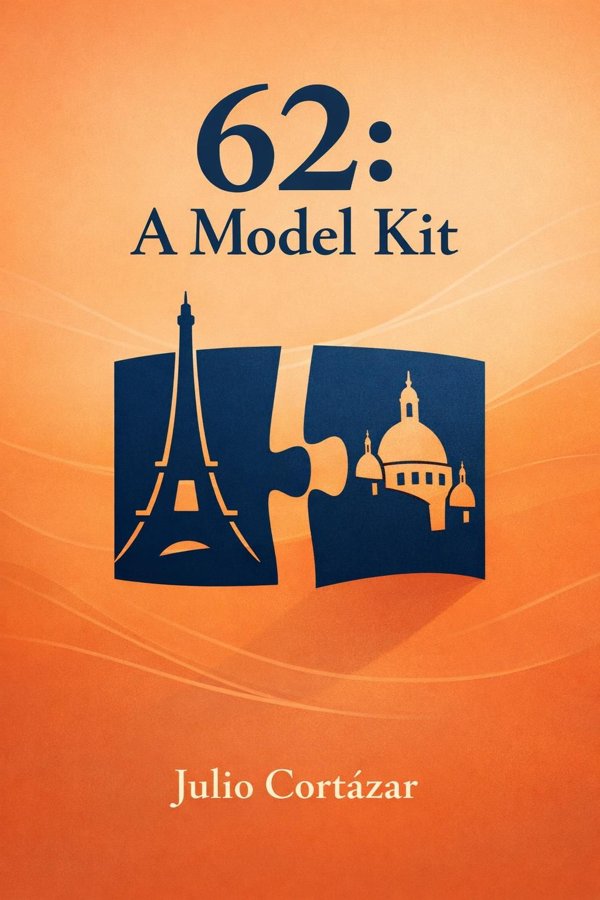
62: A Model Kit: Summary & Key Insights
 10 min8 chaptersAudio available
Key Takeaways from 62: A Model Kit
A story can begin by disorienting you, and in Cortázar’s hands that disorientation becomes the point.
Some books describe dreams; this one makes reality behave like one.
We often imagine language as a transparent tool, but Cortázar treats it as a force that bends reality.
Identity may feel solid from the inside, but Cortázar suggests it is assembled from roles, projections, and borrowed gestures.
Most novels ask to be followed; 62 asks to be built.
What Is 62: A Model Kit About?
62: A Model Kit by Julio Cortázar is a classics book spanning 4 pages. Julio Cortázar’s 62: A Model Kit is not a conventional novel so much as an intricate literary device: a book designed to be assembled by the reader. First published in 1968 and developed from a concept briefly introduced in Hopscotch, it follows a loose constellation of characters moving through Paris, London, Vienna, and other European settings, yet it resists the familiar comforts of linear plot, psychological certainty, and stable meaning. Instead, Cortázar creates a world of echoes, symbols, repetitions, and invisible connections, where conversations, gestures, and objects seem charged with hidden patterns. What makes the novel matter is precisely this refusal to behave like ordinary fiction. It asks whether reality itself may be fragmented, whether identity is composed rather than given, and whether language reveals the world or distorts it. Cortázar, one of the defining innovators of the Latin American Boom, brings to the book his signature blend of playfulness, philosophical depth, and formal daring. The result is a challenging but rewarding classic that transforms reading into an active, unsettling, and deeply imaginative act.
This FizzRead summary covers all 8 key chapters of 62: A Model Kit in approximately 10 minutes, distilling the most important ideas, arguments, and takeaways from Julio Cortázar's work. Also available as an audio summary and Key Quotes Podcast.
62: A Model Kit
Julio Cortázar’s 62: A Model Kit is not a conventional novel so much as an intricate literary device: a book designed to be assembled by the reader. First published in 1968 and developed from a concept briefly introduced in Hopscotch, it follows a loose constellation of characters moving through Paris, London, Vienna, and other European settings, yet it resists the familiar comforts of linear plot, psychological certainty, and stable meaning. Instead, Cortázar creates a world of echoes, symbols, repetitions, and invisible connections, where conversations, gestures, and objects seem charged with hidden patterns. What makes the novel matter is precisely this refusal to behave like ordinary fiction. It asks whether reality itself may be fragmented, whether identity is composed rather than given, and whether language reveals the world or distorts it. Cortázar, one of the defining innovators of the Latin American Boom, brings to the book his signature blend of playfulness, philosophical depth, and formal daring. The result is a challenging but rewarding classic that transforms reading into an active, unsettling, and deeply imaginative act.
Who Should Read 62: A Model Kit?
This book is perfect for anyone interested in classics and looking to gain actionable insights in a short read. Whether you're a student, professional, or lifelong learner, the key ideas from 62: A Model Kit by Julio Cortázar will help you think differently.
- ✓Readers who enjoy classics and want practical takeaways
- ✓Professionals looking to apply new ideas to their work and life
- ✓Anyone who wants the core insights of 62: A Model Kit in just 10 minutes
Want the full summary?
Get instant access to this book summary and 100K+ more with Fizz Moment.
Get Free SummaryAvailable on App Store • Free to download
Key Chapters
A story can begin by disorienting you, and in Cortázar’s hands that disorientation becomes the point. 62: A Model Kit opens as if the reader has stepped into a room where several lives are already in motion, their details scattered across Paris, London, and other European spaces. Instead of introducing characters one by one or establishing a clear narrative center, the novel presents fragments: scenes, impressions, bits of dialogue, recurring names, and charged objects. The result is a sense of urban displacement. These cities are not merely settings; they are mirrors, corridors, and echo chambers where identities blur and relationships feel both accidental and fated.
Cortázar uses this fractured opening to challenge the expectation that stories should orient us immediately. In ordinary novels, place provides stability. Here, place destabilizes. A café, a street, a hotel room, or a train compartment can feel like a threshold into another layer of meaning. The cosmopolitan backdrop reinforces the sensation that modern life is made of transitions rather than rooted certainties. The characters drift geographically, emotionally, and psychologically, and the reader must drift with them.
This technique has practical relevance beyond literature. Much of contemporary life feels similarly fragmented: we move between physical spaces, digital identities, social roles, and emotional registers without always connecting them into a coherent whole. Cortázar captures that fractured condition decades before it became a commonplace of modern experience. Reading the novel can sharpen your awareness of how narratives—personal and social—are built from incomplete pieces.
A useful way to approach this section is to read for patterns rather than plot. Track repeated places, moods, and encounters. Notice what seems disconnected at first but begins to resonate later. Actionable takeaway: when reading 62, stop asking “What exactly is happening?” and start asking “What connections are being suggested?”
Some books describe dreams; this one makes reality behave like one. As 62: A Model Kit progresses, the boundary between waking life and dream experience grows increasingly unstable. Scenes do not always follow from one another in causal ways, yet they feel emotionally linked. Characters seem to inhabit symbolic roles as much as realistic identities. Events carry the uncanny inevitability of dream logic, where a small object, a phrase, or a chance encounter suddenly radiates hidden significance.
Cortázar is not simply being obscure for the sake of mystery. He is exploring how human beings actually experience meaning. Much of what governs us is not rationally ordered: memory, desire, fear, repetition, intuition, and obsession often connect our lives more powerfully than logic does. The novel’s hallucinatory texture invites the reader to inhabit that layer of perception. Rather than sorting experience into neat categories—real versus unreal, conscious versus unconscious—Cortázar reveals a continuum in which symbols leak into ordinary life.
Think of how a recurring image in your own life can begin to feel strangely important: a song that keeps appearing during emotionally charged moments, a phrase that returns in different conversations, or a place that seems to gather memories from unrelated times. 62 works in a similar way. Its meanings emerge not from explanation but from recurrence and atmosphere. What matters is not always what a symbol means once and for all, but how it changes the emotional pressure of the surrounding scenes.
To get more from the novel, resist the urge to force every ambiguity into a single interpretation. Instead, read as you would recall a vivid dream: by noting patterns, emotional temperatures, and recurring motifs. Actionable takeaway: keep a short reading journal of repeated images and ask how they affect the mood, not just the plot.
We often imagine language as a transparent tool, but Cortázar treats it as a force that bends reality. In 62: A Model Kit, multilingual exchanges, misunderstandings, tonal shifts, and acts of translation become central to the book’s structure. Characters move among languages and cities, and with each movement the world seems to alter slightly. Words no longer simply describe events; they create distances, conceal motives, and generate new forms of connection.
This idea is crucial because the novel emerges from a deeply international setting. To speak across borders is also to mishear, reinterpret, and reshape what is said. Translation in the book is not just a professional or technical activity. It becomes a metaphor for all human relation. Every time one person tries to understand another, some transformation occurs. Meaning is transferred, but never perfectly. Something is gained, something is lost, and something new appears in the gap.
Cortázar’s own literary practice gives this theme weight. A brilliant stylist and translator, he understood how syntax, rhythm, and word choice alter perception. In 62, language often feels slippery, as though characters are trapped inside structures of speech they cannot fully control. A phrase can trigger a chain of associations; a casual remark can reframe an entire situation. Readers experience this instability firsthand, since the novel’s fragmented design continually reminds us that narration itself is a kind of translation from experience into form.
This matters in everyday life. Consider workplace communication, intimate relationships, or intercultural encounters: misunderstanding rarely comes only from bad intentions. It often emerges because different people live inside different verbal worlds. The novel encourages us to listen for what language omits as much as for what it states.
Actionable takeaway: while reading, pay attention to who is speaking, what is being translated, and where misunderstanding appears. Then apply that habit outside the book by asking in real conversations, “What might this mean from the other person’s linguistic or emotional frame?”
Identity may feel solid from the inside, but Cortázar suggests it is assembled from roles, projections, and borrowed gestures. In 62: A Model Kit, characters often seem less like fully stable selves than like shifting configurations. Their personalities emerge in fragments: through how others see them, through repeated behaviors, through symbolic pairings, and through situations that seem to assign them almost theatrical functions. The novel resists the classic psychological model in which each character has a fixed inner core waiting to be revealed.
This instability is one of the book’s most unsettling strengths. People in 62 do not simply act; they appear to perform themselves within a system of patterns larger than their conscious intentions. A character may feel familiar in one scene and remote in the next. Motives remain elusive. Relations are charged but often difficult to define. Rather than clarifying who someone “really is,” the novel asks whether such a final truth exists at all.
Cortázar’s approach reflects a modern insight that now feels strikingly current. In daily life, we shift identities constantly: professional, intimate, social, digital, cultural. Different contexts bring different versions of the self to the surface. The novel dramatizes that fluidity, but pushes it toward the uncanny. It implies that identity is not merely flexible; it may be fundamentally composite.
For readers, this means character analysis must change. Instead of asking whether a person is consistent, ask what pattern of appearances surrounds them. What roles do they repeat? What symbolic charge do they carry? What emotional effect do they produce in others? This method opens the book rather than reducing it.
Actionable takeaway: make a simple character map focused on relationships, recurring traits, and symbolic associations instead of fixed biographies. You’ll understand the novel better by tracing functions and echoes than by searching for definitive explanations.
Most novels ask to be followed; 62 asks to be built. The title’s phrase “A Model Kit” is not decorative. It tells you how to read the book. Cortázar presents scenes, motifs, and character relations as components rather than as a finished narrative machine. The reader’s job is not passive reception but active assembly. You must decide how pieces fit, which links matter, and what kind of whole, if any, can emerge from the arrangement.
This idea grows out of Cortázar’s larger artistic project, especially his challenge to traditional realism in Hopscotch. But 62 pushes further. Instead of offering multiple reading orders, it offers a deeper uncertainty about narrative itself. The book behaves like an open structure. The “model” can be assembled in more than one way, and no interpretation fully exhausts it. That openness is not a flaw to overcome; it is the experience the novel is designed to produce.
There is a practical analogy here to how we make sense of our lives. We rarely receive a complete story with clear causes and effects. Instead, we gather episodes, memories, symbols, explanations from others, and our own changing interpretations. Meaning is assembled retrospectively. Cortázar turns that condition into literary form. Reading 62 becomes a rehearsal for living with complexity without rushing to simplify it.
A productive strategy is to treat the novel like a system of modules. Notice repeated structures, not just repeated details: pairings, reversals, mirrored scenes, emotional correspondences. Ask what happens when one fragment illuminates another. The satisfaction comes less from “solving” the book than from perceiving its dynamic design.
Actionable takeaway: after each reading session, summarize not the plot but the new connections you noticed. Building your own network of links is the most faithful way to read this novel.
What looks accidental may be the shape of an unseen design. One of the most compelling tensions in 62: A Model Kit is the way random encounters begin to feel orchestrated. Characters meet across cities, gestures repeat, motifs recur, and seemingly minor incidents gather disproportionate force. Cortázar never fully confirms whether these links belong to fate, psychology, coincidence, or some hidden narrative mechanism. Instead, he sustains the productive uncertainty between them.
This is one reason the novel feels both eerie and intellectually stimulating. Real life often works the same way. We tell ourselves that events are separate, then suddenly perceive a pattern: a relationship that echoes another one, a decision whose consequences appear in unexpected places, a coincidence that feels too exact to dismiss. The mind is a pattern-making instrument, and Cortázar exploits that tendency brilliantly. He invites us to feel how meaning arises from recurrence, even when certainty remains unavailable.
The novel’s European geography intensifies this effect. Travel, transit, and temporary residence create a world where meetings can seem at once incidental and fated. A city becomes a web of crossings. In that web, chance encounters reveal emotional structures the characters may not fully grasp. Cortázar does not offer metaphysical reassurance. He does not say destiny governs all things. Instead, he shows how people live suspended between randomness and interpretation.
Readers can apply this insight by reflecting on how they assign significance in their own lives. Do you dismiss everything as coincidence, or overread every pattern as fate? 62 suggests a middle position: remain attentive to connections without insisting on final certainty.
Actionable takeaway: when reading, mark moments that feel accidental yet oddly resonant. Ask what emotional or symbolic pattern they join. This habit will help you understand how the novel generates meaning through repetition rather than explanation.
In great experimental fiction, objects stop being background and start becoming active agents. In 62: A Model Kit, ordinary things—rooms, dolls, restaurant details, articles of clothing, domestic spaces, travel settings—often carry an intensity larger than their practical function. Cortázar invests objects with symbolic charge, not by explaining them directly, but by placing them in patterns of recurrence, unease, and emotional displacement. An object may seem incidental when first introduced, then return later like a message whose code the reader has only partly learned.
This technique changes how we read the material world of the novel. Objects are not props decorating a plot; they are pressure points where desire, fear, memory, and fantasy condense. A room can feel like a trap. A toy can become sinister. A piece of furniture can suggest an invisible arrangement among people. By shifting attention away from straightforward action and toward charged material details, Cortázar creates an atmosphere in which the everyday becomes uncanny.
The insight has wide relevance. In our own lives, objects often absorb emotional meanings we do not articulate: a gift after a breakup, a chair in a hospital room, a cup used during a difficult conversation. Material things become carriers of experience. Cortázar dramatizes this process by making objects part of the novel’s symbolic circuitry.
For readers, the practical lesson is to avoid skimming descriptive passages. In 62, details are rarely neutral. A setting or object may function like a hinge connecting scenes that otherwise seem separate. If a detail feels oddly emphasized, it probably matters—even if its importance remains unclear for many pages.
Actionable takeaway: underline recurring objects and settings as you read. Then ask what emotions or relationships cluster around them. Tracking material motifs will reveal hidden architecture in the novel’s design.
The deepest challenge of 62: A Model Kit is not that it is difficult, but that it refuses to let the reader remain passive. Cortázar transforms reading from consumption into participation. You are not simply receiving a story already complete in itself; you are collaborating in the creation of coherence, mood, and significance. This makes the novel demanding, but also unusually alive. Every reader’s experience becomes slightly different because each assembles the model according to different emphases and sensitivities.
This participatory structure changes what literary value means. In a traditional novel, success may lie in immersion, suspense, or emotional resolution. In 62, success lies in heightened attention. The reader learns to tolerate ambiguity, hold multiple meanings at once, and notice connections that emerge slowly. Cortázar trains perception rather than delivering conclusions. The reward is less the satisfaction of arrival than the expansion of interpretive capacity.
That is why the novel matters as a classic. It demonstrates that form is not merely decoration around content. Form can embody a philosophy. Here, the philosophy is that reality itself may be discontinuous, relational, and open-ended. To read the book properly is to practice a different kind of consciousness: one less obsessed with certainty and more attuned to complexity, echo, and possibility.
This approach can enrich reading in general. Difficult works often become more rewarding when treated as invitations rather than tests. Instead of asking whether you “got it right,” ask what the work taught you to notice. Cortázar rewards readers who return, rethink, and revise.
Actionable takeaway: read 62 slowly and without the pressure to master it on the first pass. Accept active participation as the goal. The book becomes richer when you treat confusion not as failure, but as part of the experience it was designed to create.
All Chapters in 62: A Model Kit
About the Author
Julio Cortázar (1914–1984) was an Argentine writer, translator, and one of the central voices of the Latin American Boom. Born in Brussels to Argentine parents and raised in Argentina, he later settled in Paris, a city that deeply shaped his literary imagination. Cortázar became renowned for blending everyday reality with the strange, the playful, and the metaphysical, often using unconventional structures that challenged how fiction could be read. His major works include Hopscotch, 62: A Model Kit, and numerous influential short stories such as “Blow-Up” and “Axolotl.” A master of style and formal experimentation, he also worked as a translator and brought a cosmopolitan sensibility to Spanish-language literature. His writing remains celebrated for its inventiveness, intellectual daring, and enduring power to unsettle and inspire readers.
Get This Summary in Your Preferred Format
Read or listen to the 62: A Model Kit summary by Julio Cortázar anytime, anywhere. FizzRead offers multiple formats so you can learn on your terms — all free.
Available formats: App · Audio · PDF · EPUB — All included free with FizzRead
Download 62: A Model Kit PDF and EPUB Summary
Key Quotes from 62: A Model Kit
“A story can begin by disorienting you, and in Cortázar’s hands that disorientation becomes the point.”
“Some books describe dreams; this one makes reality behave like one.”
“We often imagine language as a transparent tool, but Cortázar treats it as a force that bends reality.”
“Identity may feel solid from the inside, but Cortázar suggests it is assembled from roles, projections, and borrowed gestures.”
“Most novels ask to be followed; 62 asks to be built.”
Frequently Asked Questions about 62: A Model Kit
62: A Model Kit by Julio Cortázar is a classics book that explores key ideas across 8 chapters. Julio Cortázar’s 62: A Model Kit is not a conventional novel so much as an intricate literary device: a book designed to be assembled by the reader. First published in 1968 and developed from a concept briefly introduced in Hopscotch, it follows a loose constellation of characters moving through Paris, London, Vienna, and other European settings, yet it resists the familiar comforts of linear plot, psychological certainty, and stable meaning. Instead, Cortázar creates a world of echoes, symbols, repetitions, and invisible connections, where conversations, gestures, and objects seem charged with hidden patterns. What makes the novel matter is precisely this refusal to behave like ordinary fiction. It asks whether reality itself may be fragmented, whether identity is composed rather than given, and whether language reveals the world or distorts it. Cortázar, one of the defining innovators of the Latin American Boom, brings to the book his signature blend of playfulness, philosophical depth, and formal daring. The result is a challenging but rewarding classic that transforms reading into an active, unsettling, and deeply imaginative act.
More by Julio Cortázar

You Might Also Like




Featured In
Browse by Category
Ready to read 62: A Model Kit?
Get the full summary and 100K+ more books with Fizz Moment.