
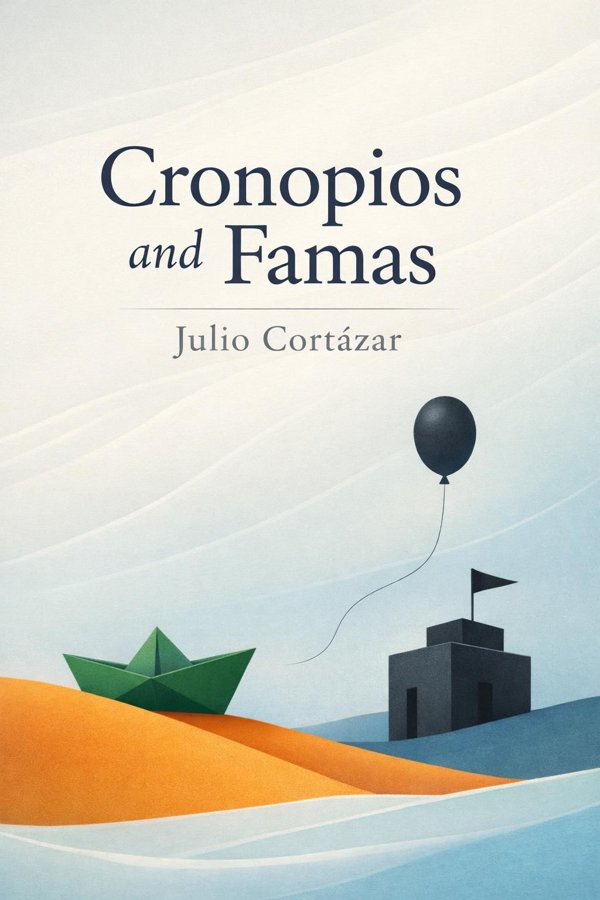
Cronopios and Famas: Summary & Key Insights
 10 min9 chaptersAudio available
Key Takeaways from Cronopios and Famas
A brilliant way to understand people is sometimes not through psychology textbooks but through invented creatures.
The fastest way to reveal the absurdity of ordinary life is to describe it as if it were a technical problem.
People often reveal themselves not in grand declarations but in tiny habits.
A story does not need scale to carry depth.
Many books criticize conformity directly; Cortázar does something more effective by making conformity look spiritually impoverished.
What Is Cronopios and Famas About?
Cronopios and Famas by Julio Cortázar is a classics book spanning 8 pages. Originally published in 1962, Cronopios and Famas is one of Julio Cortázar’s most playful and revealing books: a collection of miniatures, mock instructions, sketches, and brief stories that turns ordinary life into a stage for wonder, confusion, and philosophical comedy. Rather than offering a conventional plot, Cortázar invents a strange social universe populated by three recurring types: the dreamy cronopios, the orderly famas, and the passive esperanzas. Through them, he explores how people confront routine, anxiety, love, bureaucracy, art, and freedom. What makes the book endure is the way its lightness conceals precision. Cortázar uses humor not merely to entertain but to unsettle our habits of perception and to expose the absurd structures hidden inside daily life. A staircase, a watch, a funeral, a trip, or a simple social interaction can suddenly become surreal and newly meaningful. Cortázar, one of the most inventive voices in twentieth-century Latin American literature, brings the same formal daring that made him famous in works like Hopscotch, but here in a distilled, intimate, and mischievous form. This is a small book with a large imaginative reach.
This FizzRead summary covers all 9 key chapters of Cronopios and Famas in approximately 10 minutes, distilling the most important ideas, arguments, and takeaways from Julio Cortázar's work. Also available as an audio summary and Key Quotes Podcast.
Cronopios and Famas
Originally published in 1962, Cronopios and Famas is one of Julio Cortázar’s most playful and revealing books: a collection of miniatures, mock instructions, sketches, and brief stories that turns ordinary life into a stage for wonder, confusion, and philosophical comedy. Rather than offering a conventional plot, Cortázar invents a strange social universe populated by three recurring types: the dreamy cronopios, the orderly famas, and the passive esperanzas. Through them, he explores how people confront routine, anxiety, love, bureaucracy, art, and freedom. What makes the book endure is the way its lightness conceals precision. Cortázar uses humor not merely to entertain but to unsettle our habits of perception and to expose the absurd structures hidden inside daily life. A staircase, a watch, a funeral, a trip, or a simple social interaction can suddenly become surreal and newly meaningful. Cortázar, one of the most inventive voices in twentieth-century Latin American literature, brings the same formal daring that made him famous in works like Hopscotch, but here in a distilled, intimate, and mischievous form. This is a small book with a large imaginative reach.
Who Should Read Cronopios and Famas?
This book is perfect for anyone interested in classics and looking to gain actionable insights in a short read. Whether you're a student, professional, or lifelong learner, the key ideas from Cronopios and Famas by Julio Cortázar will help you think differently.
- ✓Readers who enjoy classics and want practical takeaways
- ✓Professionals looking to apply new ideas to their work and life
- ✓Anyone who wants the core insights of Cronopios and Famas in just 10 minutes
Want the full summary?
Get instant access to this book summary and 100K+ more with Fizz Moment.
Get Free SummaryAvailable on App Store • Free to download
Key Chapters
A brilliant way to understand people is sometimes not through psychology textbooks but through invented creatures. In Cronopios and Famas, Cortázar imagines three symbolic types: cronopios, famas, and esperanzas. Cronopios are spontaneous, emotional, disorganized, generous, and often gloriously impractical. Famas are methodical, cautious, administrative, and obsessed with order and control. Esperanzas are quieter, more passive figures who accept life as it comes and rarely resist its routines. These categories are not scientific labels or moral rankings. They are poetic tools that reveal how different temperaments move through the world.
Cortázar’s genius lies in showing that these types are instantly recognizable. A fama arrives at a hotel and carefully inspects, inventories, and secures every detail. A cronopio arrives with enthusiasm, improvises, trusts chance, and is often surprised by the consequences. An esperanza simply settles in. In a few absurd gestures, Cortázar captures entire philosophies of life: control, improvisation, and resignation.
This framework matters because it invites self-recognition without turning into self-help simplification. Most readers are not purely one thing. You may be a fama at work, a cronopio in love, and an esperanza when facing institutions too large to challenge. The book encourages you to observe your own habits with humor instead of judgment.
In practical terms, these types can sharpen your awareness in everyday situations. In meetings, are you over-planning like a fama? In creative projects, are you avoiding structure so completely that your inner cronopio sabotages you? In difficult relationships, have you become an esperanza who no longer acts? Cortázar transforms personality into playful self-diagnosis.
Actionable takeaway: Identify one situation this week in which you are acting like a fama, a cronopio, or an esperanza, and consciously experiment with the strengths of another type.
The fastest way to reveal the absurdity of ordinary life is to describe it as if it were a technical problem. Cortázar’s famous “Instructions” pieces do exactly that. He writes mock manuals on how to cry, how to climb stairs, how to wind a watch, or how to sing. By adopting the dry tone of practical guidance and applying it to intimate, obvious, or ridiculous activities, he turns the everyday into something strange, fragile, and poetic.
These short texts work on several levels. First, they are funny because they treat simple acts with excessive seriousness. Second, they expose how much of life operates automatically. Most people climb stairs without thinking; Cortázar forces us to see each movement as bizarre and ceremonial. Third, the pieces critique modern habits of control. We live surrounded by systems, instructions, procedures, and experts. Cortázar gently mocks the fantasy that everything can be managed through orderly explanation.
The lasting value of these pieces is their power to refresh perception. When familiar acts are reframed, they regain their mystery. A watch is no longer just an object you own; it becomes a machine that owns your time, your obligations, and your anxieties. A staircase is not just architecture; it is choreography. Crying is not just emotion; it is ritual. Cortázar reminds us that attention is the beginning of wonder.
This has practical application in daily life. If routine has made your days numb, try describing one common activity in absurdly formal detail: making coffee, answering email, commuting, brushing your teeth. The point is not to be silly for its own sake but to recover awareness from habit. Creativity often begins by noticing what familiarity has hidden.
Actionable takeaway: Choose one mundane action today and write your own playful “instruction manual” for it to rediscover the strangeness of ordinary experience.
A story does not need scale to carry depth. One of Cortázar’s greatest achievements in Cronopios and Famas is proving that miniature narratives can contain entire emotional climates. His short sketches and encounters between cronopios, famas, and other figures are often only a few paragraphs long, yet they suggest friendship, loneliness, social absurdity, tenderness, fear, and comic tragedy with remarkable economy.
These micro-stories work because Cortázar trusts implication. He does not explain everything, close every gap, or build conventional arcs. Instead, he creates small situations that resonate beyond themselves. A failed interaction, an odd encounter, a social misunderstanding, or a ceremonial episode can feel simultaneously light and profound. The result is a literature of compression: brief forms that still leave behind afterimages.
This style matters in a world that often equates value with length or complexity. Cortázar shows that precision and strangeness can make a tiny narrative unforgettable. He also demonstrates that humor does not weaken seriousness. On the contrary, laughter can sharpen emotional truth by making our defenses drop. A ridiculous scene may reveal vulnerability more effectively than solemn realism.
There is a practical lesson here for anyone who writes, speaks, teaches, or creates. You do not always need exhaustive explanation to communicate something meaningful. A well-chosen image, anecdote, or scene can do the work of pages of abstract commentary. In professional life, too, people remember vivid examples better than generic principles. The miniature can become memorable because it is distilled.
For readers, these stories invite a slower kind of attention. Because they are short, it is tempting to consume them quickly. But their power often lies in pausing after each one and asking what emotional or philosophical charge remains. Cortázar writes small pieces that expand in the mind.
Actionable takeaway: After reading or hearing a brief story, pause and name the larger truth it suggests rather than rushing to the next piece.
Many books criticize conformity directly; Cortázar does something more effective by making conformity look spiritually impoverished. Across Cronopios and Famas, freedom appears not as a slogan but as a style of perception. The cronopio, for all its flaws, represents a willingness to deviate from social scripts, trust surprise, and value emotional or poetic truth over efficient normality. The fama, meanwhile, embodies systems, surveillance, and management. The tension between them becomes a meditation on what it means to live freely.
Cortázar is not naive. He does not suggest that total spontaneity solves life. Cronopios can be impractical, vulnerable, and chaotic. But he clearly prefers imaginative openness to rigid administration. The book repeatedly asks whether our institutions, habits, and categories protect us or imprison us. It suggests that much of what passes for order is simply fear organized into procedure.
This idea has contemporary force. In workplaces, schools, and digital life, people are often pushed toward measurable behavior, optimized routines, and constant self-management. Cortázar offers a quiet resistance. He reminds us that improvisation, play, and imaginative drift are not childish wastes of time. They are necessary forms of inner freedom. Without them, life becomes technically efficient and spiritually flat.
Practically, imaginative disobedience does not mean rejecting responsibility. It means refusing to let usefulness become your only standard. You might take an unplanned walk without your phone, begin a creative hobby with no monetization goal, leave room in a schedule for serendipity, or solve a work problem by brainstorming wildly before narrowing options. Freedom often starts in small acts that interrupt mechanical living.
Actionable takeaway: Build one pocket of unstructured, non-optimized time into your week and protect it as an exercise in imaginative freedom.
Laughter can be more than entertainment; it can be a way of escaping the prison of official language. Cortázar uses humor in Cronopios and Famas not as decoration but as method. His absurd juxtapositions, deadpan tones, and exaggerated social rituals dissolve the authority of serious-sounding systems. Bureaucracy, convention, solemnity, and rational control all become lighter, shakier, and less inevitable under comic pressure.
This matters because many forms of domination depend on language that appears natural and unquestionable. Manuals, classifications, administrative procedures, and cultural expectations often present themselves as neutral. Cortázar exposes their hidden absurdity by pushing them slightly off balance. Once a reader laughs at a procedural logic applied to crying or stair-climbing, it becomes easier to question other supposedly obvious structures.
Humor also creates emotional distance from fear. The world of cronopios and famas contains anxiety, alienation, and the threat of social standardization, but these are transformed through play. Comedy does not erase seriousness; it makes seriousness bearable and more visible. That is why the book feels so liberating. It gives readers permission to meet the world with wit instead of mere obedience.
In everyday life, humor can perform a similar function. In a rigid team culture, a well-placed playful observation can expose inefficiency without direct confrontation. In personal life, naming your own overcontrolled habits with gentleness can loosen their hold. Even journaling about a stressful day in mock-epic or bureaucratic style can reveal how exaggerated your internal pressure has become.
Cortázar’s humor is especially useful because it is not cynical. It does not mock from a position of superiority; it reopens possibility. It says the world could be otherwise, and laughter is one way to remember that.
Actionable takeaway: The next time a routine or institution feels oppressive, describe it humorously to yourself and notice how laughter changes your sense of agency.
What looks nonsensical at first often carries philosophical depth. Cronopios and Famas is full of absurd images, impossible classifications, and irrational situations, yet the book is not random. Cortázar uses absurdity to reveal the instability of the categories we rely on. By unsettling common sense, he creates space for deeper questions: What is identity? Why do we trust routine? How much of social life is performance? What if reality is less fixed than our language suggests?
This approach places the book in conversation with broader twentieth-century concerns about alienation, existential uncertainty, and the limits of rational systems. But unlike heavier philosophical works, Cortázar arrives there lightly. His absurdity is airy rather than oppressive. It does not merely say that the world lacks meaning; it suggests that meaning may emerge precisely when rigid expectations collapse.
Think of moments in life when plans failed, when you got lost, when a misunderstanding unexpectedly led to insight, or when a ridiculous event revealed what truly mattered. Absurdity often punctures the illusion that life is linear and controllable. Cortázar turns that disruption into art. He invites us to see confusion not only as discomfort but also as a chance for reorientation.
This perspective can be practical in uncertain times. When a project goes off track or a personal plan dissolves, the first response is often frustration. Cortázar offers another possibility: examine the disruption for what it reveals. What assumptions just broke? What hidden dependency became visible? What new path appeared because the old one failed? Absurdity can become diagnostic.
The key is not to romanticize chaos but to become more supple within it. Meaning is not always found by enforcing order; sometimes it is discovered by attending carefully to the crack in order.
Actionable takeaway: When something small goes unexpectedly wrong this week, pause before fixing it and ask what this disruption is showing you about your assumptions.
The most lasting message of Cronopios and Famas may be that individuality is fragile and must be defended from standardization. Cortázar does not preach rebellion in abstract terms. Instead, he dramatizes the pressure to fit into prearranged systems of behavior, language, and expectation. The famas, with their classifications and procedures, stand for a world that wants everything legible, organized, and controlled. The cronopios stand for the irregular pulse of singular existence.
This opposition is not simplistic. Order has value; community needs forms; institutions can protect as well as constrain. Yet Cortázar insists that excessive conformity deforms life. When efficiency, habit, and social approval become the highest goods, spontaneity withers. People stop encountering one another as mysteries and begin processing one another as types, functions, or cases. The book resists that reduction by inventing its own playful taxonomy, one that reveals human variety rather than suppressing it.
The relevance today is obvious. Algorithms sort tastes, workplaces standardize communication, and social platforms reward predictable self-presentation. In such an environment, preserving one’s oddity becomes more than a stylistic choice; it becomes a moral and psychological necessity. Cortázar offers a defense of eccentricity, emotional openness, and imaginative individuality.
In practical life, this can mean protecting forms of self-expression that are not easily optimized or publicly validated. It may mean reading outside your usual categories, speaking in your own voice rather than institutional jargon, choosing relationships that allow complexity, or resisting the urge to turn every preference into a polished identity brand. Singularity survives through use.
Cortázar’s insight is gentle but firm: a life fully adapted to conformity may function smoothly while losing its music.
Actionable takeaway: Preserve one habit, taste, or creative impulse this month that feels authentically yours even if it brings no status, efficiency, or external reward.
All Chapters in Cronopios and Famas
About the Author
Julio Cortázar (1914–1984) was an Argentine writer, translator, and intellectual whose work helped redefine modern fiction in Spanish. Born in Brussels to Argentine parents and raised mainly in Argentina, he later settled in Paris, where he spent much of his adult life. Cortázar became one of the key figures of the Latin American literary boom, admired for his formal experimentation, playful imagination, and ability to fuse the ordinary with the fantastic. His major works include Hopscotch, Bestiary, Blow-Up and Other Stories, and Cronopios and Famas. Deeply influenced by jazz, surrealism, and philosophical inquiry, he wrote fiction that invites readers to participate actively rather than consume passively. His legacy endures as that of a writer who expanded the possibilities of narrative while preserving wit, mystery, and freedom.
Get This Summary in Your Preferred Format
Read or listen to the Cronopios and Famas summary by Julio Cortázar anytime, anywhere. FizzRead offers multiple formats so you can learn on your terms — all free.
Available formats: App · Audio · PDF · EPUB — All included free with FizzRead
Download Cronopios and Famas PDF and EPUB Summary
Key Quotes from Cronopios and Famas
“A brilliant way to understand people is sometimes not through psychology textbooks but through invented creatures.”
“The fastest way to reveal the absurdity of ordinary life is to describe it as if it were a technical problem.”
“People often reveal themselves not in grand declarations but in tiny habits.”
“A story does not need scale to carry depth.”
“Many books criticize conformity directly; Cortázar does something more effective by making conformity look spiritually impoverished.”
Frequently Asked Questions about Cronopios and Famas
Cronopios and Famas by Julio Cortázar is a classics book that explores key ideas across 9 chapters. Originally published in 1962, Cronopios and Famas is one of Julio Cortázar’s most playful and revealing books: a collection of miniatures, mock instructions, sketches, and brief stories that turns ordinary life into a stage for wonder, confusion, and philosophical comedy. Rather than offering a conventional plot, Cortázar invents a strange social universe populated by three recurring types: the dreamy cronopios, the orderly famas, and the passive esperanzas. Through them, he explores how people confront routine, anxiety, love, bureaucracy, art, and freedom. What makes the book endure is the way its lightness conceals precision. Cortázar uses humor not merely to entertain but to unsettle our habits of perception and to expose the absurd structures hidden inside daily life. A staircase, a watch, a funeral, a trip, or a simple social interaction can suddenly become surreal and newly meaningful. Cortázar, one of the most inventive voices in twentieth-century Latin American literature, brings the same formal daring that made him famous in works like Hopscotch, but here in a distilled, intimate, and mischievous form. This is a small book with a large imaginative reach.
More by Julio Cortázar

You Might Also Like



Browse by Category
Ready to read Cronopios and Famas?
Get the full summary and 100K+ more books with Fizz Moment.