
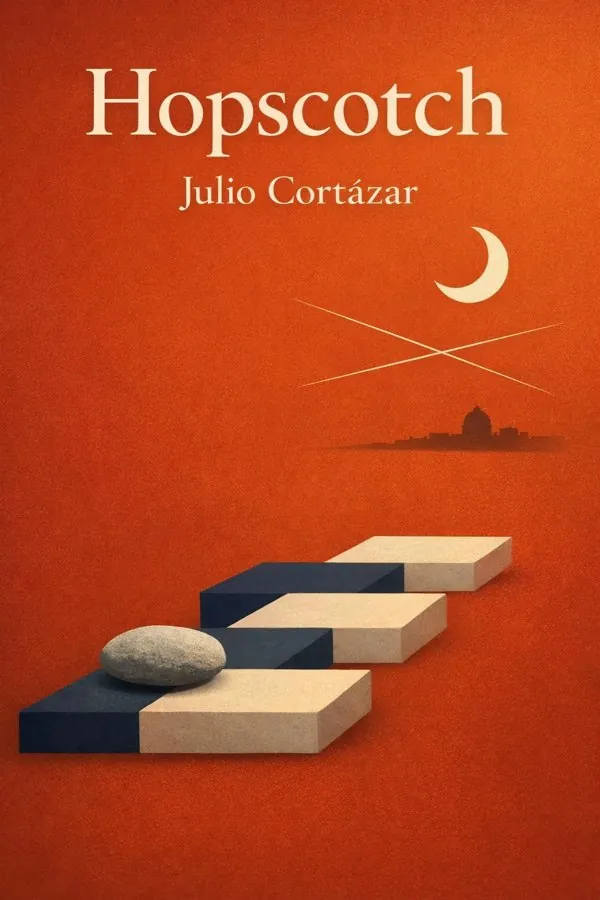
Hopscotch: Summary & Key Insights
 10 min9 chaptersAudio available
Key Takeaways from Hopscotch
Some people use ideas to get closer to life; Horacio Oliveira uses them to keep life at a distance.
A life can be full of thought and still feel empty.
We often understand what mattered only after it disappears.
Going home rarely restores the person who left.
Mental instability in Hopscotch is not just a medical theme; it is a way of testing the boundary between reality and interpretation.
What Is Hopscotch About?
Hopscotch by Julio Cortázar is a classics book spanning 8 pages. Julio Cortázar’s Hopscotch is one of the most daring novels of the twentieth century: a book that can be read in multiple sequences, a love story that resists sentimentality, and a philosophical puzzle that turns reading into an act of participation. First published in 1963, it follows Horacio Oliveira, an Argentine intellectual wandering through Paris and later Buenos Aires, as he searches for meaning, authenticity, and a way of living beyond stale habits of thought. Around him move unforgettable figures such as La Maga, whose instinctive humanity unsettles his relentless analysis, and the bohemian members of the Serpent Club, whose conversations blend jazz, metaphysics, irony, and despair. What makes Hopscotch matter is not just its plot, but its challenge: Cortázar asks whether life can ever be understood in a straight line, and whether art should mirror the chaos, freedom, and brokenness of lived experience. A central figure of the Latin American Boom, Cortázar brought rare formal invention and emotional depth to fiction, and Hopscotch remains his boldest invitation to readers willing to play, question, and think.
This FizzRead summary covers all 9 key chapters of Hopscotch in approximately 10 minutes, distilling the most important ideas, arguments, and takeaways from Julio Cortázar's work. Also available as an audio summary and Key Quotes Podcast.
Hopscotch
Julio Cortázar’s Hopscotch is one of the most daring novels of the twentieth century: a book that can be read in multiple sequences, a love story that resists sentimentality, and a philosophical puzzle that turns reading into an act of participation. First published in 1963, it follows Horacio Oliveira, an Argentine intellectual wandering through Paris and later Buenos Aires, as he searches for meaning, authenticity, and a way of living beyond stale habits of thought. Around him move unforgettable figures such as La Maga, whose instinctive humanity unsettles his relentless analysis, and the bohemian members of the Serpent Club, whose conversations blend jazz, metaphysics, irony, and despair. What makes Hopscotch matter is not just its plot, but its challenge: Cortázar asks whether life can ever be understood in a straight line, and whether art should mirror the chaos, freedom, and brokenness of lived experience. A central figure of the Latin American Boom, Cortázar brought rare formal invention and emotional depth to fiction, and Hopscotch remains his boldest invitation to readers willing to play, question, and think.
Who Should Read Hopscotch?
This book is perfect for anyone interested in classics and looking to gain actionable insights in a short read. Whether you're a student, professional, or lifelong learner, the key ideas from Hopscotch by Julio Cortázar will help you think differently.
- ✓Readers who enjoy classics and want practical takeaways
- ✓Professionals looking to apply new ideas to their work and life
- ✓Anyone who wants the core insights of Hopscotch in just 10 minutes
Want the full summary?
Get instant access to this book summary and 100K+ more with Fizz Moment.
Get Free SummaryAvailable on App Store • Free to download
Key Chapters
Some people use ideas to get closer to life; Horacio Oliveira uses them to keep life at a distance. That tension drives the Paris sections of Hopscotch, where Oliveira drifts through cafés, rented rooms, bridges, and late-night conversations with the bohemian circle known as the Serpent Club. He is intelligent, ironic, and deeply dissatisfied, a man who wants absolute truth but is incapable of surrendering to ordinary experience. In contrast stands La Maga, his lover, whose spontaneity, emotional openness, and intuitive wisdom expose everything limited in his hyper-intellectual approach.
The Serpent Club is more than a social group. It is a laboratory of modern consciousness: artists and expatriates arguing about music, literature, language, and metaphysics while trying to escape emptiness. Jazz becomes a recurring model for freedom, improvisation, and forms of understanding that exceed rational systems. Yet these brilliant conversations also reveal paralysis. Oliveira and his friends can analyze endlessly, but analysis does not save them from loneliness or confusion.
La Maga gives the Paris episodes their emotional center. She is not naïve, as Oliveira sometimes assumes, but differently alive. She notices people, moods, and fragile moments that his conceptual mind misses. Their relationship becomes a struggle between two ways of being: one that trusts experience and one that dissects it until it loses warmth.
In everyday life, this conflict is recognizable. Many people mistake sophistication for wisdom, or use cleverness to avoid vulnerability. Cortázar suggests that sensitivity, attention, and presence may reveal more than endless theory.
Actionable takeaway: Notice where overthinking keeps you from genuine connection, and practice meeting one conversation or moment with less analysis and more presence.
A life can be full of thought and still feel empty. Hopscotch returns again and again to this unsettling truth through its dense philosophical conversations and its refusal to offer stable conclusions. Oliveira and the Serpent Club confront the major questions of modern existence: Is there any transcendent order? Can language reach reality? Is the self coherent, or only a temporary arrangement of habits and voices? Cortázar places these questions inside lived scenes rather than abstract essays, making philosophy feel urgent rather than academic.
The novel absorbs influences from existentialism, surrealism, and absurdism, but it never settles inside any doctrine. Instead, it stages the experience of fragmentation itself. Thoughts interrupt feelings, jokes interrupt seriousness, and one perspective destabilizes another. Meaning appears in flashes, then dissolves. This structure mirrors Oliveira’s inner condition: he longs for a center but inhabits dispersion.
One of the book’s achievements is showing that absurdity is not only tragic; it is also comic, playful, and strangely liberating. If life does not yield a final system, then certainty loses its authority. The reader is pushed away from passive acceptance and toward active interpretation.
This has practical relevance beyond literature. In work, relationships, and identity, people often seek complete explanations before acting. But many important decisions must be made amid ambiguity. Hopscotch suggests that maturity may involve learning to think deeply without demanding total resolution.
Actionable takeaway: When faced with uncertainty, stop waiting for perfect clarity. Identify one meaningful step you can take even if the larger pattern remains unresolved.
We often understand what mattered only after it disappears. In Hopscotch, La Maga’s disappearance marks a decisive rupture in both Oliveira’s emotional life and the novel’s sense of balance. Until then, Paris has been unstable but still animated by desire, conversation, and the magnetic disorder of their relationship. Once she is gone, absence becomes the dominant reality. Oliveira is left not simply with grief, but with the collapse of an organizing illusion: that thought could somehow master experience.
La Maga’s vanishing is powerful because it is not treated as a neat plot device. Cortázar surrounds it with uncertainty, emotional recoil, and narrative dislocation. Readers do not receive tidy explanation or catharsis. Instead, they are made to feel the destabilizing force of loss itself. The world that Oliveira tried to control through language and reflection becomes ungraspable.
This moment also reveals the moral limits of Oliveira’s intelligence. He has often judged La Maga for lacking rigor, yet when confronted with real emotional catastrophe, his own powers seem sterile. His mind keeps moving, but it cannot repair what has been broken. The novel asks whether self-awareness without tenderness becomes another form of blindness.
In practical terms, the episode speaks to anyone who has intellectualized pain instead of mourning it. We explain, categorize, and reinterpret events because direct feeling is harder. Cortázar does not condemn thought, but he shows that some experiences must be endured before they can be understood.
Actionable takeaway: If you are processing loss, resist the urge to solve it immediately. Make room for grief as an experience, not just as a problem to analyze.
Going home rarely restores the person who left. When Oliveira returns to Buenos Aires, the novel shifts from expatriate bohemianism to something harsher and more intimate: the recognition that displacement can follow us everywhere. Paris had seemed like a site of searching, artistic possibility, and intellectual experiment. Buenos Aires, by contrast, confronts Oliveira with familiarity, repetition, and the residues of unresolved selfhood.
Here the narrative centers on Traveler and Talita, whose marriage and companionship form a subtle counterpoint to Oliveira’s isolation. They are not idealized, but they possess a practical connectedness that he lacks. Oliveira is drawn into their world while also projecting onto it his own confusion and desire. The return becomes less a geographical event than a psychological test: can he reenter ordinary human bonds, or is he permanently stranded in self-consciousness?
Cortázar uses Buenos Aires to puncture the fantasy that salvation lies in changing scenery. New cities, new scenes, and new circles can temporarily energize us, but they do not automatically transform our inner life. Oliveira’s disillusion deepens because he cannot blame his malaise on Paris alone; the crisis belongs to him.
This idea is widely applicable. People often imagine that fulfillment lies in the next move, next job, or next social world. Sometimes change is necessary, but relocation without inner reckoning repeats old patterns under new conditions.
Actionable takeaway: Before assuming that your dissatisfaction is caused by your environment, ask which habits of perception and behavior you are carrying with you wherever you go.
Mental instability in Hopscotch is not just a medical theme; it is a way of testing the boundary between reality and interpretation. As Oliveira’s life in Buenos Aires becomes increasingly strained, his perceptions grow more unstable, and the novel asks a disturbing question: when does radical lucidity become indistinguishable from breakdown? Cortázar refuses simplistic answers. Madness appears not as a theatrical spectacle, but as an extension of alienation, obsession, and failed contact with others.
Oliveira’s mind is brilliant at making associations, analogies, and patterns, yet the same capacity can turn destructive when no shared reality anchors it. His interactions with Traveler and Talita are charged with projection. Desire, jealousy, memory, and symbolic thinking blur together. The result is a consciousness that can no longer reliably separate inward drama from external fact.
At the same time, Cortázar complicates the idea of normality. The social world is hardly sane in any satisfying sense; it is full of routines, compromises, and deadened speech. The novel therefore avoids a simple opposition between sane society and insane individual. Instead, it shows degrees of estrangement. Some forms of madness are extreme versions of conflicts many people experience privately: overinterpretation, emotional displacement, fear of intimacy, and the inability to stop rehearsing meanings.
Readers can apply this insight by noticing how isolation intensifies distortion. When our thoughts are never tested against trusted others, they harden into private certainties. Emotional pressure then transforms speculation into conviction.
Actionable takeaway: If you feel trapped in obsessive thinking, interrupt the closed circuit—speak with someone grounded, return to concrete routines, and test your interpretations against shared reality.
Most novels ask to be followed; Hopscotch asks to be played. One of its most revolutionary features is its structure. Cortázar presents the book as containing a conventional sequence of chapters but also offers an alternative reading order that incorporates the so-called expendable chapters. These sections include reflections, digressions, comic fragments, metafictional notes, and the writings associated with Morelli, an experimental novelist whose ideas echo Cortázar’s own literary program.
Calling these chapters expendable is itself a provocation. They are not unnecessary; they transform the entire experience. They interrupt narrative momentum, complicate interpretation, and force readers to question what counts as central or marginal. Instead of consuming a finished story, the reader assembles one. Meaning becomes relational, depending on sequence, memory, juxtaposition, and choice.
This innovation matters because it changes the role of the reader from receiver to collaborator. The book refuses to behave like a closed object. Morelli’s theories help explain the ambition behind this form: literature should unsettle passive habits, break linear expectations, and generate a more open encounter between text and consciousness.
The broader application is clear. In an age of fixed categories and algorithmic predictability, active reading is a form of freedom. Whether engaging with novels, news, or personal narratives, the order in which information arrives shapes what we think it means.
Actionable takeaway: Read one chapter or passage out of sequence, then ask how context changes interpretation. Use that practice to become a more active, questioning reader in all areas of life.
Childhood games often contain adult truths in miniature. The title Hopscotch is not a decorative flourish; it names the novel’s central metaphor for existence. In the game, the player advances by jumps, hesitations, balance, and occasional missteps, moving through numbered squares toward a temporary vision of completion. Cortázar turns this into a model for consciousness, love, art, and reading itself.
Life in the novel does not unfold as a straight progression from ignorance to wisdom. It proceeds through leaps, accidents, returns, and broken patterns. Chance meetings matter. Trivial details acquire symbolic force. Progress can be undone in a moment. Even the structure of the book reproduces this hopscotch logic, asking readers to skip, double back, and navigate instability.
Play, however, is not treated as mere entertainment. For Cortázar, play is a serious mode of knowledge. It loosens rigid categories, welcomes improvisation, and allows contact with dimensions of reality that disciplined rationality often excludes. Jazz, wordplay, spontaneous association, and nonlinear reading all express this commitment. The game becomes a way to resist dead forms of order.
In practical life, adults often stop playing not because play becomes useless, but because institutions reward predictability. Yet creativity, empathy, and problem-solving often depend on exploratory thinking rather than rigid planning. Hopscotch reminds us that experimentation is not the opposite of seriousness; it may be the only way to approach what cannot be fully controlled.
Actionable takeaway: Introduce one element of deliberate play into your routine—change your route, brainstorm without judging, or explore a problem from an unexpected angle—to reopen imagination.
Some books end by answering their own questions; Hopscotch becomes more alive by refusing to do so. Its ending remains famously open, not because Cortázar lacked control, but because ambiguity is essential to the novel’s vision. Oliveira’s fate, psychological state, and spiritual prospects are left suspended. Readers are not rewarded with final certainty. Instead, they are returned to the book’s deepest concern: the search for meaning in a world that does not guarantee it.
This refusal of closure can be frustrating, especially for readers trained to expect resolution as a sign of artistic completion. But Cortázar proposes another standard. A serious novel should not always pacify; sometimes it should preserve the tension of real experience. Lives are rarely concluded by neatly arranged insights. Contradictions remain. Desires exceed explanations. Understanding arrives unevenly.
The open ending also amplifies the participatory nature of the novel. Because the text does not settle everything, readers must continue the work beyond the last page. Interpretation becomes ongoing rather than final. The novel survives in thought, conversation, rereading, and disagreement.
This is useful well beyond literature. Many personal situations—relationships, career decisions, identity questions—do not conclude with perfect clarity. Waiting for a definitive ending can become a way of postponing life. Cortázar’s ambiguity teaches tolerance for incompletion.
Actionable takeaway: The next time you face an unresolved situation, stop demanding total closure. Ask instead what uncertainty is teaching you and what kind of person you can be while the answer remains open.
When ordinary language fails, art invents another rhythm. Throughout Hopscotch, Cortázar experiments with speech, syntax, quotation, invented words, tonal shifts, and musical patterns to show that reality cannot be captured by a single register. Jazz is especially important: improvisational, collaborative, emotional, and formally daring, it becomes a model for how the novel itself wants to move.
This stylistic restlessness is not literary decoration. It reflects a central belief that conventional language often traps perception inside stale categories. If people speak in clichés, they begin to live in clichés as well. Cortázar pushes language toward play and fracture in order to recover freshness. Scenes of conversation, interior monologue, and comic invention reveal how words can both obscure and disclose experience.
Jazz offers a practical analogy. In improvisation, musicians do not abandon form altogether; they work within and against it, creating surprise through attentive risk. Hopscotch does something similar with narrative. It keeps enough recognizable structure to orient us, then breaks expectation to produce new awareness.
Readers can apply this idea by examining the language that shapes their own lives. The phrases we use about work, love, failure, or identity often become invisible assumptions. Changing language can change attention. A problem described differently may become newly solvable.
Actionable takeaway: Listen for one repeated phrase in your self-talk or daily speech, then rewrite it in fresher, more precise language. Notice how a new verbal frame alters your sense of possibility.
All Chapters in Hopscotch
About the Author
Julio Cortázar (1914-1984) was an Argentine writer, translator, and one of the defining voices of the Latin American Boom. Born in Brussels and raised in Argentina, he later settled in Paris, where much of his literary life unfolded. Cortázar became famous for combining formal innovation with emotional intensity, humor, and the uncanny, often blurring the line between everyday reality and the fantastic. He wrote influential short story collections such as Bestiary and Blow-Up and Other Stories, as well as the playful prose pieces gathered in Cronopios and Famas. His novel Hopscotch secured his international reputation by radically reimagining how a novel could be read. Deeply engaged with politics as well as aesthetics, Cortázar remains admired for his originality, intellectual daring, and lasting impact on modern world literature.
Get This Summary in Your Preferred Format
Read or listen to the Hopscotch summary by Julio Cortázar anytime, anywhere. FizzRead offers multiple formats so you can learn on your terms — all free.
Available formats: App · Audio · PDF · EPUB — All included free with FizzRead
Download Hopscotch PDF and EPUB Summary
Key Quotes from Hopscotch
“Some people use ideas to get closer to life; Horacio Oliveira uses them to keep life at a distance.”
“A life can be full of thought and still feel empty.”
“We often understand what mattered only after it disappears.”
“Going home rarely restores the person who left.”
“Mental instability in Hopscotch is not just a medical theme; it is a way of testing the boundary between reality and interpretation.”
Frequently Asked Questions about Hopscotch
Hopscotch by Julio Cortázar is a classics book that explores key ideas across 9 chapters. Julio Cortázar’s Hopscotch is one of the most daring novels of the twentieth century: a book that can be read in multiple sequences, a love story that resists sentimentality, and a philosophical puzzle that turns reading into an act of participation. First published in 1963, it follows Horacio Oliveira, an Argentine intellectual wandering through Paris and later Buenos Aires, as he searches for meaning, authenticity, and a way of living beyond stale habits of thought. Around him move unforgettable figures such as La Maga, whose instinctive humanity unsettles his relentless analysis, and the bohemian members of the Serpent Club, whose conversations blend jazz, metaphysics, irony, and despair. What makes Hopscotch matter is not just its plot, but its challenge: Cortázar asks whether life can ever be understood in a straight line, and whether art should mirror the chaos, freedom, and brokenness of lived experience. A central figure of the Latin American Boom, Cortázar brought rare formal invention and emotional depth to fiction, and Hopscotch remains his boldest invitation to readers willing to play, question, and think.
More by Julio Cortázar

You Might Also Like



Browse by Category
Ready to read Hopscotch?
Get the full summary and 100K+ more books with Fizz Moment.