
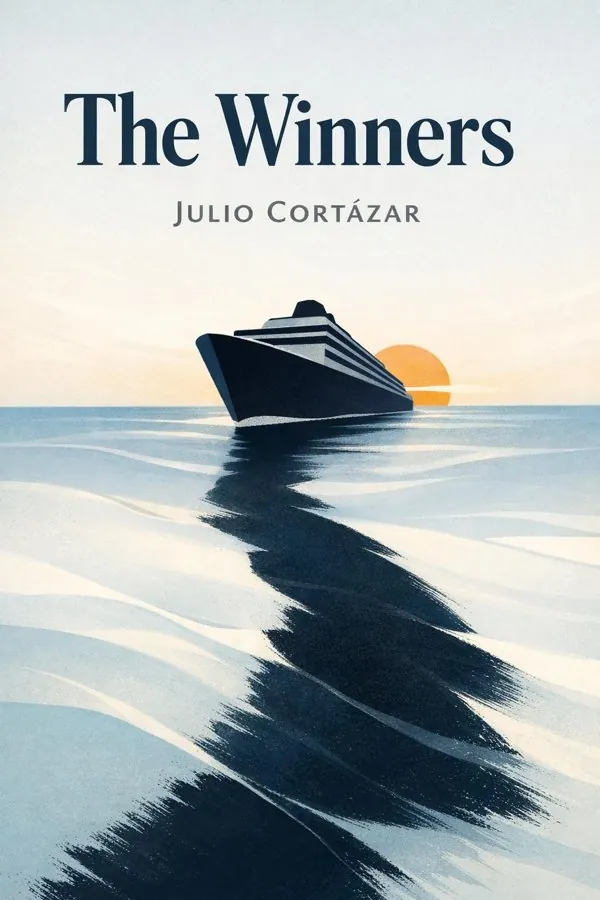
The Winners: Summary & Key Insights
 10 min9 chaptersAudio available
Key Takeaways from The Winners
One of the novel’s sharpest insights is that people often trust what flatters them before they question what confines them.
A society reveals itself most clearly when strangers are thrown together under pressure.
Put people in confinement and they will begin to rank one another almost immediately.
When institutions withhold information, imagination becomes a weapon against the mind.
Power often survives not because it is strong, but because people keep acting as if it makes sense.
What Is The Winners About?
The Winners by Julio Cortázar is a classics book spanning 5 pages. Originally published in 1960, The Winners is Julio Cortázar’s first novel, and it already contains the elements that would make him one of the most distinctive writers of the twentieth century: playful structure, psychological intensity, and a fascination with the strange hidden inside ordinary life. The premise is deceptively simple. A mixed group of Buenos Aires residents receive notice that they have won a mysterious contest and are invited on a luxury cruise. What begins as a reward soon turns unsettling. Once aboard, the passengers realize they are confined, information is scarce, and the purpose of the journey remains obscure. As uncertainty grows, so do suspicion, rivalry, desire, fear, and the need to make sense of authority. Cortázar turns this enclosed voyage into a powerful allegory about modern society, political obedience, class tensions, and the fragile stories people tell themselves to remain calm. The Winners matters because it captures how quickly civilization can slide into paranoia when freedom becomes ambiguous. For readers interested in classic literature that is intellectually rich, morally unsettling, and uncannily relevant, this novel is an essential early work by a master of literary experimentation.
This FizzRead summary covers all 9 key chapters of The Winners in approximately 10 minutes, distilling the most important ideas, arguments, and takeaways from Julio Cortázar's work. Also available as an audio summary and Key Quotes Podcast.
The Winners
Originally published in 1960, The Winners is Julio Cortázar’s first novel, and it already contains the elements that would make him one of the most distinctive writers of the twentieth century: playful structure, psychological intensity, and a fascination with the strange hidden inside ordinary life. The premise is deceptively simple. A mixed group of Buenos Aires residents receive notice that they have won a mysterious contest and are invited on a luxury cruise. What begins as a reward soon turns unsettling. Once aboard, the passengers realize they are confined, information is scarce, and the purpose of the journey remains obscure. As uncertainty grows, so do suspicion, rivalry, desire, fear, and the need to make sense of authority. Cortázar turns this enclosed voyage into a powerful allegory about modern society, political obedience, class tensions, and the fragile stories people tell themselves to remain calm. The Winners matters because it captures how quickly civilization can slide into paranoia when freedom becomes ambiguous. For readers interested in classic literature that is intellectually rich, morally unsettling, and uncannily relevant, this novel is an essential early work by a master of literary experimentation.
Who Should Read The Winners?
This book is perfect for anyone interested in classics and looking to gain actionable insights in a short read. Whether you're a student, professional, or lifelong learner, the key ideas from The Winners by Julio Cortázar will help you think differently.
- ✓Readers who enjoy classics and want practical takeaways
- ✓Professionals looking to apply new ideas to their work and life
- ✓Anyone who wants the core insights of The Winners in just 10 minutes
Want the full summary?
Get instant access to this book summary and 100K+ more with Fizz Moment.
Get Free SummaryAvailable on App Store • Free to download
Key Chapters
One of the novel’s sharpest insights is that people often trust what flatters them before they question what confines them. The passengers board the ship because they believe they have been chosen, rewarded, and elevated above the ordinary. Winning gives them a ready-made explanation: good things are happening, therefore there is no reason to be suspicious. Cortázar uses this irony brilliantly. The very word “winner” suggests freedom, pleasure, and validation, yet the trip quickly reveals itself as a structure of control. The prize contains its own trap.
This reversal is central to the novel’s power. Cortázar shows how systems of authority do not always begin with force. They often begin with seduction, convenience, prestige, or the promise of belonging. The passengers accept restrictions because those restrictions arrive wrapped in ceremony and privilege. They do not immediately resist because they cannot yet admit that the reward may be false.
This idea reaches far beyond the ship. In everyday life, people accept exploitative jobs because they come with status, surrender privacy for the convenience of digital platforms, or tolerate manipulative institutions because those institutions make them feel selected or secure. A title, a membership, or an invitation can distract from the actual terms of control.
Cortázar asks a disturbing question: how often do people cooperate with their own confinement because they like the story attached to it? The novel suggests that domination works best when it feels like recognition.
Actionable takeaway: Whenever something seems like a privilege, pause and ask what freedoms, choices, or clarity you are giving up in exchange.
A society reveals itself most clearly when strangers are thrown together under pressure. At the beginning of The Winners, Cortázar gathers a diverse set of passengers in Buenos Aires and sends them toward a shared but undefined destination. They come from different classes, temperaments, professions, and moral outlooks. Some are curious, some vain, some practical, some idealistic. Their differences matter because the ship becomes a compressed social laboratory where personal habits turn into political behavior.
Buenos Aires in the novel is not merely a backdrop. It is a city of contradictions, carrying modern aspirations alongside unease, elegance alongside deterioration. The passengers bring that fragmented world with them. Before the voyage even turns ominous, Cortázar hints that this group does not represent unity but coexistence without true understanding. They embark together, yet they do not share the same assumptions about authority, community, or dignity.
This departure scene establishes one of the novel’s major themes: uncertainty does not create character so much as expose it. When people are deprived of ordinary routines, they fall back on instinctive responses. Some seek information. Some seek advantage. Some seek companionship. Some retreat into passivity.
The setup has a practical relevance. In organizations, crises often reveal unspoken values. A team facing sudden change will quickly show who asks honest questions, who tries to dominate, who keeps others calm, and who hides behind protocol. Cortázar reminds us that beginnings matter because they contain the seeds of later conflict.
Actionable takeaway: In any new group or uncertain situation, pay attention to early reactions. They often reveal the patterns that will shape everything that follows.
Put people in confinement and they will begin to rank one another almost immediately. On the ship, the passengers do not remain a random collection of individuals for long. They start sorting themselves into circles of influence, sympathy, suspicion, and practical usefulness. The intellectuals attempt to interpret events. More assertive personalities try to lead. Workers and pragmatic figures focus on material concerns. Others drift toward dependence, gossip, or emotional alliances. Cortázar shows that hierarchy emerges not only from formal power but from uncertainty itself.
This is one of the novel’s most recognizable truths. When rules are unclear, human beings invent social order out of temperament, class assumptions, and perceived competence. Those who sound confident gain listeners, even when they know little. Those who appear calm become unofficial leaders. Those who ask uncomfortable questions risk being labeled disruptive. In this way, the ship becomes a miniature society before any official explanation is given.
Cortázar is not saying hierarchy is always avoidable. Rather, he explores how quickly people naturalize it. Even among supposed equals, status begins to harden through conversation, access to information, charisma, and exclusion. What starts as convenience can become domination. The group begins to imitate the very structures that may be trapping it.
The same pattern appears in meetings, classrooms, emergency situations, and online communities. Where authority is vague, people still look for cues about who matters. If those cues go unexamined, unhealthy power structures can solidify quickly.
Actionable takeaway: In uncertain group settings, notice who is becoming influential and why. Make space for quieter voices before temporary hierarchy turns into unquestioned authority.
When institutions withhold information, imagination becomes a weapon against the mind. As the passengers receive few clear answers about the voyage, rumors spread through the ship with increasing force. Every corridor, delay, gesture, and closed door becomes material for speculation. Cortázar carefully tracks how silence from authority does not produce patience; it produces stories. Some rumors comfort, others terrify, but all of them shape behavior.
This process is psychologically exact. Human beings struggle to tolerate a vacuum of meaning. Faced with ambiguity, they would often rather believe a flawed explanation than admit they do not know. Rumor turns uncertainty into narrative, and narrative into emotion. Fear becomes contagious. Distrust becomes rational. The group begins to react not to facts but to interpretations, and those interpretations gain power through repetition.
Cortázar also shows that rumor creates social alliances. People gather around the version of events that fits their temperament. Optimists cling to reassuring theories. Cynics assume manipulation. The angry seek evidence of betrayal. In this way, misinformation is not random; it reflects emotional needs.
The novel feels strikingly modern here. In workplaces, politics, and digital culture, lack of transparency invites conspiracy, panic, and polarization. When leaders refuse to communicate clearly, people build their own explanations from fragments. The cost is not only confusion but erosion of trust.
Cortázar suggests that paranoia is rarely born from madness alone. It often grows from a real structural absence: too little truth, too late.
Actionable takeaway: In ambiguous situations, separate what you know from what you fear. Refuse to pass along interpretations as facts unless evidence supports them.
Freedom becomes most visible when it is blocked. As tensions rise in The Winners, the passengers move toward confrontation with the ship’s opaque system of control. This is not simply a plot escalation. It is the moment when vague discomfort turns into a moral question: what does it mean to resist when the conditions of your imprisonment are still partly unclear? Cortázar refuses easy heroism. Resistance on the ship is tangled in fear, fatigue, disagreement, and uncertainty about consequences.
This complexity is one of the novel’s great strengths. Many people imagine they would defend freedom immediately if it were threatened. Cortázar suggests the reality is messier. People wait, negotiate, rationalize, and divide among themselves. Some want direct action. Some prefer caution. Some fear that rebellion will worsen the situation. Others have become too psychologically adjusted to confinement to imagine a real alternative.
The confrontation therefore reveals that freedom is not only a legal condition but an inner capacity. To act freely, people must first stop accepting absurdity as normal. They must endure the discomfort of not knowing whether resistance will succeed. Cortázar shows that the hardest barrier is often not the external prohibition but the internal erosion of initiative.
This idea is practical in less dramatic settings. People remain in controlling relationships, stagnant institutions, or unjust workplaces not because they do not value freedom, but because change requires collective courage and the willingness to enter uncertainty.
The novel does not romanticize revolt. It presents freedom as costly, fragile, and inseparable from responsibility.
Actionable takeaway: If something in your life feels quietly coercive, name it clearly. Honest naming is often the first step from passive endurance toward meaningful action.
Civilization is thinner than people like to believe. As the voyage deteriorates, The Winners studies what happens when normal social assurances begin to collapse. The passengers become more exposed not only to one another but to themselves. Under strain, courtesy gives way to aggression, desire becomes unstable, and private anxieties become social forces. Cortázar is not merely describing chaos. He is showing how pressure strips away decorative identities and reveals the instability beneath modern life.
The breakdown matters because it is both social and existential. The passengers are not just trapped on a ship; they are trapped inside the need to make life coherent. When systems fail, individuals confront emptiness, contingency, and the terrifying possibility that there may be no reassuring explanation waiting at the end. This is where the novel reaches beyond political allegory into philosophical territory. The ship becomes a stage on which human beings confront absurdity.
Yet Cortázar avoids bleak abstraction by grounding everything in gestures, quarrels, flirtations, humiliations, and moments of solidarity. Human beings break down unevenly. Some become cruel. Some become lucid. Some discover compassion only when certainty disappears. The novel suggests that crisis does not reveal one fixed human essence; it reveals a field of competing possibilities.
This remains relevant whenever systems fail: during economic instability, institutional betrayal, or personal upheaval. Stress does not invent people from scratch, but it rearranges what they are willing to show.
Actionable takeaway: Treat times of pressure as diagnostic. Notice which values in yourself and others survive when comfort, status, and routine fall away.
Some novels tell you that reality is unstable; Cortázar makes you feel that instability in the act of reading. The Winners is not experimental in the same overtly playful way as Hopscotch, but its structure, shifting perspectives, tonal variations, and elusive pacing all contribute to an atmosphere of unease. Cortázar withholds certainty, moves among characters, and allows conversations and impressions to accumulate without always delivering the clarifying authority many readers expect. Form becomes part of the meaning.
This matters because the novel’s subject is confusion under authority. If the reader were given a firm, controlling narrative standpoint, the book would lose much of its power. Instead, Cortázar places us in a position analogous to the passengers: trying to interpret fragments, uncertain how much to trust any single viewpoint, aware that the system exceeds our understanding. The result is not mere obscurity but a literary enactment of disorientation.
Cortázar’s style also captures the fluidity of social experience. People do not live events as tidy arguments. They live them as interruptions, moods, speculations, collisions, and partial insights. The novel honors that complexity. It asks readers to remain active, perceptive, and comfortable with unresolved tension.
This is useful beyond literature. Complex realities rarely arrive with a clean explanatory voice. Good judgment often requires reading patterns without immediate closure. Cortázar trains that kind of attention.
Actionable takeaway: When engaging with difficult art or difficult situations, resist the urge for instant clarity. Stay with ambiguity long enough to see what it reveals about the system and about yourself.
The ship in The Winners is more than a setting; it is a compressed image of modern society. Within its enclosed space, Cortázar stages class friction, bureaucratic opacity, emotional contagion, ideological conflict, and the struggle to remain human inside systems that treat people as manageable units. The novel can be read politically, existentially, psychologically, or all at once. That layered quality is one reason it endures.
As a social allegory, the ship resembles any environment in which people are gathered under rules they did not write and cannot fully challenge. Governments, institutions, corporations, and even nations can function this way. Citizens or members are told they are participating in something meaningful, yet access to truth is limited and decision-making remains distant. In such systems, people adapt through denial, irony, ambition, resignation, or revolt.
What makes Cortázar especially insightful is that he never reduces the passengers to symbols alone. They remain contradictory individuals. That prevents the allegory from becoming mechanical. Society is not an abstract machine; it is made of frightened, hopeful, flawed people improvising under pressure. The novel therefore avoids preaching. Instead, it lets readers feel the social logic from inside.
For contemporary readers, the book resonates with surveillance culture, institutional mistrust, political manipulation, and the uneasy sense of being carried along by forces larger than oneself. Its world feels uncanny because it exaggerates patterns we already know.
Actionable takeaway: Read institutions symbolically and concretely at once. Ask not only what a system claims to be doing, but how people inside it are being changed by its hidden logic.
All Chapters in The Winners
About the Author
Julio Cortázar (1914–1984) was an Argentine writer, translator, and teacher whose work helped redefine modern fiction in Spanish. Born in Brussels and raised in Argentina, he later settled in Paris, where he spent much of his adult life. Cortázar became one of the central figures of the Latin American Boom, admired for his formal experimentation, intellectual daring, and ability to blend the everyday with the uncanny. His fiction ranges from brilliant short stories to genre-defying novels, often exploring time, identity, language, and hidden realities beneath ordinary life. Among his best-known books are Hopscotch, Bestiary, and End of the Game. The Winners, his first novel, already shows his fascination with ambiguity, freedom, and the fragile structures that organize human experience.
Get This Summary in Your Preferred Format
Read or listen to the The Winners summary by Julio Cortázar anytime, anywhere. FizzRead offers multiple formats so you can learn on your terms — all free.
Available formats: App · Audio · PDF · EPUB — All included free with FizzRead
Download The Winners PDF and EPUB Summary
Key Quotes from The Winners
“One of the novel’s sharpest insights is that people often trust what flatters them before they question what confines them.”
“A society reveals itself most clearly when strangers are thrown together under pressure.”
“Put people in confinement and they will begin to rank one another almost immediately.”
“When institutions withhold information, imagination becomes a weapon against the mind.”
“Power often survives not because it is strong, but because people keep acting as if it makes sense.”
Frequently Asked Questions about The Winners
The Winners by Julio Cortázar is a classics book that explores key ideas across 9 chapters. Originally published in 1960, The Winners is Julio Cortázar’s first novel, and it already contains the elements that would make him one of the most distinctive writers of the twentieth century: playful structure, psychological intensity, and a fascination with the strange hidden inside ordinary life. The premise is deceptively simple. A mixed group of Buenos Aires residents receive notice that they have won a mysterious contest and are invited on a luxury cruise. What begins as a reward soon turns unsettling. Once aboard, the passengers realize they are confined, information is scarce, and the purpose of the journey remains obscure. As uncertainty grows, so do suspicion, rivalry, desire, fear, and the need to make sense of authority. Cortázar turns this enclosed voyage into a powerful allegory about modern society, political obedience, class tensions, and the fragile stories people tell themselves to remain calm. The Winners matters because it captures how quickly civilization can slide into paranoia when freedom becomes ambiguous. For readers interested in classic literature that is intellectually rich, morally unsettling, and uncannily relevant, this novel is an essential early work by a master of literary experimentation.
More by Julio Cortázar
You Might Also Like






Browse by Category
Ready to read The Winners?
Get the full summary and 100K+ more books with Fizz Moment.