
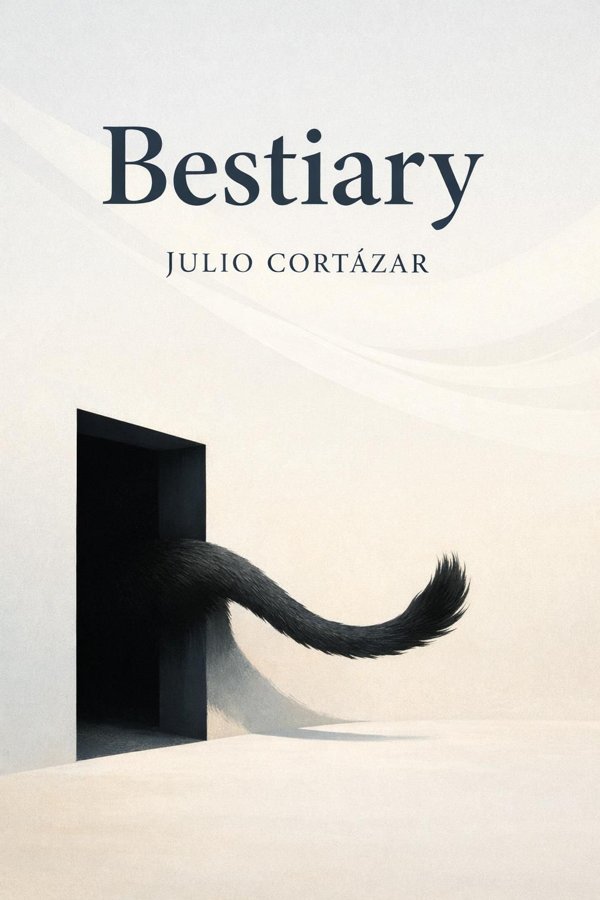
Bestiary: Summary & Key Insights
 10 min9 chaptersAudio available
Key Takeaways from Bestiary
One of Cortázar’s boldest insights is that terror does not need monsters, only a slight shift in the meaning of ordinary things.
Sometimes the impossible is the most accurate way to describe emotional distress.
In “The Distances,” Cortázar suggests that identity is not stable but stretched across longing, imagination, and estrangement.
One of the most unsettling truths in social life is that exclusion often happens without anyone explicitly announcing it.
Cortázar repeatedly suggests that what cannot be spoken may return as bodily disturbance.
What Is Bestiary About?
Bestiary by Julio Cortázar is a classics book spanning 8 pages. Julio Cortázar’s Bestiary, first published in 1951, is one of the essential entry points into modern fantastic literature. This debut short story collection gathers eight stories in which ordinary lives are unsettled by forces that are never fully explained: a house slowly becomes inaccessible, a man cannot stop producing rabbits, a child senses the hidden violence of a country estate, and social spaces turn hostile for reasons no one can name. What makes the book enduring is not spectacle but precision. Cortázar does not build fantasy worlds separate from reality; he reveals how fragile reality already is. In his fiction, habits, rooms, bodies, and relationships can suddenly become strange, exposing fear, desire, repression, and social tension. That achievement matters because Bestiary changed the possibilities of the short story in Spanish and helped shape the path toward the Latin American Boom. Cortázar, who was also an accomplished translator and one of the most inventive stylists of the twentieth century, writes with elegance, ambiguity, and control. Bestiary remains powerful because it teaches readers to look again at the everyday and notice the quiet disturbances already living inside it.
This FizzRead summary covers all 9 key chapters of Bestiary in approximately 10 minutes, distilling the most important ideas, arguments, and takeaways from Julio Cortázar's work. Also available as an audio summary and Key Quotes Podcast.
Bestiary
Julio Cortázar’s Bestiary, first published in 1951, is one of the essential entry points into modern fantastic literature. This debut short story collection gathers eight stories in which ordinary lives are unsettled by forces that are never fully explained: a house slowly becomes inaccessible, a man cannot stop producing rabbits, a child senses the hidden violence of a country estate, and social spaces turn hostile for reasons no one can name. What makes the book enduring is not spectacle but precision. Cortázar does not build fantasy worlds separate from reality; he reveals how fragile reality already is. In his fiction, habits, rooms, bodies, and relationships can suddenly become strange, exposing fear, desire, repression, and social tension. That achievement matters because Bestiary changed the possibilities of the short story in Spanish and helped shape the path toward the Latin American Boom. Cortázar, who was also an accomplished translator and one of the most inventive stylists of the twentieth century, writes with elegance, ambiguity, and control. Bestiary remains powerful because it teaches readers to look again at the everyday and notice the quiet disturbances already living inside it.
Who Should Read Bestiary?
This book is perfect for anyone interested in classics and looking to gain actionable insights in a short read. Whether you're a student, professional, or lifelong learner, the key ideas from Bestiary by Julio Cortázar will help you think differently.
- ✓Readers who enjoy classics and want practical takeaways
- ✓Professionals looking to apply new ideas to their work and life
- ✓Anyone who wants the core insights of Bestiary in just 10 minutes
Want the full summary?
Get instant access to this book summary and 100K+ more with Fizz Moment.
Get Free SummaryAvailable on App Store • Free to download
Key Chapters
One of Cortázar’s boldest insights is that terror does not need monsters, only a slight shift in the meaning of ordinary things. In “House Taken Over,” Irene and her brother live quietly in a large ancestral home, surrounded by routine, memory, and inherited order. They read, knit, clean, and preserve a life that seems sheltered from history. Then a vague intrusion begins. A part of the house becomes inaccessible. No explanation is given, no enemy is clearly seen, and yet the siblings adapt with eerie calm, retreating room by room until they abandon the home entirely. The story’s power lies in this refusal to explain. The threat could be supernatural, psychological, political, or symbolic of social decline. Cortázar makes the house feel like a mind, a family history, even a class structure under pressure.
What this story clarifies for readers is how often people normalize the loss of space, freedom, or agency when change arrives gradually. We do this in real life too. A workplace becomes more restrictive one policy at a time. A relationship shrinks through small concessions. A city becomes less livable through seemingly isolated inconveniences. Because the change is incremental, resistance often comes too late.
Cortázar also shows the emotional comfort of routine. Irene and her brother are not simply passive; they are attached to habit because habit protects them from uncertainty. That makes the story psychologically sharp, not just eerie. We often cling to the known even when it is vanishing beneath us.
Actionable takeaway: pay attention to slow encroachments in your life. If something valuable is shrinking—your time, your independence, your peace—name it early instead of adapting endlessly.
In “The Distances,” Cortázar suggests that identity is not stable but stretched across longing, imagination, and estrangement. The protagonist, Alina Reyes, lives in privilege and comfort, yet she is haunted by the sense of another woman far away, suffering in cold and poverty. This distant double becomes an obsession. The story unfolds as a psychological and almost mystical connection between two lives that seem separate but increasingly feel fused. Instead of treating identity as a unified inner core, Cortázar presents the self as divided, vulnerable to projection and haunted by what it excludes.
This is one of the collection’s deepest themes. People often imagine that their lives are coherent, but desire and guilt create fractures. We construct a polished version of ourselves while sensing another hidden self made of deprivation, fear, envy, or unrealized possibility. Alina’s fixation on her double can be read as empathy, narcissism, guilt, or spiritual dislocation. Cortázar leaves room for all of these at once. That ambiguity is what makes the story so rich.
The story also speaks to modern experience. In a global world, we live daily with distant lives entering our awareness through news, travel, and media. We compare ourselves to others, feel implicated in suffering we do not directly experience, and struggle with the moral discomfort of inequality. “The Distances” turns that discomfort into a haunting narrative about psychological overlap.
Practically, the story invites readers to ask where their self-image depends on distance from realities they would rather not inhabit. It also raises the question of whether true empathy changes us or merely fascinates us.
Actionable takeaway: examine one part of your identity that depends on contrast—who you are because you are not someone else—and ask what that contrast reveals about your fears and responsibilities.
One of the most unsettling truths in social life is that exclusion often happens without anyone explicitly announcing it. In “Omnibus,” a woman boards a bus carrying flowers and gradually realizes she and another passenger are being watched with suspicion and hostility. No rule has been broken. No one clearly explains what is wrong. Yet the atmosphere thickens with menace. Cortázar captures the chilling experience of entering a social situation where everyone seems to understand a code that you do not.
The story works because the threat remains elusive. Is this about class, ritual, desire, conformity, or paranoia? Cortázar never pins it down. Instead, he dramatizes how public spaces are governed by unspoken expectations. Belonging is not always secured by law or reason; it is often negotiated through gestures, symbols, and shared assumptions. Once a person appears out of alignment, a crowd can become quietly punitive.
This dynamic is recognizable far beyond a bus ride. Consider office cultures where unwritten norms determine who is trusted. Think about online communities where a small signal marks someone as insider or outsider. Or reflect on social gatherings where one person suddenly feels exposed without knowing why. Cortázar shows how quickly ordinary collective life can turn coercive.
What makes the story useful is its reminder that confusion in a group setting is not always personal failure. Sometimes the discomfort comes from invisible systems of meaning that others treat as obvious. Awareness of that possibility can prevent self-blame and sharpen social perception.
Actionable takeaway: when you feel sudden discomfort in a social environment, pause before assuming the problem is you. Look for the hidden code at work, and decide consciously whether you want to adapt, question it, or leave.
Cortázar repeatedly suggests that what cannot be spoken may return as bodily disturbance. “Headache” is one of the strangest stories in Bestiary, presenting a household preoccupied with the care of mysterious creatures whose illnesses and needs dominate daily life. The narration is detailed, clinical, and obsessive, yet the story remains difficult to categorize. Are the creatures real, symbolic, or projections of a shared pathology? The title directs us toward the body, but the narrative expands headache into a whole ecosystem of strain, management, and dread.
The brilliance of the story lies in how symptom becomes structure. Instead of treating pain as a minor inconvenience, Cortázar shows it as something that organizes perception, relationships, and time. Anyone who has lived with chronic stress, anxiety, migraines, or caregiving burdens will recognize this logic. Life narrows around what must be monitored. Attention is consumed by prevention, diagnosis, and small adjustments. The world becomes technical and tense.
At a broader level, the story suggests that families and institutions also develop symptoms. A group can center itself around a recurring crisis, becoming defined by maintenance rather than meaning. In workplaces, this appears when everyone is busy managing dysfunction but no one addresses its cause. In personal life, it appears when recurring distress is normalized because it has become part of identity.
Cortázar’s refusal to explain the creatures forces readers to feel the unsettling overlap between literal care and symbolic burden. The effect is not confusion for its own sake; it is an accurate portrait of how suffering often feels—specific in detail, unclear in origin.
Actionable takeaway: if a recurring symptom or crisis dominates your life, ask not only how to manage it but what larger pattern it may be expressing.
“Circe” turns the old idea of enchantment into a modern study of seduction, appetite, and danger. At the center is Delia Mañara, a young woman whose beauty and delicacy are shadowed by rumor, death, and unease. Men are drawn to her, but her presence carries an atmosphere of threat. Cortázar builds the story through suggestion rather than explicit accusation, allowing charm and menace to coexist. The result is not simply a tale about a dangerous woman; it is a meditation on how desire distorts judgment.
The story matters because it exposes the human tendency to ignore warning signs when fascination is involved. Delia’s admirers want innocence, romance, and mystery, so they interpret ambiguity in ways that preserve their desire. This is psychologically acute. People often accept contradictions when they are captivated—by another person, by a charismatic leader, by a glamorous opportunity, even by an image of themselves. Seduction does not merely attract; it edits perception.
Cortázar also explores the social production of myth. Delia becomes a figure onto whom others project fear, fantasy, and moral anxiety. That means the story is not reducible to a simple lesson about female danger. It is equally about gossip, collective imagination, and the stories communities tell around beauty and death.
In practical terms, “Circe” speaks to relationships and decisions shaped by idealization. When someone or something feels unusually magnetic, it is worth asking what part of the attraction comes from reality and what part comes from projection. The more enchanted you feel, the more disciplined your perception must become.
Actionable takeaway: when you are strongly drawn to a person or opportunity, list the facts separately from the fantasy. Attraction becomes safer when perception becomes clearer.
The title story, “Bestiary,” delivers one of Cortázar’s most memorable achievements: it uses a child’s perspective to reveal the suppressed violence and coded tensions of adult life. The young protagonist, Isabel, is sent to a country house where family routines are organized around the presence of a tiger roaming certain parts of the estate. The arrangement is accepted with unnerving normality. Rooms are used or avoided depending on where the tiger is, and adult interactions carry a subdued intensity that Isabel senses more clearly than she understands.
The tiger is both literal and symbolic, and Cortázar’s genius lies in making those dimensions inseparable. It represents danger that cannot be openly addressed, the kind of force around which families build rituals of avoidance. Many households function this way: around rage, addiction, resentment, abuse, or unspoken alliances. Children often detect these structures before they have language for them. They read tone, silence, timing, and space. Isabel’s perception captures this exact intelligence.
The story also demonstrates that innocence is not ignorance. Isabel may not interpret everything as adults do, but her attention is sharp, and her final actions reveal agency shaped by observation. Cortázar respects childhood as a mode of knowledge rather than a stage of deficiency.
In practical life, this story asks us to consider what “tigers” govern our environments. What dangerous reality do people track indirectly, speak around, and normalize through habit? It also reminds adults that children are far more perceptive than they often assume.
Actionable takeaway: identify the unspoken danger or tension in one system you belong to—family, team, or community—and ask how everyone’s behavior has been organized around avoiding it.
A final key to Bestiary is that its uncertainty is not a puzzle to be solved but a method for getting closer to reality. Across the collection, Cortázar withholds definitive explanations. Are the intrusions supernatural, psychological, symbolic, social, or all at once? The stories refuse neat categorization because lived experience often works the same way. Fear rarely arrives with a label. Desire is mixed with shame. Social hostility feels irrational until one sees the code beneath it. Family violence may be sensed long before it is named. Ambiguity, in Cortázar, is not vagueness; it is precision about complexity.
This approach is one reason the collection remains so influential. Rather than using the fantastic as escape, Cortázar uses it to disturb the false security of realism. The impossible elements in these stories do not remove us from life; they reveal the hidden logic of life more sharply. A rabbit, a tiger, an inaccessible room, a charged bus ride—each becomes a device for exposing invisible structures of feeling and power.
For readers, this has a practical payoff. Many of the most important situations in life cannot be understood through immediate certainty. Ambiguous relationships, tense workplaces, shifting identities, and social discomfort often demand patient interpretation rather than instant conclusion. Cortázar trains that patience. He asks us to remain alert, to hold competing meanings at once, and to trust that confusion can be diagnostically useful.
Reading Bestiary well therefore means resisting the urge to reduce each story to a single moral. The better question is not “What does it mean?” but “What kinds of experience does this make newly visible?”
Actionable takeaway: the next time a situation feels unclear, resist premature explanation. List multiple possible meanings and see which one best accounts for the emotional atmosphere as well as the facts.
All Chapters in Bestiary
About the Author
Julio Cortázar (1914–1984) was an Argentine writer, translator, and teacher whose work transformed modern fiction in Spanish. Born in Brussels and raised in Argentina, he first worked as a teacher and later gained recognition for his short stories, novels, and essays. He became one of the defining figures of the Latin American Boom, admired for his formal experimentation, playful intelligence, and ability to insert the fantastic into everyday life without breaking realism. His fiction often explores ambiguity, perception, games, music, and the hidden instability of ordinary experience. Among his most celebrated works are Hopscotch, End of the Game, Blow-Up and Other Stories, and Bestiary. Cortázar also translated Edgar Allan Poe into Spanish, a task that deeply influenced his attention to atmosphere, rhythm, and psychological unease.
Get This Summary in Your Preferred Format
Read or listen to the Bestiary summary by Julio Cortázar anytime, anywhere. FizzRead offers multiple formats so you can learn on your terms — all free.
Available formats: App · Audio · PDF · EPUB — All included free with FizzRead
Download Bestiary PDF and EPUB Summary
Key Quotes from Bestiary
“One of Cortázar’s boldest insights is that terror does not need monsters, only a slight shift in the meaning of ordinary things.”
“Sometimes the impossible is the most accurate way to describe emotional distress.”
“In “The Distances,” Cortázar suggests that identity is not stable but stretched across longing, imagination, and estrangement.”
“One of the most unsettling truths in social life is that exclusion often happens without anyone explicitly announcing it.”
“Cortázar repeatedly suggests that what cannot be spoken may return as bodily disturbance.”
Frequently Asked Questions about Bestiary
Bestiary by Julio Cortázar is a classics book that explores key ideas across 9 chapters. Julio Cortázar’s Bestiary, first published in 1951, is one of the essential entry points into modern fantastic literature. This debut short story collection gathers eight stories in which ordinary lives are unsettled by forces that are never fully explained: a house slowly becomes inaccessible, a man cannot stop producing rabbits, a child senses the hidden violence of a country estate, and social spaces turn hostile for reasons no one can name. What makes the book enduring is not spectacle but precision. Cortázar does not build fantasy worlds separate from reality; he reveals how fragile reality already is. In his fiction, habits, rooms, bodies, and relationships can suddenly become strange, exposing fear, desire, repression, and social tension. That achievement matters because Bestiary changed the possibilities of the short story in Spanish and helped shape the path toward the Latin American Boom. Cortázar, who was also an accomplished translator and one of the most inventive stylists of the twentieth century, writes with elegance, ambiguity, and control. Bestiary remains powerful because it teaches readers to look again at the everyday and notice the quiet disturbances already living inside it.
More by Julio Cortázar

You Might Also Like


Browse by Category
Ready to read Bestiary?
Get the full summary and 100K+ more books with Fizz Moment.