
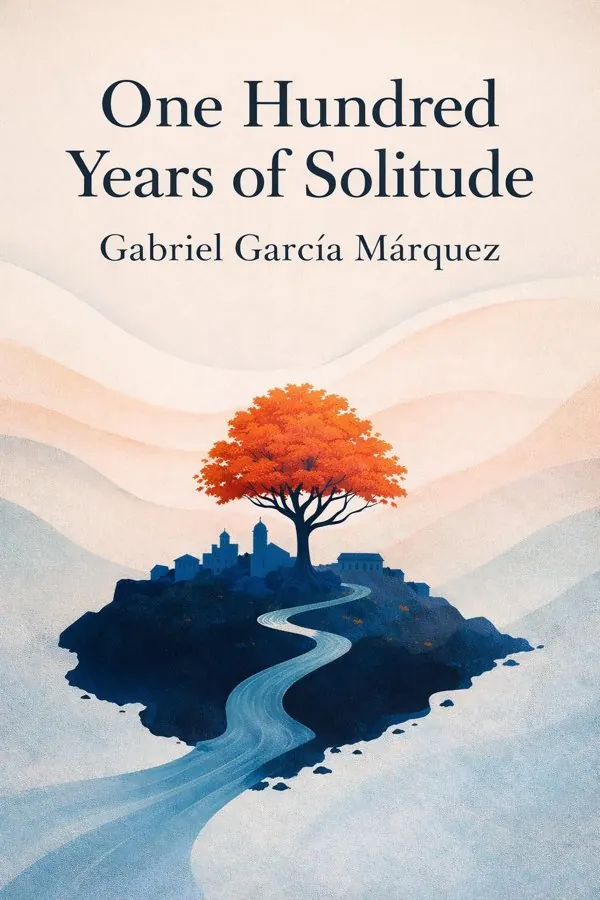
100 Years of Solitude: Summary & Key Insights
 10 min9 chapters
Key Takeaways from 100 Years of Solitude
A town can tell the story of the entire human condition.
What feels like personal choice may actually be inherited repetition.
Loneliness is not always the absence of people; often it is the failure of true connection.
The fantastic in this novel is not an escape from reality but a way of seeing it more fully.
The most dangerous events are often not the ones that happen, but the ones people are taught to forget.
What Is 100 Years of Solitude About?
100 Years of Solitude by Gabriel García Márquez is a fiction book published in 1990 spanning 12 pages. Gabriel García Márquez’s 100 Years of Solitude is one of the defining novels of modern literature: a sweeping, dreamlike chronicle of the Buendía family across multiple generations in the mythical town of Macondo. At once intimate and epic, the novel blends civil wars, love affairs, inventions, ghosts, insomnia, violence, and prophecy into a single unforgettable vision of human life. What makes the book so powerful is not only its story, but the way it transforms history, memory, and myth into something that feels both fantastical and deeply true. This novel matters because it changed the way readers around the world understood fiction. It helped bring Latin American literature to global prominence and became the landmark work most associated with magical realism, a style in which the extraordinary appears inside ordinary life without explanation. Beneath its wonder, however, lies a serious meditation on solitude, power, repetition, desire, and the fragility of civilization. García Márquez writes with the authority of a master storyteller shaped by Colombian history, oral tradition, and political upheaval. The result is a novel that rewards first-time readers and lifelong rereading alike.
This FizzRead summary covers all 9 key chapters of 100 Years of Solitude in approximately 10 minutes, distilling the most important ideas, arguments, and takeaways from Gabriel García Márquez's work.
100 Years of Solitude
Gabriel García Márquez’s 100 Years of Solitude is one of the defining novels of modern literature: a sweeping, dreamlike chronicle of the Buendía family across multiple generations in the mythical town of Macondo. At once intimate and epic, the novel blends civil wars, love affairs, inventions, ghosts, insomnia, violence, and prophecy into a single unforgettable vision of human life. What makes the book so powerful is not only its story, but the way it transforms history, memory, and myth into something that feels both fantastical and deeply true.
This novel matters because it changed the way readers around the world understood fiction. It helped bring Latin American literature to global prominence and became the landmark work most associated with magical realism, a style in which the extraordinary appears inside ordinary life without explanation. Beneath its wonder, however, lies a serious meditation on solitude, power, repetition, desire, and the fragility of civilization. García Márquez writes with the authority of a master storyteller shaped by Colombian history, oral tradition, and political upheaval. The result is a novel that rewards first-time readers and lifelong rereading alike.
Who Should Read 100 Years of Solitude?
This book is perfect for anyone interested in fiction and looking to gain actionable insights in a short read. Whether you're a student, professional, or lifelong learner, the key ideas from 100 Years of Solitude by Gabriel García Márquez will help you think differently.
- ✓Readers who enjoy fiction and want practical takeaways
- ✓Professionals looking to apply new ideas to their work and life
- ✓Anyone who wants the core insights of 100 Years of Solitude in just 10 minutes
Want the full summary?
Get instant access to this book summary and 100K+ more with Fizz Moment.
Get Free SummaryAvailable on App Store • Free to download
Key Chapters
A town can tell the story of the entire human condition. In 100 Years of Solitude, Macondo begins as an isolated settlement founded by José Arcadio Buendía and Úrsula Iguarán, full of innocence, curiosity, and possibility. Over time, it grows, modernizes, suffers political conflict, attracts outside capital, and eventually declines into decay and forgetfulness. This arc is one of the novel’s great achievements: Macondo is not just a setting, but a living symbol of how societies are born, flourish, become corrupted, and disappear.
García Márquez uses the town to compress centuries of social evolution into one narrative world. The arrival of gypsies and inventions suggests the excitement of discovery. The coming of government, war, bureaucracy, religion, and commerce marks civilization’s expansion. Later, foreign business interests and mass violence reveal how progress often carries exploitation and historical amnesia with it. In this way, Macondo becomes a miniature version of Latin American history, but also a universal portrait of communities everywhere.
Readers can apply this idea by thinking about their own environment. Families, companies, cities, and nations often follow similar cycles: idealistic beginnings, institutional growth, conflict, stagnation, and reinvention or collapse. The novel encourages us to ask whether development truly means wisdom, or simply greater complexity layered over old mistakes.
The practical value of this insight is perspective. Instead of seeing events as isolated, we learn to view them as part of long patterns. Whether you are studying history, leading a team, or reflecting on your family’s past, the fate of Macondo reminds you to notice how communities are shaped by memory, outsiders, ambition, and neglect.
Actionable takeaway: Look at one community in your life and trace its history in stages; understanding its cycle may reveal what must be preserved before it is lost.
What feels like personal choice may actually be inherited repetition. One of the most striking features of 100 Years of Solitude is the way names, temperaments, desires, and mistakes recur across generations of the Buendía family. José Arcadios tend toward physicality, impulsiveness, and appetite; Aurelianos often lean toward introspection, detachment, and solitude. The repetition of names is not a decorative trick. It creates a sense that the family is caught inside a circular pattern it can neither fully understand nor escape.
This repetition gives the novel its haunting rhythm. Characters fall into similar loves, obsessions, acts of pride, and failures of connection. Even when the world changes around them, they remain tethered to inherited tendencies. García Márquez suggests that families pass down more than stories or possessions. They pass down emotional habits, blind spots, unfinished grief, and unexamined myths.
In practical terms, this idea applies to real life powerfully. Families often repeat patterns in communication, money, romance, ambition, or silence. A person may believe they are acting freely while unconsciously reenacting an older script. The novel pushes readers to ask: What am I repeating? Which parts of my family history live inside my decisions? Why do certain conflicts keep returning in slightly different forms?
The genius of García Márquez is that he never turns this into a simplistic moral lesson. Repetition is tragic, but also human. The Buendías are not villains trapped by fate; they are people who fail to recognize themselves clearly enough to change. That is what gives the novel emotional force.
Actionable takeaway: Identify one recurring pattern in your family or personal life and name it explicitly; awareness is the first step toward breaking a cycle.
Loneliness is not always the absence of people; often it is the failure of true connection. The title 100 Years of Solitude points to the novel’s deepest theme. Nearly every major character experiences some form of isolation, even when surrounded by family, lovers, servants, children, or crowds. Some are cut off by obsession, some by pride, some by trauma, some by desire, and some by an inability to understand others. Solitude in the novel is emotional, spiritual, intellectual, and historical all at once.
Colonel Aureliano Buendía embodies one form of solitude: a man withdrawn into war, reflection, and emotional distance. Amaranta reveals another: a life hardened by resentment and fear of vulnerability. Rebeca retreats into literal seclusion. Even characters who seek passion often discover that intimacy does not dissolve inner isolation. García Márquez suggests that solitude is not just an individual condition but a family inheritance and perhaps even a civilizational one.
This theme matters because it turns the novel from a family saga into a meditation on modern life. Many readers recognize themselves in these portraits. People today can be hyperconnected socially and still remain inwardly unreachable. Work, distraction, pride, and old wounds can become forms of solitude just as potent as physical isolation.
The practical lesson is not that solitude is always destructive. The novel distinguishes between reflective inwardness and imprisoning disconnection. Creativity, contemplation, and self-knowledge may require time alone. But when solitude becomes a refusal of empathy or a defense against pain, it impoverishes life.
Actionable takeaway: Ask yourself whether your current solitude is nourishing reflection or protecting you from connection, then take one step toward the healthier of the two.
The fantastic in this novel is not an escape from reality but a way of seeing it more fully. 100 Years of Solitude is the quintessential work of magical realism, where miracles, ghosts, prophecies, impossible plagues, levitations, and astonishing events appear with the same calm tone as domestic routines or political news. García Márquez does not present the magical as a break from ordinary life. He presents it as woven into reality itself.
This narrative method matters because it shifts the reader’s expectations. In many novels, fantasy is set apart from realism. Here, the marvelous exists alongside washing clothes, conducting war, raising children, and keeping accounts. This style reflects oral storytelling traditions, folk belief, colonial histories, and cultural ways of knowing that do not draw a strict line between rational fact and lived wonder. It also serves a moral and emotional purpose: some realities, especially trauma, desire, memory, and collective myth, are better expressed through the extraordinary than through plain reportage.
Think about how people describe their own lives. We often say an event felt cursed, miraculous, unreal, ghostly, or enchanted. We use heightened language because literal description cannot fully capture experience. García Márquez builds a whole fictional universe out of that insight. For readers, this opens up a richer understanding of truth. Facts matter, but emotional and symbolic truth matter too.
The practical application extends beyond literature. In leadership, teaching, parenting, or creative work, stories and symbols often communicate more powerfully than raw information. If you want people to grasp the deeper meaning of an event, sometimes you must tell it in a way that honors its emotional texture.
Actionable takeaway: When reflecting on an important experience, describe not just what happened but how it felt symbolically; deeper understanding often begins there.
The most dangerous events are often not the ones that happen, but the ones people are taught to forget. Throughout 100 Years of Solitude, García Márquez explores the instability of memory at both personal and collective levels. Characters forget names, identities, promises, and histories. Entire communities lose track of what has occurred. The famous insomnia plague literalizes this danger: memory itself begins to fail, forcing people to label objects so they can remember what they are and how they are used.
This concern deepens when the novel engages political violence and historical erasure. Public events do not remain fixed simply because they happened. Power can distort, minimize, deny, or bury them. Individuals may know something terrible occurred, yet social institutions can rewrite the record until truth feels fragile. García Márquez shows that memory is not passive storage; it is a battleground.
This idea has enormous real-world relevance. Families suppress scandals, organizations bury mistakes, nations sanitize violence, and digital culture overwhelms attention with new information until yesterday’s tragedy vanishes. The novel asks readers to consider how much of what we call reality depends on what a community chooses to remember.
A practical application is to treat memory as an active responsibility. Journaling, archival work, family storytelling, truth-telling institutions, and historical education all resist erasure. On a personal level, naming painful events honestly can prevent confusion from becoming destiny. On a social level, remembering injustice is often the first step toward accountability.
García Márquez’s insight is sobering: forgetting does not free us from history. It leaves us vulnerable to repeating it, often with greater blindness than before.
Actionable takeaway: Preserve one important story, family truth, or community memory in writing; what is not consciously remembered is easier to lose or deny.
Passion can give life its intensity, but unchecked desire can also distort judgment and destroy what it seeks. In 100 Years of Solitude, love rarely appears as simple romance. Instead, García Márquez presents a spectrum of longing: devoted, obsessive, forbidden, nostalgic, tender, possessive, erotic, and self-destructive. Relationships in the Buendía family are shaped not only by affection but by fantasy, fear, resentment, and repetition.
The novel’s emotional complexity comes from its refusal to sentimentalize love. Some characters wait too long and lose their chance. Others confuse desire with destiny. Some chase idealized love while neglecting the living person before them. The result is a world in which intimacy often intensifies solitude rather than curing it. This is one reason the book feels so psychologically rich. Love is shown not as a guaranteed source of redemption, but as one of the forces that reveal character most brutally.
Readers can apply this insight by examining the stories they tell themselves about relationships. Do they pursue people, or projections? Are they loving another person, or trying to satisfy an old hunger? The novel repeatedly warns that desire detached from clarity becomes dangerous. Yet it also acknowledges love’s beauty, resilience, and strangeness. Without it, life becomes barren.
In everyday life, this theme encourages emotional honesty. Healthy love requires seeing another person clearly, accepting limits, and resisting the impulse to turn private longing into absolute truth. The book also reminds us that family systems strongly shape how people love: old wounds, rivalries, and loyalties travel across generations.
Actionable takeaway: In any important relationship, separate what is actually present from what you are imagining or repeating from the past; clarity protects love from becoming obsession.
Political conflict does not stay on battlefields; it enters homes, identities, and memory itself. Although 100 Years of Solitude is famous for its magical atmosphere, it is also a political novel. Civil wars, partisan struggles, military authority, and economic exploitation shape the lives of the Buendías and the fate of Macondo. Colonel Aureliano Buendía’s rise as a revolutionary leader shows how political idealism can harden into repetition, abstraction, and emotional depletion.
García Márquez does not treat violence as a temporary interruption to normal life. He shows how it becomes normalized, bureaucratized, and inherited. What begins as principle may become habit. What begins as resistance may become emptiness. This is especially evident in the way characters struggle to remember why they fight, what was lost, or whether victory would change anything at all.
The arrival of outside economic power adds another dimension. Corporate influence and mass exploitation transform Macondo in the name of progress, exposing the connection between political force and material greed. The novel thereby links intimate suffering with structural violence. Families grieve, but systems continue.
This theme remains deeply relevant. Contemporary readers can see parallels in polarized politics, ideological rigidity, corporate extraction, and the human cost of leaders treating people as expendable. The novel asks us to consider how institutions shape private life and how easily moral language can conceal self-interest or indifference.
Practically, this insight encourages skepticism toward narratives of power that sound noble but ignore human consequences. In professional and civic life, decisions should be judged not only by stated ideals but by who suffers, who benefits, and what gets erased.
Actionable takeaway: When evaluating any political or organizational cause, ask what it is doing to actual human lives, not just what it claims in theory.
Progress is often less linear than we like to believe. One of the most distinctive features of 100 Years of Solitude is its treatment of time. Events echo one another, names return, prophecies anticipate outcomes already latent in the past, and the narrative often feels as though generations are living variations of the same emotional script. The effect is not confusion for its own sake. García Márquez is challenging the modern assumption that history moves steadily forward.
In the novel, time is layered. The past remains active in the present, and the future seems mysteriously encoded in memory and text. Characters fail because they do not understand that they are repeating, not beginning anew. This circularity gives the novel its mythic quality while also making a sharp philosophical point: people rarely escape patterns simply because time has passed.
This idea has practical force. Organizations launch reforms without addressing culture. Families move to new places but recreate old dynamics. Individuals promise change while preserving the habits that produced their problems. The novel invites readers to become students of recurrence rather than mere believers in novelty.
At the same time, García Márquez does not imply that change is impossible. He suggests that change without consciousness is unlikely. To move forward, one must read the signs of repetition clearly. This is why the novel’s prophetic structure matters: understanding comes too late for many characters because they never fully interpret the pattern they inhabit.
For readers, the lesson is deeply useful. Reflection is not nostalgia; it is preparation. Looking backward honestly can reveal the hidden architecture of the present.
Actionable takeaway: Before making a major change, identify what similar situation you have lived through before and what pattern you must not repeat.
Stories do not merely describe life; they shape how life is understood. In 100 Years of Solitude, manuscripts, spoken tales, rumors, family anecdotes, and prophetic texts all play crucial roles. The novel constantly asks who gets to interpret events and whether meaning is discovered, inherited, or written in advance. Melquíades’s parchments symbolize this mystery most powerfully, suggesting that the family’s destiny has always been legible in some form, though not to those living it in confusion.
This focus on language turns the novel into a meditation on reading itself. The Buendías often live experiences they cannot interpret until too late. Readers, meanwhile, are invited to notice patterns, echoes, and symbols before the characters do. In this way, García Márquez makes storytelling an active force, not a decorative frame. To tell a story is to organize reality, assign significance, and preserve or distort truth.
The practical application is immediate. In daily life, people live inside narratives: about who they are, what their family means, what success looks like, what kind of world they inhabit. These stories can liberate or imprison. A person who sees failure as final behaves differently from one who sees it as instruction. A family that treats conflict as shame behaves differently from one that treats it as something discussable.
The novel also shows the danger of unread experience. When people do not interpret their lives carefully, they become more vulnerable to fate, manipulation, and repetition. Meaning does not automatically emerge from events; it must be sought, tested, and articulated.
Actionable takeaway: Write down one powerful story you tell about yourself and examine whether it is helping you understand your life or silently limiting it.
All Chapters in 100 Years of Solitude
About the Author
Gabriel García Márquez was a Colombian novelist, journalist, screenwriter, and one of the central literary figures of the twentieth century. Born in 1927 in Aracataca, Colombia, he drew deeply from the oral storytelling traditions, politics, and historical tensions of Latin America. His fiction is closely associated with magical realism, though his work ranges from political satire to love stories and journalistic nonfiction. García Márquez achieved international fame with 100 Years of Solitude, which helped bring Latin American literature to a global audience and remains his most celebrated novel. Other major works include Love in the Time of Cholera, Chronicle of a Death Foretold, and The Autumn of the Patriarch. In 1982, he was awarded the Nobel Prize in Literature for his richly imaginative and historically resonant writing.
Get This Summary in Your Preferred Format
Read or listen to the 100 Years of Solitude summary by Gabriel García Márquez anytime, anywhere. FizzRead offers multiple formats so you can learn on your terms — all free.
Available formats: App · Audio · PDF · EPUB — All included free with FizzRead
Download 100 Years of Solitude PDF and EPUB Summary
Key Quotes from 100 Years of Solitude
“A town can tell the story of the entire human condition.”
“What feels like personal choice may actually be inherited repetition.”
“Loneliness is not always the absence of people; often it is the failure of true connection.”
“The fantastic in this novel is not an escape from reality but a way of seeing it more fully.”
“The most dangerous events are often not the ones that happen, but the ones people are taught to forget.”
Frequently Asked Questions about 100 Years of Solitude
100 Years of Solitude by Gabriel García Márquez is a fiction book that explores key ideas across 9 chapters. Gabriel García Márquez’s 100 Years of Solitude is one of the defining novels of modern literature: a sweeping, dreamlike chronicle of the Buendía family across multiple generations in the mythical town of Macondo. At once intimate and epic, the novel blends civil wars, love affairs, inventions, ghosts, insomnia, violence, and prophecy into a single unforgettable vision of human life. What makes the book so powerful is not only its story, but the way it transforms history, memory, and myth into something that feels both fantastical and deeply true. This novel matters because it changed the way readers around the world understood fiction. It helped bring Latin American literature to global prominence and became the landmark work most associated with magical realism, a style in which the extraordinary appears inside ordinary life without explanation. Beneath its wonder, however, lies a serious meditation on solitude, power, repetition, desire, and the fragility of civilization. García Márquez writes with the authority of a master storyteller shaped by Colombian history, oral tradition, and political upheaval. The result is a novel that rewards first-time readers and lifelong rereading alike.
More by Gabriel García Márquez


You Might Also Like






Browse by Category
Ready to read 100 Years of Solitude?
Get the full summary and 100K+ more books with Fizz Moment.