
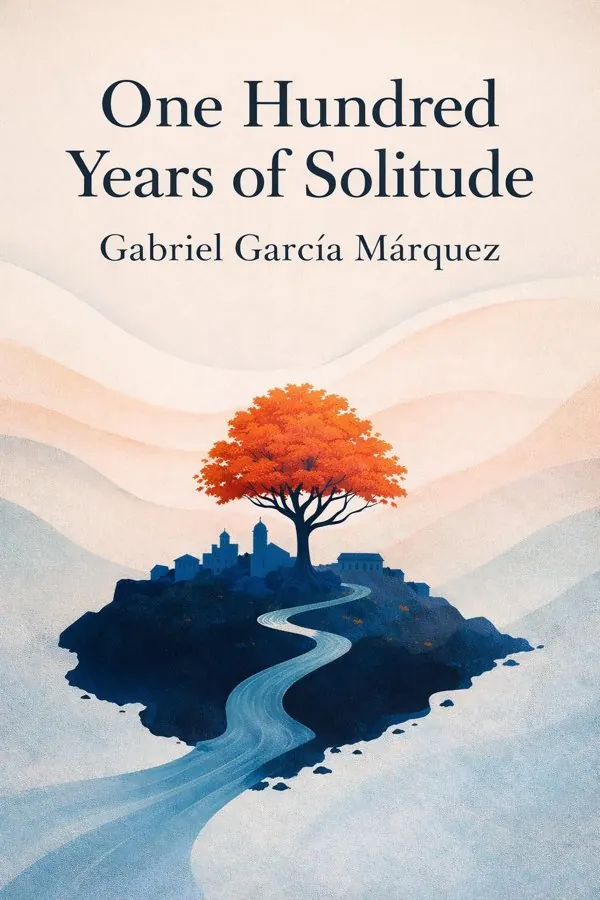
One Hundred Years of Solitude: Summary & Key Insights
 10 min9 chaptersAudio available
Key Takeaways from One Hundred Years of Solitude
One of the novel’s most unsettling insights is that people rarely escape the patterns they inherit.
The novel’s title reveals its deepest concern: solitude is not simply being alone, but becoming unreachable.
The strangest events in the novel often feel more truthful than realism alone.
Forgetting is never neutral in One Hundred Years of Solitude.
Macondo begins as an isolated, almost innocent place, but outside influences gradually transform it through technology, commerce, politics, and foreign power.
What Is One Hundred Years of Solitude About?
One Hundred Years of Solitude by Gabriel García Márquez is a general book. Gabriel García Márquez’s One Hundred Years of Solitude is one of the defining novels of the twentieth century: a sweeping, dreamlike chronicle of the Buendía family across generations in the mythical town of Macondo. At once intimate and epic, the novel explores love, ambition, war, memory, desire, violence, and the strange cycles that trap families and nations alike. What makes it unforgettable is the way García Márquez blends the ordinary and the miraculous so seamlessly that ghosts, prophecies, insomnia plagues, and impossible beauty feel as believable as political conflict or domestic grief. This is the hallmark of magical realism, and few writers have ever used it with such power. García Márquez, the Colombian Nobel Prize-winning author, drew deeply from Latin American history, folklore, and politics to create a story that feels both local and universal. More than a family saga, the novel is a meditation on time, solitude, and the human tendency to repeat the same mistakes while believing each generation is new. It matters because it teaches us how myth and history shape identity, and how loneliness can echo through entire lives.
This FizzRead summary covers all 9 key chapters of One Hundred Years of Solitude in approximately 10 minutes, distilling the most important ideas, arguments, and takeaways from Gabriel García Márquez's work. Also available as an audio summary and Key Quotes Podcast.
One Hundred Years of Solitude
Gabriel García Márquez’s One Hundred Years of Solitude is one of the defining novels of the twentieth century: a sweeping, dreamlike chronicle of the Buendía family across generations in the mythical town of Macondo. At once intimate and epic, the novel explores love, ambition, war, memory, desire, violence, and the strange cycles that trap families and nations alike. What makes it unforgettable is the way García Márquez blends the ordinary and the miraculous so seamlessly that ghosts, prophecies, insomnia plagues, and impossible beauty feel as believable as political conflict or domestic grief. This is the hallmark of magical realism, and few writers have ever used it with such power. García Márquez, the Colombian Nobel Prize-winning author, drew deeply from Latin American history, folklore, and politics to create a story that feels both local and universal. More than a family saga, the novel is a meditation on time, solitude, and the human tendency to repeat the same mistakes while believing each generation is new. It matters because it teaches us how myth and history shape identity, and how loneliness can echo through entire lives.
Who Should Read One Hundred Years of Solitude?
This book is perfect for anyone interested in general and looking to gain actionable insights in a short read. Whether you're a student, professional, or lifelong learner, the key ideas from One Hundred Years of Solitude by Gabriel García Márquez will help you think differently.
- ✓Readers who enjoy general and want practical takeaways
- ✓Professionals looking to apply new ideas to their work and life
- ✓Anyone who wants the core insights of One Hundred Years of Solitude in just 10 minutes
Want the full summary?
Get instant access to this book summary and 100K+ more with Fizz Moment.
Get Free SummaryAvailable on App Store • Free to download
Key Chapters
One of the novel’s most unsettling insights is that people rarely escape the patterns they inherit. In One Hundred Years of Solitude, time does not feel like a straight path from past to future. Instead, it loops, echoes, and doubles back on itself. Names repeat across generations, personalities reappear in descendants, and old desires rise again in new forms. The Buendías seem to live many lives, yet they also seem condemned to reenact the same emotional dramas: obsession, pride, withdrawal, passion, and loss.
García Márquez uses this circular sense of time to show how families and societies become trapped in repetition. The future is not simply created by choice; it is shaped by memory, habit, and unresolved history. This makes the novel feel both mythic and psychologically accurate. In real life, many families repeat patterns without fully noticing them. A parent’s emotional distance may become a child’s fear of intimacy. A culture’s forgotten violence may return as political instability. A community that refuses to confront injustice often relives it.
The novel suggests that repetition is not just a literary device but a human condition. We inherit narratives about love, power, shame, and ambition, and unless we examine them, they continue operating beneath the surface. This is why the Buendías’ story feels so haunting: they are not merely unlucky, they are often unable to recognize the design of their own lives.
A practical way to apply this insight is to look for recurring themes in your own history. What conflicts keep resurfacing? What beliefs about relationships, success, or identity have been handed down to you? Patterns lose power when they are named. Actionable takeaway: identify one repeating emotional or relational cycle in your life and ask what earlier story it comes from.
The novel’s title reveals its deepest concern: solitude is not simply being alone, but becoming unreachable. Nearly every major character in the book suffers from some form of isolation. Some retreat into intellectual obsession, others into erotic longing, authority, grief, or silence. Even when surrounded by family, they remain emotionally separate. García Márquez shows that solitude can look dignified, romantic, productive, or even powerful, yet it often masks an inability to connect honestly with others.
This idea gives the novel its emotional force. The Buendías do not merely endure external hardships; they repeatedly fail to bridge the distance between one another. Love exists in abundance, but understanding does not. Desire is intense, yet intimacy remains fragile. Characters speak past each other, repeat old mistakes, or become trapped inside private worlds. In that sense, solitude is both self-protection and self-destruction. It can preserve identity, but it can also harden into emotional imprisonment.
In everyday life, this theme remains strikingly relevant. People often confuse busyness, independence, or self-sufficiency with wholeness. Someone may be highly accomplished but emotionally inaccessible. A family may stay physically close while carrying generations of unspoken pain. A person may prefer withdrawal because connection feels risky. García Márquez suggests that unexamined solitude eventually narrows life.
The practical application is not to reject solitude completely. Healthy solitude can foster reflection, creativity, and autonomy. The danger begins when solitude becomes an excuse to avoid vulnerability. Relationships require not only presence but openness. Actionable takeaway: ask yourself where privacy has become emotional distance, and take one small step toward honest connection with someone you trust.
The strangest events in the novel often feel more truthful than realism alone. A girl ascends into the sky, ghosts visit the living, insomnia erases memory, and prophecies seem woven into everyday life. Yet these marvels are narrated with calm precision, as though they belong naturally to the world. This is the genius of García Márquez’s magical realism: the extraordinary is treated as ordinary, and the ordinary is shown to contain mystery.
This style is not decorative fantasy. It is a way of describing reality more fully, especially in cultures shaped by myth, religion, colonial history, and collective trauma. Magical realism allows the novel to express emotional and historical truths that literal language might flatten. A ghost can represent unresolved guilt. An impossible plague can symbolize cultural amnesia. A miraculous event can reveal how people create meaning when logic is not enough.
Readers sometimes think magical realism asks them to suspend disbelief. In fact, it asks for a different kind of belief: the recognition that human life is already full of irrational forces, inherited myths, exaggerated memories, and experiences too intense to fit into plain description. Families often tell stories in embellished ways because emotion itself reshapes reality. Nations do the same with history.
This has practical value beyond literature. When trying to understand your own life, facts matter, but so do symbols, metaphors, and the stories people tell themselves. A workplace might describe itself as a “family,” revealing hidden expectations. A recurring dream or family anecdote may contain truths not obvious on the surface. Actionable takeaway: when something in your life feels bigger than logic can explain, ask what symbolic truth it may be expressing rather than dismissing it outright.
Forgetting is never neutral in One Hundred Years of Solitude. Personal memory, family memory, and public memory all shape what the characters are able to become. When memory fades, reality itself becomes unstable. This is dramatized most memorably in the insomnia plague, when objects must be labeled so people remember what they are and how they matter. The episode is whimsical on the surface, but beneath it lies a serious warning: when memory disappears, identity and meaning begin to dissolve.
The novel connects this idea to political history as well. Communities do not suffer only from what happens to them; they also suffer from what they refuse to remember. Violence, exploitation, and injustice become easier to repeat when they are denied, minimized, or absorbed into silence. García Márquez suggests that private amnesia and national amnesia operate in similar ways. Both create conditions for repetition.
This insight applies powerfully to modern life. Families often avoid painful truths to maintain peace, but the unresolved past continues to shape behavior. Organizations repeat failed strategies because they do not learn honestly from mistakes. Societies argue over historical memory because what is remembered influences present power. Memory is not just recollection; it is moral orientation.
Practically, remembering well means more than preserving facts. It requires interpretation, acknowledgment, and sometimes grief. Journaling, family conversations, oral histories, and institutional reflection can all serve this purpose. The goal is not to live trapped in the past, but to prevent the past from operating unconsciously. Actionable takeaway: revisit one neglected personal or family story and ask what present behavior it may still be shaping.
A family is never held together by blood alone; it is held together by the stories it repeats. In the Buendía household, names, legends, fears, expectations, and warnings pass from one generation to the next. These stories help create identity, but they also become traps. To be named after an ancestor is to inherit more than a label; it is to absorb an implied fate. Characters are measured against family patterns before they can fully define themselves.
García Márquez captures something deeply recognizable here. Real families create narratives about who is strong, who is difficult, who is brilliant, who is fragile, who always leaves, and who never changes. These narratives can provide belonging, but they can also narrow possibility. A child repeatedly told that they are “the responsible one” may become incapable of rest. Someone cast as “the rebel” may struggle to be seen in more nuanced terms. Families often pass down identities before individuals can choose them.
The novel intensifies this dynamic by blending genealogy with myth. The result is both beautiful and claustrophobic. Family history becomes destiny unless someone can read it differently. That is one reason the repeated names in the novel matter so much: they symbolize the burden of inherited scripts.
In practice, this invites readers to examine the language their families use. What roles were assigned early? What stories are told at every gathering? Which ones are cherished, and which ones excuse harmful behavior? Rewriting a family story begins by noticing it. Actionable takeaway: identify one label or role your family gave you, and decide whether it still serves your life or needs to be revised.
Many characters in One Hundred Years of Solitude pursue love with overwhelming intensity, yet what they seek is often not mutual understanding but possession, idealization, escape, or compensation for inner emptiness. García Márquez portrays desire as one of the great engines of human behavior, but he also shows how easily it can become distorted. People long not only for other people, but for completion, innocence, power, or transcendence. When those needs go unrecognized, relationships become burdened with impossible expectations.
This helps explain why the novel’s romances are so memorable and so tragic. Passion in Macondo is rarely simple. It is tangled with loneliness, fantasy, memory, taboo, and repetition. Characters frequently mistake intensity for intimacy. They may feel deeply, but they do not always see clearly. In that sense, the novel offers a profound observation about emotional life: strong feeling is not proof of healthy connection.
This is highly applicable today. Modern culture often celebrates grand passion, dramatic pursuit, and all-consuming chemistry. Yet real love requires steadiness, reciprocity, and the ability to encounter another person as they are, not as a symbol of what we lack. Obsession narrows perception. Love expands it. The difference can be subtle but crucial.
A practical way to use this insight is to ask better questions about desire. Are you drawn to someone because of who they are, or because of the role they play in your fantasy, healing, or self-image? Are you seeking connection, or relief from emptiness? Awareness can reduce repetition and harm. Actionable takeaway: in any important relationship, separate what you genuinely know about the other person from what you are projecting onto them.
The novel is filled with prophecies, omens, and signs that make events feel prewritten. This creates an atmosphere of destiny, as if the Buendías are moving toward an ending already encoded in their past. Yet García Márquez complicates the idea of fate. The family’s downfall is not caused by supernatural prediction alone. It emerges from accumulated choices, blindness, isolation, and repeated failures to learn. Fate in the novel often looks like pattern mistaken for inevitability.
This distinction matters. People often call something fate when it has simply become familiar. A person who repeatedly enters damaging relationships may believe they are unlucky in love, when in fact they are reenacting a known script. A company that keeps making the same strategic mistakes may blame market conditions rather than internal culture. A nation may treat chronic inequality as unavoidable because it has lasted so long. What appears inevitable is often merely unexamined.
At the same time, the novel acknowledges a humbling truth: no one is fully free from context. We are shaped by history, temperament, inheritance, and environment. The point is not that humans can control everything, but that understanding increases freedom. The unread prophecy remains destiny; the interpreted one becomes knowledge.
This is why reflection matters. The more clearly you understand your patterns, motives, and inherited narratives, the less ruled you are by them. Even if you cannot change every condition, you can interrupt repetition at key moments. Actionable takeaway: notice one area of your life you describe as “just the way it always goes,” and investigate whether it is fate or simply an old pattern awaiting awareness.
Macondo may seem like an isolated fictional town, but it gradually becomes a microcosm of human civilization. Within its borders, García Márquez stages the rise and decline of communities, the seductions of power, the volatility of politics, the arrival of capitalism, the fragility of memory, and the persistence of myth. The local becomes universal. What happens in one family and one town begins to feel like a compressed history of nations.
This is part of the novel’s greatness. By narrowing the setting, García Márquez expands the meaning. Macondo is specific enough to feel alive, but symbolic enough to carry the weight of broader human experience. Readers recognize not only Latin American history but recurring global dynamics: outsiders exploiting local resources, governments rewriting truth, families bearing the cost of public conflict, and individuals struggling to find meaning amid rapid change.
There is also a practical lesson here about perspective. People often imagine that their private lives are separate from history, but the novel insists otherwise. Economic shifts, political violence, migration, technology, and cultural narratives all enter the home. A family story is never just a family story. It is shaped by larger systems, even when those systems feel distant.
This can help readers think more expansively about their own lives. Personal struggles may have social roots; community tensions may reflect deeper historical patterns. Seeing the larger frame does not erase individual responsibility, but it adds context and compassion. Actionable takeaway: take one personal or family challenge and ask what larger cultural, historical, or social forces may also be influencing it.
All Chapters in One Hundred Years of Solitude
About the Author
Gabriel García Márquez was a Colombian novelist, short story writer, journalist, and screenwriter widely regarded as one of the greatest authors of modern literature. Born in Aracataca, Colombia, in 1927, he drew heavily on the stories, superstitions, politics, and atmosphere of Caribbean Latin America in his fiction. His work helped bring magical realism to international prominence by blending the everyday with the extraordinary in a natural, deeply human way. García Márquez’s most famous novel, One Hundred Years of Solitude, became a global literary phenomenon and established him as a central voice in the Latin American Boom. In 1982, he received the Nobel Prize in Literature for fiction that united the fantastic and the real in a richly imagined world shaped by a continent’s life and conflicts.
Get This Summary in Your Preferred Format
Read or listen to the One Hundred Years of Solitude summary by Gabriel García Márquez anytime, anywhere. FizzRead offers multiple formats so you can learn on your terms — all free.
Available formats: App · Audio · PDF · EPUB — All included free with FizzRead
Download One Hundred Years of Solitude PDF and EPUB Summary
Key Quotes from One Hundred Years of Solitude
“One of the novel’s most unsettling insights is that people rarely escape the patterns they inherit.”
“The novel’s title reveals its deepest concern: solitude is not simply being alone, but becoming unreachable.”
“The strangest events in the novel often feel more truthful than realism alone.”
“Forgetting is never neutral in One Hundred Years of Solitude.”
“Macondo begins as an isolated, almost innocent place, but outside influences gradually transform it through technology, commerce, politics, and foreign power.”
Frequently Asked Questions about One Hundred Years of Solitude
One Hundred Years of Solitude by Gabriel García Márquez is a general book that explores key ideas across 9 chapters. Gabriel García Márquez’s One Hundred Years of Solitude is one of the defining novels of the twentieth century: a sweeping, dreamlike chronicle of the Buendía family across generations in the mythical town of Macondo. At once intimate and epic, the novel explores love, ambition, war, memory, desire, violence, and the strange cycles that trap families and nations alike. What makes it unforgettable is the way García Márquez blends the ordinary and the miraculous so seamlessly that ghosts, prophecies, insomnia plagues, and impossible beauty feel as believable as political conflict or domestic grief. This is the hallmark of magical realism, and few writers have ever used it with such power. García Márquez, the Colombian Nobel Prize-winning author, drew deeply from Latin American history, folklore, and politics to create a story that feels both local and universal. More than a family saga, the novel is a meditation on time, solitude, and the human tendency to repeat the same mistakes while believing each generation is new. It matters because it teaches us how myth and history shape identity, and how loneliness can echo through entire lives.
More by Gabriel García Márquez


You Might Also Like
Duct Tape Marketing: The World's Most Practical Small Business Marketing Guide
John Jantsch
10 minDusk, Night, Dawn: On Revival and Courage
Anne Lamott
10 minFinish Big: How Great Entrepreneurs Exit Their Companies on Top
Bo Burlingham
10 minFirst As Tragedy, Then As Farce
Slavoj Zizek
10 minFirst Principles: What America's Founders Learned from the Greeks and Romans and How That Shaped Our Country
Thomas E. Ricks
10 minGood Habits, Bad Habits: The Science of Making Positive Changes That Stick
Wendy Wood
10 minBrowse by Category
Ready to read One Hundred Years of Solitude?
Get the full summary and 100K+ more books with Fizz Moment.