
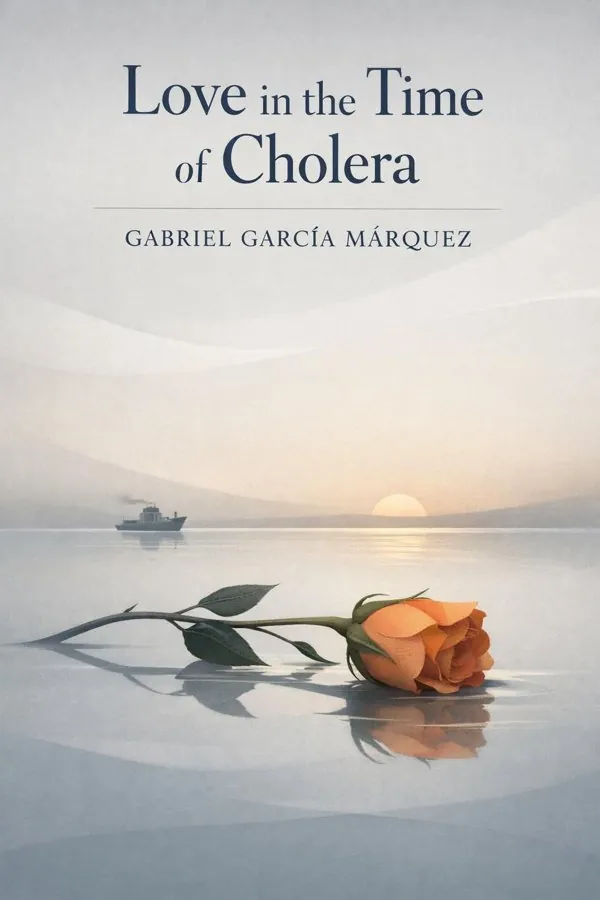
Love in the Time of Cholera: Summary & Key Insights
 10 min9 chaptersAudio available
Key Takeaways from Love in the Time of Cholera
One of the novel’s most unsettling and beautiful insights is that love does not remain pure by staying unchanged; it survives by transforming.
A troubling question runs through the novel: when does unwavering love become self-centered obsession?
Passion may ignite love stories, but Márquez shows that marriages are usually made in routines, irritations, negotiations, and repeated acts of care.
The novel insists that time is not just a background condition; it is an active force that exposes what people truly want.
Few classic novels defend the emotional seriousness of old age as powerfully as Love in the Time of Cholera.
What Is Love in the Time of Cholera About?
Love in the Time of Cholera by Gabriel García Márquez is a classics book. Gabriel García Márquez’s Love in the Time of Cholera is a sweeping meditation on desire, memory, aging, and the stubborn endurance of hope. Set in a lush Caribbean port city over the course of more than fifty years, the novel follows Florentino Ariza, who falls deeply in love with Fermina Daza in youth and spends much of his life waiting for another chance after she marries the respected doctor Juvenal Urbino. What begins as a romantic triangle becomes something far richer: an examination of how people imagine love, perform it, betray it, survive it, and rediscover it in unexpected forms. The novel matters because it challenges familiar romantic myths. Márquez asks whether love is a fever, a discipline, an illusion, or a lifelong force that changes shape with time. He also explores class ambition, marriage, sensuality, death, and the passage of decades with extraordinary emotional intelligence. One of the most celebrated novelists of the twentieth century and a Nobel Prize winner, Márquez combines lyrical prose, psychological depth, and a uniquely expansive sense of time. The result is a classic that feels intimate and epic at once, inviting readers to rethink what it means to love faithfully, foolishly, and late in life.
This FizzRead summary covers all 9 key chapters of Love in the Time of Cholera in approximately 10 minutes, distilling the most important ideas, arguments, and takeaways from Gabriel García Márquez's work. Also available as an audio summary and Key Quotes Podcast.
Love in the Time of Cholera
Gabriel García Márquez’s Love in the Time of Cholera is a sweeping meditation on desire, memory, aging, and the stubborn endurance of hope. Set in a lush Caribbean port city over the course of more than fifty years, the novel follows Florentino Ariza, who falls deeply in love with Fermina Daza in youth and spends much of his life waiting for another chance after she marries the respected doctor Juvenal Urbino. What begins as a romantic triangle becomes something far richer: an examination of how people imagine love, perform it, betray it, survive it, and rediscover it in unexpected forms.
The novel matters because it challenges familiar romantic myths. Márquez asks whether love is a fever, a discipline, an illusion, or a lifelong force that changes shape with time. He also explores class ambition, marriage, sensuality, death, and the passage of decades with extraordinary emotional intelligence. One of the most celebrated novelists of the twentieth century and a Nobel Prize winner, Márquez combines lyrical prose, psychological depth, and a uniquely expansive sense of time. The result is a classic that feels intimate and epic at once, inviting readers to rethink what it means to love faithfully, foolishly, and late in life.
Who Should Read Love in the Time of Cholera?
This book is perfect for anyone interested in classics and looking to gain actionable insights in a short read. Whether you're a student, professional, or lifelong learner, the key ideas from Love in the Time of Cholera by Gabriel García Márquez will help you think differently.
- ✓Readers who enjoy classics and want practical takeaways
- ✓Professionals looking to apply new ideas to their work and life
- ✓Anyone who wants the core insights of Love in the Time of Cholera in just 10 minutes
Want the full summary?
Get instant access to this book summary and 100K+ more with Fizz Moment.
Get Free SummaryAvailable on App Store • Free to download
Key Chapters
One of the novel’s most unsettling and beautiful insights is that love does not remain pure by staying unchanged; it survives by transforming. At the heart of Love in the Time of Cholera is the long emotional arc connecting Florentino Ariza and Fermina Daza, from youthful obsession to old-age companionship. Márquez refuses the easy fantasy that real love is frozen in a perfect first moment. Instead, he shows that what people call love can begin as idealization, be interrupted by pride and social ambition, and later return as something gentler, stranger, and more durable.
Florentino’s early devotion is intense, poetic, and almost religious. He writes letters, suffers physically from longing, and turns his emotional life into a vow. Yet Fermina eventually recognizes that youthful passion alone may not sustain a practical life. Her marriage to Juvenal Urbino introduces another version of love: structured, imperfect, social, and built through habit as much as emotion. Decades later, when age has stripped away many illusions, the possibility of love reappears in a different key. The novel suggests that love at seventy can be as meaningful as love at seventeen, though it is informed by grief, memory, compromise, and self-knowledge.
This idea applies beyond romance. Many commitments in life—friendships, work, family bonds, creative ambitions—change form over time. We often suffer because we expect them to feel forever as they did at the beginning. Márquez invites us to ask whether endurance depends not on preserving intensity but on accepting evolution.
Actionable takeaway: Revisit one important relationship in your life and ask not, “Is it what it once was?” but, “What is it becoming, and how can I meet it honestly in this new form?”
A troubling question runs through the novel: when does unwavering love become self-centered obsession? Florentino Ariza sees himself as a man of eternal fidelity, someone uniquely capable of waiting for Fermina Daza across half a century. On one level, his persistence appears romantic, even heroic. On another, Márquez exposes how obsession can hide inside the language of devotion. Florentino preserves a fantasy of Fermina not only because he loves her, but because the fantasy gives his life coherence, identity, and purpose.
This distinction matters. Devotion recognizes the reality of another person; obsession clings to an internal image. Florentino spends years emotionally attached to Fermina while also engaging in numerous affairs. His waiting is therefore not simple purity. It is a complicated performance in which his idealized first love remains untouched by the messiness of actual human reciprocity. Fermina, meanwhile, lives a full and difficult life that cannot be reduced to the role she plays in Florentino’s imagination.
In modern terms, this idea speaks to relationships sustained more by projection than by knowledge. People can remain attached to an ex, a fantasy future, or an imagined version of a partner while avoiding the harder task of mutual understanding. Social media often intensifies this tendency: it becomes easy to stay loyal to a story rather than to a real person.
Márquez does not deny the power of longing, but he asks us to examine it critically. Does our love make space for the other person’s freedom, complexity, and change? Or are we mainly protecting a dream that serves our own emotional needs?
Actionable takeaway: When you describe your strongest attachment, list what you truly know about the other person now—not years ago, not in fantasy—to test whether your feeling is rooted in reality or projection.
Passion may ignite love stories, but Márquez shows that marriages are usually made in routines, irritations, negotiations, and repeated acts of care. The relationship between Fermina Daza and Dr. Juvenal Urbino is one of the novel’s richest achievements because it avoids both cynicism and idealization. Their marriage includes respect, social status, domestic friction, tenderness, disappointment, and dependence. Rather than presenting marriage as the death of romance, Márquez portrays it as a separate and demanding form of intimacy.
Juvenal Urbino represents order, reason, prestige, and modernity. He is not a fairy-tale husband, nor is he merely an obstacle to true love. He and Fermina build a life shaped by class aspiration, household rhythms, illness, arguments, reconciliations, and the responsibilities of age. Their bond matures through shared time, not sustained ecstasy. The novel’s emotional honesty lies in acknowledging that long partnerships contain boredom and resentment without becoming meaningless.
Readers can apply this insight by reconsidering unrealistic expectations about partnership. Many people assume that a successful relationship should feel continuously thrilling or entirely conflict-free. Márquez suggests the opposite: durability often depends on how people handle repetition, difference, and repair. A marriage may be real not because it is ideal, but because two imperfect people keep participating in it.
This perspective is useful for anyone balancing romance with daily life. Caring for a partner during illness, negotiating habits, respecting independence, and continuing conversation over decades are not lesser forms of love. They are often its strongest tests.
Actionable takeaway: Strengthen one relationship through a practical gesture—an honest conversation, shared responsibility, or consistent routine—rather than waiting for emotion alone to restore closeness.
Few classic novels defend the emotional seriousness of old age as powerfully as Love in the Time of Cholera. Márquez rejects the cultural assumption that passion belongs only to the young. By returning Florentino and Fermina to one another late in life, he presents aging not as the end of desire but as a different season of intimacy. Bodies change, opportunities narrow, friends die, and mortality becomes visible, yet longing remains alive.
This matters because literature and society often flatten older people into symbols of wisdom, decline, or irrelevance. Márquez gives them erotic memory, embarrassment, vulnerability, anticipation, and risk. Love in old age is not portrayed as a sentimental consolation prize. It is complicated by grief, habit, social perception, and the accumulated weight of decades. At the same time, it may be freer than youthful love because it is less ruled by ambition, fertility, or illusion.
The novel’s late-life romance offers a practical challenge to readers of any age. We tend to divide life into supposedly meaningful years and supposedly diminished ones. But reinvention remains possible long after conventional milestones have passed. New companionship, honesty, pleasure, and courage are not reserved for the young. Even outside romance, people can begin careers, repair relationships, travel, create art, or confront old fears later than expected.
Márquez does not romanticize aging; he acknowledges frailty and loss. Yet he insists that to be alive is still to feel. That insight can deepen empathy across generations and reduce the fear that life’s most meaningful chapters must happen early.
Actionable takeaway: Challenge one age-based limitation you have accepted—your own or someone else’s—and replace it with a concrete possibility for growth, connection, or renewal.
Love may feel intimate, but Márquez shows that it is always entangled with class, reputation, family ambition, and public expectation. Fermina Daza and Florentino Ariza do not exist in a social vacuum. Their courtship is influenced by status differences, parental control, economic aspiration, and the values of a Caribbean society moving between tradition and modernity. What appears to be a personal romantic decision is also a social negotiation.
Fermina’s father seeks advancement and respectability, and her eventual marriage to Dr. Juvenal Urbino aligns with a vision of order, prestige, and security. Florentino, for all his emotional intensity, belongs to a different social position. The novel therefore complicates the idea that love naturally triumphs if it is strong enough. Often, external structures determine which relationships are considered possible, respectable, or desirable.
This theme remains relevant today. Romantic choices are still influenced by money, education, religion, geography, race, family background, and career expectations. People may insist they are following only the heart, yet practical and social pressures shape who gets pursued, introduced, approved, or abandoned. Recognizing these pressures does not make love less real; it makes our understanding of it more honest.
A practical use of this insight is to identify the outside forces affecting your own relationships. Are you attracted to someone because of genuine connection, or because they fit a social script? Are you resisting a relationship because of actual incompatibility, or because of fear of judgment? The novel urges readers to see the invisible systems beneath private emotion.
Actionable takeaway: Reflect on one important relationship choice and name the social pressures influencing it. Once identified, decide consciously which pressures deserve weight and which should not control you.
The past in this novel is not a stable record; it is a living force shaped by longing, regret, and selective remembrance. Florentino spends decades preserving his first love as if it were sacred truth. Yet memory does not simply store experience—it edits it. As years pass, youthful suffering can become noble in retrospect, and missed opportunities can acquire a glow they never had in real time. Márquez understands that people often fall in love not only with another person, but with the story they have told themselves about what once happened.
This is one reason the novel feels psychologically modern. Memory can protect meaning, but it can also trap us. Florentino’s emotional life is sustained by his remembrance of Fermina, but it is also narrowed by it. Fermina, too, revisits her past differently as age changes her perspective. The same events can appear foolish, painful, or precious depending on when they are recalled.
In everyday life, this theme appears whenever people idealize former relationships, earlier versions of themselves, or “better times.” Nostalgia can offer comfort, yet it often removes conflict and complexity. A lost love may seem perfect partly because it no longer has to survive ordinary life. The past becomes easier to adore when it cannot contradict us.
Márquez does not advise abandoning memory. Rather, he encourages a more mature relationship with it. The challenge is to honor what the past meant without allowing it to become a false standard that ruins the present.
Actionable takeaway: When you find yourself idealizing the past, write down three difficult or ordinary truths about that period to balance nostalgia with reality.
A final enduring strength of the novel is its refusal to sort human lives into easy categories of faithful or unfaithful, noble or selfish, successful or wasted. Florentino Ariza is capable of tenderness, vanity, manipulation, endurance, and self-deception. Fermina Daza is proud, perceptive, practical, and emotionally complex. Juvenal Urbino is admirable in some respects and flawed in others. Márquez does not reduce them to moral lessons. Instead, he presents life as a dense mixture of contradiction in which people are rarely only one thing.
This moral ambiguity is essential to the novel’s realism. Readers may be tempted to celebrate Florentino’s patience or condemn his behavior, admire Fermina’s practicality or question her choices, respect Urbino’s civilization or notice his limitations. The book supports all of these reactions while resisting final simplification. That complexity mirrors real life, where love and selfishness often coexist, and where meaningful relationships may include compromise, blindness, betrayal, growth, and grace.
In practical terms, this insight encourages a more mature way of reading both literature and people. We are often trained to ask who is right, who is wrong, and who deserves happiness. Márquez asks a harder question: what does it mean to live fully within one’s contradictions? This is useful in personal relationships, leadership, and self-reflection. A person can be deeply flawed and still capable of real feeling; admirable traits do not erase harm, and mistakes do not erase humanity.
Actionable takeaway: In judging yourself or someone else, replace one simplistic label with a fuller description that includes both strengths and failings. Better understanding begins where easy verdicts end.
All Chapters in Love in the Time of Cholera
About the Author
Gabriel García Márquez was a Colombian novelist, journalist, screenwriter, and Nobel laureate whose work transformed modern literature. Born in 1927 in Aracataca, Colombia, he drew deeply from Latin American history, politics, oral storytelling, and the vivid atmosphere of Caribbean life. He became internationally famous with One Hundred Years of Solitude, a landmark novel that helped define the global reach of magical realism. Yet his range extended far beyond that style, as seen in the psychological richness and emotional subtlety of Love in the Time of Cholera. In 1982, he received the Nobel Prize in Literature for works that unite imagination, history, and everyday reality. García Márquez died in 2014, but he remains one of the most widely read and admired authors in the world.
Get This Summary in Your Preferred Format
Read or listen to the Love in the Time of Cholera summary by Gabriel García Márquez anytime, anywhere. FizzRead offers multiple formats so you can learn on your terms — all free.
Available formats: App · Audio · PDF · EPUB — All included free with FizzRead
Download Love in the Time of Cholera PDF and EPUB Summary
Key Quotes from Love in the Time of Cholera
“One of the novel’s most unsettling and beautiful insights is that love does not remain pure by staying unchanged; it survives by transforming.”
“A troubling question runs through the novel: when does unwavering love become self-centered obsession?”
“Passion may ignite love stories, but Márquez shows that marriages are usually made in routines, irritations, negotiations, and repeated acts of care.”
“The novel insists that time is not just a background condition; it is an active force that exposes what people truly want.”
“Few classic novels defend the emotional seriousness of old age as powerfully as Love in the Time of Cholera.”
Frequently Asked Questions about Love in the Time of Cholera
Love in the Time of Cholera by Gabriel García Márquez is a classics book that explores key ideas across 9 chapters. Gabriel García Márquez’s Love in the Time of Cholera is a sweeping meditation on desire, memory, aging, and the stubborn endurance of hope. Set in a lush Caribbean port city over the course of more than fifty years, the novel follows Florentino Ariza, who falls deeply in love with Fermina Daza in youth and spends much of his life waiting for another chance after she marries the respected doctor Juvenal Urbino. What begins as a romantic triangle becomes something far richer: an examination of how people imagine love, perform it, betray it, survive it, and rediscover it in unexpected forms. The novel matters because it challenges familiar romantic myths. Márquez asks whether love is a fever, a discipline, an illusion, or a lifelong force that changes shape with time. He also explores class ambition, marriage, sensuality, death, and the passage of decades with extraordinary emotional intelligence. One of the most celebrated novelists of the twentieth century and a Nobel Prize winner, Márquez combines lyrical prose, psychological depth, and a uniquely expansive sense of time. The result is a classic that feels intimate and epic at once, inviting readers to rethink what it means to love faithfully, foolishly, and late in life.
More by Gabriel García Márquez


You Might Also Like

Browse by Category
Ready to read Love in the Time of Cholera?
Get the full summary and 100K+ more books with Fizz Moment.