
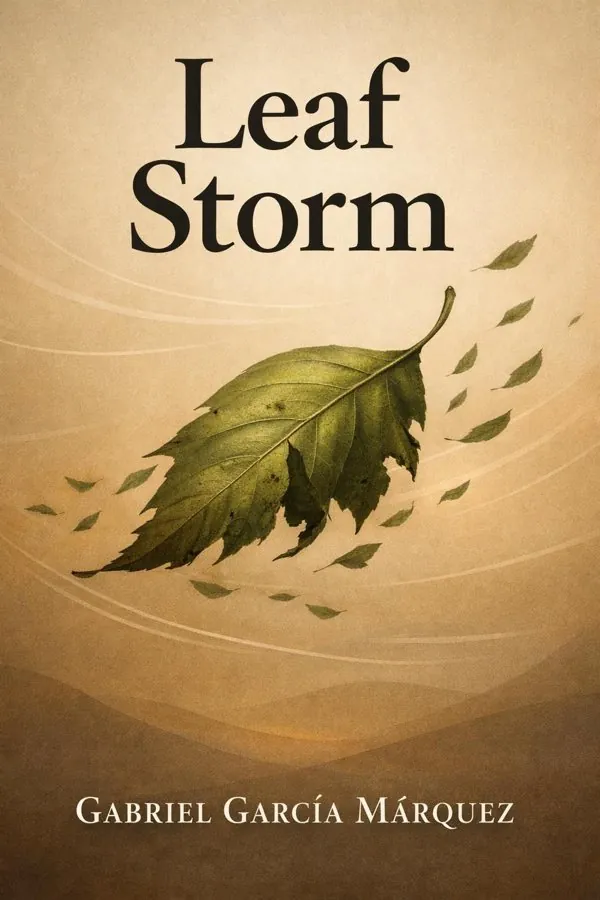
Leaf Storm: Summary & Key Insights
 10 min9 chaptersAudio available
Key Takeaways from Leaf Storm
A town can become a character when its silence speaks louder than its people.
Real honor begins where social approval ends.
Most moral decisions are not made by heroes but by ordinary people trapped between conviction and social pressure.
Children often see moral contradictions more clearly than adults because they have not yet learned how to normalize them.
The past is never past in Leaf Storm; it presses into the present until every action feels overdetermined.
What Is Leaf Storm About?
Leaf Storm by Gabriel García Márquez is a classics book spanning 6 pages. Leaf Storm is Gabriel García Márquez’s haunting first novella, published in 1955, and the book that introduced readers to Macondo, the fictional town that would later become one of the most iconic settings in world literature. On its surface, the plot is simple: a colonel, his daughter, and his grandson prepare to bury a doctor whom the entire town despises. Yet from that narrow event, García Márquez creates a dense moral drama about duty, resentment, memory, and the suffocating power of collective hatred. The story unfolds through shifting interior perspectives, turning a funeral into a confrontation with personal conscience and public judgment. What makes Leaf Storm matter is not just that it is an early work by a Nobel Prize-winning author, but that it already contains the seeds of his mature vision: fractured time, layered voices, social decay, and the strange coexistence of the ordinary and the mythic. García Márquez, one of the defining writers of the 20th century, uses this brief novella to ask a lasting question: what does honor require when a community has abandoned mercy? The result is a compact but powerful classic that rewards careful, reflective reading.
This FizzRead summary covers all 9 key chapters of Leaf Storm in approximately 10 minutes, distilling the most important ideas, arguments, and takeaways from Gabriel García Márquez's work. Also available as an audio summary and Key Quotes Podcast.
Leaf Storm
Leaf Storm is Gabriel García Márquez’s haunting first novella, published in 1955, and the book that introduced readers to Macondo, the fictional town that would later become one of the most iconic settings in world literature. On its surface, the plot is simple: a colonel, his daughter, and his grandson prepare to bury a doctor whom the entire town despises. Yet from that narrow event, García Márquez creates a dense moral drama about duty, resentment, memory, and the suffocating power of collective hatred. The story unfolds through shifting interior perspectives, turning a funeral into a confrontation with personal conscience and public judgment.
What makes Leaf Storm matter is not just that it is an early work by a Nobel Prize-winning author, but that it already contains the seeds of his mature vision: fractured time, layered voices, social decay, and the strange coexistence of the ordinary and the mythic. García Márquez, one of the defining writers of the 20th century, uses this brief novella to ask a lasting question: what does honor require when a community has abandoned mercy? The result is a compact but powerful classic that rewards careful, reflective reading.
Who Should Read Leaf Storm?
This book is perfect for anyone interested in classics and looking to gain actionable insights in a short read. Whether you're a student, professional, or lifelong learner, the key ideas from Leaf Storm by Gabriel García Márquez will help you think differently.
- ✓Readers who enjoy classics and want practical takeaways
- ✓Professionals looking to apply new ideas to their work and life
- ✓Anyone who wants the core insights of Leaf Storm in just 10 minutes
Want the full summary?
Get instant access to this book summary and 100K+ more with Fizz Moment.
Get Free SummaryAvailable on App Store • Free to download
Key Chapters
A town can become a character when its silence speaks louder than its people. In Leaf Storm, Macondo is not merely the backdrop for a burial; it is a suffocating moral climate shaped by neglect, memory, and bitterness. The novella opens in oppressive heat, with stale air and sealed rooms creating the sense that the town itself has stopped breathing. This atmosphere matters because the doctor’s funeral is not just a private family matter. It exposes the emotional rot of an entire community.
Macondo is shown as a place trapped between past upheaval and present stagnation. The title itself suggests a storm of debris left behind by outside forces, especially the boom-and-bust arrival of the banana company. What remains is exhaustion: abandoned structures, damaged pride, and people who have turned old grievances into a civic identity. The doctor becomes the focal point of that resentment, but the hatred directed at him reveals something broader. The town’s refusal to bury him is less about justice than about the comfort people find in a shared enemy.
This idea extends beyond fiction. Communities, workplaces, and families can all become like Macondo when unspoken resentments shape behavior more than principles do. An office may freeze out one difficult colleague for years, or a family may define itself around a decades-old grievance until no one remembers the original injury clearly. In such environments, routine actions take on symbolic weight.
García Márquez shows that moral decay often appears first as emotional stagnation. A society does not collapse only through violence; it can also harden through silence, pettiness, and refusal. Macondo teaches us to notice the atmosphere around conflict, not just the conflict itself.
Actionable takeaway: when facing tension in your own environment, ask whether the problem is one event or a deeper culture of resentment that needs to be named.
Real honor begins where social approval ends. The colonel stands at the moral center of Leaf Storm because he chooses to bury the doctor even when the town views the act as betrayal. His decision is not sentimental. He does not defend the doctor as lovable or innocent. Instead, he acts from a personal code rooted in gratitude, obligation, and the belief that human dignity must not depend on popularity.
This is what gives the colonel such weight. He is an aging veteran who has already witnessed political failure and personal disappointment. He knows ideals are fragile. Yet that knowledge does not make him cynical enough to abandon principle. He insists on carrying out burial rites because he once gave his word to the doctor, and because he believes a dead man should not be subjected to mob vengeance. In a town governed by spite, the colonel’s insistence on procedure becomes an act of rebellion.
His struggle is also deeply human. Duty isolates him. He must expose his daughter and grandson to public hostility, and he knows the town will not reward his loyalty. Many readers recognize this dilemma in modern life. Sometimes integrity means supporting an unpopular colleague because policy requires fairness. Sometimes it means honoring a commitment after others have walked away. The colonel’s example reminds us that ethical action often feels lonely precisely because it is not built on convenience.
Importantly, García Márquez does not portray honor as glorious. It is heavy, inconvenient, and emotionally costly. The colonel’s dignity lies in endurance, not triumph. He cannot repair Macondo, but he can refuse to let its cruelty determine his conduct.
Actionable takeaway: identify one principle you claim to value—fairness, loyalty, or dignity—and ask whether you would still uphold it if everyone around you opposed you.
Most moral decisions are not made by heroes but by ordinary people trapped between conviction and social pressure. The colonel’s daughter embodies this tension in Leaf Storm. She is neither as rigidly principled as her father nor as innocent as her son. Instead, she occupies the anxious middle ground where most readers live: she understands what should be done, yet she also feels the weight of public shame, danger, and uncertainty.
Her perspective brings domestic realism into the novella’s moral drama. While the colonel speaks from duty, she worries about practical consequences. What will the neighbors say? What will happen when they walk through hostile streets? What kind of future is being created for her child inside this atmosphere of resentment? These concerns do not make her weak. They make her psychologically credible. García Márquez shows that conformity rarely comes from evil motives alone; often it grows from fear, fatigue, and the desire to avoid becoming a target.
At the same time, her participation in the burial reveals something important about moral growth. Courage does not always look like certainty. Sometimes it looks like moving forward while still afraid. In professional or personal life, many people face similar moments: speaking up against an unfair decision while fearing backlash, refusing to join a gossip culture, or standing by a family member when others demand distance. The daughter’s conflict mirrors the emotional cost of choosing conscience over comfort.
Her role also widens the book’s moral range. Through her, Leaf Storm explores not only abstract honor but the intimate social pressures that make honor difficult. She reminds us that ethical decisions are lived through bodies, reputations, households, and children.
Actionable takeaway: when fear pushes you toward silence, separate the real risks from the imagined pressure of disapproval, then act according to the clearer truth.
Children often see moral contradictions more clearly than adults because they have not yet learned how to normalize them. The grandson in Leaf Storm offers a perspective of curiosity, confusion, and emerging awareness that gives the novella much of its emotional power. Through him, the funeral becomes not just a social scandal but an initiation into the difficult realities of death, hypocrisy, and community judgment.
The boy does not fully grasp the history surrounding the doctor, yet he feels the emotional temperature of the room. He senses fear in his mother, determination in his grandfather, and hostility in the town. This partial understanding is essential. García Márquez uses the boy’s viewpoint to show how moral consciousness develops not through lectures but through exposure to adult behavior. What the child witnesses is not simply a burial. He witnesses what people do when compassion clashes with resentment.
This perspective matters because innocence in the novella is not sentimental purity. It is a stage of questioning. The boy is learning that adults often justify cruelty with righteous language, and that respectability can coexist with vindictiveness. Many readers can relate this to formative experiences from childhood: realizing a teacher played favorites, seeing relatives exclude someone, or watching a group mock a person while insisting they deserved it. Such moments shape our lifelong understanding of fairness.
The grandson also brings the future into the story. The colonel may be acting out of memory and duty, but the boy is absorbing the meaning of those choices. In that sense, the burial is also a lesson being handed to the next generation: dignity is something you practice when it is difficult, not when it is praised.
Actionable takeaway: remember that younger people learn ethics less from what you say than from how you treat the unpopular, the inconvenient, and the powerless.
The past is never past in Leaf Storm; it presses into the present until every action feels overdetermined. García Márquez structures the novella through layered memories and interior monologues, gradually revealing why the doctor became so hated and why the colonel feels bound to him. This fractured narrative is not a stylistic flourish alone. It reflects how human beings actually experience moral conflict: through recollection, reinterpretation, and unresolved emotion.
The doctor remains elusive throughout the story, and that silence is central to his power. He is less a fully explained figure than a void around which others organize their judgments. His withdrawal from the town, his refusals, and his eventual death all generate speculation rather than closure. Because he does not defend himself, the community fills the silence with blame. The colonel’s family, meanwhile, must navigate fragments of truth mixed with rumor.
This dynamic appears often in real life. When someone becomes withdrawn, difficult, or socially isolated, others may replace understanding with narrative convenience. A colleague who stops engaging is labeled arrogant. A neighbor who keeps to himself becomes suspicious. A family member’s silence gets interpreted as contempt rather than pain. Leaf Storm asks us to consider how much cruelty grows from stories told in the absence of real knowledge.
The use of memory also shows that moral decisions are rarely made in the present alone. The colonel’s choice depends on old promises, old debts, and old injuries. Flashbacks reveal that history is not background; it is active pressure. To read the novella well is to see how every current conflict contains buried versions of itself.
Actionable takeaway: before judging a person or situation, ask what unseen history may be shaping the present and what assumptions you are making to fill the gaps.
Sometimes the smallest act becomes revolutionary when a crowd has chosen cruelty. In Leaf Storm, the burial itself is the novella’s central act of defiance. The colonel’s determination to bury the doctor according to proper rites challenges not just local hostility but the idea that public hatred has the authority to strip a person of basic human dignity.
A burial is usually a ritual of closure, but here it becomes a moral battlefield. The doctor’s corpse forces a question the town would rather avoid: does even the despised dead deserve decency? Macondo’s answer is no. The colonel’s answer is yes, regardless of what the man was like in life. This contrast gives the novella its ethical sharpness. García Márquez is not asking readers to approve of the doctor. He is asking whether civilization can survive if dignity is reserved only for the acceptable.
The scene has enduring relevance. In modern terms, we see similar tests whenever institutions decide how to treat disgraced people, difficult relatives, controversial public figures, or socially rejected individuals. To insist on humane treatment is not the same as excusing wrongdoing. It is a refusal to let vengeance masquerade as justice. The novella insists that procedures, rites, and boundaries matter precisely when emotions run hot.
There is also courage in the physical act of proceeding. The family must move through heat, tension, and hostility. Defiance here is not dramatic speech; it is disciplined follow-through. That distinction matters. Many people admire moral stands in theory but retreat when carrying them out becomes awkward, public, or inconvenient.
By focusing on burial, García Márquez turns a basic human ritual into a test of civilization. The measure of a community is not how it treats its favorites but how it treats those it cannot forgive.
Actionable takeaway: when emotions push a group toward punishment or humiliation, defend the minimum standards of dignity that should apply to everyone.
Not all stories move forward; some circle around wounds that refuse to close. Leaf Storm creates a powerful sense of suspended time, as if Macondo were living inside the aftermath of events it cannot digest. The novella takes place over a short present moment, yet that moment is swollen with years of disappointment, political residue, economic collapse, and personal memory. Time in the book feels layered rather than linear.
This is one reason the work feels larger than its page count. The town’s present decay cannot be understood without the historical forces that preceded it, particularly the arrival and retreat of outside power. The so-called leaf storm is not simply weather or chaos; it evokes the mass movement of people, ambition, and exploitation that leaves debris behind. When the storm passes, the structures remain but the vitality is gone. Macondo becomes a place living after its own disillusionment.
On a personal level, the characters also inhabit stalled time. The colonel is bound by old promises. The daughter is trapped between inherited duty and immediate anxiety. The boy enters a world whose emotional rules were set before he was born. This mirrors how many people experience institutions and families: current tensions are actually old stories still being enacted. A team may resist change because of a past betrayal. A household may repeat patterns formed around one unresolved crisis decades earlier.
García Márquez’s treatment of time teaches readers to view conflict historically. A difficult present is often the visible layer of a much older accumulation. Without that perspective, we mistake symptoms for causes.
Actionable takeaway: when a situation feels strangely stuck, map the history behind it; understanding what happened before you arrived is often the first step toward seeing what is really happening now.
Great literary worlds rarely appear fully formed; they begin as concentrated experiments. Leaf Storm matters not only as a self-contained novella but as the first appearance of Macondo, the setting García Márquez would later expand in One Hundred Years of Solitude and other works. Reading it feels like watching a master discover the emotional and symbolic terrain that would define his fiction.
Many of the elements associated with García Márquez are already present: a town suspended between history and myth, dense interiority, political residue, decaying authority, and an atmosphere where the ordinary seems charged with something uncanny. Yet Leaf Storm is also leaner and more severe than his later novels. Instead of sweeping generations and overtly miraculous events, it compresses its power into a funeral, a few rooms, and three minds. That tightness makes its themes especially clear.
For readers interested in literary development, this novella offers a practical lesson in how major artistic visions are built. Writers, creators, and thinkers often begin by returning obsessively to one place, one conflict, or one moral question. Over time, that material deepens into an entire universe. In business or creative work, the same principle applies: enduring originality often grows from sustained attention to a single fertile problem rather than constant novelty.
Leaf Storm also reveals García Márquez’s authority as a writer deeply rooted in Latin American social realities while capable of transforming them into universally resonant art. He is not merely telling a local story. He is showing how memory, power, decay, and dignity operate in any human community.
Actionable takeaway: if you admire a mature masterpiece, study the early work behind it; the origins often reveal the core questions that gave the later achievement its depth.
All Chapters in Leaf Storm
About the Author
Gabriel García Márquez (1927–2014) was a Colombian novelist, journalist, screenwriter, and short-story writer whose work reshaped modern literature. Born in Aracataca, Colombia, he drew deeply on the history, politics, oral storytelling, and atmosphere of the Caribbean region in his fiction. He became internationally celebrated for blending the everyday with the uncanny, a style often linked to magical realism, though his writing is equally marked by political insight and emotional precision. García Márquez won the Nobel Prize in Literature in 1982 and remains best known for One Hundred Years of Solitude, Love in the Time of Cholera, Chronicle of a Death Foretold, and No One Writes to the Colonel. Leaf Storm, his first published novella, introduced Macondo, the fictional town that became the center of his literary universe and one of the most memorable settings in world fiction.
Get This Summary in Your Preferred Format
Read or listen to the Leaf Storm summary by Gabriel García Márquez anytime, anywhere. FizzRead offers multiple formats so you can learn on your terms — all free.
Available formats: App · Audio · PDF · EPUB — All included free with FizzRead
Download Leaf Storm PDF and EPUB Summary
Key Quotes from Leaf Storm
“A town can become a character when its silence speaks louder than its people.”
“Real honor begins where social approval ends.”
“Most moral decisions are not made by heroes but by ordinary people trapped between conviction and social pressure.”
“Children often see moral contradictions more clearly than adults because they have not yet learned how to normalize them.”
“The past is never past in Leaf Storm; it presses into the present until every action feels overdetermined.”
Frequently Asked Questions about Leaf Storm
Leaf Storm by Gabriel García Márquez is a classics book that explores key ideas across 9 chapters. Leaf Storm is Gabriel García Márquez’s haunting first novella, published in 1955, and the book that introduced readers to Macondo, the fictional town that would later become one of the most iconic settings in world literature. On its surface, the plot is simple: a colonel, his daughter, and his grandson prepare to bury a doctor whom the entire town despises. Yet from that narrow event, García Márquez creates a dense moral drama about duty, resentment, memory, and the suffocating power of collective hatred. The story unfolds through shifting interior perspectives, turning a funeral into a confrontation with personal conscience and public judgment. What makes Leaf Storm matter is not just that it is an early work by a Nobel Prize-winning author, but that it already contains the seeds of his mature vision: fractured time, layered voices, social decay, and the strange coexistence of the ordinary and the mythic. García Márquez, one of the defining writers of the 20th century, uses this brief novella to ask a lasting question: what does honor require when a community has abandoned mercy? The result is a compact but powerful classic that rewards careful, reflective reading.
More by Gabriel García Márquez


You Might Also Like



Browse by Category
Ready to read Leaf Storm?
Get the full summary and 100K+ more books with Fizz Moment.