
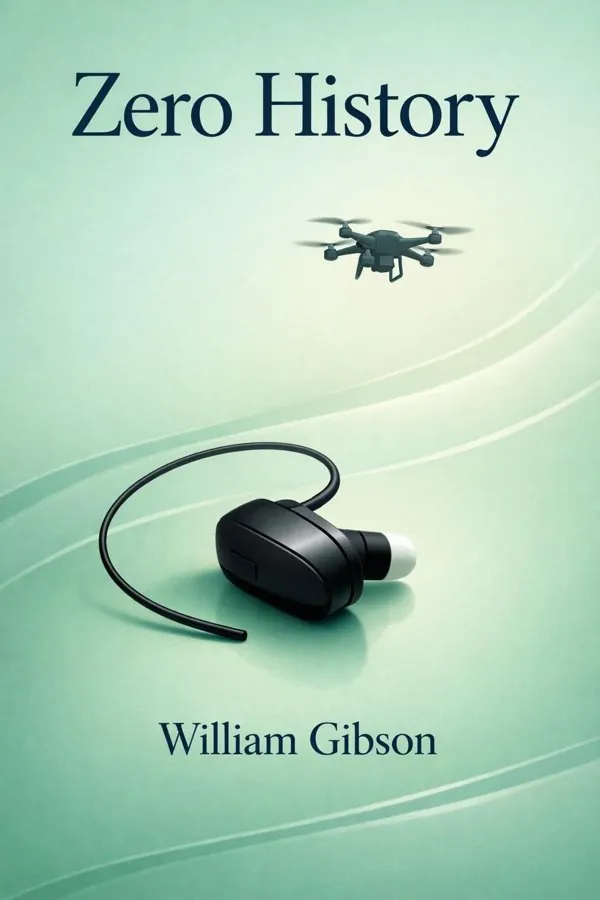
Zero History: Summary & Key Insights
 10 min9 chaptersAudio available
Key Takeaways from Zero History
The most powerful forces in modern life are often the ones that never announce themselves.
Some people do not need to control events directly; they only need to arrange the conditions under which others act.
Visibility has become so normal that privacy can feel almost suspicious.
In a culture that constantly rewards exposure, staying hidden can become a radical choice.
When shared beliefs weaken, brands often step in to organize identity.
What Is Zero History About?
Zero History by William Gibson is a scifi_fantasy book spanning 4 pages. Zero History, William Gibson’s 2010 novel, is the sharp, stylish conclusion to his Blue Ant trilogy, following Pattern Recognition and Spook Country. Set not in some distant galaxy but in a world just adjacent to our own, the book follows former rock singer Hollis Henry and former intelligence operative Milgrim as they are drawn into another of Hubertus Bigend’s opaque assignments. What begins as a search for the maker of a secretive cult fashion label gradually reveals a larger web of surveillance, military logistics, branding, and covert power. Gibson’s genius is that he makes the contemporary world feel as uncanny as classic science fiction: airports, luxury hotels, smartphones, private security, and global supply chains become the machinery of a new kind of futurism. Zero History matters because it captures a pivotal cultural shift, where identity is shaped by brands, information is currency, and secrecy itself can be monetized. Gibson, widely recognized as one of the most influential speculative writers of the past half-century, brings to this story his unmatched ability to read the cultural present as if it were a coded future already arriving.
This FizzRead summary covers all 9 key chapters of Zero History in approximately 10 minutes, distilling the most important ideas, arguments, and takeaways from William Gibson's work. Also available as an audio summary and Key Quotes Podcast.
Zero History
Zero History, William Gibson’s 2010 novel, is the sharp, stylish conclusion to his Blue Ant trilogy, following Pattern Recognition and Spook Country. Set not in some distant galaxy but in a world just adjacent to our own, the book follows former rock singer Hollis Henry and former intelligence operative Milgrim as they are drawn into another of Hubertus Bigend’s opaque assignments. What begins as a search for the maker of a secretive cult fashion label gradually reveals a larger web of surveillance, military logistics, branding, and covert power. Gibson’s genius is that he makes the contemporary world feel as uncanny as classic science fiction: airports, luxury hotels, smartphones, private security, and global supply chains become the machinery of a new kind of futurism. Zero History matters because it captures a pivotal cultural shift, where identity is shaped by brands, information is currency, and secrecy itself can be monetized. Gibson, widely recognized as one of the most influential speculative writers of the past half-century, brings to this story his unmatched ability to read the cultural present as if it were a coded future already arriving.
Who Should Read Zero History?
This book is perfect for anyone interested in scifi_fantasy and looking to gain actionable insights in a short read. Whether you're a student, professional, or lifelong learner, the key ideas from Zero History by William Gibson will help you think differently.
- ✓Readers who enjoy scifi_fantasy and want practical takeaways
- ✓Professionals looking to apply new ideas to their work and life
- ✓Anyone who wants the core insights of Zero History in just 10 minutes
Want the full summary?
Get instant access to this book summary and 100K+ more with Fizz Moment.
Get Free SummaryAvailable on App Store • Free to download
Key Chapters
The most powerful forces in modern life are often the ones that never announce themselves. In Zero History, Blue Ant is not just an advertising agency; it is a symbol of influence that operates beneath the surface of culture. Hubertus Bigend does not merely sell products. He studies signals, identifies emerging desires, and intervenes before trends become visible to everyone else. His real business is not advertising in the traditional sense, but anticipation. He wants to know what people will value before they can articulate it themselves.
This is what makes Blue Ant so unsettling. It reflects a world in which market intelligence, cultural intuition, and psychological insight merge into a kind of soft power. Fashion, media, logistics, and rumor are no longer separate domains. They are connected streams of information that can be tracked, manipulated, and monetized. Gibson suggests that the contemporary economy is less about producing goods than about shaping attention. The person or company that understands hidden patterns gains leverage over everyone else.
You can see this logic everywhere today. Streaming platforms predict what viewers will want next. Social media algorithms amplify what keeps users engaged. Luxury brands cultivate scarcity not just to raise prices, but to create myth. Even personal branding follows this model, as individuals package themselves around audience expectations.
The novel’s search for an anonymous fashion label becomes a study of how authenticity itself becomes a target for capture. Once something genuinely original appears, institutions move quickly to absorb it into the market.
Actionable takeaway: pay attention to who shapes your attention. If a trend feels spontaneous, ask what systems, incentives, or platforms may be quietly steering your interest.
Some people do not need to control events directly; they only need to arrange the conditions under which others act. Hubertus Bigend is one of Gibson’s most memorable creations because he embodies this kind of modern authority. He is not a politician, a general, or a corporate titan in the usual sense. Instead, he is a curator of momentum, someone who understands how desire, fear, image, and information can be orchestrated into power.
Bigend fascinates because he reflects a contemporary shift in leadership. Traditional power once depended on visible hierarchy, institutional rank, and command. Bigend’s power is different. It is lateral, networked, and deeply informed by data. He gathers fragments from culture, intelligence, commerce, and personal behavior, then assembles them into opportunity. He rarely seems surprised because he has built his life around reducing uncertainty.
Yet Gibson does not portray him as omnipotent. Bigend’s obsession with prediction reveals a core anxiety: the fear that something truly outside the system might emerge. That is why he is drawn to the secretive denim brand in the novel. It represents a form of creation not yet absorbed into the machinery of influence. He wants to find it not simply because it is valuable, but because it resists legibility.
This dynamic has clear real-world parallels. Tech companies seek to map consumer behavior. Consultants convert ambiguity into dashboards. Political operatives test messaging to shape emotional reactions. In each case, influence comes from framing reality before others fully understand it.
Actionable takeaway: strengthen your ability to recognize framing. When someone presents a trend, crisis, or opportunity, pause to ask who benefits from the way the situation is being defined.
Visibility has become so normal that privacy can feel almost suspicious. Zero History explores a world where surveillance is not merely governmental or militarized; it is cultural, commercial, and ambient. People are tracked through phones, transactions, travel, habits, and associations. The result is not always overt repression. More often, it is a steady erosion of anonymity, where being knowable becomes the default condition of modern life.
Gibson is especially perceptive in showing that surveillance is not only about watching people, but about making them measurable. Once behavior becomes data, it can be categorized, predicted, and acted upon. This allows institutions to intervene with precision, whether the goal is security, profit, or control. The novel’s intelligence-linked networks and private operators reveal how blurry the boundaries have become between state observation and corporate monitoring.
What makes this especially relevant is that much of this surveillance is accepted voluntarily. People carry devices that report location, use platforms that record preferences, and trade personal information for convenience. In Gibson’s world, as in ours, the surveillance system works because it is embedded in ordinary routines. It does not always need force; it often relies on habit.
At the same time, Zero History shows that those who value discretion still seek ways to disappear. The desire for obscurity becomes a form of resistance. To remain partially unreadable in a world of constant capture is a rare and valuable act.
Practical applications are obvious today: using privacy settings intentionally, reducing unnecessary data sharing, or separating public identity from private life. These are not paranoid gestures; they are acts of digital hygiene.
Actionable takeaway: audit your daily visibility. Identify one tool, app, or behavior that gives away more information than necessary, and reduce your exposure this week.
In a culture that constantly rewards exposure, staying hidden can become a radical choice. One of Zero History’s deepest insights is that anonymity is not emptiness. It can be a deliberate strategy for preserving integrity. The elusive creators and operators in the novel understand that once a person, product, or movement becomes fully visible, it can be copied, marketed, and controlled. Remaining obscure creates space for freedom.
This idea is central to the mystery of the Gabriel Hounds label, the cult denim brand that drives much of the plot. The label’s appeal comes partly from quality and design, but even more from its refusal to participate in ordinary branding. It does not flood the market. It does not advertise. It does not explain itself. That absence generates fascination, but it also protects the work from dilution. In a world saturated with messaging, silence becomes meaningful.
Gibson is not romanticizing total withdrawal. His characters still move through systems of money, travel, and technology. But he suggests that selective invisibility may be the only way to keep some forms of value from immediate extraction. Artists, entrepreneurs, and even ordinary individuals face this tension constantly. The moment something authentic gains attention, pressure builds to scale it, optimize it, and package it for wider consumption.
Think of independent creators who avoid algorithmic overexposure, companies that grow slowly to retain quality, or professionals who maintain boundaries around their personal lives rather than turning every detail into content. These choices may limit rapid recognition, but they preserve autonomy.
Actionable takeaway: identify one area of your life or work where you can choose intentional opacity over constant visibility. Protecting some distance may help you preserve what matters most.
When shared beliefs weaken, brands often step in to organize identity. Zero History suggests that in the contemporary world, branding has taken over some of the psychological territory once occupied by politics, religion, and social class. People increasingly express affiliation through products, aesthetics, and curated lifestyles. The label you wear, the device you carry, and the spaces you inhabit all become signals of belonging.
Gibson treats this not as a superficial development but as a structural one. Brands do not merely reflect taste; they shape aspiration, loyalty, and even moral perception. Certain products come to imply intelligence, authenticity, rebellion, sophistication, or ethical consciousness. As a result, consumption becomes a language through which people narrate themselves. Bigend understands this perfectly. He sees that if you can identify the right symbol at the right time, you can influence not just purchases but self-concept.
The secret fashion label in the novel matters because it has not yet been transformed into a conventional brand. It still carries an aura of genuine function and purpose rather than market-managed identity. That distinction is crucial. Gibson asks whether anything can remain meaningful once branding systems discover it.
This has clear application beyond fashion. Universities cultivate prestige branding. Employers brand corporate culture. Individuals build online identities with strategic aesthetics. Even social causes can become subject to image management, where alignment is performed through symbols rather than sustained action.
The challenge is not to reject all brands, but to understand how they shape perception. We often believe we are choosing products when in fact we are choosing stories about who we are.
Actionable takeaway: the next time you feel drawn to a product or platform, ask whether you need its utility or the identity it promises. That question can reveal what is really driving the decision.
Modern identity is no longer something we simply possess; it is something we continuously stage. Throughout Zero History, characters navigate a world in which appearance, expertise, background, and social signals are carefully managed. Hollis Henry, in particular, embodies this tension. As a former musician no longer anchored by her old public role, she moves through elite spaces with a mix of detachment and adaptability. Her value often comes from how she is perceived, but she remains alert to the instability of perception itself.
Gibson captures an especially contemporary condition: the self as a project under constant revision. People update their presentation depending on platform, profession, audience, and opportunity. This can create freedom, since identities are no longer fixed by a single institution. But it also creates pressure. If every interaction is potentially reputational, life begins to feel like ongoing brand maintenance.
The novel’s atmosphere of hotels, meetings, transit zones, and coded introductions reinforces this theme. These are environments where people are identified by context and utility rather than deep continuity. You are who the network can use, trust, or market at a given moment. That makes authenticity more elusive and more valuable.
Today this feels even more familiar. Professionals optimize LinkedIn profiles, creators refine personal aesthetics, and ordinary users switch between public-facing and private selves online. None of this is inherently false, but it becomes dangerous when performance replaces reflection. A self built entirely for external recognition can become fragile.
Gibson’s answer is not to reject performance altogether, but to remain conscious of it. Identity can be adaptive without becoming hollow.
Actionable takeaway: review one public version of yourself, such as a profile, bio, or social feed, and ask whether it reflects your real priorities or only your perceived market value. Adjust it toward the former.
The most convincing visions of the future rarely depend on spectacular inventions. Gibson’s great gift in Zero History is showing that the future announces itself through textures, interfaces, habits, and environments that seem almost ordinary. There are no flying cars dominating the narrative. Instead, there are encrypted communications, luxury retail rituals, tactical fabrics, subtle security practices, and the ambient intelligence of connected systems. The world feels futuristic because its details have quietly shifted.
This approach matters because it changes how we think about technological change. Major transformations do not always arrive as clear breaks from the past. More often, they creep in through convenience, design, and infrastructure. The culture normalizes them before people fully understand their implications. Gibson is interested in this threshold moment, where a new social logic is already operating but has not yet been named.
That is why his fiction remains so resonant. He does not predict gadgets as much as he predicts relationships between technology and behavior. He notices how tools reshape trust, status, movement, and desire. In Zero History, the near future is less about invention than about integration. Everything connects, and those connections alter what is possible.
A practical lesson follows from this. To understand where society is heading, watch not only headline breakthroughs but subtle changes in routine. How do people pay attention? How do they verify truth? How do they display belonging? How do institutions gather data? These small shifts often reveal larger transformations before they become obvious.
Actionable takeaway: develop a habit of noticing ordinary changes with extraordinary consequences. Pick one daily routine, such as shopping, communication, or travel, and ask how technology has quietly changed your behavior over the past five years.
In a world flooded with information, the rarest skill is not access but discernment. Zero History repeatedly suggests that while systems can collect data at extraordinary scale, human judgment still matters. Hollis, Milgrim, and others succeed not because they know everything, but because they can sense tone, motive, atmosphere, and credibility. They interpret what machines and organizations cannot fully reduce to metrics.
This is one reason the novel avoids becoming a cold technocratic thriller. Gibson is deeply interested in pattern recognition, but he also knows that patterns do not interpret themselves. Someone must decide what a clue means, whether a person is trustworthy, or why a signal matters. Human beings remain the site where information becomes significance.
Milgrim is especially important here. His background, vulnerabilities, and observational sensitivity allow him to notice things others miss. He is not a superhero. He is a reminder that attention shaped by experience can be more powerful than brute analytical capability. Gibson values people who can read environments and relationships, not just data streams.
This idea applies strongly to contemporary life. Organizations often prioritize measurable outputs while neglecting tacit knowledge. Yet hiring, leadership, creative work, negotiation, and risk assessment all depend on forms of judgment that resist full quantification. The ability to sense context, detect inconsistency, and understand incentives remains indispensable.
For readers, this is a reassuring and challenging message. Technology can augment perception, but it cannot replace wisdom. We still need people capable of subtle interpretation, ethical reasoning, and intuitive synthesis.
Actionable takeaway: strengthen your judgment by combining data with direct observation. Before accepting any conclusion based purely on metrics, ask what context, motive, or human factor may be missing from the numbers.
All Chapters in Zero History
About the Author
William Gibson is an American-Canadian novelist and essayist best known for helping invent the cyberpunk movement. Born in 1948 in Conway, South Carolina, he later settled in Canada and emerged as one of the most influential voices in speculative fiction. His breakthrough novel, Neuromancer, won the Hugo, Nebula, and Philip K. Dick Awards and introduced ideas that shaped how readers and technologists imagined the digital age. Gibson’s fiction is celebrated for its ability to identify cultural and technological shifts before they become obvious. Beyond his early cyberpunk works, he expanded into near-contemporary novels such as Pattern Recognition, Spook Country, and Zero History, where he examines branding, surveillance, globalization, and media with unusual precision. His work continues to influence writers, designers, and thinkers across literature and technology.
Get This Summary in Your Preferred Format
Read or listen to the Zero History summary by William Gibson anytime, anywhere. FizzRead offers multiple formats so you can learn on your terms — all free.
Available formats: App · Audio · PDF · EPUB — All included free with FizzRead
Download Zero History PDF and EPUB Summary
Key Quotes from Zero History
“The most powerful forces in modern life are often the ones that never announce themselves.”
“Some people do not need to control events directly; they only need to arrange the conditions under which others act.”
“Visibility has become so normal that privacy can feel almost suspicious.”
“In a culture that constantly rewards exposure, staying hidden can become a radical choice.”
“When shared beliefs weaken, brands often step in to organize identity.”
Frequently Asked Questions about Zero History
Zero History by William Gibson is a scifi_fantasy book that explores key ideas across 9 chapters. Zero History, William Gibson’s 2010 novel, is the sharp, stylish conclusion to his Blue Ant trilogy, following Pattern Recognition and Spook Country. Set not in some distant galaxy but in a world just adjacent to our own, the book follows former rock singer Hollis Henry and former intelligence operative Milgrim as they are drawn into another of Hubertus Bigend’s opaque assignments. What begins as a search for the maker of a secretive cult fashion label gradually reveals a larger web of surveillance, military logistics, branding, and covert power. Gibson’s genius is that he makes the contemporary world feel as uncanny as classic science fiction: airports, luxury hotels, smartphones, private security, and global supply chains become the machinery of a new kind of futurism. Zero History matters because it captures a pivotal cultural shift, where identity is shaped by brands, information is currency, and secrecy itself can be monetized. Gibson, widely recognized as one of the most influential speculative writers of the past half-century, brings to this story his unmatched ability to read the cultural present as if it were a coded future already arriving.
More by William Gibson
You Might Also Like
Red Rising
Pierce Brown
10 min
Stranger in a Strange Land
Robert A. Heinlein
10 min
AI Valley
Chen Qiufan
10 min
Bloodchild
Octavia E. Butler
10 min
Do Androids Dream of Electric Sheep?
Philip K. Dick
10 min
Jujutsu Kaisen, Vol. 24
Gege Akutami
10 minBrowse by Category
Ready to read Zero History?
Get the full summary and 100K+ more books with Fizz Moment.