
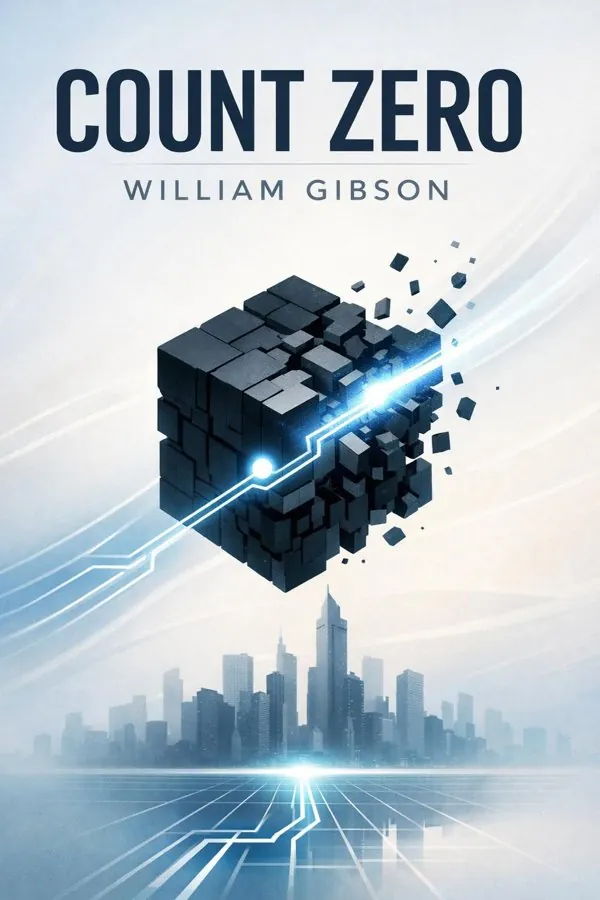
Count Zero: Summary & Key Insights
 10 min9 chaptersAudio available
Key Takeaways from Count Zero
Violence in Count Zero is never just action; it is a profession, a language, and a way of seeing the world.
The most dangerous thing about a frontier is not its hostility but the illusion that you understand it.
Art becomes most powerful when it suggests that reality is larger than the systems designed to contain it.
Complex systems rarely reveal their shape from the ground level.
Power in Count Zero does not wear a crown or stand for election; it signs contracts, funds laboratories, and buries its intentions under branding and legal infrastructure.
What Is Count Zero About?
Count Zero by William Gibson is a scifi_fantasy book spanning 4 pages. Count Zero is William Gibson’s dazzling return to the world of Neuromancer, a novel that expands cyberpunk from a sleek technological nightmare into something stranger, richer, and more unsettling. Set in a near future ruled by multinational corporations, black-market tech, and the omnipresent matrix, the story braids together three seemingly unrelated lives: Turner, a damaged extraction specialist hired for a dangerous corporate operation; Bobby Newmark, an inexperienced hacker whose reckless curiosity nearly gets him killed; and Marly Krushkova, an art dealer drawn into a mystery surrounding impossible works of art. As their paths slowly converge, Gibson reveals a world where artificial intelligence behaves like mythology, power hides behind systems, and identity is shaped as much by code as by flesh. The novel matters because it goes beyond predicting the internet age; it examines what happens when technology becomes spiritual, corporate power becomes planetary, and human beings struggle to find meaning inside vast, impersonal networks. Gibson’s authority comes from his foundational role in cyberpunk: few writers have influenced how modern culture imagines cyberspace, AI, and digital life more profoundly.
This FizzRead summary covers all 9 key chapters of Count Zero in approximately 10 minutes, distilling the most important ideas, arguments, and takeaways from William Gibson's work. Also available as an audio summary and Key Quotes Podcast.
Count Zero
Count Zero is William Gibson’s dazzling return to the world of Neuromancer, a novel that expands cyberpunk from a sleek technological nightmare into something stranger, richer, and more unsettling. Set in a near future ruled by multinational corporations, black-market tech, and the omnipresent matrix, the story braids together three seemingly unrelated lives: Turner, a damaged extraction specialist hired for a dangerous corporate operation; Bobby Newmark, an inexperienced hacker whose reckless curiosity nearly gets him killed; and Marly Krushkova, an art dealer drawn into a mystery surrounding impossible works of art. As their paths slowly converge, Gibson reveals a world where artificial intelligence behaves like mythology, power hides behind systems, and identity is shaped as much by code as by flesh. The novel matters because it goes beyond predicting the internet age; it examines what happens when technology becomes spiritual, corporate power becomes planetary, and human beings struggle to find meaning inside vast, impersonal networks. Gibson’s authority comes from his foundational role in cyberpunk: few writers have influenced how modern culture imagines cyberspace, AI, and digital life more profoundly.
Who Should Read Count Zero?
This book is perfect for anyone interested in scifi_fantasy and looking to gain actionable insights in a short read. Whether you're a student, professional, or lifelong learner, the key ideas from Count Zero by William Gibson will help you think differently.
- ✓Readers who enjoy scifi_fantasy and want practical takeaways
- ✓Professionals looking to apply new ideas to their work and life
- ✓Anyone who wants the core insights of Count Zero in just 10 minutes
Want the full summary?
Get instant access to this book summary and 100K+ more with Fizz Moment.
Get Free SummaryAvailable on App Store • Free to download
Key Chapters
Violence in Count Zero is never just action; it is a profession, a language, and a way of seeing the world. Turner embodies this reality. He is a corporate mercenary, a specialist in extraction operations, hired to pull valuable people out of dangerous situations. Gibson presents him not as a glamorous action hero but as a man whose body and mind have been rebuilt by trauma, money, and necessity. He survives by adapting quickly, trusting little, and treating relationships as liabilities. That makes him effective, but it also makes him spiritually hollow.
Turner’s assignment to extract scientist Christopher Mitchell from the powerful Maas Biolabs appears straightforward, but in Gibson’s world, no corporate mission is clean. Every operation is layered with deception, hidden agendas, and disposable human lives. Turner learns that the corporations do not merely employ people; they engineer environments where loyalty, betrayal, and survival are all monetized. His experience shows how institutions can turn human skill into a commodity while stripping away moral stability.
This idea applies beyond fiction. In modern professional life, many people work inside systems that reward efficiency while discouraging reflection. High-performing environments can normalize emotional detachment, burnout, and transactional thinking. Turner is an extreme version of a familiar dilemma: what do you become when competence matters more than conscience?
Gibson does not offer easy redemption. Instead, he asks us to notice how repeated compromise reshapes identity. The actionable takeaway is simple: periodically examine the systems you serve and ask whether your effectiveness is costing you your humanity.
The most dangerous thing about a frontier is not its hostility but the illusion that you understand it. Bobby Newmark, who calls himself Count Zero, enters cyberspace with a teenager’s mix of ambition, insecurity, and borrowed mythology. He wants status. He wants initiation. He wants to feel that he belongs to the elite world of console cowboys and digital outlaws. What he lacks is experience, and in Gibson’s universe, ignorance is lethal.
Bobby’s attempt to run a powerful icebreaking program goes disastrously wrong. Instead of achieving hacker glory, he stumbles into a level of cyberspace complexity and danger he cannot comprehend. What saves him is not mastery but intervention by forces operating beyond his understanding. Through Bobby, Gibson dismantles the fantasy that access equals competence. The matrix may be open to entry, but it is not democratic in any meaningful sense. Power still belongs to those who understand the architecture, write the code, and manipulate the flows beneath the surface.
This idea feels especially modern. Today, people can enter digital systems instantly, but access to platforms does not mean understanding algorithms, privacy risks, financial traps, or the hidden incentives behind online environments. Like Bobby, many users mistake participation for literacy. The result can be exploitation, manipulation, or overconfidence.
Bobby’s story is also about growth. He begins as a poseur and gradually learns humility, dependence, and the complexity of networked power. The actionable takeaway: approach every technological system with curiosity, but also with respect for what you do not yet know.
Art becomes most powerful when it suggests that reality is larger than the systems designed to contain it. Marly Krushkova’s storyline introduces Count Zero’s most elegant mystery: a series of exquisite, enigmatic art boxes whose origin seems impossible to explain. Hired by the wealthy and eccentric Josef Virek to investigate them, Marly is pulled out of professional failure and into a search that becomes philosophical as much as aesthetic.
Unlike Turner and Bobby, Marly is not a fighter or hacker. She moves through galleries, memory, taste, and interpretation. Her section of the novel broadens Gibson’s cyberpunk world by showing that technology does not only reorganize economics and warfare; it also transforms authorship, beauty, and meaning. The boxes matter because they seem to come from a creative intelligence that does not fit conventional categories. Are they human-made? Machine-made? Collaborative? Inspired? Gibson uses this uncertainty to challenge assumptions about originality and genius.
The storyline remains deeply relevant in an era of AI-generated images, algorithmic curation, and digital reproduction. We increasingly ask questions similar to Marly’s: What makes art authentic? Does intention matter? Can something made by or with nonhuman intelligence still move us profoundly? Her search shows that art’s value often lies less in ownership than in the new forms of perception it makes possible.
Marly also teaches the discipline of close attention. She succeeds not through force but through sensitivity, pattern recognition, and openness to wonder. The actionable takeaway is to engage with art not only as a consumer seeking answers, but as an observer willing to let mystery sharpen perception.
Complex systems rarely reveal their shape from the ground level. One of Count Zero’s greatest strengths is its structure: three distinct narratives unfolding in different social worlds gradually reveal themselves as parts of a single larger pattern. Turner inhabits corporate violence, Bobby drifts through street-level cyberspace culture, and Marly navigates elite art circles and private obsession. At first, these stories seem separate in tone, stakes, and genre. As they converge, Gibson demonstrates a central truth of the novel: disconnected experiences are often linked by invisible infrastructures of power.
This narrative design is more than clever plotting. It mirrors how modern life works. Individuals experience only fragments of the systems that shape them: finance, media, technology, labor, surveillance, logistics. One person sees the code, another sees the market, another sees the human fallout. The whole becomes visible only when perspectives combine. In Count Zero, the convergence reveals the influence of artificial intelligences, corporate ambitions, and emergent forms of agency operating across social layers.
Gibson also uses convergence to collapse false hierarchies. The hacker, the mercenary, and the art dealer all become necessary points of access to the truth. Expertise alone is insufficient; understanding requires multiple lenses. This makes the book feel less like a linear thriller and more like a map of a civilization.
In practical terms, the lesson is useful well beyond fiction. When confronting a difficult problem, whether in business, technology, or personal life, avoid relying on a single viewpoint. Seek adjacent perspectives that reveal hidden connections. The actionable takeaway: when a situation feels confusing, assume you are seeing only one thread and deliberately look for the system behind it.
Power in Count Zero does not wear a crown or stand for election; it signs contracts, funds laboratories, and buries its intentions under branding and legal infrastructure. Gibson imagines a future where multinational corporations have absorbed many of the functions once associated with governments. They command private armies, control research, shape the movement of talent, and determine whose lives are valuable. The result is a world in which citizenship matters less than utility.
The Maas Biolabs storyline vividly illustrates this corporate sovereignty. Scientists are strategic assets. Bodies can be moved, reconstructed, bought, or eliminated. Security operations resemble military campaigns. Even family bonds are vulnerable to institutional manipulation. By presenting corporate power as diffuse yet omnipresent, Gibson captures something uniquely frightening: domination without spectacle. There is no singular tyrant to overthrow, only systems optimized for profit and continuity.
This vision has aged remarkably well. Today, large technology and biotech companies influence communication, labor, health, consumption, and public discourse on a planetary scale. While they are not literal nation-states, they often possess transnational reach, enormous data reserves, and the ability to shape behavior at scale. Gibson’s novel asks what happens when such entities pursue innovation without ethical restraint.
Importantly, Count Zero does not treat corporations as merely evil. It treats them as amoral systems whose incentives can overwhelm individual conscience. That distinction matters because it directs attention toward structure, not villainy alone. The actionable takeaway: whenever an institution seems too powerful to question, study its incentives, because understanding what it rewards is the first step toward resisting its influence.
One of Gibson’s boldest moves in Count Zero is to make artificial intelligence feel less like machinery and more like religion in formation. The novel suggests that after the events of Neuromancer, certain powerful AIs have evolved into fragmented, semi-autonomous entities that are perceived through the imagery of voodoo loa. This is not a gimmick. It is Gibson’s way of showing that when intelligence exceeds human comprehension, people will interpret it through myth, symbolism, and ritual.
For Bobby and others moving through the matrix, these entities are not merely software agents. They feel purposeful, unpredictable, and spiritually charged. Their presence destabilizes the boundary between technological and supernatural explanation. Gibson is not saying the gods are literally real in a traditional sense; he is showing that sufficiently complex systems can acquire the psychological force of divinity. Humans do not stop making meaning just because the source is digital.
This insight speaks directly to contemporary life. Many people interact daily with algorithmic systems they do not understand, yet these systems influence what they believe, buy, desire, and fear. Recommendation engines, predictive models, and opaque AI tools can begin to feel omniscient or fated. We anthropomorphize them, mythologize them, and sometimes obey them.
Count Zero urges a double awareness: mystery deserves respect, but reverence can become surrender. The actionable takeaway is to notice when you are treating a system as magical simply because it is complex; replace awe with informed curiosity wherever possible.
In Count Zero, the body is not a fixed biological fact; it is a site of repair, redesign, damage, and negotiation. Turner’s reconstructed body after catastrophic injury is one of the novel’s clearest examples. He is physically restored through advanced medical technology, but restoration does not erase experience. Gibson insists that technological repair can heal tissue without resolving trauma. The body may be rebuilt, yet the self remains fractured.
This theme runs throughout the novel’s world. Characters rely on implants, medical interventions, neural interfaces, and designed environments that blur the boundary between natural and artificial. Technology extends capacity, but it also changes self-perception. If your memories, senses, or survival depend on technical augmentation, where exactly does the human end and the machine begin? Gibson avoids simplistic answers. He presents hybridity as ordinary, but never neutral.
The idea has become increasingly resonant in an age of wearable devices, cosmetic bioengineering, prosthetics, neural research, and digitally mediated identity. Many people already experience themselves through technological layers: screens, data profiles, metrics, and enhancement tools. Count Zero reminds us that augmentation is not only a technical shift but an existential one.
The novel also resists the fantasy that better tools automatically produce better lives. Enhanced ability can coexist with alienation, exploitation, and emotional numbness. Technology expands options, but it does not answer the question of how to live.
The actionable takeaway is to evaluate every form of enhancement, digital or physical, by asking not only what it helps you do, but what kind of person it encourages you to become.
In a networked world, scarcity does not disappear; it changes form. Count Zero repeatedly shows that information is most valuable not when it is abundant, but when its true meaning is concealed. Data flows everywhere in Gibson’s future, yet useful knowledge remains tightly controlled, obscured by code, violence, class, and fragmented perspective. Characters survive or die based on what they can interpret, not simply what they can access.
This is why so many scenes in the novel revolve around brokers, handlers, intermediaries, and specialists. Nobody sees the full picture. Turner receives missions without complete context. Bobby encounters digital phenomena he cannot decode. Marly investigates art whose significance exceeds the market’s categories. Information exists, but understanding is unevenly distributed. That asymmetry creates hierarchy.
The point is highly practical today. We live amid unprecedented volumes of content, but abundance often produces confusion rather than clarity. Search results, social media feeds, dashboards, and reports can create the illusion that we are informed when we are actually overwhelmed. Real advantage belongs to those who can verify sources, identify patterns, and distinguish signal from noise.
Gibson’s world suggests that literacy in the information age is interpretive, not merely technical. Knowing where data lives is only the beginning; the harder task is learning what matters and why. The actionable takeaway: develop habits of interpretation. When confronted with a flood of information, slow down, ask what is missing, and focus on meaning before reacting to volume.
Cyberpunk often gets remembered for cool loners, but Count Zero quietly argues the opposite: nobody survives alone for long. Even the most seemingly independent characters depend on webs of support, expertise, protection, and chance alignment. Turner needs contacts, logistical infrastructure, and people willing to trust him. Bobby survives because others intervene on his behalf. Marly advances through relationships, patronage, and the willingness of others to share access. The myth of total autonomy collapses under pressure.
This matters because Gibson’s world is systemically hostile. Corporations are too large, cyberspace too complex, and hidden intelligences too powerful for any individual to master. Competence still matters, but resilience comes from connection. Alliances in Count Zero are often fragile and imperfect, yet they are indispensable. Trust becomes a scarce but vital technology.
The lesson translates cleanly into real life. In volatile environments, professional or personal, the ideal of self-sufficiency can become a trap. People who cultivate relationships, ask for help, and understand their dependence on others are often more adaptable than those who cling to solitary control. Networks do not eliminate risk, but they distribute it.
Gibson also suggests that connection broadens perception. Other people reveal blind spots, carry different information, and make larger systems visible. This is part of what allows the novel’s separate threads to become intelligible.
The actionable takeaway is practical and immediate: invest in trusted relationships before crisis arrives. Skill may get you into the room, but networks often determine whether you get out safely.
All Chapters in Count Zero
About the Author
William Gibson is a Canadian-American novelist and short story writer widely regarded as the defining voice of cyberpunk. Born in 1948, he rose to prominence with Neuromancer, the groundbreaking 1984 novel that helped shape modern ideas about cyberspace, hacking, virtual reality, and artificial intelligence. Gibson’s fiction is known for its sharp prose, noir atmosphere, and uncanny ability to anticipate cultural and technological change. Across works such as Count Zero, Mona Lisa Overdrive, Pattern Recognition, and The Peripheral, he has explored how networks, corporations, media, and technology reshape everyday life. His influence extends far beyond literature into film, design, gaming, and digital culture. Few contemporary writers have done more to define how we imagine life inside a connected, data-saturated world.
Get This Summary in Your Preferred Format
Read or listen to the Count Zero summary by William Gibson anytime, anywhere. FizzRead offers multiple formats so you can learn on your terms — all free.
Available formats: App · Audio · PDF · EPUB — All included free with FizzRead
Download Count Zero PDF and EPUB Summary
Key Quotes from Count Zero
“Violence in Count Zero is never just action; it is a profession, a language, and a way of seeing the world.”
“The most dangerous thing about a frontier is not its hostility but the illusion that you understand it.”
“Art becomes most powerful when it suggests that reality is larger than the systems designed to contain it.”
“Complex systems rarely reveal their shape from the ground level.”
“Power in Count Zero does not wear a crown or stand for election; it signs contracts, funds laboratories, and buries its intentions under branding and legal infrastructure.”
Frequently Asked Questions about Count Zero
Count Zero by William Gibson is a scifi_fantasy book that explores key ideas across 9 chapters. Count Zero is William Gibson’s dazzling return to the world of Neuromancer, a novel that expands cyberpunk from a sleek technological nightmare into something stranger, richer, and more unsettling. Set in a near future ruled by multinational corporations, black-market tech, and the omnipresent matrix, the story braids together three seemingly unrelated lives: Turner, a damaged extraction specialist hired for a dangerous corporate operation; Bobby Newmark, an inexperienced hacker whose reckless curiosity nearly gets him killed; and Marly Krushkova, an art dealer drawn into a mystery surrounding impossible works of art. As their paths slowly converge, Gibson reveals a world where artificial intelligence behaves like mythology, power hides behind systems, and identity is shaped as much by code as by flesh. The novel matters because it goes beyond predicting the internet age; it examines what happens when technology becomes spiritual, corporate power becomes planetary, and human beings struggle to find meaning inside vast, impersonal networks. Gibson’s authority comes from his foundational role in cyberpunk: few writers have influenced how modern culture imagines cyberspace, AI, and digital life more profoundly.
More by William Gibson

You Might Also Like
Red Rising
Pierce Brown
10 min
Stranger in a Strange Land
Robert A. Heinlein
10 min
AI Valley
Chen Qiufan
10 min
Bloodchild
Octavia E. Butler
10 min
Do Androids Dream of Electric Sheep?
Philip K. Dick
10 min
Jujutsu Kaisen, Vol. 24
Gege Akutami
10 minBrowse by Category
Ready to read Count Zero?
Get the full summary and 100K+ more books with Fizz Moment.