
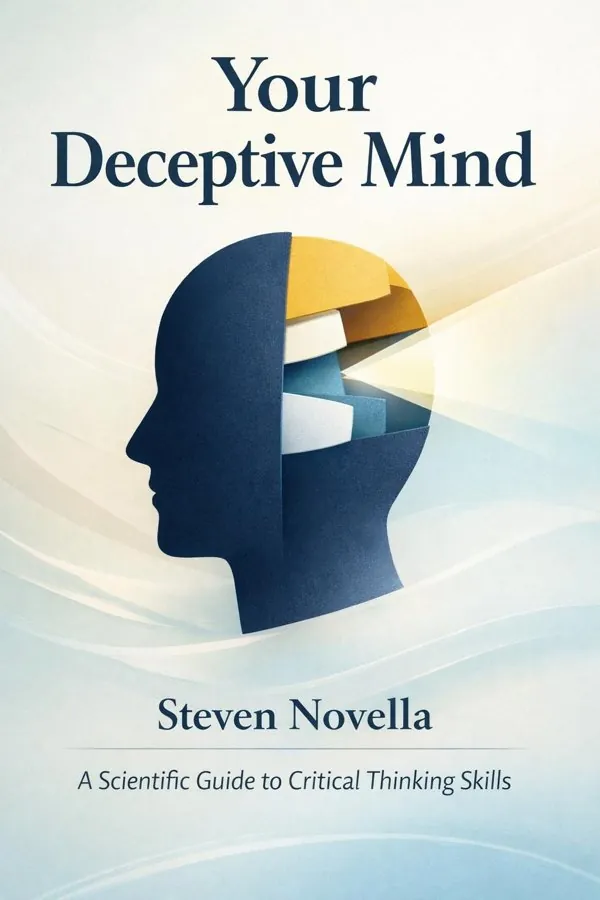
Your Deceptive Mind: A Scientific Guide to Critical Thinking Skills: Summary & Key Insights
 10 min8 chaptersAudio available
What Is Your Deceptive Mind: A Scientific Guide to Critical Thinking Skills About?
Your Deceptive Mind: A Scientific Guide to Critical Thinking Skills by Steven Novella is a cognition book spanning 8 pages. This course explores the cognitive biases and logical fallacies that distort human thinking. Dr. Steven Novella, a neurologist and educator, explains how the brain constructs reality, why we are prone to deception, and how scientific reasoning and skepticism can help us think more clearly and make better decisions.
This FizzRead summary covers all 8 key chapters of Your Deceptive Mind: A Scientific Guide to Critical Thinking Skills in approximately 10 minutes, distilling the most important ideas, arguments, and takeaways from Steven Novella's work. Also available as an audio summary and Key Quotes Podcast.
Your Deceptive Mind: A Scientific Guide to Critical Thinking Skills
This course explores the cognitive biases and logical fallacies that distort human thinking. Dr. Steven Novella, a neurologist and educator, explains how the brain constructs reality, why we are prone to deception, and how scientific reasoning and skepticism can help us think more clearly and make better decisions.
Who Should Read Your Deceptive Mind: A Scientific Guide to Critical Thinking Skills?
This book is perfect for anyone interested in cognition and looking to gain actionable insights in a short read. Whether you're a student, professional, or lifelong learner, the key ideas from Your Deceptive Mind: A Scientific Guide to Critical Thinking Skills by Steven Novella will help you think differently.
- ✓Readers who enjoy cognition and want practical takeaways
- ✓Professionals looking to apply new ideas to their work and life
- ✓Anyone who wants the core insights of Your Deceptive Mind: A Scientific Guide to Critical Thinking Skills in just 10 minutes
Want the full summary?
Get instant access to this book summary and 100K+ more with Fizz Moment.
Get Free SummaryAvailable on App Store • Free to download
Key Chapters
When I tell my medical students that their brains are lying to them, they usually laugh—until they realize I mean it quite literally. What we perceive is not an objective snapshot of the world but an adaptive simulation created from incomplete sensory data. Our eyes send inverted, low-resolution images; our ears detect compressed sound waves. The brain must interpret, integrate, and fill in missing information. Neurons in the visual cortex stitch together contours and colors, while other areas infer motion and depth. It feels instantaneous, but the brain’s reconstruction takes time and inference.
This delay and interpretation mean that what we experience as reality is an edited version optimized for survival, not accuracy. Optical illusions, like the checker-shadow or the Müller-Lyer, make this process visible. Illusions exploit the brain’s assumptions about light, distance, and perspective. The remarkable thing is not that we see incorrectly in these cases, but that we see correctly so much of the time—given how little raw data our senses provide.
But once you understand this, a deeper lesson emerges. If perception is an active process, then believing is likewise active. Every belief is a model—an attempt to make meaning of sensory and social input. We are constantly updating that internal model, but not always rationally. The emotional charge of a belief, the desire for coherence, and the pressure from our community can all shape what we accept as true. Recognizing that these factors influence every moment of perception and interpretation prepares us to question ourselves more carefully. The beginning of critical thinking, therefore, is intellectual humility: the readiness to accept that what we perceive may be incomplete or wrong.
+ 6 more chapters — available in the FizzRead app
All Chapters in Your Deceptive Mind: A Scientific Guide to Critical Thinking Skills
About the Author
Steven Novella is an American clinical neurologist and assistant professor at Yale University School of Medicine. He is known for his work in science communication and skepticism, including hosting the podcast 'The Skeptics' Guide to the Universe' and teaching courses on critical thinking and neuroscience.
Get This Summary in Your Preferred Format
Read or listen to the Your Deceptive Mind: A Scientific Guide to Critical Thinking Skills summary by Steven Novella anytime, anywhere. FizzRead offers multiple formats so you can learn on your terms — all free.
Available formats: App · Audio · PDF · EPUB — All included free with FizzRead
Download Your Deceptive Mind: A Scientific Guide to Critical Thinking Skills PDF and EPUB Summary
Key Quotes from Your Deceptive Mind: A Scientific Guide to Critical Thinking Skills
“When I tell my medical students that their brains are lying to them, they usually laugh—until they realize I mean it quite literally.”
“Our brains evolved to make quick judgments under uncertainty.”
Frequently Asked Questions about Your Deceptive Mind: A Scientific Guide to Critical Thinking Skills
Your Deceptive Mind: A Scientific Guide to Critical Thinking Skills by Steven Novella is a cognition book that explores key ideas across 8 chapters. This course explores the cognitive biases and logical fallacies that distort human thinking. Dr. Steven Novella, a neurologist and educator, explains how the brain constructs reality, why we are prone to deception, and how scientific reasoning and skepticism can help us think more clearly and make better decisions.
You Might Also Like
A Field Guide to Lies: Critical Thinking in the Information Age
Daniel J. Levitin
10 min
A Theory of Cognitive Dissonance
Leon Festinger
10 min
Black-And-White Thinking: The Burden of a Binary Brain in a Complex World
Kevin Dutton
10 min
Born Liars: Why We Can’t Live Without Deceit
Ian Leslie
10 min
Collective Illusions: Conformity, Complicity, and the Science of Why We Make Bad Decisions
Todd Rose
10 min
Concrete Mathematics: A Foundation for Computer Science
Ronald L. Graham, Donald E. Knuth, Oren Patashnik
10 minBrowse by Category
Ready to read Your Deceptive Mind: A Scientific Guide to Critical Thinking Skills?
Get the full summary and 100K+ more books with Fizz Moment.