
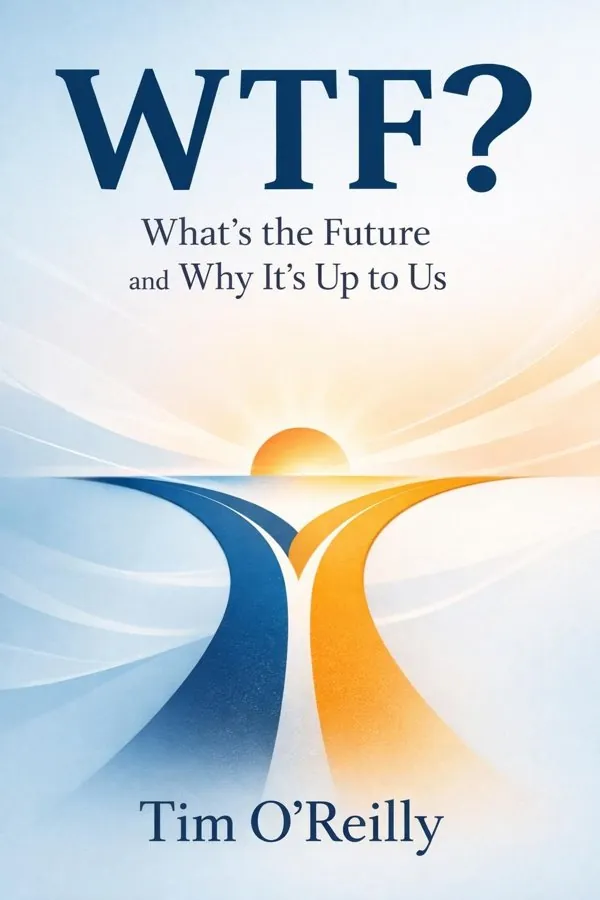
WTF?: What's the Future and Why It's Up to Us: Summary & Key Insights
by Tim O'Reilly
 10 min9 chaptersAudio available
What Is WTF?: What's the Future and Why It's Up to Us About?
WTF?: What's the Future and Why It's Up to Us by Tim O'Reilly is a future_trends book spanning 9 pages. In this book, Tim O'Reilly explores how technology and innovation are reshaping the economy, society, and the future of work. He argues that understanding the patterns behind technological disruption can help us build a better future, emphasizing the importance of adaptability, ethical responsibility, and long-term thinking in the face of rapid change.
This FizzRead summary covers all 9 key chapters of WTF?: What's the Future and Why It's Up to Us in approximately 10 minutes, distilling the most important ideas, arguments, and takeaways from Tim O'Reilly's work. Also available as an audio summary and Key Quotes Podcast.
WTF?: What's the Future and Why It's Up to Us
In this book, Tim O'Reilly explores how technology and innovation are reshaping the economy, society, and the future of work. He argues that understanding the patterns behind technological disruption can help us build a better future, emphasizing the importance of adaptability, ethical responsibility, and long-term thinking in the face of rapid change.
Who Should Read WTF?: What's the Future and Why It's Up to Us?
This book is perfect for anyone interested in future_trends and looking to gain actionable insights in a short read. Whether you're a student, professional, or lifelong learner, the key ideas from WTF?: What's the Future and Why It's Up to Us by Tim O'Reilly will help you think differently.
- ✓Readers who enjoy future_trends and want practical takeaways
- ✓Professionals looking to apply new ideas to their work and life
- ✓Anyone who wants the core insights of WTF?: What's the Future and Why It's Up to Us in just 10 minutes
Want the full summary?
Get instant access to this book summary and 100K+ more with Fizz Moment.
Get Free SummaryAvailable on App Store • Free to download
Key Chapters
When you study technological revolutions, a pattern begins to emerge—each wave of innovation seems chaotic in the moment but forms part of a much larger arc of human progress. From the invention of the printing press to the rise of industrial manufacturing, every major transformation redefined who could create, communicate, and participate in economic life. Gutenberg’s press democratized knowledge; the steam engine mechanized productivity; the Internet opened a global agora of ideas and commerce. In those moments, people faced enormous uncertainty. They lost jobs, struggled to adapt, and feared that their skills were obsolete. Yet societies that embraced learning and adaptability eventually thrived.
I often remind myself that technology amplifies existing human tendencies—it doesn’t replace them. The Industrial Revolution wasn’t simply about machines; it was about reorganizing work, capital, and power. Similarly, our current digital revolution is about reorganizing information, networks, and data. History tells us that when we focus too narrowly on the invention itself, we miss the bigger story. It’s the systems of coordination and trust that truly transform civilizations.
The lesson here is both sobering and empowering. Disruption is inevitable, but direction is a choice. The future favors those who pay attention to how technologies change the behavioral and institutional fabric of society, not just those who chase efficiency or novelty. By studying the past, we equip ourselves to guide the next wave with wisdom rather than fear.
Platforms are the operating system of modern civilization. Companies like Google, Amazon, and Uber aren’t just businesses—they are infrastructures that define how value moves through the economy. When I first coined the term 'Web 2.0', it was to describe this shift: the Internet had evolved from static pages into a living ecosystem powered by participation. The businesses that flourished weren’t those that produced everything themselves but those that created spaces where others could contribute.
Google doesn’t write the web—it indexes it. Amazon doesn’t manufacture all its goods—it connects buyers and sellers through a platform that learns from every transaction. Uber doesn’t own cars—it orchestrates drivers and riders in real time through data. What all these examples share is a deep commitment to harnessing network effects. The more people use them, the smarter and more valuable they become, creating virtuous cycles of growth.
But the power of platforms comes with responsibility. When algorithms decide what you see, buy, or even believe, their designers wield cultural influence unlike anything before. In building these ecosystems, we must ask how they serve their communities and what values are encoded in their rules. A platform isn’t just a business model—it’s a social contract. The more open, fair, and aligned with human well-being it is, the more sustainable its success will be. In this sense, platform thinking isn’t only for corporations; it’s a mindset that individuals and organizations can adopt to enable collaboration and learning on every level.
+ 7 more chapters — available in the FizzRead app
All Chapters in WTF?: What's the Future and Why It's Up to Us
About the Author
Tim O'Reilly is the founder and CEO of O'Reilly Media, a leading publisher and technology conference organizer. He is known for popularizing terms such as 'open source' and 'Web 2.0' and for his influential role in shaping the technology industry through his writing and advocacy.
Get This Summary in Your Preferred Format
Read or listen to the WTF?: What's the Future and Why It's Up to Us summary by Tim O'Reilly anytime, anywhere. FizzRead offers multiple formats so you can learn on your terms — all free.
Available formats: App · Audio · PDF · EPUB — All included free with FizzRead
Download WTF?: What's the Future and Why It's Up to Us PDF and EPUB Summary
Key Quotes from WTF?: What's the Future and Why It's Up to Us
“When you study technological revolutions, a pattern begins to emerge—each wave of innovation seems chaotic in the moment but forms part of a much larger arc of human progress.”
“Platforms are the operating system of modern civilization.”
Frequently Asked Questions about WTF?: What's the Future and Why It's Up to Us
WTF?: What's the Future and Why It's Up to Us by Tim O'Reilly is a future_trends book that explores key ideas across 9 chapters. In this book, Tim O'Reilly explores how technology and innovation are reshaping the economy, society, and the future of work. He argues that understanding the patterns behind technological disruption can help us build a better future, emphasizing the importance of adaptability, ethical responsibility, and long-term thinking in the face of rapid change.
You Might Also Like
Futureproof: 9 Rules for Humans in the Age of Automation
Kevin Roose
10 min
The Third Wave
Alvin Toffler
10 min
2030: How Today's Biggest Trends Will Collide and Reshape the Future of Everything
Mauro F. Guillén
10 min
A Very Human Future: Enriching Humanity in a Digitized World
Rohit Talwar, Steve Wells, Alexandra Whittington
10 min
AI 2041: Ten Visions for Our Future
Kai-Fu Lee, Chen Qiufan
10 min
Abundance: The Future Is Better Than You Think
Peter H. Diamandis, Steven Kotler
10 minBrowse by Category
Ready to read WTF?: What's the Future and Why It's Up to Us?
Get the full summary and 100K+ more books with Fizz Moment.