
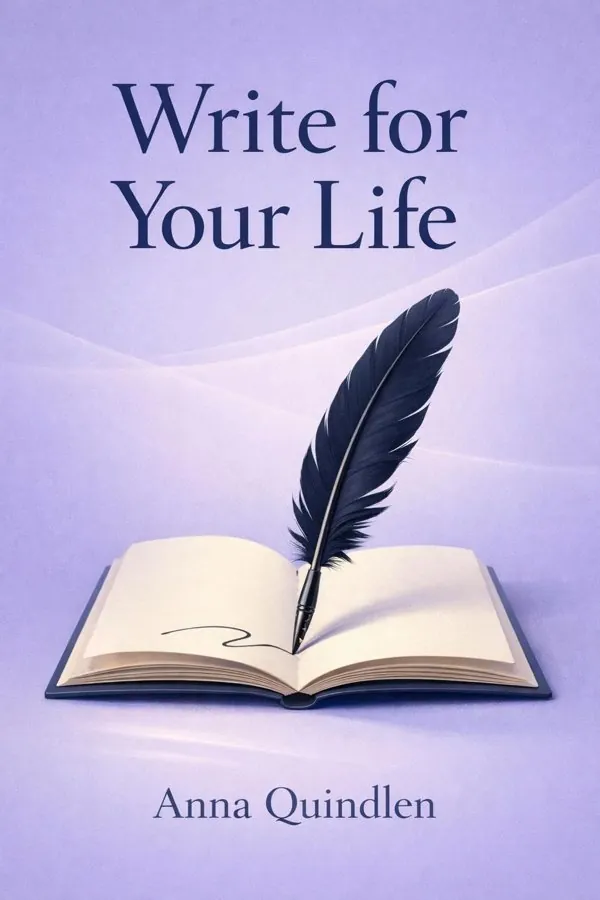
Write for Your Life: Summary & Key Insights
 10 min10 chaptersAudio available
Key Takeaways from Write for Your Life
The most important writing in our lives often never appears in a book, a newspaper, or even a public post.
We often think we write down what we already know, but Quindlen suggests the opposite: we write to discover what we think and feel.
Few acts are more intimate than choosing words for another person.
What survives of any generation depends largely on what it writes down.
The digital age has made communication constant, but not always meaningful.
What Is Write for Your Life About?
Write for Your Life by Anna Quindlen is a writing book spanning 10 pages. Anna Quindlen’s Write for Your Life is a passionate defense of writing as an essential human act, not a specialized talent reserved for professionals. In this warm, reflective book, Quindlen argues that writing helps us understand what we feel, preserve what matters, and connect more honestly with other people. She moves beyond the idea of writing as publication or performance and restores it to its deepest purpose: making meaning out of life. Drawing from her experience as a Pulitzer Prize–winning journalist, novelist, and longtime observer of ordinary lives, Quindlen shows how letters, journals, lists, notes, stories, and private reflections all shape who we are. She also addresses what is lost in an age of speed, screens, and abbreviated communication, reminding readers that careful language fosters attention, empathy, and memory. This book matters because it reclaims writing as both practical and intimate. Whether you are an experienced writer, a hesitant beginner, or someone who has not written by hand in years, Quindlen offers a compelling invitation: write not to impress, but to remember, to heal, to witness, and to live more fully.
This FizzRead summary covers all 10 key chapters of Write for Your Life in approximately 10 minutes, distilling the most important ideas, arguments, and takeaways from Anna Quindlen's work. Also available as an audio summary and Key Quotes Podcast.
Write for Your Life
Anna Quindlen’s Write for Your Life is a passionate defense of writing as an essential human act, not a specialized talent reserved for professionals. In this warm, reflective book, Quindlen argues that writing helps us understand what we feel, preserve what matters, and connect more honestly with other people. She moves beyond the idea of writing as publication or performance and restores it to its deepest purpose: making meaning out of life. Drawing from her experience as a Pulitzer Prize–winning journalist, novelist, and longtime observer of ordinary lives, Quindlen shows how letters, journals, lists, notes, stories, and private reflections all shape who we are. She also addresses what is lost in an age of speed, screens, and abbreviated communication, reminding readers that careful language fosters attention, empathy, and memory. This book matters because it reclaims writing as both practical and intimate. Whether you are an experienced writer, a hesitant beginner, or someone who has not written by hand in years, Quindlen offers a compelling invitation: write not to impress, but to remember, to heal, to witness, and to live more fully.
Who Should Read Write for Your Life?
This book is perfect for anyone interested in writing and looking to gain actionable insights in a short read. Whether you're a student, professional, or lifelong learner, the key ideas from Write for Your Life by Anna Quindlen will help you think differently.
- ✓Readers who enjoy writing and want practical takeaways
- ✓Professionals looking to apply new ideas to their work and life
- ✓Anyone who wants the core insights of Write for Your Life in just 10 minutes
Want the full summary?
Get instant access to this book summary and 100K+ more with Fizz Moment.
Get Free SummaryAvailable on App Store • Free to download
Key Chapters
The most important writing in our lives often never appears in a book, a newspaper, or even a public post. It lives in grocery lists, journal entries, thank-you notes, messages to children, postcards to friends, and scraps of thought written in the margins of ordinary days. Anna Quindlen insists that these forms of writing matter because they are woven into daily life. They help us organize, remember, comfort, confess, and connect. In a culture that often celebrates polished publication, she reminds us that writing’s deepest value is not prestige but usefulness and truth.
Everyday writing gives shape to moments that would otherwise disappear. A note tucked into a lunchbox says more than information; it says presence. A journal entry after a hard day turns confusion into language. A letter to an old friend revives a bond that quick digital exchanges may not fully sustain. Even a simple family recipe card can preserve a voice, a gesture, a way of being that future generations can touch. Writing turns the fleeting into the tangible.
This perspective is liberating because it removes the pressure to be literary. You do not need to produce beautiful prose for writing to be meaningful. You only need to pay attention long enough to put life into words. If you begin to treat writing as part of living rather than a performance, you will likely write more honestly and more often.
Actionable takeaway: Start a daily writing habit built around ordinary life. Write one note, one paragraph, or one memory each day, with no goal except to capture something real before it vanishes.
We often think we write down what we already know, but Quindlen suggests the opposite: we write to discover what we think and feel. Writing is a conversation with the self, one that can expose contradictions, clarify desires, and bring hidden emotions into view. A feeling that seems vague in the mind often becomes unmistakable once it is given words. That is why writing can feel unsettling as well as freeing; it reveals us to ourselves.
This kind of self-discovery happens because writing slows thought down. In conversation, we improvise. In our minds, we jump from one fragment to another. On the page, however, we must choose. We decide what happened first, what mattered most, what we really meant. That act of selection creates insight. A person writing about anger may discover grief underneath it. Someone describing a happy childhood may notice patterns of loneliness they had never fully named. The page becomes a mirror, but one that reflects with more precision than memory alone.
Quindlen’s argument is especially useful for anyone going through transition: grief, divorce, parenthood, career change, illness, or aging. In uncertain periods, writing offers a stable place to think. You do not need to arrive with clarity; writing helps produce it. Freewriting, personal essays, unsent letters, and reflective journaling are all practical ways to begin.
Actionable takeaway: When you feel emotionally tangled, set a timer for ten minutes and write without stopping. Do not edit or judge. At the end, underline the sentence that feels most true. That is often where understanding begins.
Few acts are more intimate than choosing words for another person. Quindlen argues that writing creates a different kind of connection than speech because it carries intention, permanence, and care. Spoken words vanish quickly, but written words can be revisited, reread, saved, and inherited. A letter, a card, or even a thoughtful email says: I paused long enough to consider you carefully. In that pause, relationship deepens.
Writing allows us to say things that are hard to express aloud. Gratitude, apology, admiration, forgiveness, and grief often become clearer on the page. Many people find that they can write what they cannot comfortably speak. A parent may write to a child about family history or hope for the future. A friend may write after a loss, offering presence when conversation feels impossible. A partner may put into words a tenderness that daily routine usually leaves implied. Written language gives emotional weight to what matters.
Quindlen also hints at a broader social function: writing helps us reach beyond our immediate circles. Essays, memoirs, and stories allow strangers to recognize themselves in one another. Reading another person’s words can soften judgment and enlarge empathy. In this way, writing is not just communication; it is bridge-building.
In practical terms, writing can strengthen relationships in simple ways. Keep up correspondence with someone you care about. Write family stories for younger generations. Send a note instead of a reaction emoji. The depth of human connection often depends on the depth of expression.
Actionable takeaway: Choose one person this week and write them a thoughtful message, letter, or email that says something meaningful you have left unsaid. Be specific, sincere, and unhurried.
What survives of any generation depends largely on what it writes down. Quindlen places personal writing in a larger historical context, reminding readers that diaries, letters, speeches, newspaper columns, and private notebooks become the record of how people actually lived. Official histories tell us what happened; personal writing tells us what it felt like. That distinction matters. Without ordinary voices, the past becomes abstract.
Throughout history, people have used writing to document wars, migrations, family routines, social changes, and inner life. A grandmother’s diary can reveal more about a period than a textbook chapter. A bundle of letters can capture class, language, fear, humor, and affection in ways no summary can. Writing preserves the textures of living: the slang people used, the worries they carried, the meals they cooked, the values they passed down. Culture is not stored only in institutions; it is stored in the words of individuals.
Quindlen’s point also applies to the present. If people stop writing with fullness and care, future generations inherit less of what made this era human. Photos show faces; writing shows consciousness. A caption may mark an event, but a paragraph can preserve its meaning. This is why family histories, personal memoirs, and reflective notes matter. They resist forgetting.
You do not need to be famous to become a witness to your time. Record holidays, neighborhoods, local customs, political tensions, family sayings, recipes, losses, and celebrations. What feels ordinary today may be invaluable tomorrow.
Actionable takeaway: Write a one-page account of a family tradition, a neighborhood memory, or a major event as you experienced it. Save it somewhere others can find it in the future.
The digital age has made communication constant, but not always meaningful. Quindlen reflects on what is gained through speed and convenience, while warning about what may be lost when language becomes hurried, abbreviated, and disposable. Texts, captions, and instant replies keep us connected, but they can also train us to communicate in fragments rather than fully formed thought. Writing, in Quindlen’s richer sense, requires more than transmission; it requires attention.
To write well, even privately, is to linger long enough to notice nuance. It means resisting the impulse to reduce every feeling to a shorthand symbol or every experience to a quick update. Digital tools are not the enemy, but they can encourage speed over reflection. When every message is expected immediately, there is less room for contemplation. Yet contemplation is precisely what makes writing clarifying and humane.
Quindlen’s argument is not nostalgic for nostalgia’s sake. Instead, she invites readers to preserve depth within modern life. That may mean journaling by hand, composing longer emails, drafting personal reflections before posting publicly, or keeping digital notes that are not meant for anyone else. The issue is not the medium alone, but the mindset. Intentional writing asks us to think before we send, to feel before we summarize.
In a noisy culture, writing can become a form of resistance against distraction. It creates a private space where thought is allowed to ripen. That space is increasingly valuable.
Actionable takeaway: Set aside fifteen minutes each day for undistracted writing with notifications off. Use that time for reflection, not messaging, and notice how the quality of your thinking changes.
Many people do not avoid writing because they have nothing to say; they avoid it because they are afraid of saying it badly. Quindlen challenges the belief that writing must be elegant, impressive, or correct from the start. Fear and perfectionism silence countless voices before they begin. The inner critic says your words are clumsy, your memories unimportant, your grammar insufficient, your story already told by someone better. But this standard confuses writing with performance. Most meaningful writing begins in imperfection.
Quindlen’s encouragement is practical and generous: writing is a process of discovery, not a display of mastery. First drafts are supposed to be uncertain. Journal pages can be repetitive. Letters can be awkward. Personal reflections can wander before they arrive somewhere true. The point is not to produce flawless language on demand; the point is to keep going until honesty emerges.
This idea is especially empowering for nonprofessional writers. You do not need credentials to keep a notebook, write your memories, or record your thoughts. Fear shrinks when writing becomes regular. If you write often enough, you stop expecting brilliance every time. You begin to trust revision, patience, and practice.
A useful strategy is to separate drafting from judging. Write quickly at first, then return later to shape and refine. If the page feels intimidating, lower the stakes: describe a room, recount a conversation, or write to one imagined reader rather than to the world. Momentum matters more than polish in the beginning.
Actionable takeaway: For one week, write a page a day with one rule only: do not edit while drafting. Let the words be imperfect. Save judgment for a later pass, if any.
Pain often resists easy explanation, yet writing can make suffering more bearable by giving it form. Quindlen presents writing as a tool for healing not because it erases hardship, but because it helps us face it. Loss, illness, disappointment, trauma, loneliness, and fear can feel shapeless when kept inside. On the page, they become narratable. Even when answers are unavailable, language can offer containment.
Healing through writing happens in several ways. First, it allows emotional release. Writing privately about grief or anger can reduce the pressure of carrying everything silently. Second, it creates coherence. When people describe what happened and how it affected them, they begin to build a story instead of reliving isolated fragments. Third, it can restore agency. Suffering often makes people feel powerless; writing lets them become witnesses to their own experience rather than only victims of it.
This does not mean all writing about pain must be confessional or dramatic. Some people heal through direct testimony; others through lists, poems, prayers, memories, or letters they never send. A widow may write down daily moments after a spouse’s death. A patient may keep notes during treatment. Someone emerging from burnout may journal to understand what was ignored for too long. Writing gives difficult experience a place to go.
Quindlen’s point is compassionate rather than sentimental. Writing is not a cure. But it can accompany recovery, mourning, and resilience with dignity.
Actionable takeaway: If you are carrying something heavy, write a private letter beginning with the words, “What I have not been able to say is…” Keep it for yourself unless sharing feels truly helpful.
Good writing begins before the first sentence. It begins with noticing. Quindlen emphasizes the practice of observation because writing depends on attention to the world: the way light falls across a kitchen table, the phrase a child repeats, the silence after bad news, the posture of a stranger on a train. People often imagine writing as invention, but much of it is disciplined seeing. We cannot describe what we have not taken the time to notice.
Observation strengthens all forms of writing, from private journals to public essays. Detailed noticing makes memory more vivid and language more precise. Instead of writing “I had a difficult day,” an observant writer may record the cold coffee untouched on the desk, the unanswered call, the feeling of holding back tears in the grocery aisle. Such details do more than decorate writing; they reveal meaning. They let truth appear through the concrete.
Observation also sharpens empathy. When we attend carefully to how others speak, move, and inhabit their lives, we become less superficial in our judgments. This matters not just for writers, but for citizens, friends, parents, and partners. To observe is to respect reality enough not to flatten it.
The skill can be practiced anywhere. Carry a notebook or use a notes app. Describe rooms, overheard conversations, weather, gestures, routines, and changes over time. If you revisit these notes later, you will discover that they hold more emotional and narrative material than you expected.
Actionable takeaway: Once a day, pause for five minutes and write down five precise details about your surroundings or a recent interaction. Focus on what is specific, sensory, and revealing.
Human beings are meaning-making creatures, and storytelling is one of our oldest tools for making sense of experience. Quindlen treats storytelling not merely as entertainment, but as a way of organizing life. We tell stories about childhood, love, work, failure, family, and change because narrative helps us understand cause, consequence, identity, and hope. Without stories, events remain scattered. With stories, they begin to form a pattern.
This does not mean every life has a neat arc. In fact, Quindlen’s sensibility honors messiness. Storytelling is valuable precisely because life is often unresolved. By telling what happened, we decide what deserves emphasis. By shaping a beginning, middle, and end, even provisionally, we transform chaos into something communicable. A family’s move across states becomes more than logistics; it becomes a story about reinvention. A career setback becomes a story about reevaluation. A childhood memory becomes a story about inheritance and identity.
Stories also travel. They allow us to pass lessons, values, humor, warnings, and tenderness from one person to another. Children often remember family stories more vividly than abstract advice. Communities remember themselves through shared narratives. Nations argue over stories because stories influence what people believe matters.
For everyday writers, storytelling can be simple: record one scene from your past, one turning point, one mistake that changed you, one piece of advice you resisted and later understood. The story does not have to be dramatic to be meaningful. It only has to be honest enough to illuminate something true.
Actionable takeaway: Write a one-page story about a moment that changed you. Focus on one scene, one conflict, and one lesson rather than trying to summarize your entire life.
Memory is fragile, selective, and easily reshaped by time. Quindlen underscores writing’s power to preserve what the mind alone cannot reliably hold. We assume we will remember the details that matter most, yet years later we often retain only outlines. Writing protects against that erosion. It captures names, voices, settings, emotions, and fleeting observations that would otherwise dissolve.
This is especially important because memory is more than storage; it is identity. The stories we remember about our lives help define who we are. When those stories fade, parts of the self can fade with them. Writing creates an external memory, one we can revisit when grief blurs the past, when age alters recall, or when younger generations ask where they came from. A notebook can become a second mind, preserving experiences that later acquire unexpected significance.
Quindlen’s vision of memory is not limited to grand events. Often, what we most cherish are the ordinary moments: the joke someone always told at dinner, the smell of a parent’s coat in winter, the first apartment with its broken radiator, the baby’s invented word, the route walked to school. These details rarely survive unless someone writes them down. Once recorded, however, they can outlast us.
A practical memory practice might include keeping a family journal, writing annual reflections, labeling photographs with stories instead of just dates, or jotting down snippets after gatherings and milestones. The goal is not completeness. It is preservation of what feels alive now.
Actionable takeaway: Tonight, write down one memory you would be sorry to lose in ten years. Include at least five concrete details so that the moment remains vivid when you read it again later.
All Chapters in Write for Your Life
About the Author
Anna Quindlen is an American journalist, columnist, and author whose work has long explored the intersection of personal life and public culture. She began her career in journalism and rose to national prominence through her columns for The New York Times, where her writing stood out for its clarity, compassion, and moral seriousness. In 1992, she won the Pulitzer Prize for Commentary. Quindlen has since written numerous nonfiction books and bestselling novels, often focusing on family, identity, memory, social change, and the textures of everyday life. Her voice is known for being reflective, accessible, and emotionally intelligent. In Write for Your Life, she brings together her gifts as both observer and storyteller to argue that writing is not just an artistic practice, but a vital tool for understanding, preserving, and enriching human experience.
Get This Summary in Your Preferred Format
Read or listen to the Write for Your Life summary by Anna Quindlen anytime, anywhere. FizzRead offers multiple formats so you can learn on your terms — all free.
Available formats: App · Audio · PDF · EPUB — All included free with FizzRead
Download Write for Your Life PDF and EPUB Summary
Key Quotes from Write for Your Life
“The most important writing in our lives often never appears in a book, a newspaper, or even a public post.”
“We often think we write down what we already know, but Quindlen suggests the opposite: we write to discover what we think and feel.”
“Few acts are more intimate than choosing words for another person.”
“What survives of any generation depends largely on what it writes down.”
“The digital age has made communication constant, but not always meaningful.”
Frequently Asked Questions about Write for Your Life
Write for Your Life by Anna Quindlen is a writing book that explores key ideas across 10 chapters. Anna Quindlen’s Write for Your Life is a passionate defense of writing as an essential human act, not a specialized talent reserved for professionals. In this warm, reflective book, Quindlen argues that writing helps us understand what we feel, preserve what matters, and connect more honestly with other people. She moves beyond the idea of writing as publication or performance and restores it to its deepest purpose: making meaning out of life. Drawing from her experience as a Pulitzer Prize–winning journalist, novelist, and longtime observer of ordinary lives, Quindlen shows how letters, journals, lists, notes, stories, and private reflections all shape who we are. She also addresses what is lost in an age of speed, screens, and abbreviated communication, reminding readers that careful language fosters attention, empathy, and memory. This book matters because it reclaims writing as both practical and intimate. Whether you are an experienced writer, a hesitant beginner, or someone who has not written by hand in years, Quindlen offers a compelling invitation: write not to impress, but to remember, to heal, to witness, and to live more fully.
More by Anna Quindlen
You Might Also Like
The Art of Perspective
Christopher Castellani
10 min
Making a Point: The Persnickety Story of English Punctuation
David Crystal
10 min
The Elements Of Eloquence: How To Turn The Perfect English Phrase
Mark Forsyth
10 min
The Pocket Muse: Ideas and Inspirations for Writing
Monica Wood
10 min
A Little Book on Form: An Exploration into the Formal Imagination of Poetry
Robert Hass
10 min
Adventures In The Screen Trade: A Personal View Of Hollywood And Screenwriting
William Goldman
10 minBrowse by Category
Ready to read Write for Your Life?
Get the full summary and 100K+ more books with Fizz Moment.