
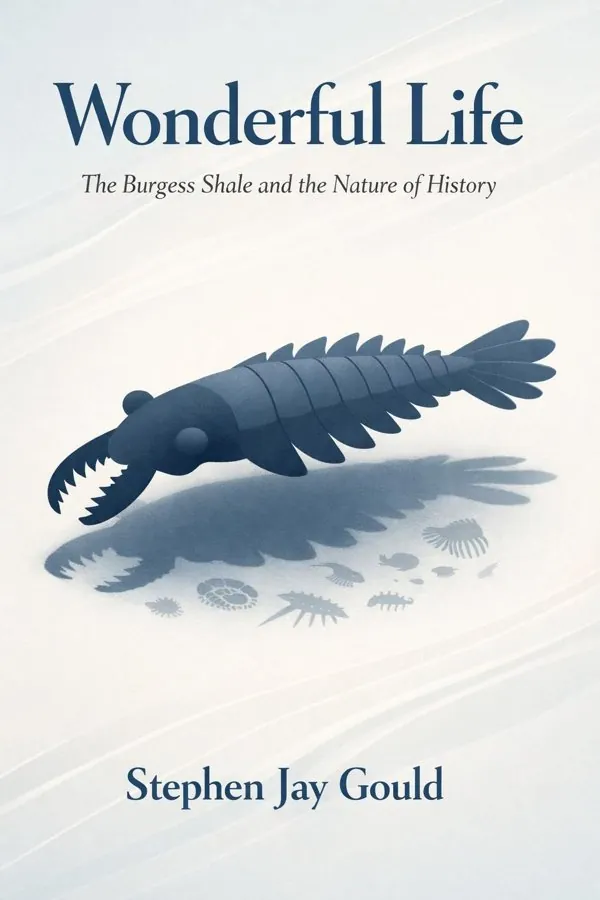
Wonderful Life: The Burgess Shale and the Nature of History: Summary & Key Insights
 10 min10 chaptersAudio available
Key Takeaways from Wonderful Life: The Burgess Shale and the Nature of History
Sometimes a single discovery does not just add facts to science—it forces science to ask different questions.
A discovery can be revolutionary, yet still be interpreted through old assumptions.
Scientific progress often begins when someone dares to look again.
Nature is under no obligation to fit neatly inside human filing systems.
The past is not a straight road; it is a branching path littered with accidents.
What Is Wonderful Life: The Burgess Shale and the Nature of History About?
Wonderful Life: The Burgess Shale and the Nature of History by Stephen Jay Gould is a life_science book spanning 10 pages. What if the history of life was not a steady climb toward complexity, intelligence, or humanity, but a fragile sequence of accidents that could easily have turned out differently? In Wonderful Life, Stephen Jay Gould uses one of the most astonishing fossil discoveries in science—the Burgess Shale of British Columbia—to challenge our deepest assumptions about evolution. These exquisitely preserved Cambrian fossils reveal a world filled with bizarre body plans and experimental forms of life, many of which left no descendants. Gould argues that this early explosion of diversity suggests evolution is shaped not only by natural selection, but also by contingency: unpredictable events, historical quirks, and mass extinctions that redirect the course of life. The book matters because it reframes evolution as a historical process rather than a march of progress. Gould, a Harvard paleontologist, evolutionary biologist, and gifted historian of science, brings both scientific rigor and literary flair to the subject. He combines fossil evidence, intellectual history, and philosophical reflection to show that humans are not the inevitable pinnacle of nature, but one improbable outcome among many. The result is a profound and humbling meditation on science, chance, and our place in time.
This FizzRead summary covers all 10 key chapters of Wonderful Life: The Burgess Shale and the Nature of History in approximately 10 minutes, distilling the most important ideas, arguments, and takeaways from Stephen Jay Gould's work. Also available as an audio summary and Key Quotes Podcast.
Wonderful Life: The Burgess Shale and the Nature of History
What if the history of life was not a steady climb toward complexity, intelligence, or humanity, but a fragile sequence of accidents that could easily have turned out differently? In Wonderful Life, Stephen Jay Gould uses one of the most astonishing fossil discoveries in science—the Burgess Shale of British Columbia—to challenge our deepest assumptions about evolution. These exquisitely preserved Cambrian fossils reveal a world filled with bizarre body plans and experimental forms of life, many of which left no descendants. Gould argues that this early explosion of diversity suggests evolution is shaped not only by natural selection, but also by contingency: unpredictable events, historical quirks, and mass extinctions that redirect the course of life.
The book matters because it reframes evolution as a historical process rather than a march of progress. Gould, a Harvard paleontologist, evolutionary biologist, and gifted historian of science, brings both scientific rigor and literary flair to the subject. He combines fossil evidence, intellectual history, and philosophical reflection to show that humans are not the inevitable pinnacle of nature, but one improbable outcome among many. The result is a profound and humbling meditation on science, chance, and our place in time.
Who Should Read Wonderful Life: The Burgess Shale and the Nature of History?
This book is perfect for anyone interested in life_science and looking to gain actionable insights in a short read. Whether you're a student, professional, or lifelong learner, the key ideas from Wonderful Life: The Burgess Shale and the Nature of History by Stephen Jay Gould will help you think differently.
- ✓Readers who enjoy life_science and want practical takeaways
- ✓Professionals looking to apply new ideas to their work and life
- ✓Anyone who wants the core insights of Wonderful Life: The Burgess Shale and the Nature of History in just 10 minutes
Want the full summary?
Get instant access to this book summary and 100K+ more with Fizz Moment.
Get Free SummaryAvailable on App Store • Free to download
Key Chapters
Sometimes a single discovery does not just add facts to science—it forces science to ask different questions. That is what happened with the Burgess Shale, a fossil deposit discovered in 1909 by Charles Doolittle Walcott in the Canadian Rockies. Unlike ordinary fossil beds, the Burgess Shale preserved soft-bodied organisms from the Cambrian period, around 508 million years ago. This meant paleontologists could study not only shells and bones, but entire creatures with limbs, guts, appendages, and anatomies unlike anything alive today.
Gould presents the Burgess Shale as a window into a crucial moment in evolutionary history: the Cambrian explosion, when animal life diversified dramatically. Before this discovery, scientists had limited access to the full scope of early animal diversity because most soft-bodied forms rarely fossilize. The Burgess fossils revealed a world packed with strange organisms, many so unfamiliar that they seemed to challenge the standard categories of zoology.
The importance of the site is not just scientific but conceptual. It suggests that early animal life may have explored many more anatomical possibilities than survive now. In modern ecosystems, the range of basic body architectures appears relatively constrained. The Burgess Shale hints that this narrowness may be misleading—a result of extinction rather than destiny.
This insight has practical value beyond paleontology. In business, culture, and technology, what survives is often mistaken for what was best. But survival may reflect timing, luck, and circumstance as much as superiority. Looking at early evolutionary history reminds us not to confuse current success with inevitable success.
Actionable takeaway: When assessing any system—biological, social, or professional—ask not only what survived, but what alternatives disappeared and why.
A discovery can be revolutionary, yet still be interpreted through old assumptions. Gould gives Charles Doolittle Walcott a central role not only as the discoverer of the Burgess Shale, but as an example of how scientific frameworks shape what researchers are able to see. Walcott was a highly accomplished paleontologist, but he approached the fossils with a strong expectation that early animal life must fit into familiar modern groups. As a result, he often classified strange organisms as primitive members of known phyla rather than as fundamentally distinct forms.
Gould does not present this as simple incompetence. Instead, he uses Walcott to illustrate a larger truth about science: data never arrive without interpretation. Scientists bring habits, training, and cultural assumptions to every specimen. Walcott lived in a scientific era that favored order, continuity, and evolutionary progress. In that framework, the weird creatures of the Burgess Shale were forced into recognizable boxes.
This matters because misinterpretation can delay understanding for decades. Walcott had the fossils, but not the conceptual flexibility to recognize their full significance. That recognition only emerged later, when new researchers examined the material with different tools and fewer preconceptions.
The lesson applies widely. Organizations often dismiss disruptive ideas because they do not fit existing categories. A company may see a new market as a variation of an old one. A student may misread a problem because they assume they already know its type. Innovation often requires reclassifying what first seemed familiar.
Actionable takeaway: Periodically revisit old evidence, decisions, or assumptions and ask whether you are interpreting them through an outdated mental model.
Scientific progress often begins when someone dares to look again. Decades after Walcott’s initial work, paleontologists Harry Whittington, Derek Briggs, and Simon Conway Morris reexamined the Burgess Shale fossils with fresh techniques and fresh questions. Their work, beginning in the mid-twentieth century, transformed the Burgess Shale from an interesting fossil deposit into one of the most important arguments in evolutionary thought.
These researchers carefully prepared specimens, compared anatomical features in detail, and resisted the urge to force strange animals into established groups too quickly. Their analyses showed that many Burgess organisms were not simply odd crustaceans, worms, or arthropods, but creatures with body plans that defied easy classification. Some, like Opabinia with its five eyes and frontal nozzle, looked almost absurd by modern standards. Others, like Hallucigenia, were reconstructed so strangely at first that they became symbols of how alien Cambrian life could appear.
Gould uses this scientific detective story to show how knowledge advances: not through uninterrupted certainty, but through correction, reinterpretation, and debate. The reanalysis also demonstrates the value of technical craftsmanship. Better preparation methods and closer anatomical study changed the meaning of fossils that had been sitting in drawers for decades.
In everyday life, this is a reminder that breakthroughs are often hidden in neglected archives, familiar datasets, or old experiences. A business can rediscover value in unused customer feedback. A researcher can find a pattern in previously ignored data. A person can reinterpret a past failure as a source of strategic insight.
Actionable takeaway: Build a habit of revisiting overlooked material—old notes, shelved projects, stored data—because the next breakthrough may come from seeing existing information differently.
Nature is under no obligation to fit neatly inside human filing systems. One of Gould’s most memorable themes is that the Burgess Shale creatures challenged traditional taxonomy, the scientific practice of classifying organisms into nested groups. Many fossils seemed so unusual that they raised a disturbing possibility: early animal evolution may have included a far broader range of basic anatomical designs than the modern world suggests.
Normally, zoologists classify animals into phyla—major body-plan categories such as arthropods, mollusks, and chordates. Walcott tended to interpret Burgess fossils as early representatives of known phyla. But Gould argues that some of these creatures may represent entirely separate experiments in multicellular design, perhaps worthy of recognition as distinct high-level groups. Whether every one of Gould’s specific claims has stood unchanged is less important than the broader point: the early history of animals was more exuberant, more experimental, and more structurally diverse than many had assumed.
This directly challenges the tendency to treat present-day diversity as a complete map of life’s potential. Modern lineages are just the winners of a historical filter. If most alternatives were eliminated, then today’s taxonomies reflect survival, not the full inventory of what was once possible.
The practical implication is powerful. In many domains, categories are useful but limiting. Educational systems classify intelligence narrowly. Companies classify talent by job title. Markets classify consumers by fixed segments. Yet reality often includes hybrid forms and overlooked possibilities.
Actionable takeaway: Use categories as tools, not truths. When something does not fit your framework, consider whether the framework—not the object—is what needs revision.
The past is not a straight road; it is a branching path littered with accidents. This is the heart of Gould’s argument about contingency. Evolution, in his account, is not merely the predictable sorting of better adaptations through natural selection. It is also a historical process shaped by chance events, environmental disruptions, and inherited quirks that can lock lineages onto particular paths.
Contingency means that outcomes depend on prior events that could easily have been otherwise. A storm, a geographic split, a mutation, or a mass extinction may redirect the future in ways no law of progress could predict. The Burgess Shale supports this view because it reveals many anatomically distinct creatures early in animal history, most of which disappeared. Their extinction was not necessarily proof of inferiority. In many cases, they may simply have lost the lottery of survival.
Gould is careful not to deny natural selection. Organisms still adapt to local conditions. But adaptation operates within a historical setting. Selection works on what exists, not on all conceivable possibilities. If history begins from different starting points or passes through different bottlenecks, selection may produce very different worlds.
This idea matters in real life because people and institutions often tell overly tidy stories about success. We assume outcomes were deserved, predictable, or earned by superior design alone. Yet careers, companies, and social movements are also shaped by timing, context, and random shocks. Recognizing contingency can make us more humble in victory and more compassionate in failure.
Actionable takeaway: When evaluating outcomes, separate skill from circumstance and ask how luck, timing, and inherited constraints helped shape the result.
Few scientific thought experiments are as memorable as Gould’s idea of replaying the tape of life. If we could return to the Cambrian period and let evolution run again from the same starting point, would the same forms of life emerge? Gould’s answer is bold: probably not. The outcomes would likely be radically different, because small historical changes could cascade into entirely new evolutionary trajectories.
This argument is not that anything could happen at all, or that natural laws do not matter. Physical and biological constraints still shape what organisms can do. But within those constraints, history remains deeply sensitive to contingency. If one Burgess lineage survives instead of another, future ecosystems may develop around different body plans. If a key extinction event unfolds differently, major groups may never rise. Under that view, humans are not the destined endpoint of evolution, but one improbable result among countless unrealized possibilities.
The force of this idea lies in how directly it challenges comforting narratives of inevitability. We often assume that intelligence, complexity, or human-like consciousness had to appear eventually. Gould argues that this confidence is historically unjustified. The tape might replay into a biosphere with no primates, no mammals, and no beings capable of asking these questions.
In modern decision-making, this thought experiment encourages scenario thinking. Businesses often extrapolate current trends as if the future is prewritten. Individuals assume their present path was always obvious. But alternate histories are real and instructive. Strategic resilience comes from imagining different possible tapes.
Actionable takeaway: When planning for the future, develop multiple scenarios instead of betting on a single inevitable outcome.
One of Gould’s sharpest criticisms is aimed not at evolution itself, but at the stories people tell about it. He argues that many readers and even many scientists smuggle in a progressivist narrative: the idea that life naturally advances from simple to complex, from primitive to superior, culminating somehow in humans. Wonderful Life rejects this interpretation. Evolution has direction in local cases—organisms adapt to environments—but it has no built-in global goal.
The Burgess Shale helps expose the illusion. If the history of life were a steady ascent toward modern forms, we would expect early diversity to look crude and limited, with later periods unfolding as predictable improvement. Instead, the Cambrian fossil record reveals startling disparity early on—many radically different body plans appearing near the beginning of complex animal life. Later history, in Gould’s view, reflects pruning more than ascent. Diversity within surviving groups expanded, but the range of basic architectures narrowed.
Gould also points out that complexity is not the sole standard of evolutionary success. Bacteria remain astonishingly successful and dominant in terms of biomass, resilience, and longevity. Human preference for intelligence or complexity says more about human self-regard than about nature’s objectives.
This critique has practical importance because progress narratives distort how we judge societies, careers, technologies, and ourselves. We equate later with better, bigger with superior, and complexity with value. But growth can conceal fragility, and simplicity can be adaptive. Not every change is improvement.
Actionable takeaway: Replace assumptions of automatic progress with careful questions: progress toward what, by whose standard, and at what cost?
We usually think of extinction as an ending, but Gould shows that it is also a shaper of beginnings. The modern living world is not simply the best of all possible evolutionary outcomes. It is the remnant that remained after repeated episodes of elimination. In that sense, extinction is not an unfortunate footnote to evolution—it is one of its most powerful authors.
The Burgess Shale organisms reveal an early burst of anatomical experimentation. Yet most of those experiments vanished. The groups that survived passed through evolutionary bottlenecks and became the ancestors of later animal life. This means the structure of modern biodiversity reflects historical winnowing. The body plans familiar to us are not necessarily the inherently superior ones; they are those that endured a sequence of unpredictable filters.
Gould’s emphasis on extinction weakens simplistic ideas of competition as a fair tournament. A lineage may disappear because of environmental catastrophe, ecological reshuffling, or bad historical timing rather than any deep inferiority. This perspective is important for understanding both natural history and human systems. Industries disappear because regulation changes. Skills become obsolete because technology shifts. Communities decline because of external shocks rather than internal failure alone.
Seeing extinction as historically decisive also encourages preservation. When unique forms vanish—species, languages, institutions, ecosystems—the loss is not just sentimental. It removes future possibilities, narrows diversity, and reshapes what can come next.
Actionable takeaway: Treat preservation of diversity as a strategic priority, because once options are eliminated, future pathways narrow in ways that cannot easily be reversed.
The most unsettling conclusion of Wonderful Life is also its most humane: we are not the preordained center of evolution. Gould uses the Burgess Shale and the logic of contingency to argue that human beings emerged through a chain of events so improbable that, had history been rerun, our species would almost certainly not appear again.
This claim can sound diminishing, but Gould intends the opposite. If humanity is not inevitable, then our existence becomes more precious, not less. We are not nature’s goal; we are one remarkable historical outcome among many alternatives that never came to be. This perspective strips away cosmic entitlement while deepening wonder. It invites gratitude instead of dominance.
Gould also challenges the moral misuse of evolution. If humans are not the apex toward which life strives, then evolution cannot be invoked to justify superiority, hierarchy, or historical destiny. Our intelligence gives us power, but not metaphysical privilege. The same history that produced us also erased countless other possibilities.
In practical terms, this insight can reshape how we think about leadership, success, and identity. People often build self-worth on narratives of necessity—believing they were meant for a role or that their current position proves natural superiority. Gould’s view encourages a humbler and more responsible mindset. If your place is contingent, then what matters is how you use it.
Actionable takeaway: Let contingency cultivate humility—treat your achievements not as proof of destiny, but as opportunities for stewardship, gratitude, and ethical responsibility.
Great science books do more than report findings; they change how readers think about meaning. Wonderful Life stands out because Gould does not stop at anatomy or classification. He connects paleontology to philosophy, asking what the fossil record tells us about history, interpretation, and the human search for significance. The Burgess Shale becomes both a scientific archive and a lens for examining how narratives are built.
A major part of this synthesis is Gould’s historical approach to science itself. He pays attention to the personalities, assumptions, and cultural influences that shaped interpretations of the fossils. In doing so, he reminds readers that science is a disciplined human activity, not a machine that produces truth without context. This does not weaken science; it makes its self-correcting nature more impressive. Error, debate, and revision are not signs of failure but part of how understanding deepens.
Philosophically, Gould’s message is sobering and liberating. History has no guaranteed direction, and nature offers no promise that intelligence or moral worth will prevail. Yet this very absence of predetermined meaning gives human reflection greater importance. If the universe does not assign purpose, then our responsibility to create value becomes more urgent.
This synthesis has broad application. In public policy, medicine, education, and technology, facts alone do not guide decisions. We also need awareness of assumptions, history, and unintended consequences. Gould models a way of thinking that is empirically grounded yet philosophically alert.
Actionable takeaway: Practice intellectual humility by combining evidence with reflection—ask not only what the facts are, but what assumptions shape your interpretation of them.
All Chapters in Wonderful Life: The Burgess Shale and the Nature of History
About the Author
Stephen Jay Gould (1941–2002) was an American paleontologist, evolutionary biologist, historian of science, and one of the most influential science writers of the twentieth century. He spent most of his academic career at Harvard University, where he taught geology and zoology and became widely respected for his work on evolution, fossils, and biological diversity. Gould was also known for his gift for public communication, especially through essays that brought complex scientific ideas to general readers with clarity, wit, and philosophical depth. His work often challenged simplistic ideas about progress, human exceptionalism, and the meaning of evolutionary history. In Wonderful Life, Gould brought together his strengths as a scientist, historian, and essayist to examine the Burgess Shale fossils and argue for the central role of contingency in the history of life.
Get This Summary in Your Preferred Format
Read or listen to the Wonderful Life: The Burgess Shale and the Nature of History summary by Stephen Jay Gould anytime, anywhere. FizzRead offers multiple formats so you can learn on your terms — all free.
Available formats: App · Audio · PDF · EPUB — All included free with FizzRead
Download Wonderful Life: The Burgess Shale and the Nature of History PDF and EPUB Summary
Key Quotes from Wonderful Life: The Burgess Shale and the Nature of History
“Sometimes a single discovery does not just add facts to science—it forces science to ask different questions.”
“A discovery can be revolutionary, yet still be interpreted through old assumptions.”
“Scientific progress often begins when someone dares to look again.”
“Nature is under no obligation to fit neatly inside human filing systems.”
“The past is not a straight road; it is a branching path littered with accidents.”
Frequently Asked Questions about Wonderful Life: The Burgess Shale and the Nature of History
Wonderful Life: The Burgess Shale and the Nature of History by Stephen Jay Gould is a life_science book that explores key ideas across 10 chapters. What if the history of life was not a steady climb toward complexity, intelligence, or humanity, but a fragile sequence of accidents that could easily have turned out differently? In Wonderful Life, Stephen Jay Gould uses one of the most astonishing fossil discoveries in science—the Burgess Shale of British Columbia—to challenge our deepest assumptions about evolution. These exquisitely preserved Cambrian fossils reveal a world filled with bizarre body plans and experimental forms of life, many of which left no descendants. Gould argues that this early explosion of diversity suggests evolution is shaped not only by natural selection, but also by contingency: unpredictable events, historical quirks, and mass extinctions that redirect the course of life. The book matters because it reframes evolution as a historical process rather than a march of progress. Gould, a Harvard paleontologist, evolutionary biologist, and gifted historian of science, brings both scientific rigor and literary flair to the subject. He combines fossil evidence, intellectual history, and philosophical reflection to show that humans are not the inevitable pinnacle of nature, but one improbable outcome among many. The result is a profound and humbling meditation on science, chance, and our place in time.
More by Stephen Jay Gould
The Desert Evolution
Stephen Jay Gould
10 min
Ever Since Darwin: Reflections in Natural History
Stephen Jay Gould
10 min
The Panda’s Thumb: More Reflections in Natural History
Stephen Jay Gould
10 min
Full House: The Spread of Excellence from Plato to Darwin
Stephen Jay Gould
10 minYou Might Also Like
The Selfish Gene
Richard Dawkins
10 min
Awakenings
Oliver Sacks
10 min
Parasite Rex: Inside the Bizarre World of Nature's Most Dangerous Creatures
Carl Zimmer
10 min
The Atlas of Life on Earth
Various
10 min
The Book of Humans: The Story of How We Became Us
Adam Rutherford
10 min
The Horse
Wendy Williams
10 minBrowse by Category
Ready to read Wonderful Life: The Burgess Shale and the Nature of History?
Get the full summary and 100K+ more books with Fizz Moment.