
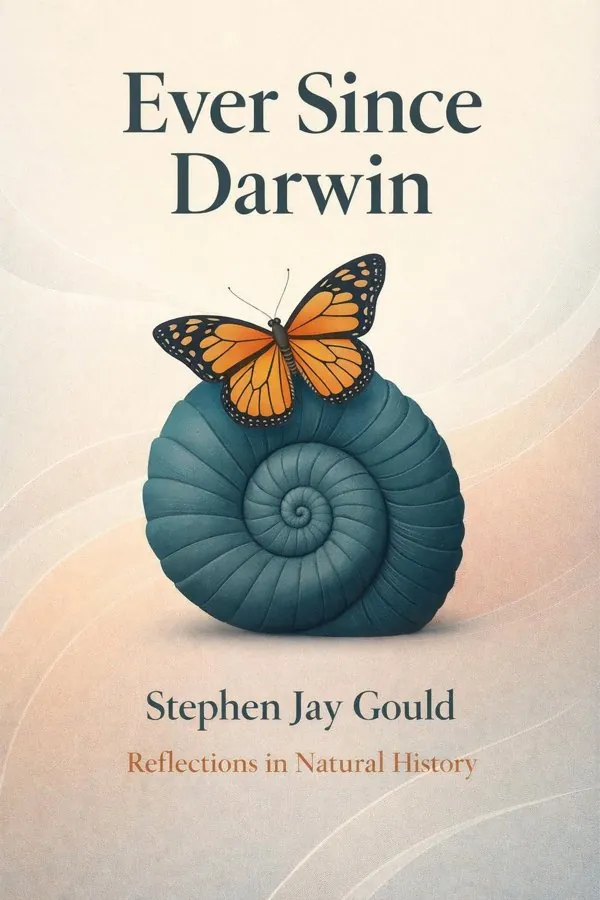
Ever Since Darwin: Reflections in Natural History: Summary & Key Insights
 10 min9 chaptersAudio available
Key Takeaways from Ever Since Darwin: Reflections in Natural History
A truly revolutionary idea does not just answer old questions; it forces us to ask new ones.
Nothing invites misuse more quickly than a scientific idea that seems to explain who we are.
One of the most tempting habits in biology is to assume that every feature must be an optimal adaptation.
Evolution cannot act without differences, and Gould treats variation not as noise around an ideal type but as the fundamental reality of life.
Change in nature is not always smooth, gradual, and continuous at every visible scale.
What Is Ever Since Darwin: Reflections in Natural History About?
Ever Since Darwin: Reflections in Natural History by Stephen Jay Gould is a life_science book spanning 8 pages. Ever Since Darwin: Reflections in Natural History is Stephen Jay Gould’s brilliant invitation to think more carefully about evolution, science, and the stories we tell about nature. First published in 1977, the book gathers essays originally written for Natural History magazine, but it reads as far more than a magazine collection. Gould uses vivid examples from fossils, biology, human origins, and the history of scientific ideas to show that evolution is neither a simple ladder of progress nor a convenient justification for social beliefs. Instead, it is a complex, contingent process shaped by variation, history, and natural selection. What makes the book endure is Gould’s ability to connect big scientific questions with everyday assumptions. He explains Darwin’s legacy, challenges common misunderstandings about adaptation and human superiority, and reveals how scientific errors often arise when cultural bias is mistaken for fact. Gould writes with the authority of a leading paleontologist and evolutionary theorist, yet with the clarity of a gifted essayist. For readers curious about life science, scientific reasoning, or the deep history of life, this book remains a sharp, humane, and intellectually rewarding classic.
This FizzRead summary covers all 9 key chapters of Ever Since Darwin: Reflections in Natural History in approximately 10 minutes, distilling the most important ideas, arguments, and takeaways from Stephen Jay Gould's work. Also available as an audio summary and Key Quotes Podcast.
Ever Since Darwin: Reflections in Natural History
Ever Since Darwin: Reflections in Natural History is Stephen Jay Gould’s brilliant invitation to think more carefully about evolution, science, and the stories we tell about nature. First published in 1977, the book gathers essays originally written for Natural History magazine, but it reads as far more than a magazine collection. Gould uses vivid examples from fossils, biology, human origins, and the history of scientific ideas to show that evolution is neither a simple ladder of progress nor a convenient justification for social beliefs. Instead, it is a complex, contingent process shaped by variation, history, and natural selection.
What makes the book endure is Gould’s ability to connect big scientific questions with everyday assumptions. He explains Darwin’s legacy, challenges common misunderstandings about adaptation and human superiority, and reveals how scientific errors often arise when cultural bias is mistaken for fact. Gould writes with the authority of a leading paleontologist and evolutionary theorist, yet with the clarity of a gifted essayist. For readers curious about life science, scientific reasoning, or the deep history of life, this book remains a sharp, humane, and intellectually rewarding classic.
Who Should Read Ever Since Darwin: Reflections in Natural History?
This book is perfect for anyone interested in life_science and looking to gain actionable insights in a short read. Whether you're a student, professional, or lifelong learner, the key ideas from Ever Since Darwin: Reflections in Natural History by Stephen Jay Gould will help you think differently.
- ✓Readers who enjoy life_science and want practical takeaways
- ✓Professionals looking to apply new ideas to their work and life
- ✓Anyone who wants the core insights of Ever Since Darwin: Reflections in Natural History in just 10 minutes
Want the full summary?
Get instant access to this book summary and 100K+ more with Fizz Moment.
Get Free SummaryAvailable on App Store • Free to download
Key Chapters
A truly revolutionary idea does not just answer old questions; it forces us to ask new ones. That is what Darwin accomplished, and Gould’s opening essays make clear that Darwin’s legacy goes far beyond the technical mechanism of natural selection. Before Darwin, many people explained life’s diversity through fixed designs, essential types, or divine plans that placed humans at the center. Darwin replaced that static picture with descent with modification: species change over time, share common ancestry, and are shaped by natural processes rather than predetermined purpose.
Gould emphasizes that this shift was philosophically unsettling because it removed humanity from a privileged position in nature. Evolution suggests continuity rather than separation between humans and other organisms. It also replaces certainty with history. Living things are not ideal forms; they are products of accumulated change, adaptation, and constraint.
In practical terms, this way of thinking matters whenever we classify organisms, interpret fossils, or discuss what is “natural.” For example, medicine increasingly relies on evolutionary thinking to understand antibiotic resistance, viral change, and why certain anatomical vulnerabilities persist. Socially, Darwin’s influence reminds us to be cautious about claims that current arrangements reflect timeless design or destiny.
Gould also highlights that Darwin’s greatness lay partly in his method: careful observation, willingness to challenge intuition, and patience with complexity. Evolution is not a slogan but a framework for understanding living systems historically.
Actionable takeaway: when evaluating any claim about biology, ask first, “What historical process produced this trait or pattern?” That Darwinian question often reveals more than assumptions about purpose or perfection.
Nothing invites misuse more quickly than a scientific idea that seems to explain who we are. Gould argues that human evolution has repeatedly been twisted into moral, political, and social narratives that science cannot support. Instead of treating evolution as a descriptive account of biological change, people often convert it into a ranking system, using it to justify superiority, inequality, or inevitability.
Gould is especially alert to the dangers of reading human history as a march toward perfection. Fossil evidence does not show a straight line from primitive to advanced; it shows branching diversity, experimentation, extinction, and contingency. The popular image of evolution as a procession from ape to human oversimplifies both ancestry and variation. Humans are not the predetermined goal of evolution but one twig on a large, irregular tree.
This matters far beyond paleoanthropology. Misreadings of evolution have been used to support racism, sexism, and deterministic claims about intelligence or behavior. Gould insists that scientific descriptions of biological difference do not dictate social value or moral worth. Confusing what exists in nature with what ought to be true in society is a major intellectual error.
A practical example is the way measurements of skulls or brains have historically been treated as objective proof of hierarchy. Gould shows that such work often reflects cultural expectations as much as evidence. Modern readers can see parallels in debates over genetics, intelligence testing, and claims about innate group differences.
Actionable takeaway: whenever someone uses evolution to justify social inequality or moral judgment, separate the evidence from the ideology and ask whether the science is being stretched beyond what it can actually show.
One of the most tempting habits in biology is to assume that every feature must be an optimal adaptation. Gould pushes back against this instinct. Natural selection is powerful, but not every trait exists because it was directly designed by selection for its current use. Some traits are byproducts of other structures, some persist because of historical constraints, and some are simply good enough rather than perfect.
This point is crucial because adaptationist thinking can become lazy storytelling. It is easy to invent a plausible survival advantage for nearly any trait after the fact. Gould urges a more disciplined approach: ask what evidence supports an adaptive explanation, what alternatives exist, and whether the trait may have emerged under different conditions than those we see today.
Consider human anatomy. Our backs, knees, and sinuses are not examples of perfect engineering; they reflect evolutionary compromises built on inherited structures. Likewise, certain animal features may persist not because they are ideal but because evolution works with what already exists. Selection modifies available materials; it does not redesign from scratch.
This insight has broad application. In business, education, or technology, people often assume that what survives is necessarily optimal. Gould’s perspective suggests otherwise: many enduring systems are patched together, historically constrained, and only locally effective. Understanding limits can be more useful than praising efficiency.
Gould’s deeper lesson is intellectual humility. Biological explanation should not stop at the first clever answer. Good science tests whether an adaptation story is necessary, sufficient, and historically grounded.
Actionable takeaway: when you encounter a neat explanation for why a trait, behavior, or system exists, ask what evidence supports adaptation and what role accident, constraint, or history might also have played.
Evolution cannot act without differences, and Gould treats variation not as noise around an ideal type but as the fundamental reality of life. Older ways of thinking often imagined species as fixed essences, with individual differences treated as imperfections. Darwin overturned that view by recognizing variation within populations as the very material on which natural selection works.
Gould builds on this idea to show that averages can mislead. When we focus only on the typical form, we miss the importance of spread, diversity, and outliers. In biology, this means understanding populations rather than abstract ideals. In human affairs, it means recognizing that natural variation is real and cannot be reduced neatly to rigid categories.
A practical example appears in medicine. If doctors rely too heavily on the “average patient,” they may miss how symptoms, drug responses, or risks differ across individuals. In evolution, small differences among organisms can become decisive when environments change. Variation is what allows populations to respond rather than collapse.
Gould also uses variation to challenge simplistic rankings. If diversity within a group is broad, then attempts to define sharp biological hierarchies often rest on exaggeration or selective sampling. This insight connects to his critiques of scientific racism and other abuses of measurement.
The wider philosophical point is powerful: nature is not organized around perfect prototypes. It is full of distributions, overlaps, and historical mixtures. That makes reality messier, but it also makes science more honest.
Actionable takeaway: pay more attention to ranges, distributions, and exceptions rather than relying only on averages. Whether in biology, data analysis, or everyday judgment, real understanding begins when variation is treated as informative, not incidental.
Change in nature is not always smooth, gradual, and continuous at every visible scale. Gould became famous for developing, with Niles Eldredge, the idea of punctuated equilibrium, and the essays in this collection help readers grasp why evolutionary tempo matters. The central argument is not that gradual change never happens, but that the fossil record often shows long periods of relative stability interrupted by geologically rapid episodes of speciation.
This challenged a popular image of evolution as a slow, constant, almost imperceptible transformation within lineages. Gould argues that species may remain relatively unchanged for long stretches because stabilizing conditions and developmental constraints preserve successful forms. Significant change often appears when small, isolated populations branch off and evolve quickly in response to new circumstances.
The importance of this idea lies partly in how we interpret evidence. Gaps in the fossil record are not always failures of preservation hiding smooth transitions; some discontinuities may reflect the actual pattern of evolutionary history. This gives paleontology a more active role in theory rather than reducing fossils to incomplete snapshots.
Beyond biology, punctuated equilibrium has become a useful metaphor for social and organizational change. Institutions may appear stable for years, then shift rapidly under pressure. Personal development can look similar: long stretches of consolidation followed by major transition.
Gould warns, however, against abusing the metaphor. Scientific concepts should illuminate patterns, not become catchphrases detached from evidence.
Actionable takeaway: when studying change, do not assume that progress is always linear. Look for periods of stability, underlying pressures, and the specific conditions that make rapid transformation possible.
If we could replay the history of life, Gould suggests, we should not expect the same outcome. This is one of his most profound themes: evolution is shaped not only by law-like processes such as selection, but also by contingency, accident, and historical sequence. Extinctions, environmental shifts, geographic isolation, and chance survival events all influence what kinds of organisms appear and persist.
That means the living world is not the inevitable unfolding of progress toward complexity or intelligence. Dinosaurs dominated for millions of years; mammals rose after a catastrophic extinction opened ecological space. Countless forms of life flourished and vanished without leading to humans. Our existence depends on a chain of events that could easily have turned out differently.
This perspective transforms how we read natural history. Fossils are not steps toward us; they are records of organisms adapted to their own times. The tree of life is full of dead branches, side branches, and experiments that never became ancestral to present species. Contingency also explains why similar challenges can produce different solutions in different lineages.
In everyday thinking, this idea is a corrective to hindsight bias. Once an outcome occurs, people often invent narratives that make it seem inevitable. Gould reminds us that success frequently depends on timing, context, and chance opportunities as much as intrinsic superiority.
This is relevant in careers, innovation, and politics as well as science. Surviving systems may not be best in every absolute sense; they may simply have been favored by circumstance.
Actionable takeaway: resist stories that treat current outcomes as inevitable. Whether reading history or evaluating present success, ask what accidents, lost alternatives, and contingent events shaped the path that actually occurred.
Scientists seek objectivity, but they are never free from the assumptions of their time. Gould repeatedly shows that scientific ideas emerge within cultural settings that influence which questions are asked, which methods are trusted, and how evidence is interpreted. This does not mean science is merely opinion. It means that scientific progress often requires recognizing and correcting hidden biases.
Gould is especially strong when exposing how social prejudice can wear the mask of measurement. In studies of intelligence, race, sex differences, and human ranking, supposedly neutral procedures have often smuggled in prior expectations. Numbers can lend authority to weak assumptions if researchers do not examine the framework behind the data.
A practical lesson appears whenever people treat quantification as automatically objective. Metrics are useful, but they depend on choices about what to measure, how to define categories, and which comparisons matter. In education, hiring, medicine, and public policy, flawed measures can reinforce the very biases they claim to reveal.
At the same time, Gould does not abandon science. He believes science is valuable precisely because it contains tools for self-correction: peer criticism, historical analysis, better methods, and broader participation. Awareness of bias is not a reason for cynicism; it is a reason for more careful inquiry.
This idea remains highly relevant in modern debates over algorithms, genetics, and social data. The central question is never just whether a study uses statistics, but whether its assumptions, sampling, and interpretation are sound.
Actionable takeaway: when faced with a scientific claim, look beyond the numbers. Ask what categories were created, what assumptions were built in, and whether cultural beliefs may be influencing how the evidence is framed.
Facts alone rarely change minds; stories help people see why facts matter. One reason Ever Since Darwin remains powerful is Gould’s gift for turning scientific ideas into vivid narratives. He draws on museum specimens, historical episodes, odd organisms, famous misconceptions, and personal reflection to show that science is not a dry list of conclusions but an ongoing human effort to understand a complicated world.
For Gould, storytelling is not decoration added to science after the real work is done. It is part of explanation. A good narrative can reveal how a concept emerged, why a mistake persisted, or how an unexpected detail changes the larger picture. This is especially important in evolutionary biology, where historical processes unfold across vast timescales and cannot always be grasped through equations alone.
The practical application is enormous. Teachers, writers, leaders, and researchers all benefit from learning how to connect evidence to memorable examples. A student is more likely to understand variation through a concrete case than through abstract terminology. A public audience is more likely to grasp natural selection when it is tied to disease resistance, domestication, or fossil discovery.
But Gould also shows that stories can mislead if they become too tidy. The challenge is to use narrative without sacrificing complexity. Science communication works best when it invites curiosity while preserving uncertainty and nuance.
In a time of misinformation, that balance matters. People need explanations that are both accurate and engaging.
Actionable takeaway: when you want to explain a complex idea, pair clear evidence with a concrete story or example—but check that the story illuminates the science rather than oversimplifying it.
Scientific knowledge does not defend itself automatically. Gould believes scientists have a responsibility not only to conduct research but also to explain it, place it in historical context, and challenge public misunderstandings. Many of the essays in this collection exist because he took that responsibility seriously. He wrote for non-specialists without condescension, trusting readers to follow difficult ideas if they were presented clearly and honestly.
This matters because evolutionary biology has always been vulnerable to distortion. Misconceptions about “survival of the fittest,” progress, human uniqueness, or biological destiny can spread quickly when experts remain silent. Public understanding of science influences education, policy, medicine, and social debate. If scientists do not participate, oversimplifiers and ideologues often fill the gap.
Gould models a style of engagement that combines authority with openness. He does not merely announce conclusions; he explains reasoning, acknowledges uncertainty, and shows where previous interpretations went wrong. That approach builds trust more effectively than jargon or appeals to expertise alone.
The lesson extends beyond science. Any specialist working in law, economics, health, or technology faces the same challenge: expertise becomes socially useful only when translated responsibly for broader audiences. Public education is not a distraction from serious work; it is part of it.
For readers, Gould’s essays also demonstrate that one need not be a professional scientist to think scientifically. Curiosity, skepticism, historical awareness, and respect for evidence are habits anyone can cultivate.
Actionable takeaway: if you possess specialized knowledge, practice explaining it to non-experts with clarity and humility. And as a reader, seek sources that show their reasoning rather than simply asserting authority.
All Chapters in Ever Since Darwin: Reflections in Natural History
About the Author
Stephen Jay Gould (1941–2002) was an American paleontologist, evolutionary biologist, and historian of science whose work shaped both academic debate and public understanding of evolution. He spent most of his career at Harvard University and the American Museum of Natural History, specializing in fossil land snails and macroevolution. Gould became internationally known for co-developing the theory of punctuated equilibrium with Niles Eldredge, arguing that evolutionary change often occurs in relatively rapid bursts separated by long periods of stability. Beyond research, he was one of the most gifted science writers of his era, publishing influential essay collections and books that made complex ideas vivid and accessible. His work consistently combined scientific rigor, historical awareness, and a sharp critique of the misuse of biology in social and political arguments.
Get This Summary in Your Preferred Format
Read or listen to the Ever Since Darwin: Reflections in Natural History summary by Stephen Jay Gould anytime, anywhere. FizzRead offers multiple formats so you can learn on your terms — all free.
Available formats: App · Audio · PDF · EPUB — All included free with FizzRead
Download Ever Since Darwin: Reflections in Natural History PDF and EPUB Summary
Key Quotes from Ever Since Darwin: Reflections in Natural History
“A truly revolutionary idea does not just answer old questions; it forces us to ask new ones.”
“Nothing invites misuse more quickly than a scientific idea that seems to explain who we are.”
“One of the most tempting habits in biology is to assume that every feature must be an optimal adaptation.”
“Evolution cannot act without differences, and Gould treats variation not as noise around an ideal type but as the fundamental reality of life.”
“Change in nature is not always smooth, gradual, and continuous at every visible scale.”
Frequently Asked Questions about Ever Since Darwin: Reflections in Natural History
Ever Since Darwin: Reflections in Natural History by Stephen Jay Gould is a life_science book that explores key ideas across 9 chapters. Ever Since Darwin: Reflections in Natural History is Stephen Jay Gould’s brilliant invitation to think more carefully about evolution, science, and the stories we tell about nature. First published in 1977, the book gathers essays originally written for Natural History magazine, but it reads as far more than a magazine collection. Gould uses vivid examples from fossils, biology, human origins, and the history of scientific ideas to show that evolution is neither a simple ladder of progress nor a convenient justification for social beliefs. Instead, it is a complex, contingent process shaped by variation, history, and natural selection. What makes the book endure is Gould’s ability to connect big scientific questions with everyday assumptions. He explains Darwin’s legacy, challenges common misunderstandings about adaptation and human superiority, and reveals how scientific errors often arise when cultural bias is mistaken for fact. Gould writes with the authority of a leading paleontologist and evolutionary theorist, yet with the clarity of a gifted essayist. For readers curious about life science, scientific reasoning, or the deep history of life, this book remains a sharp, humane, and intellectually rewarding classic.
More by Stephen Jay Gould
The Desert Evolution
Stephen Jay Gould
10 min
The Panda’s Thumb: More Reflections in Natural History
Stephen Jay Gould
10 min
Full House: The Spread of Excellence from Plato to Darwin
Stephen Jay Gould
10 min
The Book of Life: An Illustrated History of the Evolution of Life on Earth
Stephen Jay Gould
10 minYou Might Also Like
The Selfish Gene
Richard Dawkins
10 min
Awakenings
Oliver Sacks
10 min
Parasite Rex: Inside the Bizarre World of Nature's Most Dangerous Creatures
Carl Zimmer
10 min
The Atlas of Life on Earth
Various
10 min
The Book of Humans: The Story of How We Became Us
Adam Rutherford
10 min
The Horse
Wendy Williams
10 minBrowse by Category
Ready to read Ever Since Darwin: Reflections in Natural History?
Get the full summary and 100K+ more books with Fizz Moment.