
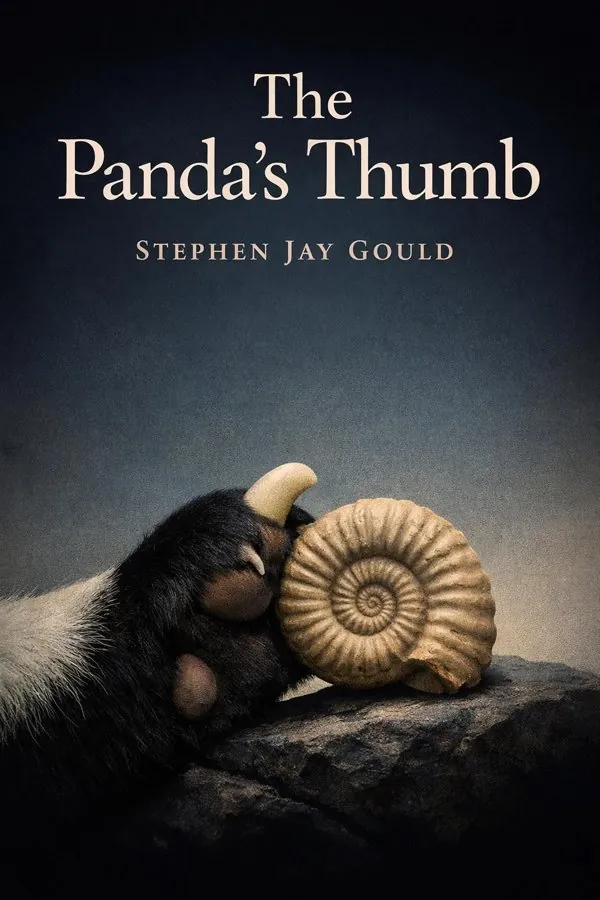
The Panda’s Thumb: More Reflections in Natural History: Summary & Key Insights
 10 min10 chaptersAudio available
Key Takeaways from The Panda’s Thumb: More Reflections in Natural History
One of the clearest signs of evolution is that nature often solves problems awkwardly rather than elegantly.
The strangest features in nature are often the most informative.
Humans are meaning-making creatures, and one of Gould’s recurring concerns is how easily symbolism can distort our reading of nature.
Not every trait exists because natural selection designed it for its current role.
Few stories in natural history have been simplified more misleadingly than the evolution of horses.
What Is The Panda’s Thumb: More Reflections in Natural History About?
The Panda’s Thumb: More Reflections in Natural History by Stephen Jay Gould is a life_science book spanning 10 pages. Stephen Jay Gould’s The Panda’s Thumb: More Reflections in Natural History is a dazzling collection of essays that turns evolution from an abstract theory into a vivid, surprising, and deeply human story. Drawing on paleontology, zoology, anatomy, and the history of science, Gould shows that life is not the product of perfect design but of improvisation, constraint, accident, and time. The book’s famous title example—the panda’s “thumb,” which is actually a modified wrist bone—captures Gould’s larger point: nature works with what is available, not with ideal blueprints. What makes this book enduring is not just the science, but Gould’s method. He uses curiosities, apparent mistakes, and overlooked details to reveal how evolution truly operates. Along the way, he challenges common misunderstandings about progress, adaptation, human superiority, and the neatness of natural history. Gould writes with unusual authority: he was one of the twentieth century’s leading paleontologists, a Harvard professor, and one of science’s most gifted essayists. This book matters because it teaches readers how to think scientifically—historically, critically, and humbly—about life on Earth.
This FizzRead summary covers all 10 key chapters of The Panda’s Thumb: More Reflections in Natural History in approximately 10 minutes, distilling the most important ideas, arguments, and takeaways from Stephen Jay Gould's work. Also available as an audio summary and Key Quotes Podcast.
The Panda’s Thumb: More Reflections in Natural History
Stephen Jay Gould’s The Panda’s Thumb: More Reflections in Natural History is a dazzling collection of essays that turns evolution from an abstract theory into a vivid, surprising, and deeply human story. Drawing on paleontology, zoology, anatomy, and the history of science, Gould shows that life is not the product of perfect design but of improvisation, constraint, accident, and time. The book’s famous title example—the panda’s “thumb,” which is actually a modified wrist bone—captures Gould’s larger point: nature works with what is available, not with ideal blueprints.
What makes this book enduring is not just the science, but Gould’s method. He uses curiosities, apparent mistakes, and overlooked details to reveal how evolution truly operates. Along the way, he challenges common misunderstandings about progress, adaptation, human superiority, and the neatness of natural history. Gould writes with unusual authority: he was one of the twentieth century’s leading paleontologists, a Harvard professor, and one of science’s most gifted essayists. This book matters because it teaches readers how to think scientifically—historically, critically, and humbly—about life on Earth.
Who Should Read The Panda’s Thumb: More Reflections in Natural History?
This book is perfect for anyone interested in life_science and looking to gain actionable insights in a short read. Whether you're a student, professional, or lifelong learner, the key ideas from The Panda’s Thumb: More Reflections in Natural History by Stephen Jay Gould will help you think differently.
- ✓Readers who enjoy life_science and want practical takeaways
- ✓Professionals looking to apply new ideas to their work and life
- ✓Anyone who wants the core insights of The Panda’s Thumb: More Reflections in Natural History in just 10 minutes
Want the full summary?
Get instant access to this book summary and 100K+ more with Fizz Moment.
Get Free SummaryAvailable on App Store • Free to download
Key Chapters
One of the clearest signs of evolution is that nature often solves problems awkwardly rather than elegantly. Gould’s celebrated example is the giant panda’s “thumb,” which is not a true thumb at all. Instead, it is an enlarged radial sesamoid bone from the wrist, adapted to help the animal grip bamboo. If species were created from scratch by an engineer aiming at perfection, the panda would likely have received a proper opposable digit. But evolution does not build from ideal plans. It modifies inherited structures, reshaping old parts for new uses.
This matters because it shows what evolutionary history looks like in the body. Organisms carry the marks of their ancestry. A structure may be functional and still be clumsy, limited, or historically constrained. The panda’s thumb works well enough, but it also reveals that adaptation is a compromise between present need and past inheritance. Gould uses this case to argue against simplistic ideas of perfect design and for a richer understanding of evolution as tinkering.
The insight extends far beyond pandas. Human knees, the recurrent laryngeal nerve in mammals, and the blind spot in vertebrate eyes all reflect similar historical compromises. In science, business, and daily life, many systems also evolve this way: new solutions are layered onto old frameworks rather than built fresh. Recognizing this helps us judge structures less by elegance and more by historical context.
Actionable takeaway: when you encounter something inefficient yet functional, ask what history produced it. The path to understanding often lies in tracing how an imperfect solution came to be.
The strangest features in nature are often the most informative. Gould repeatedly argues that biological oddities are not embarrassments to be ignored but clues that illuminate how evolution actually works. Curious forms—a flounder with both eyes on one side of its head, peculiar anatomical detours, or bizarre fossil creatures—show that life’s diversity is shaped by ancestry, adaptation, and contingency rather than tidy design.
Why are oddities so revealing? Because ordinary structures can be explained away by common sense. A wing seems made for flying; a fin seems made for swimming. But when we encounter a structure that appears awkward, asymmetrical, or jury-rigged, we are forced to ask how it emerged. The answer often lies in descent with modification. Evolution proceeds incrementally, preserving workable changes even when they do not produce perfect outcomes. Oddities therefore become historical documents written into flesh and bone.
Gould’s broader lesson is methodological. Science advances not only by confirming expectations, but by dwelling on anomalies. In medicine, rare disorders can reveal how normal physiology works. In geology, unusual rock layers may expose ancient environmental shifts. In everyday reasoning, exceptions often tell us more than the rule. Paying attention to what doesn’t fit can sharpen observation and challenge lazy assumptions.
This perspective also invites intellectual humility. Nature is not obliged to match human categories of beauty, symmetry, or purpose. The living world is richer and weirder than our first impressions suggest. Gould’s essays train readers to see the apparently marginal as scientifically central.
Actionable takeaway: make a habit of studying the exceptions, outliers, and awkward cases in any field. They often expose deeper patterns than the obvious examples ever could.
Humans are meaning-making creatures, and one of Gould’s recurring concerns is how easily symbolism can distort our reading of nature. In discussing examples such as national emblems, animal imagery, and cultural interpretations of biology, he shows that we often project moral, political, or spiritual significance onto organisms that are simply following evolutionary paths. The danger is subtle: once nature becomes a symbol, it can be mistaken for a lesson deliberately written for us.
Gould pushes back against this tendency by separating biological reality from human metaphor. An eagle is not noble in any objective moral sense; a lion is not born regal; a species does not embody our values because we choose it as an emblem. The same confusion appears in arguments that try to derive social hierarchies, gender roles, or political ideologies directly from biology. Nature contains competition and cooperation, violence and mutual aid, abundance and extinction. It does not deliver a single social doctrine.
This idea remains highly relevant. Modern debates often invoke “what is natural” to defend preferences, habits, or policies. But descriptive facts about organisms do not automatically yield ethical conclusions. Gould encourages readers to enjoy symbolism while refusing to confuse it with science. Biological knowledge should clarify reality, not sanctify ideology.
Practically, this means becoming more alert whenever scientific language is used rhetorically. Ask whether a claim is reporting evidence or borrowing authority from nature to support a cultural viewpoint. Gould’s essays remind us that scientific literacy includes learning where science ends and symbolism begins.
Actionable takeaway: whenever someone says nature proves how humans ought to live, pause and separate the biological description from the moral argument before accepting either.
Not every trait exists because natural selection designed it for its current role. Gould’s discussion of “spandrels,” developed with Richard Lewontin, is one of his most influential contributions to evolutionary thought. A spandrel, in architecture, is a byproduct created when arches meet beneath a dome; it may later be decorated beautifully, but it was not originally designed as a standalone feature. Gould uses this analogy to challenge the habit of treating every biological characteristic as a direct adaptation.
The point is profound. Some features are side effects of other structures, developmental constraints, or historical inheritances. Others may later be co-opted for use, but that does not mean they arose for that purpose. This distinction matters because adaptationist storytelling can become too easy. It is always tempting to invent a neat survival function for any trait, from human behaviors to animal markings. Gould urges more discipline: before declaring a feature adaptive, we should consider alternatives such as structural necessity, correlated growth, or evolutionary leftovers.
This framework strengthens science by demanding better evidence. In psychology, for example, not every common behavior must be explained as an evolved optimization. In anatomy, some forms may persist because they are linked to other selected traits. In culture and institutions, many practices endure not because they are ideal, but because they came attached to previous arrangements.
Gould’s larger lesson is that origins and current uses are not always the same. A trait can be useful now without having been selected for that use initially. That idea deepens our understanding of complexity and guards against oversimplification.
Actionable takeaway: when evaluating any feature, ask three questions—what is its current function, how did it originate, and could it be a byproduct rather than a direct adaptation?
Few stories in natural history have been simplified more misleadingly than the evolution of horses. Gould shows how textbook images often present horse evolution as a smooth, linear march from small, primitive ancestors to the large modern horse. This narrative is visually tidy and emotionally satisfying because it reinforces a broader cultural bias toward progress. But it misrepresents the fossil evidence.
In reality, horse evolution was branching, diverse, and experimental. Many lineages coexisted. Some increased in size; others did not. Some traits appeared, disappeared, or evolved in parallel. The modern horse is not the inevitable endpoint of a single upward trajectory, but the surviving twig of a much bushier evolutionary tree. Gould uses this example to dismantle the ladder view of evolution, replacing it with a branching model shaped by changing environments, extinction, and contingency.
This correction matters because linear narratives encourage false assumptions about superiority, destiny, and direction in evolution. They tempt us to imagine life as striving toward predefined goals, often with humans at the top. Gould insists that evolution has no built-in aim. It produces diversification, not moral or metaphysical ascent.
The lesson translates beyond biology. In technology, careers, politics, and culture, histories are often rewritten as inevitable successions leading to the present. Real histories are usually more tangled, with dead ends, reversals, competitors, and chance events. Recognizing branching complexity makes us better historians and less complacent interpreters.
Actionable takeaway: whenever you see a simple progression from “primitive” to “advanced,” look for the branches, alternatives, and extinctions that the story leaves out.
If evolution teaches one humbling lesson, it is that the history of life could have turned out very differently. Gould’s reflections on the Burgess Shale fossils emphasize contingency—the idea that chance events and fragile historical pathways shape what survives. The Burgess Shale preserves a startling array of Cambrian creatures, many of them anatomically unlike anything alive today. Their existence reveals that early animal life was far more experimentally diverse than our modern world suggests.
For Gould, these fossils challenge the comforting assumption that the forms we know now were bound to arise. If we could “replay the tape of life,” as he famously put it elsewhere, the results might be radically different. Extinctions, ecological shifts, developmental constraints, and accidents of timing can redirect evolution. The species alive today are not the necessary winners of a predictable contest, but the contingent survivors of a long and uneven history.
This perspective reshapes how we think about humanity as well. Human intelligence, culture, and even our existence become less like destiny and more like improbable outcomes. That does not diminish our significance; it deepens our appreciation of life’s fragility.
Contingency also offers a practical mental model. In personal and institutional history, outcomes often look inevitable in hindsight, though they depended on small turning points at the time. Gould teaches readers to respect path dependence and chance rather than inventing false narratives of necessity.
Actionable takeaway: resist hindsight bias. When analyzing any outcome, ask what accidents, forks in the road, and lost alternatives made the present possible.
Science does not advance in a straight line, and Gould is especially good at showing how fossils have often been misinterpreted before being properly understood. These episodes are not merely entertaining historical mistakes. They reveal how scientists, like everyone else, are influenced by prevailing assumptions, incomplete evidence, and the categories available to them at a given moment. Fossils are often fragmentary, distorted, or context-poor, which makes them especially vulnerable to projection.
Gould uses such cases to make a larger point about the self-correcting nature of science. Error is not evidence that science fails; it is part of how science works. Claims are proposed, challenged, revised, or discarded as better methods and new evidence emerge. The history of paleontology is full of reclassifications, reinterpretations, and recovered surprises. This is not weakness but strength, because it shows a discipline willing to revise itself.
For readers, this is an important lesson in scientific literacy. We should neither worship consensus as infallible nor dismiss science because it changes. Instead, we should ask how conclusions were reached, what evidence supports them, and how open the field remains to correction. Gould’s historical essays model this balanced skepticism.
The same principle applies elsewhere. In policy, journalism, and personal judgment, first interpretations are often shaped by bias and limited perspective. Good thinking requires revisability. Mature confidence does not mean never being wrong; it means building systems that can detect and correct error.
Actionable takeaway: treat initial explanations as hypotheses, not final truths, and prefer methods and institutions that can openly revise their conclusions when better evidence appears.
Nothing distorts public understanding of evolution more persistently than the belief that humans represent its pinnacle. Gould opposes this idea forcefully, especially in discussions of human evolution. He argues that our lineage is not a ladder climbing toward perfection, but one branch among many in the primate tree. Human traits emerged through specific historical circumstances, not through a universal drive toward intelligence, morality, or superiority.
Gould is particularly concerned with how evolutionary language has been misused to support racism, sexism, class prejudice, and triumphalist views of civilization. Once evolution is imagined as a scale from lower to higher forms, it becomes easy to place some people above others. Gould shows that such rankings are scientifically false and morally dangerous. Evolution describes branching descent and adaptation to environments, not a hierarchy of worth.
His corrective is both scientific and ethical. Scientifically, humans share common ancestry with all life and are subject to the same contingent processes as any species. Ethically, recognizing this can foster humility rather than arrogance. Our remarkable capacities do not exempt us from biology, nor do they justify reading moral superiority into anatomy.
This insight remains urgent in an age of genetic data, AI-driven classification, and renewed biological determinism. Gould reminds us that facts about variation must be handled carefully and interpreted within a framework that rejects simplistic ranking.
Actionable takeaway: whenever human evolution is presented as a march upward, replace the image of a ladder with a branching tree and ask whether hidden assumptions about value or hierarchy are shaping the story.
One reason evolution is difficult to grasp is that human intuition is poorly suited to immense stretches of time. Gould repeatedly emphasizes scale—especially deep geological time—as essential for understanding biological change. Evolution is not usually visible in the rhythm of everyday life. It unfolds over thousands, millions, and hundreds of millions of years, through accumulation, divergence, extinction, and environmental turnover.
This temporal perspective transforms how we interpret both fossils and living organisms. A minor variation that seems trivial in one generation can become significant over vast timescales. Entire ecosystems rise and vanish. Lineages flourish, fragment, and disappear. Without deep time, evolution can look improbable or too slow to matter. With it, the diversity of life becomes not only plausible but expected.
Gould also uses time to challenge human self-importance. Our species occupies a tiny sliver of Earth’s history. Civilizations, however grand they feel to us, are brief episodes against the planetary backdrop. This awareness can be unsettling, but Gould presents it as intellectually liberating. It enlarges our imagination and places current concerns within a broader natural context.
Practically, learning to think in long timescales helps in many domains. Climate change, biodiversity loss, urban planning, and public health all involve processes whose most important consequences emerge gradually. Short-term intuition can be a poor guide when systems evolve slowly but decisively.
Actionable takeaway: cultivate long-range thinking. When judging natural or social change, ask what becomes visible only when you zoom out across decades, centuries, or deeper spans of time.
Gould’s essays are not just about bones, shells, and extinct creatures; they are about how scientific ideas interact with the beliefs societies hold about order, meaning, and human place in nature. He shows that biology often becomes entangled with politics, religion, education, and cultural identity. Evolutionary concepts are used to inspire wonder, but also to justify harmful ideologies or to provoke anxiety about purpose and value.
Rather than pretending science exists in a vacuum, Gould examines this interaction directly. He argues that scientific claims must be judged by evidence, yet scientists and readers alike should remain aware of the social contexts that shape interpretation. A theory can be empirically robust while still being misunderstood, misused, or oversold. Evolution has suffered all three fates. Gould therefore becomes not only an explainer of science, but a defender of careful public reasoning.
This theme helps explain the enduring power of his essays. He models a way to engage controversial ideas without surrendering rigor. He rejects both scientism—the claim that science answers every kind of question—and anti-scientific relativism, which treats evidence as merely another opinion. For Gould, biology can challenge worldviews, humble assumptions, and illuminate history, but it should not be twisted into a substitute for ethics or philosophy.
In modern life, where scientific findings are constantly filtered through media and politics, this lesson is indispensable. Readers need not only facts, but habits of interpretation.
Actionable takeaway: whenever science enters public debate, examine both the evidence itself and the cultural story being built around it before drawing conclusions.
All Chapters in The Panda’s Thumb: More Reflections in Natural History
About the Author
Stephen Jay Gould (1941–2002) was an American paleontologist, evolutionary biologist, historian of science, and one of the most influential science writers of his era. He spent most of his academic career at Harvard University, where he became a leading scholar of fossil invertebrates and evolutionary theory. Gould was widely admired for bringing sophisticated scientific ideas to general readers through essays that combined intellectual rigor, narrative flair, and a strong sense of history. He wrote extensively for Natural History magazine, and many of those essays were collected into bestselling books, including The Panda’s Thumb. Beyond paleontology, he engaged major public debates on evolution, biological determinism, intelligence, and the misuse of science in social thought. His work remains central to popular and academic discussions of evolution.
Get This Summary in Your Preferred Format
Read or listen to the The Panda’s Thumb: More Reflections in Natural History summary by Stephen Jay Gould anytime, anywhere. FizzRead offers multiple formats so you can learn on your terms — all free.
Available formats: App · Audio · PDF · EPUB — All included free with FizzRead
Download The Panda’s Thumb: More Reflections in Natural History PDF and EPUB Summary
Key Quotes from The Panda’s Thumb: More Reflections in Natural History
“One of the clearest signs of evolution is that nature often solves problems awkwardly rather than elegantly.”
“The strangest features in nature are often the most informative.”
“Humans are meaning-making creatures, and one of Gould’s recurring concerns is how easily symbolism can distort our reading of nature.”
“Not every trait exists because natural selection designed it for its current role.”
“Few stories in natural history have been simplified more misleadingly than the evolution of horses.”
Frequently Asked Questions about The Panda’s Thumb: More Reflections in Natural History
The Panda’s Thumb: More Reflections in Natural History by Stephen Jay Gould is a life_science book that explores key ideas across 10 chapters. Stephen Jay Gould’s The Panda’s Thumb: More Reflections in Natural History is a dazzling collection of essays that turns evolution from an abstract theory into a vivid, surprising, and deeply human story. Drawing on paleontology, zoology, anatomy, and the history of science, Gould shows that life is not the product of perfect design but of improvisation, constraint, accident, and time. The book’s famous title example—the panda’s “thumb,” which is actually a modified wrist bone—captures Gould’s larger point: nature works with what is available, not with ideal blueprints. What makes this book enduring is not just the science, but Gould’s method. He uses curiosities, apparent mistakes, and overlooked details to reveal how evolution truly operates. Along the way, he challenges common misunderstandings about progress, adaptation, human superiority, and the neatness of natural history. Gould writes with unusual authority: he was one of the twentieth century’s leading paleontologists, a Harvard professor, and one of science’s most gifted essayists. This book matters because it teaches readers how to think scientifically—historically, critically, and humbly—about life on Earth.
More by Stephen Jay Gould
The Desert Evolution
Stephen Jay Gould
10 min
Ever Since Darwin: Reflections in Natural History
Stephen Jay Gould
10 min
Full House: The Spread of Excellence from Plato to Darwin
Stephen Jay Gould
10 min
The Book of Life: An Illustrated History of the Evolution of Life on Earth
Stephen Jay Gould
10 minYou Might Also Like
The Selfish Gene
Richard Dawkins
10 min
Awakenings
Oliver Sacks
10 min
Parasite Rex: Inside the Bizarre World of Nature's Most Dangerous Creatures
Carl Zimmer
10 min
The Atlas of Life on Earth
Various
10 min
The Book of Humans: The Story of How We Became Us
Adam Rutherford
10 min
The Horse
Wendy Williams
10 minBrowse by Category
Ready to read The Panda’s Thumb: More Reflections in Natural History?
Get the full summary and 100K+ more books with Fizz Moment.