
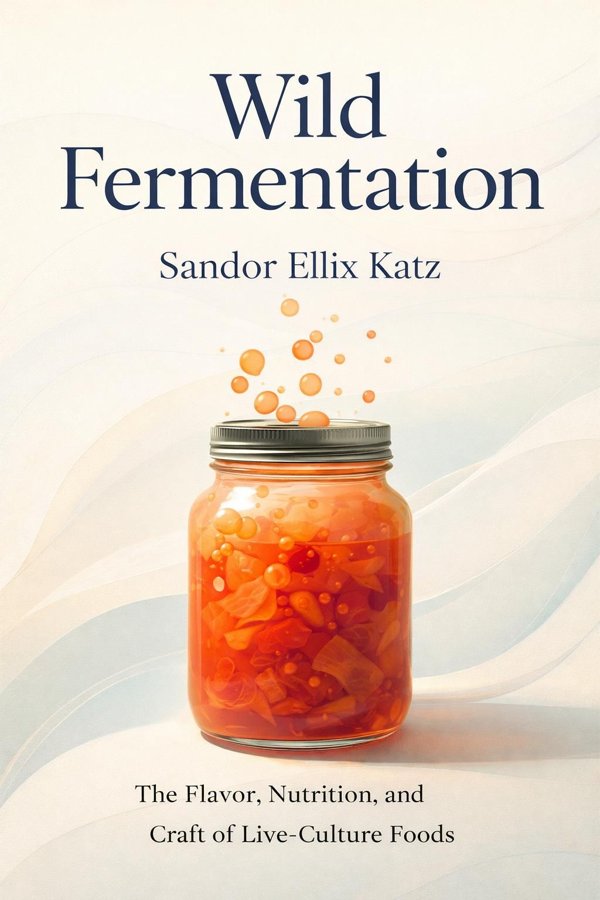
Wild Fermentation: The Flavor, Nutrition, and Craft of Live-Culture Foods: Summary & Key Insights
 10 min10 chaptersAudio available
Key Takeaways from Wild Fermentation: The Flavor, Nutrition, and Craft of Live-Culture Foods
The most important truth about fermentation is also the easiest to overlook: food transformation starts with unseen life already present around us.
Every fermented food tells a story about the people who made it.
A head of cabbage may seem simple, but in Katz’s hands it becomes a gateway to the entire logic of fermentation.
Milk is highly perishable, yet across history people found ways to turn it into stable, flavorful, and often more digestible foods.
Many staple foods are nutritious but difficult to digest in their raw or minimally processed forms.
What Is Wild Fermentation: The Flavor, Nutrition, and Craft of Live-Culture Foods About?
Wild Fermentation: The Flavor, Nutrition, and Craft of Live-Culture Foods by Sandor Ellix Katz is a nutrition book spanning 10 pages. Wild Fermentation is both a practical handbook and a manifesto for reclaiming one of humanity’s oldest food traditions. In this influential book, Sandor Ellix Katz shows that fermentation is not a niche culinary hobby but a living process that connects flavor, preservation, health, and culture. He explains how vegetables, milk, grains, beans, fruits, and drinks can be transformed by beneficial microbes into foods that are more complex, more digestible, and often more nutritious than their raw ingredients. What makes the book matter is its larger argument: modern food culture has become overly fearful of bacteria and overly dependent on industrial standardization, while fermentation invites us to work with life rather than against it. Katz writes not as a distant scientist but as an experienced practitioner, teacher, and food activist who helped spark the modern fermentation revival. His guidance is hands-on, accessible, and encouraging, making traditional methods feel possible in any home kitchen. For readers interested in nutrition, self-reliance, culinary creativity, or microbial health, Wild Fermentation offers a deeply empowering way to rethink food.
This FizzRead summary covers all 10 key chapters of Wild Fermentation: The Flavor, Nutrition, and Craft of Live-Culture Foods in approximately 10 minutes, distilling the most important ideas, arguments, and takeaways from Sandor Ellix Katz's work. Also available as an audio summary and Key Quotes Podcast.
Wild Fermentation: The Flavor, Nutrition, and Craft of Live-Culture Foods
Wild Fermentation is both a practical handbook and a manifesto for reclaiming one of humanity’s oldest food traditions. In this influential book, Sandor Ellix Katz shows that fermentation is not a niche culinary hobby but a living process that connects flavor, preservation, health, and culture. He explains how vegetables, milk, grains, beans, fruits, and drinks can be transformed by beneficial microbes into foods that are more complex, more digestible, and often more nutritious than their raw ingredients. What makes the book matter is its larger argument: modern food culture has become overly fearful of bacteria and overly dependent on industrial standardization, while fermentation invites us to work with life rather than against it. Katz writes not as a distant scientist but as an experienced practitioner, teacher, and food activist who helped spark the modern fermentation revival. His guidance is hands-on, accessible, and encouraging, making traditional methods feel possible in any home kitchen. For readers interested in nutrition, self-reliance, culinary creativity, or microbial health, Wild Fermentation offers a deeply empowering way to rethink food.
Who Should Read Wild Fermentation: The Flavor, Nutrition, and Craft of Live-Culture Foods?
This book is perfect for anyone interested in nutrition and looking to gain actionable insights in a short read. Whether you're a student, professional, or lifelong learner, the key ideas from Wild Fermentation: The Flavor, Nutrition, and Craft of Live-Culture Foods by Sandor Ellix Katz will help you think differently.
- ✓Readers who enjoy nutrition and want practical takeaways
- ✓Professionals looking to apply new ideas to their work and life
- ✓Anyone who wants the core insights of Wild Fermentation: The Flavor, Nutrition, and Craft of Live-Culture Foods in just 10 minutes
Want the full summary?
Get instant access to this book summary and 100K+ more with Fizz Moment.
Get Free SummaryAvailable on App Store • Free to download
Key Chapters
The most important truth about fermentation is also the easiest to overlook: food transformation starts with unseen life already present around us. Katz argues that fermentation is not something humans invented from scratch; it is a natural process driven by microorganisms such as lactic acid bacteria, yeasts, and molds. These organisms live on plants, in the air, on our hands, and in our kitchens. Rather than treating microbes only as threats, the book asks us to recognize that many are allies that preserve food, create flavor, and support digestion.
Katz explains fermentation as a controlled collaboration with these life forms. In vegetable ferments, salt creates an environment where beneficial bacteria can thrive and spoilage organisms are suppressed. In bread, wild yeasts and bacteria leaven and acidify dough. In milk, cultures turn lactose-rich liquid into yogurt or kefir. Once you understand this principle, fermentation stops feeling mysterious. It becomes an ecological process you can guide with the right ingredients, timing, and conditions.
This idea has practical consequences. Instead of chasing laboratory sterility, Katz encourages attentiveness: use clean tools, observe smell and texture, and trust the gradual signs of healthy fermentation. A jar of cabbage bubbling into sauerkraut is not rotting; it is being remade by microbial succession into a safer and more flavorful food.
The larger lesson is that life creates life. When you welcome beneficial microbes, your kitchen becomes a place of renewal rather than control. Actionable takeaway: start with one simple ferment, such as sauerkraut, and use it to learn the basic signs of microbial transformation—bubbles, acidity, aroma, and texture change.
Every fermented food tells a story about the people who made it. Katz emphasizes that fermentation is not merely a technique for extending shelf life; it is a carrier of memory, geography, ritual, and identity. Across the world, communities developed local ferments based on climate, available crops, and inherited knowledge. Kimchi in Korea, sourdough in Europe, tempeh in Indonesia, yogurt in Central Asia, and pickled vegetables across countless regions all reflect local conditions and social life.
Katz presents fermentation as a democratic and ancestral craft. It emerged long before refrigeration and industrial food systems, allowing people to store harvests, survive lean seasons, and create prized flavors from ordinary ingredients. But it also shaped taste preferences and communal habits. Ferments often appear at celebrations, family meals, religious observances, and seasonal transitions. They are evidence that preservation and pleasure have always been linked.
This cultural perspective matters because industrial food has tended to flatten regional diversity into standardized products. Commercial yogurt tastes similar across continents; homemade cultured dairy can vary household by household. Fermentation resists sameness. It invites adaptation, improvisation, and continuity with the past.
In practice, this means readers can use fermentation to reconnect with heritage or explore traditions beyond their own. Making a family pickle recipe, reviving an old sourdough starter, or learning to brew a traditional beverage becomes a form of cultural participation, not just meal prep.
Actionable takeaway: choose one fermented food with personal or historical significance and learn its background while making it, so the process becomes both culinary and cultural education.
A head of cabbage may seem simple, but in Katz’s hands it becomes a gateway to the entire logic of fermentation. Vegetable fermentation is one of the most approachable entry points because it requires minimal equipment, relies on naturally occurring bacteria, and produces clear, satisfying results. Salted or brined vegetables create an environment where lactic acid bacteria multiply, sugars are consumed, acidity increases, and the food develops complexity and durability.
Katz uses classics like sauerkraut and kimchi to show how vegetables can be transformed by patience and proportion. Salt draws water from plant cells, creating brine. Submerged beneath that brine, shredded cabbage, radishes, carrots, turnips, cucumbers, and other vegetables begin to sour. Their flavors deepen, textures shift, and their shelf life extends. The process can be highly traditional or highly improvisational. Garlic, ginger, herbs, chili, seaweed, and spices all reshape the outcome.
The practical lesson is empowering: you do not need expensive gear or packaged cultures to ferment vegetables successfully. A bowl, a knife, salt, a jar, and attentive tasting are often enough. Katz encourages sensory learning over rigid perfection. Taste the ferment daily. If you prefer a bright crunch, refrigerate earlier. If you want greater acidity and funk, let it go longer.
Vegetable fermentation also reduces waste. Surplus produce, trimmings, and seasonal abundance can all be preserved rather than discarded. This makes fermentation a nutritional strategy and a frugal household practice.
Actionable takeaway: ferment one seasonal vegetable this week using only salt and a jar, then taste it each day to learn how time changes acidity, aroma, and texture.
Milk is highly perishable, yet across history people found ways to turn it into stable, flavorful, and often more digestible foods. Katz uses yogurt, kefir, cultured butter, cheese, and related dairy ferments to show how fermentation converts fragility into resilience. Bacteria and yeasts consume milk sugars, produce acids, alter proteins, and create entirely new textures and tastes. A liquid becomes spoonable yogurt. Cream becomes tangy cultured butter. Milk becomes curds, whey, and a spectrum of cheeses.
One of Katz’s central insights is that fermentation makes dairy accessible to many people who struggle with fresh milk. As microbes break down lactose and pre-digest components of the food, some fermented dairy products are easier to tolerate. At the same time, fermentation introduces beneficial organisms and compounds associated with gut health and food diversity.
Katz does not frame dairy fermentation as an industrial mystery. He shows that homemade yogurt can be made with warmth and a starter culture, and kefir can be sustained through a living colony of grains. These methods restore intimacy with food. Instead of buying anonymous products, readers can witness and direct the transformation themselves.
The broader value is culinary. Cultured dairy delivers acidity, richness, and microbial life that can elevate everyday meals. Yogurt can become breakfast, sauce, marinade, or dessert. Kefir can be drunk plain or blended. Fresh cheese can turn excess milk into a satisfying staple.
Actionable takeaway: make one simple cultured dairy food, such as yogurt or kefir, and notice not only the flavor difference from store-bought versions but also how fermentation changes texture, satiety, and digestive experience.
Many staple foods are nutritious but difficult to digest in their raw or minimally processed forms. Katz highlights fermentation as a way of unlocking the potential of grains and beans by improving flavor, digestibility, and usefulness. Sourdough bread, dosas, idli, fermented porridges, miso-like bean pastes, and tempeh-like preparations all demonstrate how microbes can soften harshness, reduce antinutrients, and create foods that are easier for the body to handle.
The idea is especially powerful because grains and legumes often sit at the center of affordable nutrition. Fermentation helps make these staples more satisfying and bioavailable. In sourdough, wild yeasts and bacteria break down components of the flour and create structure, aroma, and tang. In fermented batters, soaking and microbial activity change both texture and cooking performance. Beans, when fermented, can become savory condiments, cakes, or spreads with dramatically different digestibility and depth.
Katz also reminds readers that fermentation and cooking often work together rather than competing. Soaking, sprouting, fermenting, and heating are all complementary tools. A bean does not need to remain raw to be alive with microbial transformation. Fermentation can be one stage in a broader food preparation chain.
This section broadens the meaning of nutrition. Nutritional value is not just what a food contains on paper; it is what the body can access and use. Traditional food cultures understood this intuitively and built fermentation into daily staples.
Actionable takeaway: replace one store-bought bread or grain product with a fermented alternative this week—such as sourdough or an overnight fermented batter—and pay attention to differences in flavor, digestion, and fullness.
Alcoholic fermentation is often treated as either a commercial industry or a romantic mystery, but Katz presents it as another branch of the same microbial partnership that animates all ferments. Yeasts convert sugars into alcohol and carbon dioxide, turning fruit juice into wine, grain into beer, honey into mead, and sweet liquids into a range of lightly or strongly alcoholic beverages. The process can be ancient, celebratory, local, and surprisingly accessible.
Katz’s treatment is notable because he keeps the focus on relationship rather than technical intimidation. Home brewing does involve sanitation, timing, and monitoring, but it also rewards experimentation. Seasonal fruits can become country wines. Ginger, herbs, or roots can support homemade ales. Fermented beverages can be rustic and personal rather than industrially uniform.
Just as important, Katz situates alcohol in a broader lineage of fermentation rather than placing it outside nutrition and culture. Historically, low-alcohol fermented drinks were often safer than contaminated water and served as everyday nourishment as well as social glue. Even now, beverages like cider, beer, and mead reflect agriculture, local ingredients, and communal identity.
At the same time, his approach implies respect. Fermentation creates potency, and potency demands intention. The craft is not merely about producing alcohol; it is about understanding transformation, flavor development, and responsible enjoyment.
Actionable takeaway: if you are curious about beverage fermentation, begin with a low-risk, small-batch project such as ginger beer or fruit kvass to learn the rhythms of yeast activity before attempting more complex wines or beers.
Some of the most powerful fermented foods are not eaten by the bowlful but by the spoonful. Katz gives fermented condiments their own importance because they concentrate microbial action, preservation, and flavor into forms that can transform everyday meals. Soy sauce, miso, fish sauce, chutneys, hot sauces, relishes, and other cultured seasonings show that fermentation does not just preserve ingredients; it amplifies them.
This matters for home cooks because condiments are often the easiest way to integrate fermentation into a regular diet. A small dollop of fermented salsa can brighten eggs, grains, or beans. A spoonful of miso can build an instant broth. A splash of fermented hot sauce can add acidity, heat, and complexity to vegetables or soups. Even when people are hesitant about eating bowls of sauerkraut, they are often open to fermented accents.
Katz also reveals a deeper principle here: fermentation creates savory depth by breaking ingredients down into more expressive forms. Time, salt, microbes, and enzymes collaborate to produce umami, aroma, and persistence that fresh ingredients alone may not offer. This is why fermented condiments have played such a large role in cuisines worldwide, especially where people needed to make simple staples more satisfying.
Because condiments are modular, they also invite creativity. Leftover peppers, garlic, herbs, or vegetables can become sauces and pastes rather than waste. This turns fermentation into a practical kitchen habit rather than an occasional project.
Actionable takeaway: keep one fermented condiment in regular rotation and use it on at least three different meals this week to experience how small amounts can reshape taste and increase food variety.
Modern nutrition often focuses on macronutrients, calories, vitamins, and restrictions, but Katz pushes the conversation toward a different dimension: our relationship with living microbes. He argues that fermented foods matter not only because they preserve food or taste good, but because they can contribute beneficial organisms and support a healthier microbial ecology in the body. In a world increasingly shaped by antibiotics, sanitization, processed foods, and fear of bacteria, fermentation offers a counterbalance.
Katz does not oversimplify health claims into miracle cures. Instead, he presents fermented foods as part of a broader pattern of resilience. They can aid digestion, increase enzymatic activity, improve nutrient availability, and diversify what we eat. The value lies partly in regular exposure to living cultures and partly in eating foods that have already undergone transformative breakdown.
This perspective is especially relevant in nutrition because it reframes health as ecological rather than purely mechanical. Human beings are not sealed systems; we are hosts to vast microbial communities. Supporting those communities may influence digestion, immunity, and overall well-being. Fermented foods become one practical way to restore contact with beneficial microbial life.
The key is consistency and variety, not perfection. A spoonful of kraut, a cup of yogurt, a glass of kefir, or a little miso soup can all contribute to a more diverse diet. The point is to reintroduce living foods into ordinary routines.
Actionable takeaway: add one live-culture food to your daily diet for two weeks and observe changes in digestion, cravings, meal satisfaction, and your openness to more diverse flavors.
One jar on a counter may look like a private experiment, but Katz sees fermentation as inherently social and ecological. It helps households preserve seasonal abundance, reduce dependence on industrial supply chains, and share knowledge across generations and communities. Fermentation is one of the simplest ways to participate in a more sustainable food system because it extends the life of ingredients, minimizes waste, and relies on biological processes rather than energy-intensive storage alone.
This idea becomes vivid when harvest time produces more vegetables or fruit than can be eaten fresh. Instead of spoilage, fermentation offers continuity. Cabbage becomes sauerkraut for winter. Milk becomes yogurt or cheese. Fruit becomes cider or vinegar. What could have been waste becomes future nourishment. That practical power has always mattered in agrarian societies, and it matters again in an era concerned with food miles, resilience, and overconsumption.
Katz also emphasizes the communal side of the craft. Starters are shared. Recipes are adapted. Taste is discussed. Fermentation workshops and kitchen exchanges turn food preparation into collective learning. Unlike many forms of consumer culture, fermentation produces confidence through participation. People discover that they can preserve food themselves rather than outsourcing every transformation to industry.
This combination of sustainability and community makes fermentation more than a culinary hobby. It becomes a quiet form of food citizenship.
Actionable takeaway: preserve one surplus or seasonal ingredient through fermentation and share a portion, the method, or the starter with another person to turn the practice into both waste reduction and community building.
Many beginners avoid fermentation because they assume it requires exact chemistry, specialized gear, or zero tolerance for mistakes. Katz’s reassuring message is that successful fermentation depends less on perfection than on observation. Traditional peoples fermented for centuries without modern laboratory tools because they learned to read signs: smell, bubble formation, acidity, color, mold behavior, texture, temperature, and time. The craft develops through attention.
This does not mean anything goes. Katz takes cleanliness, safe practices, and informed judgment seriously. But he challenges the fear that every deviation means failure. A softer pickle is not necessarily spoiled. Surface yeasts can sometimes be skimmed. A ferment that tastes too salty can be adjusted next time. Fermentation is a living process, so variation is normal.
This is one of the book’s most liberating lessons. Instead of memorizing only rules, readers are encouraged to build sensory confidence. Taste your sauerkraut at different stages. Notice how warm weather speeds fermentation. Compare a tightly packed jar with a looser one. Learn what healthy sourness smells like. Over time, the kitchen becomes a place of apprenticeship with life itself.
Adaptation is especially important because ingredients, climates, and preferences vary widely. A method that works in one region may need slight changes elsewhere. Katz values this responsiveness because it keeps fermentation alive as a tradition rather than frozen as a formula.
Actionable takeaway: keep a simple fermentation journal for your next project, noting ingredient ratios, room temperature, smell, taste, and timing so you can learn from direct experience rather than relying only on fixed recipes.
All Chapters in Wild Fermentation: The Flavor, Nutrition, and Craft of Live-Culture Foods
About the Author
Sandor Ellix Katz is an American food activist, writer, and teacher widely credited with helping revive fermentation as a mainstream culinary and health practice. Best known for Wild Fermentation and the later reference work The Art of Fermentation, Katz has inspired home cooks, chefs, nutrition enthusiasts, and sustainable food advocates around the world. His work blends hands-on kitchen knowledge with cultural history, ecology, and a deep appreciation for microbial life. Rather than treating fermentation as a specialized science reserved for experts, he presents it as an ancient, democratic skill available to anyone with curiosity and patience. Based in Tennessee for many years, Katz has taught workshops internationally and become one of the most influential voices in the modern live-culture food movement.
Get This Summary in Your Preferred Format
Read or listen to the Wild Fermentation: The Flavor, Nutrition, and Craft of Live-Culture Foods summary by Sandor Ellix Katz anytime, anywhere. FizzRead offers multiple formats so you can learn on your terms — all free.
Available formats: App · Audio · PDF · EPUB — All included free with FizzRead
Download Wild Fermentation: The Flavor, Nutrition, and Craft of Live-Culture Foods PDF and EPUB Summary
Key Quotes from Wild Fermentation: The Flavor, Nutrition, and Craft of Live-Culture Foods
“The most important truth about fermentation is also the easiest to overlook: food transformation starts with unseen life already present around us.”
“Every fermented food tells a story about the people who made it.”
“A head of cabbage may seem simple, but in Katz’s hands it becomes a gateway to the entire logic of fermentation.”
“Milk is highly perishable, yet across history people found ways to turn it into stable, flavorful, and often more digestible foods.”
“Many staple foods are nutritious but difficult to digest in their raw or minimally processed forms.”
Frequently Asked Questions about Wild Fermentation: The Flavor, Nutrition, and Craft of Live-Culture Foods
Wild Fermentation: The Flavor, Nutrition, and Craft of Live-Culture Foods by Sandor Ellix Katz is a nutrition book that explores key ideas across 10 chapters. Wild Fermentation is both a practical handbook and a manifesto for reclaiming one of humanity’s oldest food traditions. In this influential book, Sandor Ellix Katz shows that fermentation is not a niche culinary hobby but a living process that connects flavor, preservation, health, and culture. He explains how vegetables, milk, grains, beans, fruits, and drinks can be transformed by beneficial microbes into foods that are more complex, more digestible, and often more nutritious than their raw ingredients. What makes the book matter is its larger argument: modern food culture has become overly fearful of bacteria and overly dependent on industrial standardization, while fermentation invites us to work with life rather than against it. Katz writes not as a distant scientist but as an experienced practitioner, teacher, and food activist who helped spark the modern fermentation revival. His guidance is hands-on, accessible, and encouraging, making traditional methods feel possible in any home kitchen. For readers interested in nutrition, self-reliance, culinary creativity, or microbial health, Wild Fermentation offers a deeply empowering way to rethink food.
More by Sandor Ellix Katz
You Might Also Like
Eating by the Seasons Cookbook: Seasonal Produce-Focused Recipes
Clare Foster
10 min
From Crook to Cook: Platinum Recipes from Tha Boss Dogg's Kitchen
Snoop Dogg with Ryan Ford
10 min
Juicing for Beginners: The Essential Guide to Juicing Recipes and Juicing for Weight Loss
Rockridge Press
10 min
The Food Therapist: Break Bad Habits, Eat with Intention, and Indulge Without Worry
Shira Lenchewski
10 min
The Mediterranean Diet Meal Plan: A 4-Week Meal Plan for Optimal Health and Weight Loss
Various Contributors
10 min
The Well Plated Cookbook: Simple, Wholesome Recipes for Everyday Meals
Erin Clarke
10 minBrowse by Category
Ready to read Wild Fermentation: The Flavor, Nutrition, and Craft of Live-Culture Foods?
Get the full summary and 100K+ more books with Fizz Moment.