
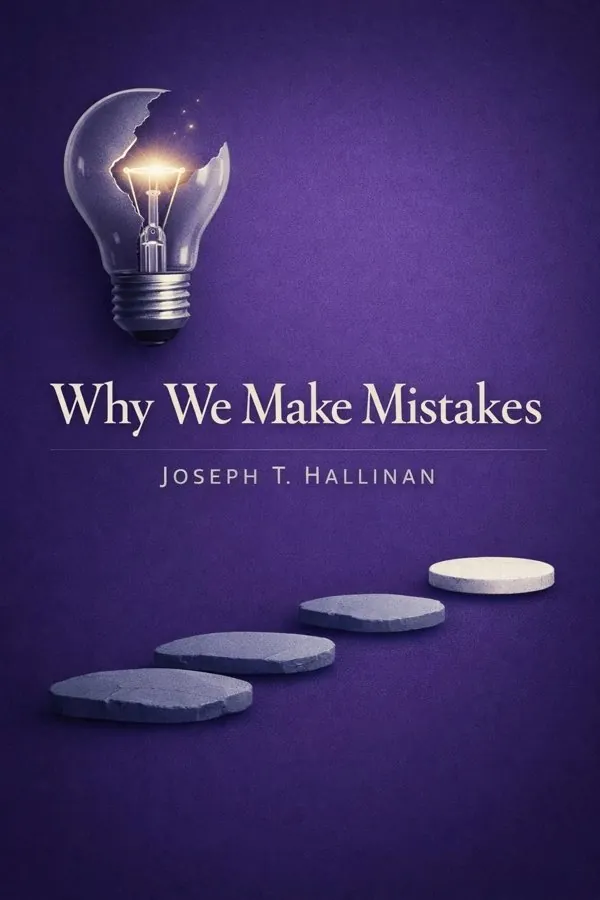
Why We Make Mistakes: How We Look Without Seeing, Forget Things in Seconds, and Are All Pretty Sure We Are Way Above Average: Summary & Key Insights
 10 min10 chaptersAudio available
What Is Why We Make Mistakes: How We Look Without Seeing, Forget Things in Seconds, and Are All Pretty Sure We Are Way Above Average About?
Why We Make Mistakes: How We Look Without Seeing, Forget Things in Seconds, and Are All Pretty Sure We Are Way Above Average by Joseph T. Hallinan is a cognition book spanning 10 pages. This book explores the psychology behind human error, examining why people consistently make mistakes in everyday life. Drawing on research from cognitive science and behavioral psychology, Hallinan explains how perception, memory, and overconfidence lead to errors, and offers insights into how we can better understand and mitigate them.
This FizzRead summary covers all 10 key chapters of Why We Make Mistakes: How We Look Without Seeing, Forget Things in Seconds, and Are All Pretty Sure We Are Way Above Average in approximately 10 minutes, distilling the most important ideas, arguments, and takeaways from Joseph T. Hallinan's work. Also available as an audio summary and Key Quotes Podcast.
Why We Make Mistakes: How We Look Without Seeing, Forget Things in Seconds, and Are All Pretty Sure We Are Way Above Average
This book explores the psychology behind human error, examining why people consistently make mistakes in everyday life. Drawing on research from cognitive science and behavioral psychology, Hallinan explains how perception, memory, and overconfidence lead to errors, and offers insights into how we can better understand and mitigate them.
Who Should Read Why We Make Mistakes: How We Look Without Seeing, Forget Things in Seconds, and Are All Pretty Sure We Are Way Above Average?
This book is perfect for anyone interested in cognition and looking to gain actionable insights in a short read. Whether you're a student, professional, or lifelong learner, the key ideas from Why We Make Mistakes: How We Look Without Seeing, Forget Things in Seconds, and Are All Pretty Sure We Are Way Above Average by Joseph T. Hallinan will help you think differently.
- ✓Readers who enjoy cognition and want practical takeaways
- ✓Professionals looking to apply new ideas to their work and life
- ✓Anyone who wants the core insights of Why We Make Mistakes: How We Look Without Seeing, Forget Things in Seconds, and Are All Pretty Sure We Are Way Above Average in just 10 minutes
Want the full summary?
Get instant access to this book summary and 100K+ more with Fizz Moment.
Get Free SummaryAvailable on App Store • Free to download
Key Chapters
We see, but we do not always notice. That’s one of the paradoxes of human perception. In countless experiments, psychologists have shown that attention is far narrower than we believe. Consider the famous 'invisible gorilla' experiment: viewers concentrating on counting basketball passes fail to notice a person in a gorilla suit walking right through the scene. This is not because they’re inattentive per se, but because our attentional system filters out what it deems irrelevant. Perception is selective—and highly efficient at excluding the unnecessary.
When I studied this kind of blindness, it struck me how much of life we navigate without really seeing it. Driving down the highway, talking on the phone, or scanning a crowded screen, our minds grasp fragments and construct coherence from limited data. We think we’re observing everything, but what we actually perceive is a mental approximation. Most of the time that’s fine; other times, it leads to costly errors. Pilots overlooking instrument readings, doctors missing telltale signs—they aren’t being careless, they’re being human.
The key insight is that our brains are not passive cameras recording the world. They’re active editors. Attention is a spotlight; perception is the scene that gets lit. Understanding this allows us to appreciate why we overlook what’s obvious and even misinterpret what’s in front of us. Once we accept that our attention is naturally constrained, we can begin to compensate—for example, by deliberately slowing down, double-checking, and designing environments that highlight what truly matters.
Memory feels permanent, but it’s one of the most slippery functions we possess. We imagine it as a filing cabinet or hard drive, storing facts intact. In reality, it’s more like a storytelling engine: every time you recall something, you recreate it. And whenever we recreate, we alter. Forgetting isn’t a defect; it’s an intrinsic process of the brain optimizing for relevance. Our minds discard massive amounts of detail daily because remembering everything would paralyze us.
I discuss how forgetting can occur almost instantly—sometimes within seconds after learning. Names and faces vanish, obligations slip by. Psychologists have long shown that memory deteriorates in predictable curves, and that confidence in recollection rarely matches accuracy. Even so-called 'flashbulb memories'—vivid recollections of major events—shift subtly each time we retell them. We don't notice the changes, because our brains seamlessly fill in gaps to maintain continuity.
When we understand that memory is imperfect but adaptive, we can change how we handle information. We can stop relying on it as a flawless record and start treating it as a useful but fallible guide. Reinforcing key points, externalizing reminders, and spacing learning all build resilience. But before any technique matters, the foundational humility must be there: we forget because we are designed to.
+ 8 more chapters — available in the FizzRead app
All Chapters in Why We Make Mistakes: How We Look Without Seeing, Forget Things in Seconds, and Are All Pretty Sure We Are Way Above Average
About the Author
Joseph T. Hallinan is an American journalist and author, known for his work on human behavior and cognitive psychology. He won a Pulitzer Prize for investigative reporting and has written extensively on how people think and make decisions.
Get This Summary in Your Preferred Format
Read or listen to the Why We Make Mistakes: How We Look Without Seeing, Forget Things in Seconds, and Are All Pretty Sure We Are Way Above Average summary by Joseph T. Hallinan anytime, anywhere. FizzRead offers multiple formats so you can learn on your terms — all free.
Available formats: App · Audio · PDF · EPUB — All included free with FizzRead
Download Why We Make Mistakes: How We Look Without Seeing, Forget Things in Seconds, and Are All Pretty Sure We Are Way Above Average PDF and EPUB Summary
Key Quotes from Why We Make Mistakes: How We Look Without Seeing, Forget Things in Seconds, and Are All Pretty Sure We Are Way Above Average
“That’s one of the paradoxes of human perception.”
“Memory feels permanent, but it’s one of the most slippery functions we possess.”
Frequently Asked Questions about Why We Make Mistakes: How We Look Without Seeing, Forget Things in Seconds, and Are All Pretty Sure We Are Way Above Average
Why We Make Mistakes: How We Look Without Seeing, Forget Things in Seconds, and Are All Pretty Sure We Are Way Above Average by Joseph T. Hallinan is a cognition book that explores key ideas across 10 chapters. This book explores the psychology behind human error, examining why people consistently make mistakes in everyday life. Drawing on research from cognitive science and behavioral psychology, Hallinan explains how perception, memory, and overconfidence lead to errors, and offers insights into how we can better understand and mitigate them.
You Might Also Like
A Field Guide to Lies: Critical Thinking in the Information Age
Daniel J. Levitin
10 min
A Theory of Cognitive Dissonance
Leon Festinger
10 min
Black-And-White Thinking: The Burden of a Binary Brain in a Complex World
Kevin Dutton
10 min
Born Liars: Why We Can’t Live Without Deceit
Ian Leslie
10 min
Collective Illusions: Conformity, Complicity, and the Science of Why We Make Bad Decisions
Todd Rose
10 min
Concrete Mathematics: A Foundation for Computer Science
Ronald L. Graham, Donald E. Knuth, Oren Patashnik
10 minBrowse by Category
Ready to read Why We Make Mistakes: How We Look Without Seeing, Forget Things in Seconds, and Are All Pretty Sure We Are Way Above Average?
Get the full summary and 100K+ more books with Fizz Moment.