
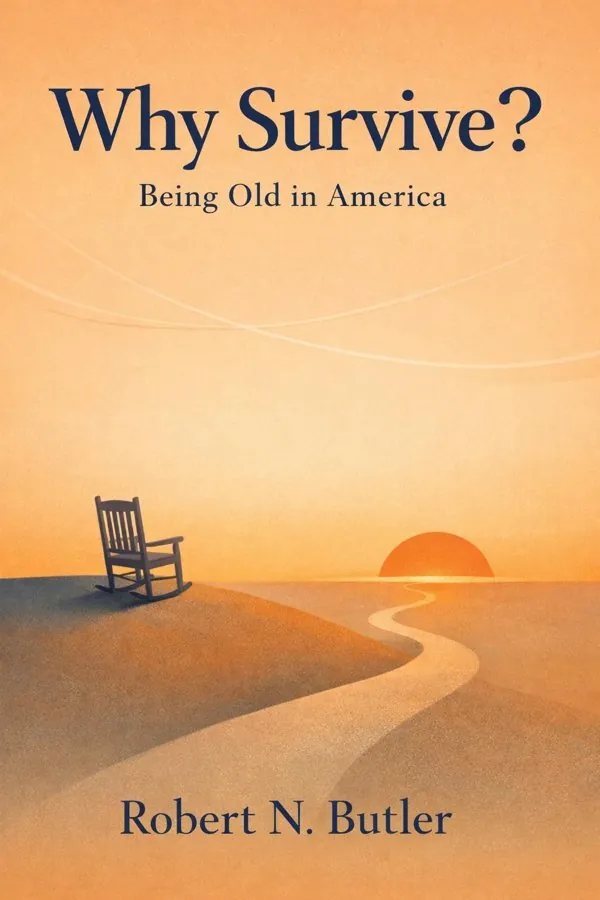
Why Survive?: Being Old in America: Summary & Key Insights
 10 min9 chaptersAudio available
Key Takeaways from Why Survive?: Being Old in America
A society reveals its moral priorities by how it treats people who are no longer economically central.
Prejudice against older people often hides behind politeness, humor, or false pity.
Living longer is a triumph only if those added years are livable.
One of Butler’s sharpest criticisms is that medicine often extends life without adequately addressing the quality of that life.
Old age becomes especially painful when society strips it of meaning.
What Is Why Survive?: Being Old in America About?
Why Survive?: Being Old in America by Robert N. Butler is a biographies book spanning 11 pages. Why Survive?: Being Old in America is a landmark examination of what it means to grow old in a society that prizes youth, productivity, and independence above almost everything else. In this Pulitzer Prize–winning work, physician, psychiatrist, and gerontologist Robert N. Butler asks a disturbing but necessary question: if modern medicine helps people live longer, what kind of life are they actually being saved for? Butler explores the realities of aging in the United States through social policy, medical care, economics, psychology, family life, and cultural prejudice. He argues that old age is not inherently tragic; what makes it painful is the neglect, discrimination, and institutional failure that too often surround it. The book matters because many of its central concerns—loneliness, inadequate elder care, retirement insecurity, and age-based bias—remain urgent today. Butler writes not only as a scholar but as a pioneering authority who founded the National Institute on Aging and coined the term “ageism.” His combination of clinical experience, moral clarity, and policy insight makes this book both a powerful diagnosis and a call to reform.
This FizzRead summary covers all 9 key chapters of Why Survive?: Being Old in America in approximately 10 minutes, distilling the most important ideas, arguments, and takeaways from Robert N. Butler's work. Also available as an audio summary and Key Quotes Podcast.
Why Survive?: Being Old in America
Why Survive?: Being Old in America is a landmark examination of what it means to grow old in a society that prizes youth, productivity, and independence above almost everything else. In this Pulitzer Prize–winning work, physician, psychiatrist, and gerontologist Robert N. Butler asks a disturbing but necessary question: if modern medicine helps people live longer, what kind of life are they actually being saved for? Butler explores the realities of aging in the United States through social policy, medical care, economics, psychology, family life, and cultural prejudice. He argues that old age is not inherently tragic; what makes it painful is the neglect, discrimination, and institutional failure that too often surround it. The book matters because many of its central concerns—loneliness, inadequate elder care, retirement insecurity, and age-based bias—remain urgent today. Butler writes not only as a scholar but as a pioneering authority who founded the National Institute on Aging and coined the term “ageism.” His combination of clinical experience, moral clarity, and policy insight makes this book both a powerful diagnosis and a call to reform.
Who Should Read Why Survive?: Being Old in America?
This book is perfect for anyone interested in biographies and looking to gain actionable insights in a short read. Whether you're a student, professional, or lifelong learner, the key ideas from Why Survive?: Being Old in America by Robert N. Butler will help you think differently.
- ✓Readers who enjoy biographies and want practical takeaways
- ✓Professionals looking to apply new ideas to their work and life
- ✓Anyone who wants the core insights of Why Survive?: Being Old in America in just 10 minutes
Want the full summary?
Get instant access to this book summary and 100K+ more with Fizz Moment.
Get Free SummaryAvailable on App Store • Free to download
Key Chapters
A society reveals its moral priorities by how it treats people who are no longer economically central. Butler shows that the experience of aging in America cannot be understood as a private, biological event alone. It is shaped by historical change: industrialization, urban migration, smaller families, retirement systems, and the breakdown of older patterns in which elders remained embedded in work, kinship, and community life. In agrarian settings, older people often retained practical authority because they held land, skills, and memory. Modern life, by contrast, increasingly separated generations and shifted value toward speed, specialization, and market productivity.
This does not mean the past was ideal or that old age was once universally respected. Butler is too careful a thinker for nostalgia. His point is that the status of older people changes with social structures. When work moves out of the home, when families are geographically dispersed, and when institutions define worth narrowly in terms of output, older adults can become socially invisible even while living longer than ever.
A practical application of this idea is to stop treating aging problems as isolated personal failures. If an older adult is lonely, financially unstable, or excluded from meaningful activity, the cause may lie not in character but in housing design, transportation access, healthcare systems, labor policy, and community fragmentation. Cities with walkable neighborhoods, intergenerational centers, and accessible public transit often support aging far better than places designed only for the young and mobile.
Actionable takeaway: When thinking about aging, ask not only “How is this person coping?” but also “What social arrangements are making old age harder or easier?”
Prejudice against older people often hides behind politeness, humor, or false pity. Butler’s most influential contribution in this book is naming “ageism,” the systematic stereotyping and discrimination directed at people because they are old. Once named, the pattern becomes impossible to ignore. Jokes about senility, assumptions that older adults cannot learn, medical decisions based on age rather than need, and workplace exclusion all flow from a culture that equates aging with decline and irrelevance.
Butler argues that ageism is not just bad manners. It is a serious social force that shapes institutions. An older patient’s symptoms may be dismissed as “just old age” instead of investigated properly. Employers may push capable workers into retirement. Families may make decisions for elders without listening to their preferences. Even well-meaning professionals can infantilize older people by confusing frailty with incompetence.
The practical relevance of this concept is enormous. Once we recognize ageism, we can begin to challenge it in daily life and public policy. In healthcare, it means evaluating individuals rather than relying on stereotypes. In media, it means depicting later life in its full variety rather than as caricature. In families, it means asking older relatives what they want instead of assuming they have stopped wanting anything important.
Ageism also harms younger people because it teaches them to fear their own future selves. A culture that despises aging turns every birthday into a warning. Butler’s insight invites a healthier perspective: aging is not an alien condition affecting “them”; it is a human trajectory affecting nearly all of us.
Actionable takeaway: Notice and challenge one age-based assumption this week—in language, policy, media, or personal behavior—and replace it with an individual, evidence-based view.
Living longer is a triumph only if those added years are livable. Butler emphasizes the harsh contradiction at the center of modern aging: medical and public health advances extended life expectancy, but social systems often failed to provide enough income, housing, and protection for those extra years. Many older Americans faced poverty not because they had been irresponsible, but because wages were low, pensions were weak, savings were inadequate, inflation eroded purchasing power, and illness created crushing costs.
Economic insecurity in old age has cascading effects. It limits food quality, delays medical treatment, increases dependence, and creates chronic anxiety. It can also deepen isolation. An older adult without reliable income may not be able to maintain transportation, participate in community life, or remain in a familiar neighborhood. Financial precarity shrinks freedom.
Butler’s argument remains practical today. Retirement planning cannot be reduced to personal discipline alone. Structural conditions matter: Social Security design, employer pensions, housing markets, healthcare costs, and protections against fraud all influence how secure aging becomes. A teacher, laborer, or caregiver may have worked hard for decades and still face insecurity due to low lifetime earnings or interrupted employment.
At the individual level, families can use Butler’s insight to discuss aging finances early rather than waiting for crisis. Communities can support financial counseling for older adults and create programs that reduce isolation-related costs, such as transportation assistance or subsidized meals. Policymakers can assess whether income supports actually match the real costs of aging.
Actionable takeaway: Treat financial well-being in old age as both a personal planning issue and a public justice issue; review one elder-related financial risk in your family or community and identify a concrete support.
One of Butler’s sharpest criticisms is that medicine often extends life without adequately addressing the quality of that life. Older adults do not only need treatment for disease; they need care that considers function, dignity, mental health, pain, social support, and autonomy. Too often, healthcare systems fragment the person into diagnoses while ignoring the lived experience of being old.
Butler challenges the tendency to write off suffering as inevitable. Hearing loss, depression, mobility limitations, medication side effects, malnutrition, confusion, and chronic pain may all be dismissed as natural aging when they are in fact treatable or manageable. This failure is both clinical and moral. It tells older adults to expect less and professionals to investigate less.
The book encourages a broader model of care. Good geriatric medicine asks practical questions: Can this person walk safely? Are they eating well? Do they understand their medications? Are they lonely? Are they being overtreated or undertreated? A patient with multiple conditions may need coordination more than one more isolated intervention. For example, reducing unnecessary drugs, arranging home support, and addressing depression may improve life far more than an aggressive procedure with little benefit.
This idea also applies to caregivers and families. Instead of focusing only on diagnosis, they can observe day-to-day functioning, mood, and social engagement. Asking “What matters most to you now?” can transform care decisions. For one person, the goal may be pain relief; for another, staying at home; for another, preserving mental clarity.
Actionable takeaway: In any conversation about elder healthcare, add at least three quality-of-life questions—about function, mood, and personal priorities—not just disease management.
When care institutions are poorly designed, they can keep people alive while draining life of identity. Butler is especially critical of long-term care settings that prioritize efficiency, control, and routine over humanity. Nursing homes and other residential institutions may be necessary for some people, but they often reflect society’s willingness to warehouse elders out of sight rather than build systems of care rooted in dignity.
The problem is not merely physical conditions, though those matter greatly. It is the loss of autonomy, privacy, stimulation, and individuality. Residents may be managed according to schedules convenient for staff rather than according to personal habits or preferences. Shared rooms, impersonal meals, little activity, and limited decision-making can produce emotional flattening, passivity, and decline. Once people are treated as burdens to be processed, their sense of self can erode rapidly.
Butler pushes readers to ask what kind of institutional care is acceptable in a humane society. Better models emphasize smaller communities, personalized routines, family involvement, rehabilitation, social engagement, and professional staff trained to see the whole person. Even when resources are limited, attitudes matter. Knowing a resident’s life story, preferences, and relationships can change the quality of care dramatically.
Families can apply this idea by evaluating care settings not only for cleanliness and safety but also for atmosphere, staff interactions, resident activity, and respect for choice. Policymakers can measure outcomes beyond survival, including quality of life and resident autonomy.
Actionable takeaway: If assessing elder care, look for signs of person-centered living—choice, engagement, privacy, and respectful interaction—not just medical supervision and orderliness.
No policy can fully compensate for the human need to belong. Butler underscores that the quality of aging depends heavily on family ties and community connections, yet he avoids sentimentalizing either. Families can support older members with love, advocacy, and continuity. They can also neglect, patronize, exploit, or abandon them. Likewise, communities can either integrate older adults into daily life or isolate them in invisible margins.
One of Butler’s key insights is that dependency itself is not the problem; humiliating or unsupported dependency is. All human beings move in and out of dependence across the life course. The question is whether that dependence is met with reciprocity and respect. Older adults often need practical help with transportation, health management, or household tasks, but they also continue to offer wisdom, childcare, emotional grounding, and family memory.
In practical terms, communities that age well usually create ordinary opportunities for contact. Shared public spaces, senior centers connected to broader civic life, faith groups, neighborhood check-ins, and intergenerational programs can reduce isolation and strengthen mutual aid. Families can improve aging outcomes by planning early: discussing housing preferences, healthcare wishes, financial responsibilities, and caregiving expectations before emergencies make every conversation harder.
Butler invites readers to move beyond the false choice between total independence and total institutional care. Many older adults thrive with modest supports at home or in community settings. What they need is coordination, respect, and reliable relationships.
Actionable takeaway: Start one proactive conversation about aging preferences—housing, support, transportation, or care—with an older family member before crisis forces decisions without their full voice.
The deepest question in Butler’s book is not whether aging is difficult, but whether society is willing to make later life worth living. His answer is a call for reform across public policy, healthcare, housing, employment, and culture. He argues that the suffering of many older Americans is not unavoidable. It results from decisions, priorities, and institutions that can be changed.
Public policy, in Butler’s view, should do more than keep elders barely alive. It should support income security, accessible healthcare, decent housing, preventive services, community-based care, transportation, and legal protections against discrimination. At the same time, cultural change is essential. A society that speaks respectfully about older adults, values their contribution, and integrates them into ordinary life creates conditions for healthier aging than one that sees them mainly as costs.
Butler’s recommendations are striking because they connect ethics to administration. Compassion without structure is fragile; structure without compassion is cold. Real reform requires both. For example, expanding home-based services can reduce institutionalization, but only if workers are trained, paid fairly, and integrated into a larger care system. Protecting older workers from discrimination matters, but so does changing managerial attitudes about what competence looks like across age groups.
For readers today, the book offers a framework for advocacy. Aging policy is not a niche concern. It affects families, workplaces, cities, healthcare systems, and every person fortunate enough to live long. Butler insists that the measure of progress is not merely longer survival, but fuller human possibility throughout the lifespan.
Actionable takeaway: Choose one domain—healthcare, work, housing, caregiving, or public policy—and support one concrete reform that would make aging more dignified in your community.
All Chapters in Why Survive?: Being Old in America
About the Author
Robert N. Butler (1927–2010) was a pioneering American physician, psychiatrist, and gerontologist whose work transformed the study of aging. He is best known for coining the term “ageism,” which gave public language to prejudice and discrimination against older adults. Butler founded the National Institute on Aging, helping establish aging as a major field of medical and social research in the United States. His work consistently bridged clinical care, public policy, and ethics, emphasizing that later life should be understood not only in biological terms but also through economics, psychology, and social structures. In 1976, he received the Pulitzer Prize for Why Survive?: Being Old in America, a landmark critique of how society treats its elderly. He remains one of the most influential voices in modern gerontology.
Get This Summary in Your Preferred Format
Read or listen to the Why Survive?: Being Old in America summary by Robert N. Butler anytime, anywhere. FizzRead offers multiple formats so you can learn on your terms — all free.
Available formats: App · Audio · PDF · EPUB — All included free with FizzRead
Download Why Survive?: Being Old in America PDF and EPUB Summary
Key Quotes from Why Survive?: Being Old in America
“A society reveals its moral priorities by how it treats people who are no longer economically central.”
“Prejudice against older people often hides behind politeness, humor, or false pity.”
“Living longer is a triumph only if those added years are livable.”
“One of Butler’s sharpest criticisms is that medicine often extends life without adequately addressing the quality of that life.”
“Old age becomes especially painful when society strips it of meaning.”
Frequently Asked Questions about Why Survive?: Being Old in America
Why Survive?: Being Old in America by Robert N. Butler is a biographies book that explores key ideas across 9 chapters. Why Survive?: Being Old in America is a landmark examination of what it means to grow old in a society that prizes youth, productivity, and independence above almost everything else. In this Pulitzer Prize–winning work, physician, psychiatrist, and gerontologist Robert N. Butler asks a disturbing but necessary question: if modern medicine helps people live longer, what kind of life are they actually being saved for? Butler explores the realities of aging in the United States through social policy, medical care, economics, psychology, family life, and cultural prejudice. He argues that old age is not inherently tragic; what makes it painful is the neglect, discrimination, and institutional failure that too often surround it. The book matters because many of its central concerns—loneliness, inadequate elder care, retirement insecurity, and age-based bias—remain urgent today. Butler writes not only as a scholar but as a pioneering authority who founded the National Institute on Aging and coined the term “ageism.” His combination of clinical experience, moral clarity, and policy insight makes this book both a powerful diagnosis and a call to reform.
You Might Also Like

An American Marriage
Tayari Jones
10 min
Benjamin Franklin: An American Life
Walter Isaacson
10 min
I Know Why The Caged Bird Sings
Maya Angelou
10 min
Long Walk to Freedom
Nelson Mandela
10 min
Persepolis
Marjane Satrapi
10 min
Surely You're Joking, Mr. Feynman!
Richard P. Feynman
10 minBrowse by Category
Ready to read Why Survive?: Being Old in America?
Get the full summary and 100K+ more books with Fizz Moment.