
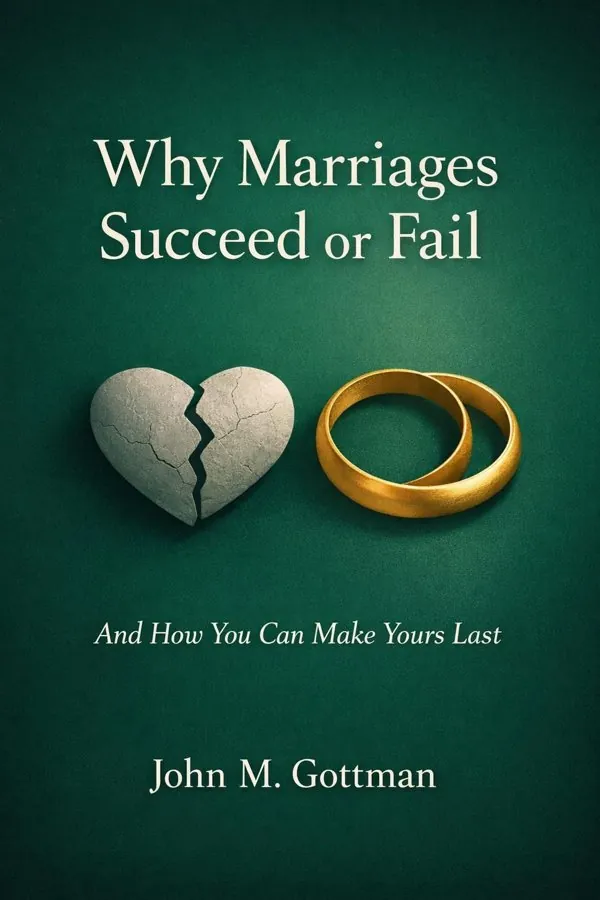
Why Marriages Succeed or Fail: And How You Can Make Yours Last: Summary & Key Insights
 10 min6 chaptersAudio available
What Is Why Marriages Succeed or Fail: And How You Can Make Yours Last About?
Why Marriages Succeed or Fail: And How You Can Make Yours Last by John M. Gottman is a relationships book spanning 6 pages. In this groundbreaking work, Dr. John M. Gottman presents the results of his extensive research on over two thousand married couples, revealing the key behaviors and attitudes that determine whether a marriage will thrive or deteriorate. He identifies four destructive patterns—contempt, criticism, defensiveness, and stonewalling—and offers practical exercises and insights to help couples build stronger, more resilient relationships. The book provides scientifically grounded strategies for improving communication, resolving conflict, and fostering emotional connection.
This FizzRead summary covers all 6 key chapters of Why Marriages Succeed or Fail: And How You Can Make Yours Last in approximately 10 minutes, distilling the most important ideas, arguments, and takeaways from John M. Gottman's work. Also available as an audio summary and Key Quotes Podcast.
Why Marriages Succeed or Fail: And How You Can Make Yours Last
In this groundbreaking work, Dr. John M. Gottman presents the results of his extensive research on over two thousand married couples, revealing the key behaviors and attitudes that determine whether a marriage will thrive or deteriorate. He identifies four destructive patterns—contempt, criticism, defensiveness, and stonewalling—and offers practical exercises and insights to help couples build stronger, more resilient relationships. The book provides scientifically grounded strategies for improving communication, resolving conflict, and fostering emotional connection.
Who Should Read Why Marriages Succeed or Fail: And How You Can Make Yours Last?
This book is perfect for anyone interested in relationships and looking to gain actionable insights in a short read. Whether you're a student, professional, or lifelong learner, the key ideas from Why Marriages Succeed or Fail: And How You Can Make Yours Last by John M. Gottman will help you think differently.
- ✓Readers who enjoy relationships and want practical takeaways
- ✓Professionals looking to apply new ideas to their work and life
- ✓Anyone who wants the core insights of Why Marriages Succeed or Fail: And How You Can Make Yours Last in just 10 minutes
Want the full summary?
Get instant access to this book summary and 100K+ more with Fizz Moment.
Get Free SummaryAvailable on App Store • Free to download
Key Chapters
Early in my career, many people doubted whether a marriage could be quantified or predicted scientifically. Yet the data showed unmistakable patterns. In my laboratory, couples engaged in normal discussions while sensors monitored their heart rate, facial expressions, and tone of voice. With astonishing consistency, these physiological and behavioral markers foretold whether they would remain together or not. A marriage is essentially a dynamic emotional exchange—a system of interactions that stabilizes when partners respond to each other with empathy, and destabilizes when defensiveness and criticism take over.
I found that successful marriages maintain a healthy balance between positive and negative interactions. The 'magic ratio'—about five positive interactions for every one negative—proved to be a telling predictor. When warmth and humor outweigh irritation, relationships stay resilient even through conflict. Failures arise when negativity floods the emotional system, leading partners to misinterpret each other’s motives. This insight reshaped how therapists across the world understood marital therapy, emphasizing emotional regulation over mere problem-solving.
The real discovery, though, was that small moments matter most. Everyday habits—listening with curiosity, making affectionate remarks, turning toward your partner when they bid for attention—create emotional reserves that keep connection strong. Marriage succeeds not through grand solutions but through constant micro-interactions that sustain trust.
Through years of videotaped sessions and longitudinal tracking, I identified four recurring patterns that predicted divorce with startling accuracy. The first is **criticism**, which attacks your partner’s character rather than addressing specific behaviors. It sounds like 'You never' or 'You always'—phrases that magnify faults and erase context. Criticism corrodes affection because it communicates rejection rather than care.
The second horseman, **contempt**, is the deadliest. It manifests through sarcasm, hostility, eye-rolling, or ridicule. Contempt communicates superiority, the belief that one partner is better than the other. Couples plagued by contempt are not just arguing—they’re eroding mutual respect, which research proves is the strongest predictor of marital happiness.
Next is **defensiveness**, the instinctive shield that deflects responsibility. When accused, a defensive partner counters with another complaint or denial, turning every exchange into a stalemate. It’s an emotional reflex that prevents growth because it blocks vulnerability. The fourth horseman, **stonewalling**, occurs when a partner withdraws, emotionally or physically, from interaction. Stonewalling looks like silence, avoidance, or tuning out—and it signals the physiological flooding that shuts down communication entirely.
Recognizing these four behaviors is the first step toward transformation. Each has its antidote. Instead of criticism, use gentle start-up language—express feelings by describing your needs. Replace contempt with appreciation, defensiveness with accountability, and stonewalling with self-soothing paired with re-engagement. The point isn’t perfection, but awareness: knowing when the horsemen appear allows you to change the script before damage accumulates.
+ 4 more chapters — available in the FizzRead app
All Chapters in Why Marriages Succeed or Fail: And How You Can Make Yours Last
About the Author
John M. Gottman, Ph.D., is a renowned psychologist and researcher known for his pioneering work on marital stability and relationship analysis. He is the co-founder of The Gottman Institute and has authored numerous influential books on relationships and emotional intelligence. His research has been widely cited in the fields of psychology and family therapy.
Get This Summary in Your Preferred Format
Read or listen to the Why Marriages Succeed or Fail: And How You Can Make Yours Last summary by John M. Gottman anytime, anywhere. FizzRead offers multiple formats so you can learn on your terms — all free.
Available formats: App · Audio · PDF · EPUB — All included free with FizzRead
Download Why Marriages Succeed or Fail: And How You Can Make Yours Last PDF and EPUB Summary
Key Quotes from Why Marriages Succeed or Fail: And How You Can Make Yours Last
“Early in my career, many people doubted whether a marriage could be quantified or predicted scientifically.”
“Through years of videotaped sessions and longitudinal tracking, I identified four recurring patterns that predicted divorce with startling accuracy.”
Frequently Asked Questions about Why Marriages Succeed or Fail: And How You Can Make Yours Last
Why Marriages Succeed or Fail: And How You Can Make Yours Last by John M. Gottman is a relationships book that explores key ideas across 6 chapters. In this groundbreaking work, Dr. John M. Gottman presents the results of his extensive research on over two thousand married couples, revealing the key behaviors and attitudes that determine whether a marriage will thrive or deteriorate. He identifies four destructive patterns—contempt, criticism, defensiveness, and stonewalling—and offers practical exercises and insights to help couples build stronger, more resilient relationships. The book provides scientifically grounded strategies for improving communication, resolving conflict, and fostering emotional connection.
More by John M. Gottman
You Might Also Like
The 5 Love Languages
Gary Chapman
10 min
Men Are from Mars, Women Are from Venus
John Gray
10 min
She Comes First
Ian Kerner
10 min
No More Mr Nice Guy
Robert Glover
10 min
Hold Me Tight
Sue Johnson
10 min
Mating in Captivity
Esther Perel
10 minBrowse by Category
Ready to read Why Marriages Succeed or Fail: And How You Can Make Yours Last?
Get the full summary and 100K+ more books with Fizz Moment.