
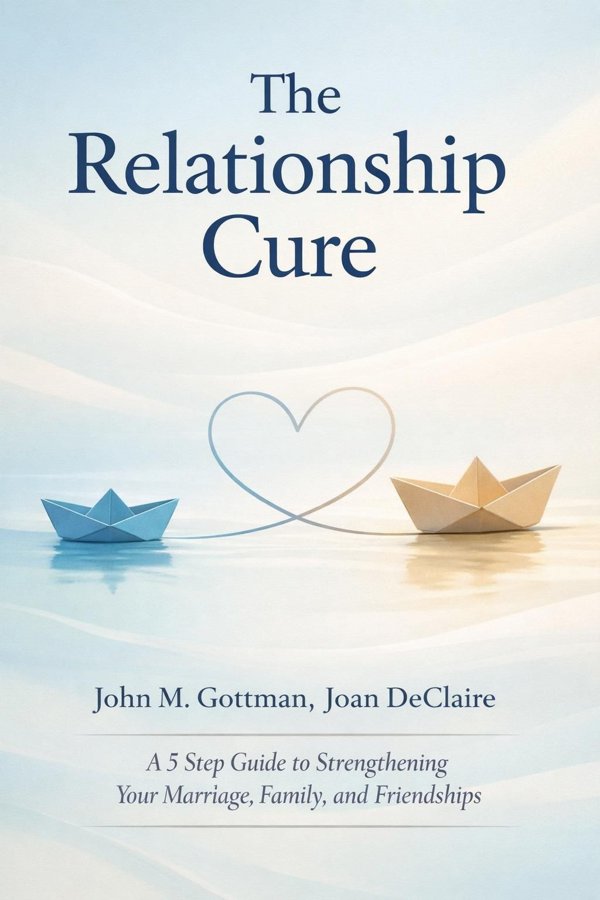
The Relationship Cure: A 5 Step Guide to Strengthening Your Marriage, Family, and Friendships: Summary & Key Insights
by John M. Gottman, Joan DeClaire
 10 min8 chaptersAudio available
What Is The Relationship Cure: A 5 Step Guide to Strengthening Your Marriage, Family, and Friendships About?
The Relationship Cure: A 5 Step Guide to Strengthening Your Marriage, Family, and Friendships by John M. Gottman, Joan DeClaire is a relationships book spanning 8 pages. In this influential guide, psychologist John M. Gottman and writer Joan DeClaire present a five-step program for improving emotional communication and building stronger, more fulfilling relationships. Drawing on decades of research at the Gottman Institute, the book explains how to recognize and respond to 'bids for connection'—the small moments that form the foundation of trust and intimacy in marriages, families, and friendships.
This FizzRead summary covers all 8 key chapters of The Relationship Cure: A 5 Step Guide to Strengthening Your Marriage, Family, and Friendships in approximately 10 minutes, distilling the most important ideas, arguments, and takeaways from John M. Gottman, Joan DeClaire's work. Also available as an audio summary and Key Quotes Podcast.
The Relationship Cure: A 5 Step Guide to Strengthening Your Marriage, Family, and Friendships
In this influential guide, psychologist John M. Gottman and writer Joan DeClaire present a five-step program for improving emotional communication and building stronger, more fulfilling relationships. Drawing on decades of research at the Gottman Institute, the book explains how to recognize and respond to 'bids for connection'—the small moments that form the foundation of trust and intimacy in marriages, families, and friendships.
Who Should Read The Relationship Cure: A 5 Step Guide to Strengthening Your Marriage, Family, and Friendships?
This book is perfect for anyone interested in relationships and looking to gain actionable insights in a short read. Whether you're a student, professional, or lifelong learner, the key ideas from The Relationship Cure: A 5 Step Guide to Strengthening Your Marriage, Family, and Friendships by John M. Gottman, Joan DeClaire will help you think differently.
- ✓Readers who enjoy relationships and want practical takeaways
- ✓Professionals looking to apply new ideas to their work and life
- ✓Anyone who wants the core insights of The Relationship Cure: A 5 Step Guide to Strengthening Your Marriage, Family, and Friendships in just 10 minutes
Want the full summary?
Get instant access to this book summary and 100K+ more with Fizz Moment.
Get Free SummaryAvailable on App Store • Free to download
Key Chapters
The first step toward emotional connection begins with noticing. Most people are unaware of how often they send and receive emotional bids throughout a typical day. A bid might appear as a question, a touch, a smile, or even a small complaint. It’s any act that says: “Pay attention to me, connect with me, respond to me.” The tragedy in many relationships is not that people don’t care—it’s that they don’t recognize these signals when they occur.
In my studies of couples, families, and colleagues, I found that successful relationships are defined by one consistent behavior: turning toward bids. When your partner makes a comment about a movie, or your child sighs in frustration, how you respond—by engaging, ignoring, or dismissing—determines the emotional trajectory that follows. Turning away, even unconsciously, establishes patterns of emotional isolation. Turning toward builds trust and intimacy.
Understanding bids means becoming sensitive not just to words but to tone, gesture, and emotional context. When your friend mentions how tired they are, they might be seeking comfort or acknowledgment. When your spouse jokes about being ignored, they might be testing whether you see them. The key is learning to interpret these subtleties without judgment, and without retreating into defensiveness. Emotional bids are invitations, not accusations.
In therapy rooms and observational studies, I’ve watched countless moments where missed bids turned into missed opportunities. A person sips coffee with a faraway look, their partner glances up but says nothing. That silence echoes louder than any argument. To understand bids is to train your emotional ear—to hear not what is said, but what is meant beneath the surface.
This awareness may feel delicate at first, but it’s an enormous strength. It builds the foundation for emotional intelligence and teaches you how to respond not to words, but to needs.
Once you can recognize bids, the next step is self-awareness—understanding your own emotional habits and how they influence the way you respond to others. Everyone has a distinctive communication style rooted in personal history, temperament, and family learning. Some people naturally turn toward bids with curiosity and warmth; others protect themselves through withdrawal or sarcasm; still others overcompensate, flooding interactions with intensity.
Through our research at the Gottman Institute, we’ve identified patterns of emotional communication that can fuel or block connection. If you tend to retreat under pressure, your partner’s bids may feel intrusive. If you crave constant interaction, you may misinterpret quiet as rejection. Recognizing these tendencies isn’t about blame—it’s about understanding the filters through which you perceive emotional signals.
I often ask people to look into their earliest experiences: how did your parents or caregivers respond when you sought comfort, shared your feelings, or expressed need? Those formative responses become your implicit emotional map. Understanding them helps you rewrite unhelpful habits.
This step invites genuine honesty. It asks you to notice not only what you say but what you feel when someone bids for your attention. Do you tense up? Do you fear being judged? Are you quick to respond or quick to retreat? The more clearly you can identify your own emotional style, the more skillfully you can adjust it to meet others with presence and empathy.
Emotional mastery doesn’t mean suppressing feelings. It means integrating awareness and choice—knowing your patterns so you can choose how to engage. When both partners, friends, or family members understand their emotional styles, dialogue becomes less reactive and more intentional. This is the soil from which emotional attunement grows.
+ 6 more chapters — available in the FizzRead app
All Chapters in The Relationship Cure: A 5 Step Guide to Strengthening Your Marriage, Family, and Friendships
About the Authors
John M. Gottman, Ph.D., is a renowned psychologist and researcher known for his work on marital stability and relationship analysis. He is the co-founder of the Gottman Institute. Joan DeClaire is a writer specializing in psychology and health communication.
Get This Summary in Your Preferred Format
Read or listen to the The Relationship Cure: A 5 Step Guide to Strengthening Your Marriage, Family, and Friendships summary by John M. Gottman, Joan DeClaire anytime, anywhere. FizzRead offers multiple formats so you can learn on your terms — all free.
Available formats: App · Audio · PDF · EPUB — All included free with FizzRead
Download The Relationship Cure: A 5 Step Guide to Strengthening Your Marriage, Family, and Friendships PDF and EPUB Summary
Key Quotes from The Relationship Cure: A 5 Step Guide to Strengthening Your Marriage, Family, and Friendships
“The first step toward emotional connection begins with noticing.”
“Once you can recognize bids, the next step is self-awareness—understanding your own emotional habits and how they influence the way you respond to others.”
Frequently Asked Questions about The Relationship Cure: A 5 Step Guide to Strengthening Your Marriage, Family, and Friendships
The Relationship Cure: A 5 Step Guide to Strengthening Your Marriage, Family, and Friendships by John M. Gottman, Joan DeClaire is a relationships book that explores key ideas across 8 chapters. In this influential guide, psychologist John M. Gottman and writer Joan DeClaire present a five-step program for improving emotional communication and building stronger, more fulfilling relationships. Drawing on decades of research at the Gottman Institute, the book explains how to recognize and respond to 'bids for connection'—the small moments that form the foundation of trust and intimacy in marriages, families, and friendships.
You Might Also Like
The 5 Love Languages
Gary Chapman
10 min
Men Are from Mars, Women Are from Venus
John Gray
10 min
She Comes First
Ian Kerner
10 min
No More Mr Nice Guy
Robert Glover
10 min
Hold Me Tight
Sue Johnson
10 min
Mating in Captivity
Esther Perel
10 minBrowse by Category
Ready to read The Relationship Cure: A 5 Step Guide to Strengthening Your Marriage, Family, and Friendships?
Get the full summary and 100K+ more books with Fizz Moment.