
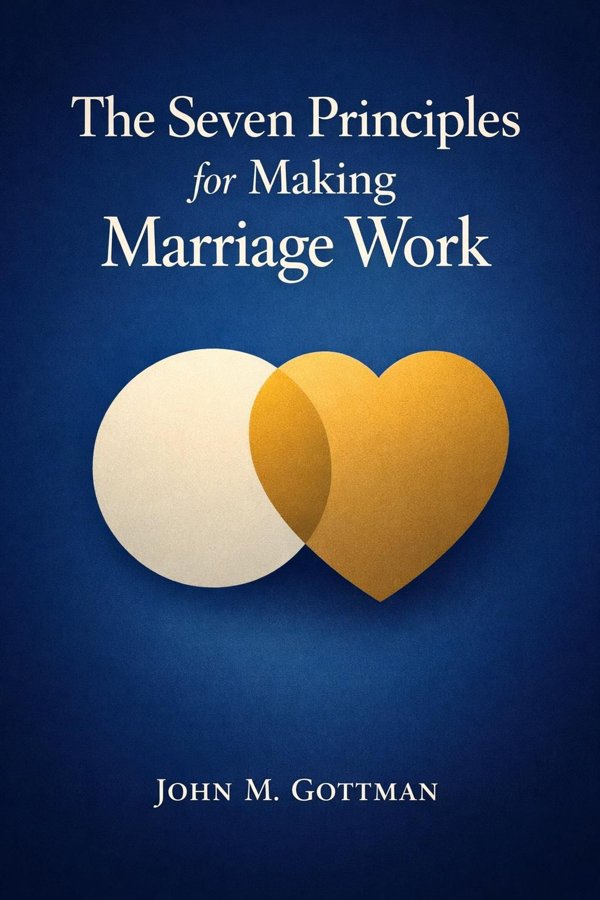
The Seven Principles for Making Marriage Work: A Practical Guide from the Country's Foremost Relationship Expert: Summary & Key Insights
 10 min9 chaptersAudio available
Key Takeaways from The Seven Principles for Making Marriage Work: A Practical Guide from the Country's Foremost Relationship Expert
A relationship usually does not collapse because of one dramatic betrayal; it erodes through repeated negative patterns that become normal.
Intimacy is not built by mind-reading; it is built by ongoing curiosity.
Long-term love survives not because couples avoid disappointment, but because they maintain a generous way of seeing each other.
Relationships are built in small moments, not just major milestones.
Strong relationships are not power struggles won by the most stubborn person.
What Is The Seven Principles for Making Marriage Work: A Practical Guide from the Country's Foremost Relationship Expert About?
The Seven Principles for Making Marriage Work: A Practical Guide from the Country's Foremost Relationship Expert by John M. Gottman is a relationships book spanning 9 pages. The Seven Principles for Making Marriage Work distills decades of scientific research into a practical guide for building a stronger, more resilient relationship. Rather than relying on vague advice or romantic idealism, John M. Gottman draws on years of observing couples in his famous “Love Lab,” where he studied how partners talk, fight, reconnect, and drift apart. His conclusion is both sobering and hopeful: successful marriages are not defined by the absence of conflict, but by the presence of emotional connection, mutual respect, and repair. The book matters because it replaces myths about marriage with evidence-based habits that ordinary couples can practice. Gottman explains why small moments of attention matter more than grand gestures, why some arguments never fully disappear, and why friendship is the foundation of lasting love. He also identifies communication patterns that predict divorce with startling accuracy and offers concrete tools to replace them. For couples who want to strengthen their bond, recover closeness, or better understand the dynamics of long-term love, this book remains one of the most influential and actionable relationship guides ever written.
This FizzRead summary covers all 9 key chapters of The Seven Principles for Making Marriage Work: A Practical Guide from the Country's Foremost Relationship Expert in approximately 10 minutes, distilling the most important ideas, arguments, and takeaways from John M. Gottman's work. Also available as an audio summary and Key Quotes Podcast.
The Seven Principles for Making Marriage Work: A Practical Guide from the Country's Foremost Relationship Expert
The Seven Principles for Making Marriage Work distills decades of scientific research into a practical guide for building a stronger, more resilient relationship. Rather than relying on vague advice or romantic idealism, John M. Gottman draws on years of observing couples in his famous “Love Lab,” where he studied how partners talk, fight, reconnect, and drift apart. His conclusion is both sobering and hopeful: successful marriages are not defined by the absence of conflict, but by the presence of emotional connection, mutual respect, and repair.
The book matters because it replaces myths about marriage with evidence-based habits that ordinary couples can practice. Gottman explains why small moments of attention matter more than grand gestures, why some arguments never fully disappear, and why friendship is the foundation of lasting love. He also identifies communication patterns that predict divorce with startling accuracy and offers concrete tools to replace them.
For couples who want to strengthen their bond, recover closeness, or better understand the dynamics of long-term love, this book remains one of the most influential and actionable relationship guides ever written.
Who Should Read The Seven Principles for Making Marriage Work: A Practical Guide from the Country's Foremost Relationship Expert?
This book is perfect for anyone interested in relationships and looking to gain actionable insights in a short read. Whether you're a student, professional, or lifelong learner, the key ideas from The Seven Principles for Making Marriage Work: A Practical Guide from the Country's Foremost Relationship Expert by John M. Gottman will help you think differently.
- ✓Readers who enjoy relationships and want practical takeaways
- ✓Professionals looking to apply new ideas to their work and life
- ✓Anyone who wants the core insights of The Seven Principles for Making Marriage Work: A Practical Guide from the Country's Foremost Relationship Expert in just 10 minutes
Want the full summary?
Get instant access to this book summary and 100K+ more with Fizz Moment.
Get Free SummaryAvailable on App Store • Free to download
Key Chapters
A relationship usually does not collapse because of one dramatic betrayal; it erodes through repeated negative patterns that become normal. Gottman’s most famous finding is that four communication habits strongly predict marital failure: criticism, contempt, defensiveness, and stonewalling. He calls them the Four Horsemen because once they dominate daily interaction, emotional safety disappears.
Criticism attacks a partner’s character rather than addressing a specific behavior. Instead of saying, “I felt overwhelmed when the dishes were left undone,” criticism sounds like, “You’re so lazy.” Contempt is even more corrosive. It shows up as sarcasm, eye-rolling, mockery, or superiority, and it communicates disgust. Defensiveness blocks accountability by turning every complaint into a counterattack or excuse. Stonewalling occurs when one partner emotionally shuts down, withdraws, or stops engaging altogether.
Gottman emphasizes that these patterns are dangerous not simply because they create unpleasant conversations, but because they gradually reshape how partners see one another. A spouse stops being an ally and becomes an adversary. The antidotes are equally important: replace criticism with gentle startup, contempt with appreciation, defensiveness with responsibility, and stonewalling with self-soothing and re-engagement.
Imagine a couple arguing about finances. One says, “You never think ahead,” the other snaps back, and soon both are either attacking or disengaging. A healthier version starts with, “I’m feeling anxious about our spending. Can we look at the budget together?” The topic may still be hard, but the tone preserves goodwill.
Actionable takeaway: In your next conflict, identify which Horseman is appearing and consciously substitute its antidote before the conversation escalates.
Intimacy is not built by mind-reading; it is built by ongoing curiosity. Gottman uses the term “love maps” to describe the mental knowledge partners hold about each other’s inner world: worries, dreams, current stresses, joys, friendships, values, and changing priorities. Strong marriages are grounded in this detailed understanding.
Many couples assume they know each other because they once did. But people evolve. Careers change, family roles shift, health concerns emerge, ambitions deepen or fade. If partners stop updating their knowledge, they begin living beside each other rather than with each other. Gottman argues that emotional distance often starts long before obvious conflict. It begins when partners no longer ask meaningful questions or stop noticing what matters to the other person.
Love maps are strengthened through ordinary conversation. Asking, “What’s stressing you most this week?” or “What are you looking forward to right now?” may seem simple, but such questions signal attention and care. A spouse who knows the names of their partner’s close colleagues, understands their unresolved family tension, and remembers their recent disappointment is far better equipped to offer comfort and support.
This principle also matters during conflict. When you know your partner’s background, fears, and pressure points, you can interpret behavior more generously. A withdrawn mood may reflect work exhaustion rather than rejection. A sharp tone may be linked to anxiety, not lack of love.
Actionable takeaway: Spend ten minutes each day asking open-ended questions that help you update your partner’s emotional world, and listen without trying to fix everything.
Long-term love survives not because couples avoid disappointment, but because they maintain a generous way of seeing each other. Gottman argues that fondness and admiration form a protective shield around a relationship. When partners regularly notice and express what they value in one another, they create emotional resilience that helps them weather inevitable stress.
This principle may sound sentimental, but it is deeply practical. Relationships become fragile when irritation overshadows appreciation. Once negative sentiment takes over, even neutral actions are interpreted badly. A forgotten errand becomes proof of selfishness. A distracted moment becomes evidence of indifference. Fondness interrupts this slide by keeping positive memories and present-day respect alive.
Gottman encourages couples to recall what first drew them together and to continue expressing appreciation in small, specific ways. Instead of generic praise like “You’re great,” say, “I appreciate how patient you were with the kids tonight,” or “I admire how hard you work even when you’re tired.” Specificity makes praise believable and emotionally meaningful.
Fondness also shows up in storytelling. Couples who describe their history with warmth, humor, and gratitude tend to have stronger marriages than those who recount it with bitterness. The way partners talk about their past reveals whether admiration is still accessible.
In everyday life, this can be as simple as thanking your spouse for making coffee, noticing their effort after a hard day, or recalling a shared challenge you overcame together. These are not trivial gestures. They shape the emotional climate of the relationship.
Actionable takeaway: Every day, voice one concrete thing you appreciate or admire about your partner, especially when life feels busy or stressful.
Relationships are built in small moments, not just major milestones. One of Gottman’s most powerful insights is that partners constantly make “bids” for connection: brief attempts to get attention, affection, humor, comfort, or interest. A bid can be as simple as “Look at this,” a sigh after a hard day, a joke from the kitchen, or a hand placed lightly on a shoulder. The success of a marriage often depends on whether these bids are met.
When partners turn toward each other, they acknowledge the bid with interest, warmth, or responsiveness. Turning away means ignoring it. Turning against means responding with annoyance or hostility. Over time, these tiny choices accumulate. Couples who consistently turn toward each other build trust and emotional intimacy. Couples who routinely miss or dismiss bids create loneliness even while sharing a home.
This principle explains why seemingly minor exchanges matter so much. If one partner says, “I had such a weird meeting today,” and the other barely looks up from a phone, an opportunity for connection disappears. But if the response is, “What happened?” the message is clear: your inner life matters to me.
Turning toward does not require endless availability. It requires responsiveness often enough that your partner feels seen. Even a delayed but sincere response can help: “I want to hear this, but give me five minutes to finish this email.” The point is not perfection. It is a pattern of engagement.
Actionable takeaway: For one week, consciously notice your partner’s bids for connection and respond warmly to as many as possible, especially the small ones you normally overlook.
Strong relationships are not power struggles won by the most stubborn person. Gottman finds that happy couples practice mutual influence: they listen to each other, respect each other’s perspectives, and allow themselves to be changed by what the other says. This is especially important when one partner tends to become rigid, dismissive, or controlling.
Accepting influence does not mean surrendering your preferences or agreeing on everything. It means treating your partner as a legitimate source of insight. A spouse who says, “You’re right, I hadn’t considered that,” is strengthening the relationship, not losing authority. By contrast, refusing influence sends the message that only one person’s needs, values, or interpretations matter.
Gottman notes that many recurring conflicts become more manageable when partners stop fighting for dominance and start looking for overlap. For example, if one person wants a highly structured weekend and the other wants spontaneity, the goal is not total victory for either side. It is a solution that incorporates both voices: perhaps planning one anchor activity while leaving room for flexibility.
Influence also matters emotionally. If your partner says your tone felt harsh, you do not have to agree with their intent to take their impact seriously. Saying, “I didn’t mean it that way, but I can see it hurt you,” preserves connection.
Mutual influence fosters trust because it proves that each person matters. It creates a marriage that feels collaborative rather than hierarchical.
Actionable takeaway: In your next disagreement, identify one point your partner makes that you can sincerely validate or incorporate into the solution.
Many arguments are decided in their opening moments. Gottman shows that the way a difficult conversation begins often predicts how it will end. Harsh startups—blame, accusation, sarcasm, and pent-up frustration—invite defensiveness and escalation. Soft startups, by contrast, make problem-solving possible.
A soft startup includes three elements: describing the issue calmly, expressing feelings without attack, and stating a positive need. Compare “You never help around here” with “I’m feeling overwhelmed by the housework, and I’d really appreciate us making a plan together.” The second approach addresses the same concern but protects dignity and cooperation.
This principle is especially useful for solvable problems: recurring practical issues involving chores, schedules, parenting logistics, money management, or household routines. These are not deep value clashes, though they can still create major tension if handled poorly. Gottman advises couples to complain without blame, make and receive repair attempts, and de-escalate when conversations become physiologically flooded.
Repair attempts are crucial. A joke, a pause, an “I’m not saying this well,” or “Let’s start over” can prevent an argument from hardening. Successful couples do not avoid missteps; they recover from them faster.
Consider a conflict about lateness. A harsh startup—“You’re always inconsiderate”—turns a logistical problem into a character indictment. A soft startup—“I get stressed when we run late, and I want us to figure out a better routine”—keeps the issue solvable.
Actionable takeaway: Before raising a complaint, rewrite it into a soft startup using this formula: “I feel... about... and I need...”
Not all marital conflict can be solved through compromise alone. Gottman distinguishes between solvable problems and perpetual problems. Perpetual problems arise from deeper differences in personality, lifestyle, values, or emotional needs. When these become painful and polarized, couples experience gridlock.
Gridlock is not really about the surface topic. An argument about holidays may be about loyalty to family. A clash over spending may be about security, freedom, status, or childhood scarcity. A dispute over how social to be may reflect identity, energy limits, or longing for belonging. Gottman’s key insight is that behind many stuck conflicts lies an unspoken dream.
The goal is not to eliminate these differences but to understand them. Partners must move from “my way versus your way” to curiosity about what the issue symbolizes. Asking, “What does this mean to you?” can transform a deadlocked argument. One spouse may want a tidy home because chaos in childhood felt frightening. Another may resist rigid order because spontaneity feels life-giving. Once dreams are named, compassion becomes possible.
Couples can then search for areas of flexibility. Rarely is every part of a position nonnegotiable. One person may need some financial structure but not extreme control. The other may want freedom but can agree to spending limits. Progress begins when each partner feels heard at the level of meaning, not just preference.
Actionable takeaway: Choose one recurring conflict and ask each other what deeper value, fear, history, or dream lies underneath your position before trying to negotiate a solution.
Change becomes easier when couples can see their patterns clearly. One of the practical strengths of Gottman’s book is its use of questionnaires, exercises, and structured conversations to help partners assess the health of their relationship. These tools are not gimmicks; they are designed to turn vague dissatisfaction into specific insight.
Many couples know something feels off but cannot name it. They say they feel disconnected, misunderstood, or stuck. Assessments help locate where the strain lies. Is the friendship system weak? Are bids being missed? Is conflict full of harsh startups? Is there too little admiration? Is one partner stonewalling under stress? Once a pattern is identified, the relationship becomes more workable because the problem is externalized and defined.
Exercises also create productive dialogue. Love map questions prompt discovery. Appreciation practices rebuild warmth. Conflict worksheets slow down reactivity and encourage listening. Dream-within-conflict conversations uncover hidden meaning. Even a simple check-in can reveal assumptions each partner did not know they were making.
Importantly, Gottman’s method encourages couples to think in habits rather than dramatic breakthroughs. Marriages often improve through repeated micro-adjustments, not one transformative conversation. An assessment can serve as a baseline and a way to measure growth over time.
This principle is valuable for couples at any stage, including those who are not in crisis. Structured reflection can strengthen a good marriage before resentment accumulates. It can also help struggling couples move from blame to shared problem-solving.
Actionable takeaway: Set aside an hour to complete one relationship exercise together and discuss the results with curiosity, not judgment.
All Chapters in The Seven Principles for Making Marriage Work: A Practical Guide from the Country's Foremost Relationship Expert
About the Author
John M. Gottman, Ph.D., is a renowned American psychologist and one of the world’s leading researchers on relationships, marriage, and emotional communication. Over several decades, he studied couples in laboratory settings and identified behavioral patterns that can predict marital success or breakdown with remarkable accuracy. He is best known for developing concepts such as the Four Horsemen of conflict and for emphasizing the role of friendship, repair, and emotional responsiveness in lasting relationships. Gottman co-founded the Gottman Institute with Dr. Julie Schwartz Gottman, where their research is translated into therapy methods, workshops, and educational tools for couples and professionals. His books have become foundational works in the fields of relationship psychology and couples counseling.
Get This Summary in Your Preferred Format
Read or listen to the The Seven Principles for Making Marriage Work: A Practical Guide from the Country's Foremost Relationship Expert summary by John M. Gottman anytime, anywhere. FizzRead offers multiple formats so you can learn on your terms — all free.
Available formats: App · Audio · PDF · EPUB — All included free with FizzRead
Download The Seven Principles for Making Marriage Work: A Practical Guide from the Country's Foremost Relationship Expert PDF and EPUB Summary
Key Quotes from The Seven Principles for Making Marriage Work: A Practical Guide from the Country's Foremost Relationship Expert
“A relationship usually does not collapse because of one dramatic betrayal; it erodes through repeated negative patterns that become normal.”
“Intimacy is not built by mind-reading; it is built by ongoing curiosity.”
“Long-term love survives not because couples avoid disappointment, but because they maintain a generous way of seeing each other.”
“Relationships are built in small moments, not just major milestones.”
“Strong relationships are not power struggles won by the most stubborn person.”
Frequently Asked Questions about The Seven Principles for Making Marriage Work: A Practical Guide from the Country's Foremost Relationship Expert
The Seven Principles for Making Marriage Work: A Practical Guide from the Country's Foremost Relationship Expert by John M. Gottman is a relationships book that explores key ideas across 9 chapters. The Seven Principles for Making Marriage Work distills decades of scientific research into a practical guide for building a stronger, more resilient relationship. Rather than relying on vague advice or romantic idealism, John M. Gottman draws on years of observing couples in his famous “Love Lab,” where he studied how partners talk, fight, reconnect, and drift apart. His conclusion is both sobering and hopeful: successful marriages are not defined by the absence of conflict, but by the presence of emotional connection, mutual respect, and repair. The book matters because it replaces myths about marriage with evidence-based habits that ordinary couples can practice. Gottman explains why small moments of attention matter more than grand gestures, why some arguments never fully disappear, and why friendship is the foundation of lasting love. He also identifies communication patterns that predict divorce with startling accuracy and offers concrete tools to replace them. For couples who want to strengthen their bond, recover closeness, or better understand the dynamics of long-term love, this book remains one of the most influential and actionable relationship guides ever written.
More by John M. Gottman
You Might Also Like

The 5 Love Languages
Gary Chapman
10 min
Men Are from Mars, Women Are from Venus
John Gray
10 min
She Comes First
Ian Kerner
10 min
No More Mr Nice Guy
Robert Glover
10 min
Hold Me Tight
Sue Johnson
10 min
Mating in Captivity
Esther Perel
10 minBrowse by Category
Ready to read The Seven Principles for Making Marriage Work: A Practical Guide from the Country's Foremost Relationship Expert?
Get the full summary and 100K+ more books with Fizz Moment.