
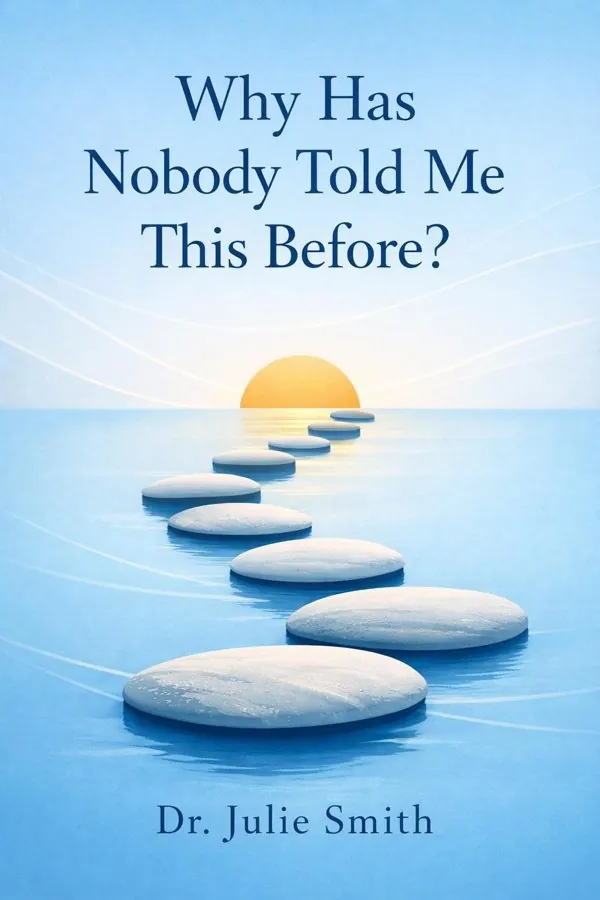
Why Has Nobody Told Me This Before: Summary & Key Insights
by Julie Smith
 10 min9 chaptersAudio available
Key Takeaways from Why Has Nobody Told Me This Before
One of the most liberating truths in psychology is that emotions rarely appear out of nowhere.
Feeling low becomes more dangerous when we judge ourselves for it.
Anxiety often feels like evidence that something is terribly wrong, but Smith reframes it as a survival system working too hard.
One of the most counterintuitive lessons in the book is that motivation is often the result of action, not the prerequisite for it.
People often notice stress only when they are already close to breaking point.
What Is Why Has Nobody Told Me This Before About?
Why Has Nobody Told Me This Before by Julie Smith is a psychology book published in 2022 spanning 5 pages. Why Has Nobody Told Me This Before is a practical, compassionate guide to mental health from clinical psychologist Dr. Julie Smith. Rather than treating emotional struggles as mysterious personal failures, Smith explains them as understandable human experiences that can be worked with skillfully. The book covers anxiety, low mood, motivation, stress, self-doubt, grief, and relationships, offering readers clear tools they can use in everyday life. Its power lies in its tone: warm, nonjudgmental, and grounded in real therapeutic practice. What makes this book especially valuable is its accessibility. Smith translates core psychological principles into language that feels simple without being simplistic. She does not promise quick fixes or constant happiness. Instead, she helps readers build emotional resilience, recognize patterns in thoughts and behavior, and respond to difficult moments with more wisdom and self-compassion. The result is a mental health handbook that feels immediately useful. Smith writes with the authority of a practicing clinician and the clarity of a gifted educator. Drawing on years of therapy work and her widely shared educational content, she offers the kind of emotional knowledge many people wish they had learned much earlier in life.
This FizzRead summary covers all 9 key chapters of Why Has Nobody Told Me This Before in approximately 10 minutes, distilling the most important ideas, arguments, and takeaways from Julie Smith's work. Also available as an audio summary and Key Quotes Podcast.
Why Has Nobody Told Me This Before
Why Has Nobody Told Me This Before is a practical, compassionate guide to mental health from clinical psychologist Dr. Julie Smith. Rather than treating emotional struggles as mysterious personal failures, Smith explains them as understandable human experiences that can be worked with skillfully. The book covers anxiety, low mood, motivation, stress, self-doubt, grief, and relationships, offering readers clear tools they can use in everyday life. Its power lies in its tone: warm, nonjudgmental, and grounded in real therapeutic practice.
What makes this book especially valuable is its accessibility. Smith translates core psychological principles into language that feels simple without being simplistic. She does not promise quick fixes or constant happiness. Instead, she helps readers build emotional resilience, recognize patterns in thoughts and behavior, and respond to difficult moments with more wisdom and self-compassion. The result is a mental health handbook that feels immediately useful.
Smith writes with the authority of a practicing clinician and the clarity of a gifted educator. Drawing on years of therapy work and her widely shared educational content, she offers the kind of emotional knowledge many people wish they had learned much earlier in life.
Who Should Read Why Has Nobody Told Me This Before?
This book is perfect for anyone interested in psychology and looking to gain actionable insights in a short read. Whether you're a student, professional, or lifelong learner, the key ideas from Why Has Nobody Told Me This Before by Julie Smith will help you think differently.
- ✓Readers who enjoy psychology and want practical takeaways
- ✓Professionals looking to apply new ideas to their work and life
- ✓Anyone who wants the core insights of Why Has Nobody Told Me This Before in just 10 minutes
Want the full summary?
Get instant access to this book summary and 100K+ more with Fizz Moment.
Get Free SummaryAvailable on App Store • Free to download
Key Chapters
One of the most liberating truths in psychology is that emotions rarely appear out of nowhere. They are shaped by an ongoing relationship between our thoughts, bodily sensations, past experiences, and behaviors. Dr. Julie Smith begins by helping readers understand that the mind is not chaotic or broken simply because it feels overwhelming. Instead, it follows patterns, and once we can see those patterns, we can begin to influence them.
A central idea in the book is that thoughts, emotions, and behaviors constantly affect one another. A stressful event may trigger anxious thoughts, which create physical tension, which then leads us to avoid situations, and that avoidance reinforces the original fear. Likewise, low mood can produce negative self-talk, which drains energy and leads to withdrawal, making us feel worse. Smith does not suggest that we can simply “think positive” and solve everything. Rather, she shows that small shifts in one part of the cycle can change the whole system.
For example, if you wake up feeling heavy and unmotivated, waiting to feel better before taking action may keep you stuck. But choosing one manageable behavior, like showering, stepping outside, or texting a friend, can slightly improve mood and disrupt the downward spiral. Similarly, noticing a thought such as “I always mess things up” and labeling it as a mental event rather than a fact creates distance and reduces its power.
This framework is empowering because it replaces shame with curiosity. Instead of asking, “What is wrong with me?” readers learn to ask, “What is happening in this cycle, and where can I intervene?” Actionable takeaway: when emotions rise, pause and identify one thought, one body sensation, and one behavior linked to the moment, then choose the easiest point in the cycle to shift.
Feeling low becomes more dangerous when we judge ourselves for it. Smith argues that low mood and depression often worsen not only because of the pain itself, but because people layer guilt, self-criticism, and isolation on top of that pain. Many assume that if they were stronger, more grateful, or more disciplined, they would simply snap out of it. This belief is not only false, it can prevent recovery.
The book distinguishes between ordinary sadness and more persistent low mood, while emphasizing that both deserve attention. When energy drops, concentration narrows, pleasure fades, and daily tasks begin to feel impossible, people often wait for motivation before taking action. But depression tends to reduce motivation precisely when action is most needed. That is why Smith recommends behavioral activation: doing small, meaningful actions before you feel ready, rather than after. Action can help generate momentum.
She also explains how depression alters perception. It convinces people that the future is hopeless, that they are a burden, and that nothing will help. These thoughts feel real, but they are part of the condition rather than objective truth. Practical strategies include reducing overwhelming tasks into tiny steps, lowering the threshold for success, maintaining basic routines, and staying connected to supportive people even when withdrawal feels easier.
Imagine someone struggling to get out of bed. Instead of setting a giant goal like “be productive all day,” Smith would encourage one next step: sit up, drink water, open the curtains. These actions may seem insignificant, but they create friction against inertia and communicate care to the nervous system.
Actionable takeaway: when low mood hits, replace the question “How do I feel?” with “What is the smallest helpful thing I can do in the next five minutes?”
Anxiety often feels like evidence that something is terribly wrong, but Smith reframes it as a survival system working too hard. The anxious mind is trying to predict danger, prevent pain, and keep us safe. The problem is not that the system exists; the problem is that it can become overactive, misreading uncertainty as threat and everyday discomfort as emergency.
This perspective matters because it reduces fear of fear. Many people become trapped not only by anxiety itself but by the belief that anxiety means they are weak, broken, or losing control. Smith explains the body’s stress response in practical terms: racing heart, rapid breathing, tense muscles, nausea, and dizziness are signs of a mobilized nervous system. They may be uncomfortable, but they are not necessarily dangerous.
The book offers tools for managing anxiety without feeding it. One key principle is to stop treating every anxious thought as a command. If your mind says, “Don’t go, you’ll embarrass yourself,” obeying that thought through avoidance may bring short-term relief, but it teaches your brain that the situation really was dangerous. Over time, your world shrinks. Instead, Smith encourages gradual exposure, allowing the body to learn that discomfort can be tolerated and that feared outcomes are often survivable or exaggerated.
She also emphasizes grounding techniques, slow breathing, and anchoring attention in the present moment when worry spirals into imagined futures. For instance, before a stressful meeting, you might notice your feet on the floor, lengthen your exhale, and remind yourself that anxiety is preparing your body, not predicting failure.
Actionable takeaway: the next time anxiety rises, name it as a protective response, slow your breathing, and take one small step toward the situation you want to avoid rather than away from it.
One of the most counterintuitive lessons in the book is that motivation is often the result of action, not the prerequisite for it. Many people assume they need to feel inspired before they can begin exercising, studying, cleaning, creating, or making difficult decisions. Smith challenges this myth by showing how waiting for the perfect internal state can keep people frozen for days, weeks, or years.
Motivation is unreliable because it fluctuates with mood, sleep, stress, and confidence. If you build your life around acting only when you feel driven, your progress will be inconsistent. Instead, Smith recommends designing environments and routines that lower the effort required to start. Starting is usually the hardest part. Once movement begins, energy and clarity often follow.
For example, someone wanting to exercise might stop aiming for a full, intense workout and instead commit to putting on gym clothes and walking for five minutes. A student stuck on an essay might open the document and write one rough sentence. These actions matter because they bypass the brain’s resistance and create evidence that movement is possible.
Smith also addresses the emotional side of procrastination. Delay is not always laziness; it is often a way of avoiding discomfort, fear of failure, or perfectionism. When people understand what they are protecting themselves from, they can respond more skillfully. The task becomes not “be more disciplined” but “make the first step safer and smaller.”
This approach builds trust in yourself. Repeatedly doing tiny actions even when your mood is low teaches you that you do not need to wait for ideal conditions to live according to your values.
Actionable takeaway: choose one task you have been avoiding and shrink it until it feels almost too easy, then commit to doing only that first step today.
People often notice stress only when they are already close to breaking point. Smith argues that stress management is not just about recovering from overwhelm; it is about recognizing pressure earlier and responding before the nervous system becomes exhausted. Chronic stress can narrow attention, increase irritability, disrupt sleep, weaken concentration, and make small problems feel enormous. Left unchecked, it erodes both mental and physical health.
A major contribution of the book is its rejection of the idea that resilience means endlessly pushing through. True resilience is not constant toughness. It is the capacity to recover, adapt, and use resources wisely. That includes rest, boundaries, support, and self-awareness. Smith encourages readers to notice their personal warning signs, such as snapping at loved ones, doom-scrolling late at night, forgetting basic tasks, or feeling emotionally numb.
She also highlights the difference between controllable and uncontrollable stressors. We suffer more when we pour energy into fighting realities we cannot change. In those situations, the task shifts from solving the external problem to regulating our response to it. That might mean taking a break, reducing stimulation, protecting sleep, talking with someone trustworthy, or simplifying commitments.
Practical stress care can be surprisingly ordinary: eating regularly, moving your body, limiting caffeine when already anxious, and creating transitions between work and rest. A person juggling a demanding job and caregiving responsibilities may not be able to remove the pressure immediately, but they can build micro-recovery into the day through breathing pauses, brief walks, or moments of genuine disengagement.
Actionable takeaway: identify your top three early signs of stress and decide on one recovery action you will use as soon as those signs appear, not after burnout sets in.
Self-doubt becomes most powerful when we treat it as a verdict instead of a feeling. Smith explains that insecurity, imposter syndrome, and fear of judgment are deeply human experiences, especially when we care about something meaningful. The goal is not to eliminate self-doubt completely, but to stop giving it authority over our choices.
Much of self-doubt is future-focused imagination. We picture failing publicly, disappointing others, or being exposed as inadequate. These mental rehearsals can feel persuasive because they are emotionally charged, yet they remain predictions, not facts. Smith encourages readers to create distance from the inner critic by noticing its voice, understanding its origins, and refusing to build an identity around it.
A powerful antidote is values-based action. Instead of asking, “Do I feel confident enough to do this?” ask, “Is this important to me?” Confidence often grows after repeated action, not before it. Someone may never feel fully ready to apply for a new role, set a boundary, publish their work, or speak honestly in a relationship. But if the action aligns with their values, waiting for certainty can become a trap.
Smith also reminds readers that comparison distorts reality. We compare our private doubts with other people’s public performance, then conclude that we alone are struggling. In truth, many capable people are acting while uncertain. Courage is often quiet and unglamorous.
The practical implication is that you can carry doubt without obeying it. You do not need to win an argument with every insecure thought. You only need to choose your direction.
Actionable takeaway: write down one decision you have been postponing because of self-doubt, identify the value underneath it, and take one step that honors the value even if confidence is still missing.
Many relationship problems are not caused by a lack of love, but by a lack of emotional tools. Smith emphasizes that communication, boundaries, repair, and mutual regulation are skills, not personality traits that some people naturally possess and others do not. When people feel hurt, threatened, or misunderstood, they often react defensively and then wonder why connection breaks down.
The book encourages readers to become more aware of what happens inside them during conflict. A small disagreement can activate old wounds, fears of rejection, or beliefs like “I’m not important” or “I always get blamed.” Once activated, we may attack, shut down, people-please, or try to control the other person. These patterns make sense as attempts at protection, but they often create the very disconnection we fear.
Smith advocates for clear and compassionate communication. That includes naming feelings accurately, expressing needs without accusation, and tolerating the discomfort of honest conversations. Boundaries are another major theme. Setting a boundary is not an act of hostility; it is an act of clarity. Without boundaries, resentment builds and relationships become shaped by avoidance rather than trust.
For example, instead of silently agreeing to every request from a friend and then feeling drained, a healthier approach might be: “I care about you, but I don’t have the capacity tonight.” Similarly, in conflict with a partner, taking a pause to regulate before continuing the conversation can prevent escalation and create room for understanding.
Strong relationships are not conflict-free. They are repair-capable. Actionable takeaway: in your next difficult interaction, focus on stating one feeling and one need clearly, without blaming the other person for having to hear it.
People often treat difficult emotions as enemies to defeat as quickly as possible. Smith offers a more balanced view: emotions can be painful, inconvenient, and intense, but they also carry information. Sadness may signal loss, anger may signal violation, guilt may point to misalignment with values, and fear may highlight uncertainty or risk. Ignoring emotions entirely can be as unhelpful as being ruled by them.
This does not mean every emotion should be followed blindly. Anger may tell you that something matters, but it does not automatically tell you the best response. Anxiety may alert you to uncertainty, but it may overestimate danger. The task is to listen without surrendering judgment. Smith encourages emotional literacy: learning to identify what you feel, what triggered it, what it may be trying to communicate, and what response would be wise rather than merely immediate.
This skill can prevent impulsive reactions. Suppose you feel sudden irritation after a colleague interrupts you. Instead of snapping instantly or pretending nothing happened, you might ask what the emotion is revealing. Do you feel disrespected? Are you already overloaded? Do you need to speak up, or do you need rest? Emotions become more manageable when they are named and understood.
Smith also reassures readers that emotional waves pass more easily when they are allowed rather than suppressed. Fighting sadness, fear, or grief often intensifies them. Making room for emotion, while staying grounded, reduces secondary suffering.
Actionable takeaway: when a strong emotion appears, ask yourself three questions: what am I feeling, what might it be pointing to, and what response would help me rather than merely discharge the feeling?
Perhaps the most realistic message in the book is that mental well-being is not a finish line. There is no permanent state in which difficult feelings disappear and life becomes emotionally effortless. Smith presents psychological health as an ongoing practice of adjustment, awareness, and care. This mindset is deeply relieving because it replaces perfectionism with maintenance.
Many readers search for a technique that will make anxiety vanish, stop self-doubt forever, or guarantee motivation every day. Smith gently argues that the aim is not emotional control in that absolute sense. The aim is flexibility: the ability to experience hard moments without being completely derailed by them. Balance comes from repeated, ordinary habits that support the mind over time.
These habits include sleep, movement, nourishment, connection, reflection, and boundaries, but also something less tangible: self-respect. People are more resilient when they treat themselves as worth caring for, even when life is messy. A difficult week does not mean progress is lost. A return of anxiety or low mood does not mean failure. It may simply mean the system needs attention again.
This perspective helps readers prepare rather than panic. Instead of expecting never to struggle, they can build a personal toolkit, notice early warning signs, and return to supportive practices faster. Mental health becomes something lived day by day, not something achieved once and secured forever.
Actionable takeaway: create a short personal maintenance plan with three habits that keep you well, three warning signs that you are slipping, and three actions you will take when those signs appear.
All Chapters in Why Has Nobody Told Me This Before
About the Author
Dr. Julie Smith is a British clinical psychologist, author, and mental health educator best known for translating psychological advice into clear, practical guidance for everyday life. Drawing on years of experience in therapy, she helps people understand emotions, manage stress, and build resilience using tools grounded in clinical practice. She gained widespread recognition through her social media presence, where her short videos and posts made mental health concepts accessible to millions. Smith’s work stands out for its calm, compassionate tone and its emphasis on useful action over abstract theory. With Why Has Nobody Told Me This Before, she brought that same approach into book form, creating a widely read guide that offers readers the emotional skills many feel they were never taught.
Get This Summary in Your Preferred Format
Read or listen to the Why Has Nobody Told Me This Before summary by Julie Smith anytime, anywhere. FizzRead offers multiple formats so you can learn on your terms — all free.
Available formats: App · Audio · PDF · EPUB — All included free with FizzRead
Download Why Has Nobody Told Me This Before PDF and EPUB Summary
Key Quotes from Why Has Nobody Told Me This Before
“One of the most liberating truths in psychology is that emotions rarely appear out of nowhere.”
“Feeling low becomes more dangerous when we judge ourselves for it.”
“Anxiety often feels like evidence that something is terribly wrong, but Smith reframes it as a survival system working too hard.”
“One of the most counterintuitive lessons in the book is that motivation is often the result of action, not the prerequisite for it.”
“People often notice stress only when they are already close to breaking point.”
Frequently Asked Questions about Why Has Nobody Told Me This Before
Why Has Nobody Told Me This Before by Julie Smith is a psychology book that explores key ideas across 9 chapters. Why Has Nobody Told Me This Before is a practical, compassionate guide to mental health from clinical psychologist Dr. Julie Smith. Rather than treating emotional struggles as mysterious personal failures, Smith explains them as understandable human experiences that can be worked with skillfully. The book covers anxiety, low mood, motivation, stress, self-doubt, grief, and relationships, offering readers clear tools they can use in everyday life. Its power lies in its tone: warm, nonjudgmental, and grounded in real therapeutic practice. What makes this book especially valuable is its accessibility. Smith translates core psychological principles into language that feels simple without being simplistic. She does not promise quick fixes or constant happiness. Instead, she helps readers build emotional resilience, recognize patterns in thoughts and behavior, and respond to difficult moments with more wisdom and self-compassion. The result is a mental health handbook that feels immediately useful. Smith writes with the authority of a practicing clinician and the clarity of a gifted educator. Drawing on years of therapy work and her widely shared educational content, she offers the kind of emotional knowledge many people wish they had learned much earlier in life.
You Might Also Like
The Body Keeps the Score
Bessel van der Kolk
10 min
Surrounded by Idiots
Thomas Erikson
10 min
Emotional Intelligence
Daniel Goleman
10 min
Attached
Amir Levine
10 min
Why Does He Do That
Lundy Bancroft
10 min
Women Who Run with the Wolves
Clarissa Pinkola Estés
10 minFeatured In
Browse by Category
Ready to read Why Has Nobody Told Me This Before?
Get the full summary and 100K+ more books with Fizz Moment.