
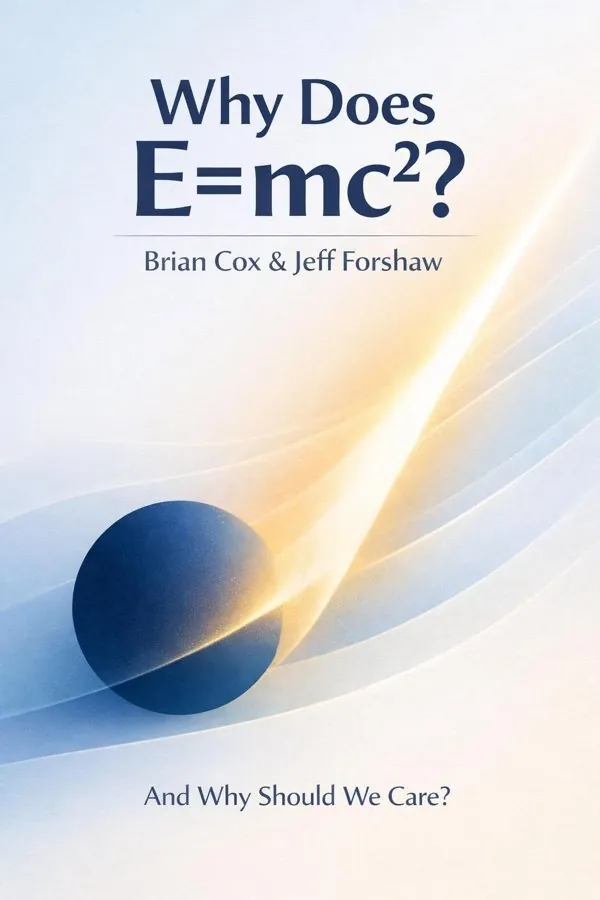
Why Does E=mc²?: And Why Should We Care?: Summary & Key Insights
 10 min10 chaptersAudio available
What Is Why Does E=mc²?: And Why Should We Care? About?
Why Does E=mc²?: And Why Should We Care? by Brian Cox, Jeff Forshaw is a popular_sci book spanning 10 pages. This book explains Einstein’s famous equation E=mc² in accessible terms, exploring the fundamental principles of physics that underpin it. Brian Cox and Jeff Forshaw guide readers through the concepts of energy, mass, and the speed of light, showing how these ideas connect to the structure of the universe. The authors use clear analogies and engaging examples to make complex scientific ideas understandable to a general audience.
This FizzRead summary covers all 10 key chapters of Why Does E=mc²?: And Why Should We Care? in approximately 10 minutes, distilling the most important ideas, arguments, and takeaways from Brian Cox, Jeff Forshaw's work. Also available as an audio summary and Key Quotes Podcast.
Why Does E=mc²?: And Why Should We Care?
This book explains Einstein’s famous equation E=mc² in accessible terms, exploring the fundamental principles of physics that underpin it. Brian Cox and Jeff Forshaw guide readers through the concepts of energy, mass, and the speed of light, showing how these ideas connect to the structure of the universe. The authors use clear analogies and engaging examples to make complex scientific ideas understandable to a general audience.
Who Should Read Why Does E=mc²?: And Why Should We Care??
This book is perfect for anyone interested in popular_sci and looking to gain actionable insights in a short read. Whether you're a student, professional, or lifelong learner, the key ideas from Why Does E=mc²?: And Why Should We Care? by Brian Cox, Jeff Forshaw will help you think differently.
- ✓Readers who enjoy popular_sci and want practical takeaways
- ✓Professionals looking to apply new ideas to their work and life
- ✓Anyone who wants the core insights of Why Does E=mc²?: And Why Should We Care? in just 10 minutes
Want the full summary?
Get instant access to this book summary and 100K+ more with Fizz Moment.
Get Free SummaryAvailable on App Store • Free to download
Key Chapters
To appreciate E=mc², we first must place ourselves in the historical context that gave rise to Einstein’s special relativity. For centuries, physicists lived comfortably within Newtonian mechanics, a framework that explained planetary motion, falling apples, and tides with extraordinary clarity. Yet, as the nineteenth century progressed, cracks began to appear—especially in our understanding of light. Experiments such as those conducted by Michelson and Morley seemed to defy Newtonian expectations. Light, they found, always traveled at the same speed, regardless of how fast the observer was moving. This stubborn constancy puzzled scientists because, under Newton’s laws, speeds should combine additively.
Einstein’s genius was to accept the experimental facts directly and rebuild the theory of motion around them. He proposed that the speed of light, c, is not just a property of light itself but a fundamental limit—a constant woven into the fabric of reality. Everything else must adjust to preserve that constancy. Time, length, simultaneity—all the seemingly absolute measures of Newton’s universe become flexible, depending on relative motion. In making this leap, Einstein redefined the concept of a universal frame of reference.
From this foundation arises the radical idea that observations depend on the observer’s velocity. Two different observers could measure different times for the same event or disagree on distances, yet both would be correct within their frames. The principle of relativity states that the laws of physics are identical for all observers moving uniformly relative to one another. This symmetry forms the backbone of modern physics, and E=mc² is one of its most elegant consequences.
As we explore later chapters, you’ll see that proclaiming the speed of light as cosmic constant isn’t an arbitrary rule—it’s the thread that ties together everything from the conservation of energy to the geometry of space and time. Relativity begins with a willingness to let go of preconceived absolutes, and the reward is a deeper harmony among physical laws.
Once the constancy of light is accepted, reality itself needs new dimensions of meaning. Space and time—once considered independent backdrops against which physics played out—merge into a continuum known as spacetime. Here, motion through space affects the flow of time, and vice versa. Moving clocks tick more slowly. Distances contract along the direction of travel. These are not strange optical illusions; they are real consequences of how the universe maintains the invariance of light speed.
In the book, Jeff and I take care to show how intuitive this idea can become. Imagine you’re watching a particle dart through space. If light must travel at the same speed for both you and the particle, then something has to give—either the particle’s measurement of time or yours. The result is time dilation: from your perspective, the particle’s clock runs a bit slower. This isn’t because the mechanism malfunctions; it’s because time itself stretches differently across frames of motion.
Similarly, length contraction occurs because the synchronization of position measurements depends on the observer’s frame. What looks elongated to one observer may appear foreshortened to another. Einstein’s core insight was that these distortions aren’t imperfections—they are intrinsic features of spacetime geometry. The faster something moves, the more space and time bend to uphold the cosmic speed limit.
This interweaving leads to profound consequences. It means that neither space nor time are constants separately; only spacetime as a whole retains its structure across all observations. Every object traces a path through this four-dimensional fabric, a worldline that unites its motion through space and time into a single, seamless trajectory.
Understanding this unity prepares us to see why energy and mass relate so intimately. In a universe where space and time bend with motion, mass cannot remain an isolated property—it too participates in the geometry of spacetime, echoing its curvature and its constants. The realization that time slows and lengths contract is the stepping stone toward seeing how energy transforms into mass and vice versa, for they, too, belong to the same cosmic continuum.
+ 8 more chapters — available in the FizzRead app
All Chapters in Why Does E=mc²?: And Why Should We Care?
About the Authors
Brian Cox is a British physicist and professor of particle physics at the University of Manchester, known for his work on the Large Hadron Collider and for presenting science programs for the BBC. Jeff Forshaw is also a professor of theoretical physics at the University of Manchester, specializing in quantum field theory and particle physics. Together, they have co-authored several popular science books.
Get This Summary in Your Preferred Format
Read or listen to the Why Does E=mc²?: And Why Should We Care? summary by Brian Cox, Jeff Forshaw anytime, anywhere. FizzRead offers multiple formats so you can learn on your terms — all free.
Available formats: App · Audio · PDF · EPUB — All included free with FizzRead
Download Why Does E=mc²?: And Why Should We Care? PDF and EPUB Summary
Key Quotes from Why Does E=mc²?: And Why Should We Care?
“To appreciate E=mc², we first must place ourselves in the historical context that gave rise to Einstein’s special relativity.”
“Once the constancy of light is accepted, reality itself needs new dimensions of meaning.”
Frequently Asked Questions about Why Does E=mc²?: And Why Should We Care?
Why Does E=mc²?: And Why Should We Care? by Brian Cox, Jeff Forshaw is a popular_sci book that explores key ideas across 10 chapters. This book explains Einstein’s famous equation E=mc² in accessible terms, exploring the fundamental principles of physics that underpin it. Brian Cox and Jeff Forshaw guide readers through the concepts of energy, mass, and the speed of light, showing how these ideas connect to the structure of the universe. The authors use clear analogies and engaging examples to make complex scientific ideas understandable to a general audience.
More by Brian Cox, Jeff Forshaw
You Might Also Like

Structures: Or Why Things Don"t Fall Down
J.E. Gordon
10 min
The Road to Wigan Pier
George Orwell
10 min
Bonk: The Curious Coupling of Science and Sex
Mary Roach
10 min
First Bite: How We Learn to Eat
Bee Wilson
10 min
In Pursuit Of The Unknown: 17 Equations That Changed The World
Ian Stewart
10 min
Napoleon's Buttons: 17 Molecules That Changed History
Penny Le Couteur and Jay Burreson
10 minBrowse by Category
Ready to read Why Does E=mc²?: And Why Should We Care??
Get the full summary and 100K+ more books with Fizz Moment.