
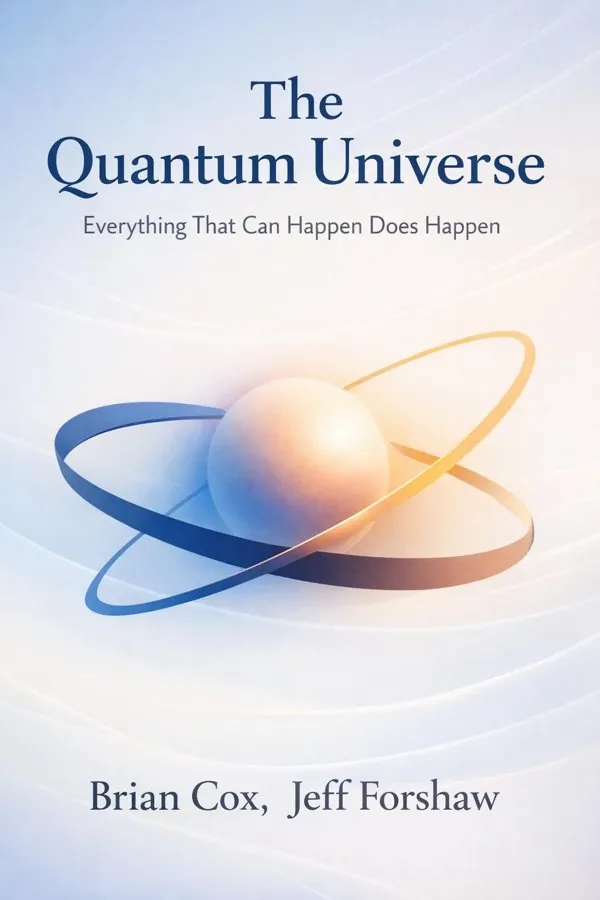
The Quantum Universe: Everything That Can Happen Does Happen: Summary & Key Insights
 10 min10 chaptersAudio available
Key Takeaways from The Quantum Universe: Everything That Can Happen Does Happen
The real shock of quantum mechanics is not that nature is complicated, but that certainty itself has limits.
If one experiment captures the unsettling beauty of quantum mechanics, it is the double-slit experiment.
Quantum mechanics does not tell us what a particle is doing in the classical sense; it tells us what can happen and with what likelihood.
One of quantum mechanics’ most radical claims is that a system can exist in a combination of states before measurement.
The uncertainty principle is often reduced to a slogan about measurement being clumsy, but Cox and Forshaw show that its meaning is far deeper.
What Is The Quantum Universe: Everything That Can Happen Does Happen About?
The Quantum Universe: Everything That Can Happen Does Happen by Brian Cox, Jeff Forshaw is a popular_sci book spanning 7 pages. The Quantum Universe is an ambitious and remarkably readable guide to the most successful and most bewildering theory in modern science: quantum mechanics. In this book, physicists Brian Cox and Jeff Forshaw take readers from the familiar certainty of classical physics into a world where particles behave like waves, outcomes are governed by probabilities, and reality seems far stranger than common sense allows. Rather than treating quantum theory as a collection of mysterious slogans, they patiently build its logic from the ground up, showing why the microscopic world must be described in a new way. What makes the book matter is that quantum mechanics is not a fringe idea or a philosophical curiosity. It is the framework behind atoms, chemistry, stars, semiconductors, lasers, and much of modern technology. To understand it is to understand the basic operating system of the universe. Cox, a celebrated particle physicist and science communicator, and Forshaw, a theoretical physicist with deep expertise in quantum field theory, bring unusual authority to the subject. Together, they make quantum mechanics feel less like magic and more like a disciplined, beautiful, and unavoidable description of nature.
This FizzRead summary covers all 10 key chapters of The Quantum Universe: Everything That Can Happen Does Happen in approximately 10 minutes, distilling the most important ideas, arguments, and takeaways from Brian Cox, Jeff Forshaw's work. Also available as an audio summary and Key Quotes Podcast.
The Quantum Universe: Everything That Can Happen Does Happen
The Quantum Universe is an ambitious and remarkably readable guide to the most successful and most bewildering theory in modern science: quantum mechanics. In this book, physicists Brian Cox and Jeff Forshaw take readers from the familiar certainty of classical physics into a world where particles behave like waves, outcomes are governed by probabilities, and reality seems far stranger than common sense allows. Rather than treating quantum theory as a collection of mysterious slogans, they patiently build its logic from the ground up, showing why the microscopic world must be described in a new way.
What makes the book matter is that quantum mechanics is not a fringe idea or a philosophical curiosity. It is the framework behind atoms, chemistry, stars, semiconductors, lasers, and much of modern technology. To understand it is to understand the basic operating system of the universe. Cox, a celebrated particle physicist and science communicator, and Forshaw, a theoretical physicist with deep expertise in quantum field theory, bring unusual authority to the subject. Together, they make quantum mechanics feel less like magic and more like a disciplined, beautiful, and unavoidable description of nature.
Who Should Read The Quantum Universe: Everything That Can Happen Does Happen?
This book is perfect for anyone interested in popular_sci and looking to gain actionable insights in a short read. Whether you're a student, professional, or lifelong learner, the key ideas from The Quantum Universe: Everything That Can Happen Does Happen by Brian Cox, Jeff Forshaw will help you think differently.
- ✓Readers who enjoy popular_sci and want practical takeaways
- ✓Professionals looking to apply new ideas to their work and life
- ✓Anyone who wants the core insights of The Quantum Universe: Everything That Can Happen Does Happen in just 10 minutes
Want the full summary?
Get instant access to this book summary and 100K+ more with Fizz Moment.
Get Free SummaryAvailable on App Store • Free to download
Key Chapters
The real shock of quantum mechanics is not that nature is complicated, but that certainty itself has limits. For centuries, physics was shaped by the Newtonian dream: if you knew the position and speed of every object, you could predict the future exactly. The universe appeared to be a giant machine, precise and lawful, unfolding in a fully determined way. Cox and Forshaw show how this vision worked brilliantly for planets, falling apples, and moving cannonballs, yet began to fail once scientists looked closely at atoms, light, and subatomic particles.
The turning point came through a series of experimental puzzles. Light sometimes behaved like a wave, yet in other settings it acted as if it arrived in packets. Atoms emitted energy in discrete amounts rather than continuously. Electrons did not orbit nuclei like miniature planets. These anomalies were not minor exceptions; they revealed that classical concepts were too crude for the microscopic world. Physics had to move from certainty to probability, from fixed trajectories to possible outcomes.
This shift was not a retreat from rigor. Quantum theory is one of the most accurate frameworks ever developed. It replaces everyday intuitions with deeper mathematical rules that match reality far better than common sense does. Modern electronics, MRI scanners, LEDs, and computer chips all work because nature is quantum, not classical.
A useful way to apply this idea is to notice how often human reasoning assumes predictability where only probabilities exist. In science, business, or personal decisions, the world often rewards probabilistic thinking over false certainty. Actionable takeaway: replace the question “Can I predict this exactly?” with “What outcomes are possible, and how likely are they?”
If one experiment captures the unsettling beauty of quantum mechanics, it is the double-slit experiment. Cox and Forshaw use it to show, with minimal mystification, that the world does not behave according to ordinary visual logic. Imagine firing particles such as electrons toward a barrier with two narrow openings and recording where they land on a screen behind it. Classical intuition says each electron should pass through one slit or the other, producing two simple bands. But what appears instead is an interference pattern, the hallmark of waves.
The deeper surprise comes when electrons are sent through one at a time. Even then, as many individual impacts accumulate, the same wave-like interference pattern appears. It is as if each electron somehow explores multiple paths and interferes with itself. Yet when researchers measure which slit the electron goes through, the interference disappears. The result changes depending on whether path information is available.
This is not just a laboratory curiosity. It reveals a central rule of quantum theory: outcomes depend on amplitudes that combine like waves until measurement forces a definite result. The experiment challenges the idea that microscopic objects possess simple, observer-independent properties in the way billiard balls do.
Practical applications are profound. The logic behind interference underpins electron microscopy, quantum sensors, and parts of quantum computing. More broadly, the experiment teaches humility: reality is not obligated to fit our everyday categories. Actionable takeaway: when a problem seems paradoxical, test whether your assumptions come from habit rather than evidence; often the frame, not the facts, is the real obstacle.
Quantum mechanics does not tell us what a particle is doing in the classical sense; it tells us what can happen and with what likelihood. The tool for this is the wave function, one of the most important and misunderstood ideas in physics. Cox and Forshaw explain it not as mystical vapor but as a precise mathematical object containing the information needed to calculate probabilities of measurement outcomes.
Unlike a physical water wave, the wave function is not a ripple in ordinary space. It is a compact way of describing possibilities. Its magnitude tells us the probability of finding a particle in a given state, while its phase determines how different possibilities interfere. This is why quantum theory predicts patterns that classical probability alone cannot. Before a measurement, the wave function evolves smoothly and deterministically according to the Schrödinger equation. At measurement, however, only one result is observed.
This framework sounds abstract, but its consequences are concrete. Chemists use wave functions to predict molecular bonds. Engineers rely on quantum states when designing semiconductors and lasers. Physicists describe electrons in atoms through orbitals, which are directly tied to wave functions rather than little planetary tracks around a nucleus.
The concept also offers a useful intellectual lesson. Many important systems are best understood not by tracking one definite story, but by modeling a landscape of possibilities. Weather forecasting, financial risk analysis, and strategic planning all work this way. Actionable takeaway: whenever certainty is impossible, build a model of possible outcomes and their interactions instead of clinging to a single narrative.
One of quantum mechanics’ most radical claims is that a system can exist in a combination of states before measurement. This is superposition, and it is the engine behind much of the theory’s strangeness. Cox and Forshaw make clear that superposition does not mean particles are vaguely indecisive. It means the mathematics requires us to treat multiple possible states as simultaneously contributing to what happens next.
A spinning electron, for example, need not be simply “up” or “down” before measurement. It can be in a superposed state that contains both possibilities. The same is true for position, momentum, polarization, and many other properties. Superposition is what allows interference effects to arise, since different components of the wave function can reinforce or cancel one another.
This idea is often dramatized in thought experiments like Schrödinger’s cat, but its real significance is practical. Quantum computers, in principle, exploit superposition to process information in ways unavailable to classical machines. Atomic clocks, precision sensors, and secure communication technologies also draw on quantum coherence, the careful preservation of superposed states.
The broader lesson is that reality may not obey binary either-or categories at every level. Many difficult problems in life and work are distorted when treated as if only one option can be true or relevant at once. Competing possibilities may need to be held together until evidence resolves them. Actionable takeaway: practice tolerating ambiguity longer; some of the best decisions emerge only after you allow multiple explanations or strategies to coexist without prematurely forcing a single answer.
The uncertainty principle is often reduced to a slogan about measurement being clumsy, but Cox and Forshaw show that its meaning is far deeper. Heisenberg’s uncertainty principle says that certain pairs of properties, such as position and momentum, cannot both be known with unlimited precision at the same time. This is not because our instruments are poor. It is because the world itself is structured in a way that does not permit exact simultaneous values of these quantities.
The principle follows from the wave-like nature of quantum objects. A sharply localized wave packet requires many wavelengths mixed together, which makes momentum less definite. A pure wavelength has a precise momentum but is spread out in space. The trade-off is built into the mathematics of the wave function. In other words, the fuzziness is not ignorance layered on top of reality; it is part of reality’s grammar.
This has enormous implications. Electrons do not collapse into atomic nuclei partly because quantum uncertainty gives them unavoidable motion-like spread. The stability of atoms, and therefore of matter itself, depends on this principle. Technologies such as electron microscopes, nanoscale devices, and quantum cryptography all operate within or because of these limits.
Psychologically, uncertainty is often treated as a failure to be eliminated. Quantum mechanics suggests a more mature stance: some limits are not temporary gaps but permanent features. Actionable takeaway: distinguish between uncertainty you can reduce with better information and uncertainty that is intrinsic; your strategy should change depending on which kind you are facing.
Entanglement is the point where quantum mechanics seems to challenge not just intuition, but our whole picture of separateness. Cox and Forshaw explain that when two particles interact in certain ways, their quantum states can become linked so completely that neither particle has an independent description anymore. Measuring one immediately tells us something about the other, even if they are later separated by vast distances.
This does not mean hidden messages are traveling faster than light. Relativity remains safe. What entanglement shows is that the quantum state of the pair is primary, while the individual parts can become secondary. The world, at least at the quantum level, is sometimes less like a collection of isolated objects and more like a single system with distributed relationships.
Experiments inspired by Bell’s theorem have tested this repeatedly, ruling out simple local hidden-variable explanations. Entanglement is not speculative philosophy; it is experimentally established. It also powers emerging technologies. Quantum cryptography uses entangled states to detect eavesdropping. Quantum teleportation transfers state information using entanglement and classical communication. Future quantum networks may depend on it.
Outside physics, entanglement offers a powerful metaphor for systems thinking. In organizations, ecosystems, and societies, parts often cannot be understood fully in isolation because relationships shape behavior. Actionable takeaway: when analyzing a complex problem, look beyond individual components and map the connections between them; often the structure of relationships explains more than the properties of the parts.
Few parts of quantum theory have generated more confusion than measurement, because measurement seems to mark the boundary between possibility and actual event. Cox and Forshaw handle this with admirable restraint. They do not pretend the interpretive issues are trivial, but they also emphasize that the predictive rules of quantum mechanics work extraordinarily well whether or not we settle every philosophical debate.
Before measurement, the wave function evolves smoothly, containing many possible outcomes. After measurement, we observe one actual result. Why this transition appears to happen, and what exactly counts as a measurement, has inspired many interpretations: Copenhagen-like views, many-worlds ideas, decoherence-based accounts, and more. The book’s title itself echoes one provocative intuition: that everything allowed by the wave function is in some sense realized. Yet the authors focus less on speculative excess and more on what the mathematics and experiments justify.
Decoherence helps explain part of the mystery. Interactions with the environment rapidly destroy delicate quantum interference in large systems, making the everyday world appear classical. This is why chairs and planets do not display visible superpositions, while electrons can.
The practical importance is enormous. Building quantum computers requires controlling decoherence. Precision measurements depend on understanding how observation and environment affect quantum states. Actionable takeaway: separate what a theory predicts reliably from the stories we tell to interpret it; in any field, progress often comes from respecting that distinction while remaining open to deeper explanations.
Quantum mechanics is often presented as a strange theory relevant only to physicists, but Cox and Forshaw insist on the opposite: the ordinary world exists in its familiar form because of quantum rules. Atoms hold together because electrons occupy quantized states rather than crashing into nuclei. Chemistry works because electron wave functions determine bonding patterns. Solids have the properties they do because quantum principles shape how electrons move through materials.
This means much of modern life is quietly quantum. Transistors in computer chips rely on quantum behavior in semiconductors. Lasers depend on stimulated emission, a thoroughly quantum process. Solar cells, LEDs, MRI machines, and many medical imaging tools all emerge from quantum principles translated into engineering. Even the colors we see in materials reflect electronic energy levels that only make sense through quantum theory.
The book is especially effective in showing that quantum mechanics is not merely weird but useful. It is the framework behind both cosmic understanding and practical invention. Without it, there is no modern electronics industry, no precise understanding of chemical reactions, and no realistic account of matter itself.
For readers who feel intimidated by abstract science, this is the reassuring point: you are already surrounded by successful applications of quantum mechanics. You do not need to master every equation to appreciate its reach. Actionable takeaway: connect difficult ideas to familiar technologies; when learning something abstract, ask which everyday tools, systems, or experiences depend on it, because usefulness often makes complexity easier to grasp.
Quantum mechanics is not confined to tiny laboratory systems; it scales upward into the structure and history of the universe itself. Cox and Forshaw show that the quantum world and the cosmic world are not separate stories but deeply linked. The life cycles of stars, the behavior of matter under extreme conditions, and even the early universe all depend on quantum principles.
Nuclear fusion in stars occurs because quantum tunneling allows particles to cross energy barriers they could not overcome classically. Without tunneling, the Sun would not shine as it does. The elements forged in stars and supernovae, the energy they release, and the radiation they emit all require quantum descriptions. At the smallest scales, particle physics uses quantum field theory to explain the interactions that structure matter. At the largest scales, cosmology increasingly depends on quantum ideas to understand the origins of fluctuations that later became galaxies.
This union of the very small and the very large is one of the book’s most inspiring themes. It reminds readers that the same laws governing electrons also shape starlight and the material from which life is made. Quantum mechanics is not a niche chapter in physics. It is central to any serious account of reality.
A practical lesson follows: major insights often emerge when seemingly separate domains are connected. Whether in research, business, or creative work, breakthroughs frequently come from integrating scales and disciplines. Actionable takeaway: look for hidden links between micro-level details and big-picture outcomes; understanding how local rules produce large patterns can transform the way you solve problems.
The deepest gift of The Quantum Universe is not technical knowledge alone, but a changed sense of what it means to understand reality. Cox and Forshaw present quantum mechanics as a discipline in intellectual humility. Nature does not organize itself around the categories most comfortable to human intuition. Instead, we are asked to accept a world where probability is fundamental, measurement matters, and reality may be richer than ordinary description can capture.
This does not force us into irrationalism. Quite the opposite: quantum theory is a triumph of disciplined reasoning over common sense. It teaches that our direct experience is not the final judge of truth. Mathematics, experiment, and conceptual courage can reveal structures far beyond what evolution prepared our brains to picture. That lesson has philosophical weight far beyond physics.
It also affects how we think about knowledge. We often imagine understanding as building a perfectly clear mental picture. Quantum mechanics suggests another model: understanding can mean possessing a framework that predicts accurately, connects phenomena, and survives testing, even if it resists simple visualization. In that sense, science is not always about making the universe feel familiar; sometimes it is about learning to live intelligently with strangeness.
This perspective is useful in modern life, where complexity often outruns intuition. Actionable takeaway: treat discomfort with an idea as a signal to investigate, not dismiss; some of the most important truths are initially unsettling precisely because they reveal the limits of ordinary thinking.
All Chapters in The Quantum Universe: Everything That Can Happen Does Happen
About the Authors
Brian Cox is a British physicist, professor of particle physics at the University of Manchester, and one of the most recognizable science communicators in the world. His research has included work in high-energy physics and major international experiments linked to the Large Hadron Collider. Beyond academia, he is known for making complex scientific ideas accessible through television, lectures, and bestselling books. Jeff Forshaw is a theoretical physicist and professor at the University of Manchester whose expertise lies in particle physics and quantum field theory. He is especially respected for his ability to explain difficult concepts with precision and clarity. Together, Cox and Forshaw combine frontline scientific knowledge with exceptional teaching skill, making them unusually well qualified to guide readers through the strange but rigorous world of quantum mechanics.
Get This Summary in Your Preferred Format
Read or listen to the The Quantum Universe: Everything That Can Happen Does Happen summary by Brian Cox, Jeff Forshaw anytime, anywhere. FizzRead offers multiple formats so you can learn on your terms — all free.
Available formats: App · Audio · PDF · EPUB — All included free with FizzRead
Download The Quantum Universe: Everything That Can Happen Does Happen PDF and EPUB Summary
Key Quotes from The Quantum Universe: Everything That Can Happen Does Happen
“The real shock of quantum mechanics is not that nature is complicated, but that certainty itself has limits.”
“If one experiment captures the unsettling beauty of quantum mechanics, it is the double-slit experiment.”
“Quantum mechanics does not tell us what a particle is doing in the classical sense; it tells us what can happen and with what likelihood.”
“One of quantum mechanics’ most radical claims is that a system can exist in a combination of states before measurement.”
“The uncertainty principle is often reduced to a slogan about measurement being clumsy, but Cox and Forshaw show that its meaning is far deeper.”
Frequently Asked Questions about The Quantum Universe: Everything That Can Happen Does Happen
The Quantum Universe: Everything That Can Happen Does Happen by Brian Cox, Jeff Forshaw is a popular_sci book that explores key ideas across 10 chapters. The Quantum Universe is an ambitious and remarkably readable guide to the most successful and most bewildering theory in modern science: quantum mechanics. In this book, physicists Brian Cox and Jeff Forshaw take readers from the familiar certainty of classical physics into a world where particles behave like waves, outcomes are governed by probabilities, and reality seems far stranger than common sense allows. Rather than treating quantum theory as a collection of mysterious slogans, they patiently build its logic from the ground up, showing why the microscopic world must be described in a new way. What makes the book matter is that quantum mechanics is not a fringe idea or a philosophical curiosity. It is the framework behind atoms, chemistry, stars, semiconductors, lasers, and much of modern technology. To understand it is to understand the basic operating system of the universe. Cox, a celebrated particle physicist and science communicator, and Forshaw, a theoretical physicist with deep expertise in quantum field theory, bring unusual authority to the subject. Together, they make quantum mechanics feel less like magic and more like a disciplined, beautiful, and unavoidable description of nature.
More by Brian Cox, Jeff Forshaw
You Might Also Like

Structures: Or Why Things Don"t Fall Down
J.E. Gordon
10 min
The Road to Wigan Pier
George Orwell
10 min
Bonk: The Curious Coupling of Science and Sex
Mary Roach
10 min
First Bite: How We Learn to Eat
Bee Wilson
10 min
In Pursuit Of The Unknown: 17 Equations That Changed The World
Ian Stewart
10 min
Napoleon's Buttons: 17 Molecules That Changed History
Penny Le Couteur and Jay Burreson
10 minBrowse by Category
Ready to read The Quantum Universe: Everything That Can Happen Does Happen?
Get the full summary and 100K+ more books with Fizz Moment.