
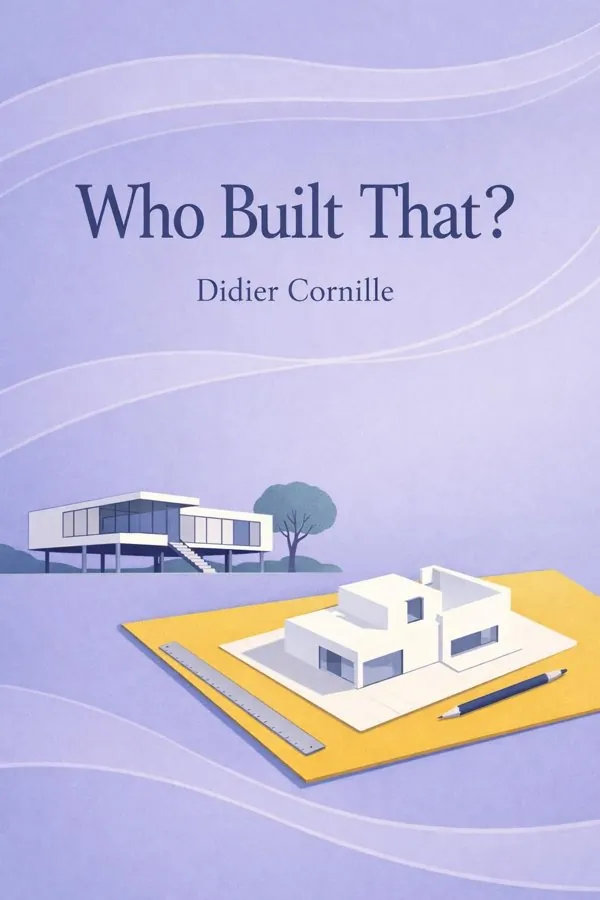
Who Built That?: Amazing Homes and the People Who Built Them: Summary & Key Insights
 10 min8 chaptersAudio available
What Is Who Built That?: Amazing Homes and the People Who Built Them About?
Who Built That?: Amazing Homes and the People Who Built Them by Didier Cornille is a education book spanning 8 pages. This illustrated children's book introduces young readers to famous architects and their iconic houses. Through playful drawings and accessible explanations, it explores how these buildings were designed and constructed, highlighting creativity and ingenuity in modern architecture.
This FizzRead summary covers all 8 key chapters of Who Built That?: Amazing Homes and the People Who Built Them in approximately 10 minutes, distilling the most important ideas, arguments, and takeaways from Didier Cornille's work. Also available as an audio summary and Key Quotes Podcast.
Who Built That?: Amazing Homes and the People Who Built Them
This illustrated children's book introduces young readers to famous architects and their iconic houses. Through playful drawings and accessible explanations, it explores how these buildings were designed and constructed, highlighting creativity and ingenuity in modern architecture.
Who Should Read Who Built That?: Amazing Homes and the People Who Built Them?
This book is perfect for anyone interested in education and looking to gain actionable insights in a short read. Whether you're a student, professional, or lifelong learner, the key ideas from Who Built That?: Amazing Homes and the People Who Built Them by Didier Cornille will help you think differently.
- ✓Readers who enjoy education and want practical takeaways
- ✓Professionals looking to apply new ideas to their work and life
- ✓Anyone who wants the core insights of Who Built That?: Amazing Homes and the People Who Built Them in just 10 minutes
Want the full summary?
Get instant access to this book summary and 100K+ more with Fizz Moment.
Get Free SummaryAvailable on App Store • Free to download
Key Chapters
Frank Lloyd Wright believed a home should not dominate its surroundings, but grow out of them. When he designed Fallingwater, perched above a rushing Pennsylvania waterfall, he showed what happens when architecture listens to nature rather than conquers it. Wright’s vision of ‘organic architecture’ strove to unite people with the rhythms of the earth. The stone that formed the house was drawn from the same quarry as the rocks below it; the horizontal lines seem to echo the ledges of the stream itself.
What fascinates me about Fallingwater is how it changes our sense of home. Here, the living room opens directly to the sound and sight of water cascading beneath it. Windows stretch wide to let in forest light. Wright was saying through this house that life and nature are inseparable; design should make that truth tangible. He wanted people to feel that their homes were living organisms, breathing and growing with the land.
When children see Wright’s drawings, they understand immediately how his thinking connects to the environment. A house doesn’t have to stand apart from its setting. It can be part of it. Fallingwater invites us to look at our surroundings, even if it’s a city street or a garden, and ask: how do we build with respect, with harmony? That idea remains as fresh today as ever, guiding not only architects but anyone who dreams of living in balance with nature.
Le Corbusier, one of the great visionaries of modernism, saw architecture as a discipline of precision and function. He described the house as ‘a machine for living in,’ meaning a well-designed building should serve the needs of its inhabitants efficiently and elegantly. In Villa Savoye—his famous white cube resting on slender pilotis in the French countryside—he captured that philosophy in pure form.
Walking through Villa Savoye, you sense movement and clarity: the house rises above the ground, letting light and air circulate freely. Cars can pass underneath; the roof garden returns green space lost to the building footprint. For Le Corbusier, architecture had entered a new age, one driven by technology and modern life. He believed beauty lay in simplicity and function, not decoration.
But Villa Savoye wasn’t cold or mechanical. It was an experiment in human-centered design. He asked: how do people experience space when freed from traditional walls and boundaries? The open interiors, ribbon windows, and gentle curves invite exploration. I wanted children to see that even though modern architecture can look abstract, it always begins with human needs. The elegance of Le Corbusier’s math hides a tenderness for form and life, as if the geometry itself could nurture the inhabitants.
From this lesson we learn that efficiency and emotion can coexist. A home can be airy, rational, and still deeply humane. The ‘machine’ Le Corbusier imagined hums not with gears but with the heartbeat of those who dwell inside.
+ 6 more chapters — available in the FizzRead app
All Chapters in Who Built That?: Amazing Homes and the People Who Built Them
About the Author
Didier Cornille is a French designer and illustrator known for his educational books that make architecture and design accessible to children. He teaches design at the École des Beaux-Arts du Mans and has published several works on contemporary architecture.
Get This Summary in Your Preferred Format
Read or listen to the Who Built That?: Amazing Homes and the People Who Built Them summary by Didier Cornille anytime, anywhere. FizzRead offers multiple formats so you can learn on your terms — all free.
Available formats: App · Audio · PDF · EPUB — All included free with FizzRead
Download Who Built That?: Amazing Homes and the People Who Built Them PDF and EPUB Summary
Key Quotes from Who Built That?: Amazing Homes and the People Who Built Them
“Frank Lloyd Wright believed a home should not dominate its surroundings, but grow out of them.”
“Le Corbusier, one of the great visionaries of modernism, saw architecture as a discipline of precision and function.”
Frequently Asked Questions about Who Built That?: Amazing Homes and the People Who Built Them
Who Built That?: Amazing Homes and the People Who Built Them by Didier Cornille is a education book that explores key ideas across 8 chapters. This illustrated children's book introduces young readers to famous architects and their iconic houses. Through playful drawings and accessible explanations, it explores how these buildings were designed and constructed, highlighting creativity and ingenuity in modern architecture.
You Might Also Like

Bedtime Biography: Florence Nightingale
Isabel Thomas
10 min
Introduction To Museum Studies
Howard H. Hoyt
10 min
A Mind for Numbers: How to Excel at Math and Science (Even If You Flunked Algebra)
Barbara Oakley
10 min
AI for Educators: Learning Strategies, Teacher Empowerment, and the Future of Education
Matt Miller
10 min
Animation For Beginners
Morr Meroz
10 min
Artificial Intelligence for Learning
Donald Clark
10 minBrowse by Category
Ready to read Who Built That?: Amazing Homes and the People Who Built Them?
Get the full summary and 100K+ more books with Fizz Moment.