
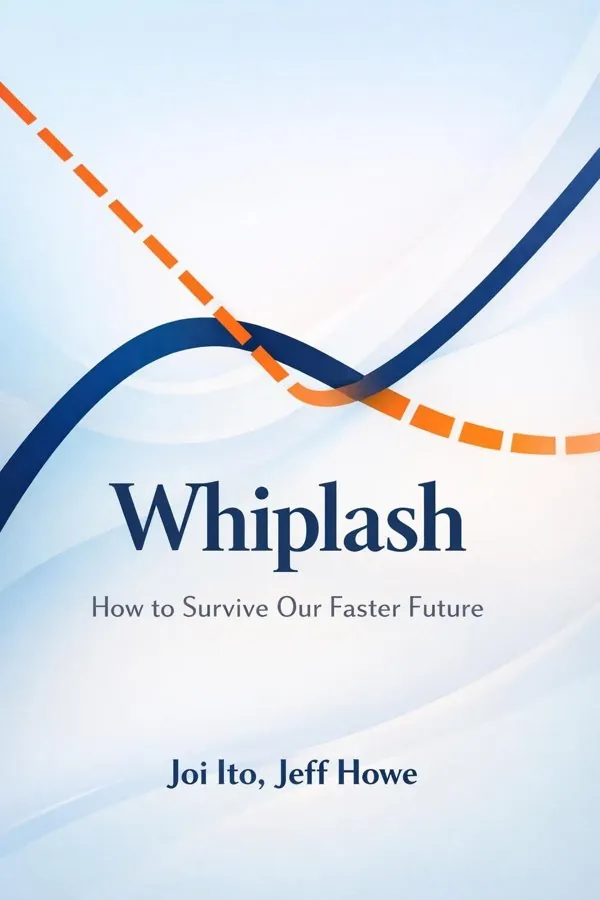
Whiplash: How to Survive Our Faster Future: Summary & Key Insights
 10 min9 chaptersAudio available
What Is Whiplash: How to Survive Our Faster Future About?
Whiplash: How to Survive Our Faster Future by Joi Ito, Jeff Howe is a future_trends book spanning 9 pages. Whiplash: How to Survive Our Faster Future explores how rapid technological and social changes are reshaping the world. Joi Ito and Jeff Howe present nine organizing principles for thriving in an era of constant disruption, emphasizing adaptability, resilience, and decentralized innovation. The book draws on examples from science, technology, and culture to illustrate how individuals and organizations can navigate complexity and uncertainty.
This FizzRead summary covers all 9 key chapters of Whiplash: How to Survive Our Faster Future in approximately 10 minutes, distilling the most important ideas, arguments, and takeaways from Joi Ito, Jeff Howe's work. Also available as an audio summary and Key Quotes Podcast.
Whiplash: How to Survive Our Faster Future
Whiplash: How to Survive Our Faster Future explores how rapid technological and social changes are reshaping the world. Joi Ito and Jeff Howe present nine organizing principles for thriving in an era of constant disruption, emphasizing adaptability, resilience, and decentralized innovation. The book draws on examples from science, technology, and culture to illustrate how individuals and organizations can navigate complexity and uncertainty.
Who Should Read Whiplash: How to Survive Our Faster Future?
This book is perfect for anyone interested in future_trends and looking to gain actionable insights in a short read. Whether you're a student, professional, or lifelong learner, the key ideas from Whiplash: How to Survive Our Faster Future by Joi Ito, Jeff Howe will help you think differently.
- ✓Readers who enjoy future_trends and want practical takeaways
- ✓Professionals looking to apply new ideas to their work and life
- ✓Anyone who wants the core insights of Whiplash: How to Survive Our Faster Future in just 10 minutes
Want the full summary?
Get instant access to this book summary and 100K+ more with Fizz Moment.
Get Free SummaryAvailable on App Store • Free to download
Key Chapters
For decades, industrial societies perfected the art of 'push.' We designed plans, forecasted demand, and created elaborate long-term pipelines. But the digital world is driven by 'pull'—you draw resources when you need them, adapting on the fly to unexpected circumstances. At the Media Lab, we didn’t stockpile expertise or predict the next technology. We built modular, flexible networks capable of drawing talent and data precisely when required.
Think of it as surfing rather than swimming upstream. Instead of trying to plan where the wave will break, you position yourself so that when it does, you can ride it. Innovations in 3D printing, real-time logistics, and crowdsourcing all reflect this shift. In a pull economy, value emerges from responsiveness and connectivity, not from inventory and control.
This principle invites humility. You can’t know everything, and that’s okay. Build your life and work as an open system—ready to absorb ideas from unexpected sources, ready to pivot when the wave changes. Pull keeps you agile; push keeps you rigid. In a world moving at exponential speed, flexibility is your only certainty.
+ 7 more chapters — available in the FizzRead app
All Chapters in Whiplash: How to Survive Our Faster Future
About the Authors
Joi Ito is a Japanese-American entrepreneur and former director of the MIT Media Lab, known for his work in internet innovation and digital culture. Jeff Howe is an American journalist and professor at Northeastern University, credited with coining the term 'crowdsourcing' and writing extensively on technology and creativity.
Get This Summary in Your Preferred Format
Read or listen to the Whiplash: How to Survive Our Faster Future summary by Joi Ito, Jeff Howe anytime, anywhere. FizzRead offers multiple formats so you can learn on your terms — all free.
Available formats: App · Audio · PDF · EPUB — All included free with FizzRead
Download Whiplash: How to Survive Our Faster Future PDF and EPUB Summary
Key Quotes from Whiplash: How to Survive Our Faster Future
“When information moves freely, when knowledge proliferates across networks, decisions made by a single authority fail to match the speed and nuance of a crowd’s collective intelligence.”
“For decades, industrial societies perfected the art of 'push.”
Frequently Asked Questions about Whiplash: How to Survive Our Faster Future
Whiplash: How to Survive Our Faster Future by Joi Ito, Jeff Howe is a future_trends book that explores key ideas across 9 chapters. Whiplash: How to Survive Our Faster Future explores how rapid technological and social changes are reshaping the world. Joi Ito and Jeff Howe present nine organizing principles for thriving in an era of constant disruption, emphasizing adaptability, resilience, and decentralized innovation. The book draws on examples from science, technology, and culture to illustrate how individuals and organizations can navigate complexity and uncertainty.
You Might Also Like
Futureproof: 9 Rules for Humans in the Age of Automation
Kevin Roose
10 min
The Third Wave
Alvin Toffler
10 min
2030: How Today's Biggest Trends Will Collide and Reshape the Future of Everything
Mauro F. Guillén
10 min
A Very Human Future: Enriching Humanity in a Digitized World
Rohit Talwar, Steve Wells, Alexandra Whittington
10 min
AI 2041: Ten Visions for Our Future
Kai-Fu Lee, Chen Qiufan
10 min
Abundance: The Future Is Better Than You Think
Peter H. Diamandis, Steven Kotler
10 minBrowse by Category
Ready to read Whiplash: How to Survive Our Faster Future?
Get the full summary and 100K+ more books with Fizz Moment.