
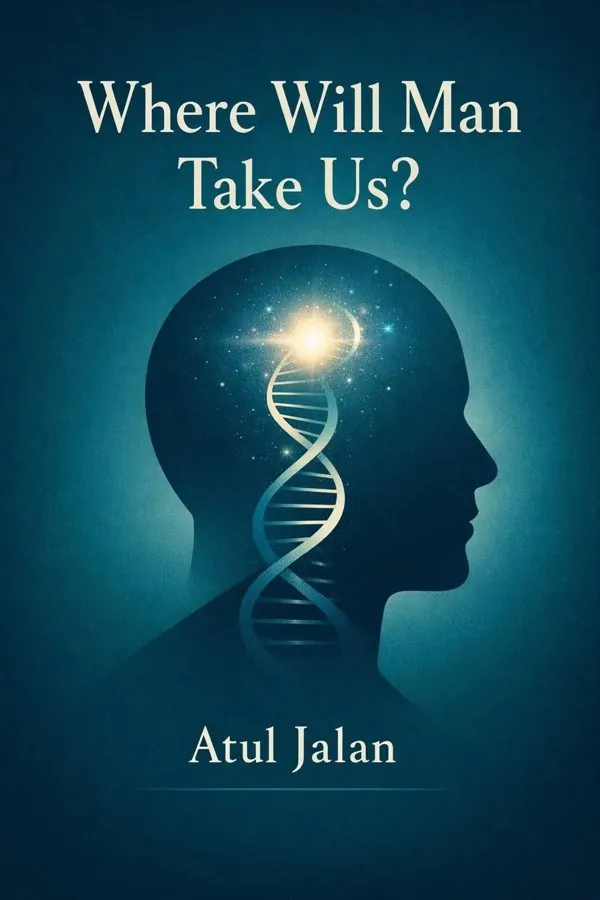
Where Will Man Take Us?: The Bold Story of the Man Technology Is Creating: Summary & Key Insights
by Atul Jalan
 10 min9 chaptersAudio available
Key Takeaways from Where Will Man Take Us?: The Bold Story of the Man Technology Is Creating
Civilization advances not only because humans need to survive, but because they cannot stop asking questions.
When machines begin to perform tasks once considered uniquely human, the shock is not merely economic; it is existential.
To edit genes is to move from reading life to rewriting it.
The more convincingly machines simulate thought, the more urgently we must ask what thought actually is.
Power in the modern world increasingly belongs not to those who merely possess information, but to those who can structure decisions through data.
What Is Where Will Man Take Us?: The Bold Story of the Man Technology Is Creating About?
Where Will Man Take Us?: The Bold Story of the Man Technology Is Creating by Atul Jalan is a future_trends book spanning 8 pages. Where Will Man Take Us? is not just a book about new machines, smarter software, or scientific breakthroughs. It is a sweeping reflection on the future of the human species itself. Atul Jalan asks a deeper question than whether technology will change our world: he asks how it will change us. As artificial intelligence begins to replicate human cognition, genetic engineering reshapes biology, and digital systems influence how we think, choose, and relate, the boundary between the human and the technological is becoming harder to define. What makes this book especially compelling is its range. Jalan moves across science, philosophy, history, and ethics to explore what it means to be human in an age of rapid transformation. He does not treat technology as a neutral tool, but as a force that is actively rewriting identity, consciousness, creativity, and power. Jalan brings unusual authority to this subject as an entrepreneur and technologist deeply involved in analytics and AI, while also thinking like a futurist and cultural observer. The result is a provocative, accessible book for anyone trying to understand not only where technology is going, but where it may be taking humanity.
This FizzRead summary covers all 9 key chapters of Where Will Man Take Us?: The Bold Story of the Man Technology Is Creating in approximately 10 minutes, distilling the most important ideas, arguments, and takeaways from Atul Jalan's work. Also available as an audio summary and Key Quotes Podcast.
Where Will Man Take Us?: The Bold Story of the Man Technology Is Creating
Where Will Man Take Us? is not just a book about new machines, smarter software, or scientific breakthroughs. It is a sweeping reflection on the future of the human species itself. Atul Jalan asks a deeper question than whether technology will change our world: he asks how it will change us. As artificial intelligence begins to replicate human cognition, genetic engineering reshapes biology, and digital systems influence how we think, choose, and relate, the boundary between the human and the technological is becoming harder to define.
What makes this book especially compelling is its range. Jalan moves across science, philosophy, history, and ethics to explore what it means to be human in an age of rapid transformation. He does not treat technology as a neutral tool, but as a force that is actively rewriting identity, consciousness, creativity, and power.
Jalan brings unusual authority to this subject as an entrepreneur and technologist deeply involved in analytics and AI, while also thinking like a futurist and cultural observer. The result is a provocative, accessible book for anyone trying to understand not only where technology is going, but where it may be taking humanity.
Who Should Read Where Will Man Take Us?: The Bold Story of the Man Technology Is Creating?
This book is perfect for anyone interested in future_trends and looking to gain actionable insights in a short read. Whether you're a student, professional, or lifelong learner, the key ideas from Where Will Man Take Us?: The Bold Story of the Man Technology Is Creating by Atul Jalan will help you think differently.
- ✓Readers who enjoy future_trends and want practical takeaways
- ✓Professionals looking to apply new ideas to their work and life
- ✓Anyone who wants the core insights of Where Will Man Take Us?: The Bold Story of the Man Technology Is Creating in just 10 minutes
Want the full summary?
Get instant access to this book summary and 100K+ more with Fizz Moment.
Get Free SummaryAvailable on App Store • Free to download
Key Chapters
Civilization advances not only because humans need to survive, but because they cannot stop asking questions. One of Jalan’s most important insights is that curiosity, more than necessity, has powered the human journey. Fire was not merely discovered to keep warm; it became a gateway to community, cooking, storytelling, and experimentation. Language was not just a tool for coordination; it opened the door to abstract thought, memory, and culture. Art, mathematics, religion, and science all emerged from the same restless human impulse to reach beyond the immediate and the known.
This matters because technology is often discussed as if it were separate from human nature, when in fact it is one of curiosity’s greatest expressions. The smartphone, the telescope, the gene sequencer, and the neural network are all descendants of the same inner drive: to explore, understand, and extend our capabilities. In Jalan’s view, every major technological leap reveals something essential about us. We are the species that refuses to remain fixed.
This perspective also reframes fear about the future. New technologies can be dangerous, but the instinct to create them is deeply human. The question is not whether curiosity should continue, but how it should be guided. In education, this means rewarding inquiry rather than rote learning. In organizations, it means encouraging experimentation rather than punishing uncertainty. In public life, it means shaping institutions that can absorb discovery responsibly.
Practical examples are everywhere: scientific research labs, startup ecosystems, open-source communities, and even curious households where children are allowed to tinker, fail, and ask difficult questions. These environments produce not just innovation, but adaptive humans.
Actionable takeaway: Treat curiosity as a discipline. Ask one deeper question each day about the tools, systems, and assumptions shaping your life, because the future belongs to those willing to investigate it.
When machines begin to perform tasks once considered uniquely human, the shock is not merely economic; it is existential. Jalan argues that artificial intelligence represents more than a technical breakthrough. It challenges the way humans define intelligence, value, and identity. For centuries, reasoning, pattern recognition, memory, and decision-making were treated as core markers of human superiority. AI destabilizes that confidence by showing that many of these abilities can be modeled, scaled, and in some cases improved by machines.
This does not mean humans are becoming obsolete. Rather, it means the old definition of human uniqueness is no longer sufficient. If a machine can diagnose disease, compose music, write code, or defeat grandmasters, then intelligence must be understood as broader than computation alone. Empathy, moral judgment, context, embodiment, meaning-making, and self-awareness become more important in defining the human role.
Jalan invites readers to see AI not only as automation, but as a mirror. It reflects what we truly value. In workplaces, AI may take over routine analysis while humans focus on complex judgment and relationship-building. In medicine, algorithms can identify anomalies in scans, but doctors still interpret treatment within the patient’s emotional and social reality. In education, AI tutors may personalize instruction, while teachers cultivate curiosity, resilience, and character.
Yet AI also raises hard questions about dependence and control. If algorithms shape hiring, policing, insurance, credit, and media consumption, then identity is not only being challenged philosophically but structured politically. The issue is not just what AI can do, but who designs it, who benefits, and whose biases it encodes.
Actionable takeaway: As AI spreads, invest in distinctly human strengths such as ethical reasoning, communication, interdisciplinary thinking, and emotional intelligence. The more machines optimize tasks, the more humans must deepen judgment.
To edit genes is to move from reading life to rewriting it. Jalan treats genetic engineering as one of the most profound thresholds in human history because it shifts our relationship with biology from acceptance to intervention. For most of history, genes were destiny in the broadest sense: inherited, fixed, and beyond deliberate control. With tools such as CRISPR and advanced genomic analysis, that condition is changing. Humanity can now imagine curing inherited disorders, enhancing resistance to disease, improving agriculture, and perhaps eventually shaping physical and cognitive traits before birth.
The promise is extraordinary. Families burdened by genetic disease may one day avoid generations of suffering. Crops can be designed to survive harsh climates. Personalized medicine can move treatment away from trial and error toward targeted precision. These are not distant fantasies; versions of them are already underway in laboratories, clinics, and biotech firms around the world.
But Jalan’s concern is that technical ability races ahead of moral clarity. Once editing becomes possible, where should society draw the line between healing and enhancement? Is it acceptable to prevent a deadly disorder? Most would say yes. But what about selecting for height, memory, appearance, or temperament? If such tools remain expensive, genetic advantage could become a new form of inequality. What begins as medicine could evolve into a market for engineered identity.
This is why genetic engineering must be seen not only as a scientific field but as a civilizational debate. Policymakers, ethicists, scientists, and citizens all need a voice. The future of life cannot be outsourced solely to labs or investors.
Actionable takeaway: Follow developments in genetics with both openness and scrutiny. Support applications that reduce suffering, but demand transparent ethical standards before enhancement technologies become normalized.
The more convincingly machines simulate thought, the more urgently we must ask what thought actually is. Jalan uses the rise of advanced computing to reopen one of humanity’s oldest questions: what is consciousness? Is it merely complex information processing, or is there something irreducibly human about subjective experience, self-awareness, intention, and inner life?
Digital systems can now recognize faces, translate languages, generate text, and imitate conversation with startling fluency. These abilities tempt many people to assume that consciousness is simply a matter of computational complexity. But Jalan pushes readers to look deeper. A machine may produce language without understanding meaning in the human sense. It may mimic emotion without feeling. It may optimize behavior without possessing an inner world.
This distinction matters because societies increasingly respond to simulation as if it were experience. People form attachments to virtual assistants, chatbots, and digital companions. Online environments also reshape human consciousness itself, conditioning attention spans, emotional reactions, and social identity. In that sense, the digital age does not merely challenge the concept of consciousness; it actively participates in remolding it.
Consider practical examples: social media platforms that reward impulsive reaction over reflection, immersive gaming environments that blur reality and performance, and mental health tools that use AI for conversation and support. Each of these technologies affects how people experience themselves. The question is not only whether machines can become conscious, but whether humans can remain deeply conscious in machine-shaped environments.
Jalan suggests that preserving consciousness means preserving depth: contemplation, embodiment, silence, and the capacity to witness one’s own thoughts rather than constantly outsource them to devices.
Actionable takeaway: Build regular spaces free from digital interruption. If consciousness is the core of human life, then protecting attention and reflection becomes a practical form of self-defense.
Power in the modern world increasingly belongs not to those who merely possess information, but to those who can structure decisions through data. Jalan argues that data and algorithms are becoming the invisible architecture of contemporary life. From what news people see to what products they buy, what routes they travel, whom they date, and whether they qualify for loans, data systems are constantly interpreting, predicting, and nudging human behavior.
This can create remarkable efficiency. Recommendation engines help users find relevant content. Predictive analytics improve inventory planning and fraud detection. Hospitals can identify health risks earlier. Cities can optimize traffic flow and energy use. In business, data-driven decision-making reduces guesswork and improves responsiveness. These are real advantages.
Yet Jalan warns that convenience can hide control. Algorithms are not neutral observers; they are designed systems shaped by assumptions, incentives, and historical inputs. If biased data trains a hiring model, discrimination may be automated at scale. If engagement is prioritized above truth, social media platforms may amplify outrage and misinformation. If predictive policing relies on flawed records, surveillance can intensify existing injustice.
There is also a more personal danger: the erosion of agency. When every decision is pre-filtered by recommendation systems, people may gradually lose the habit of choosing deliberately. Convenience becomes dependency. The human decision-maker is not replaced outright, but subtly managed.
The practical implication is that algorithmic literacy must become a core civic skill. Citizens should understand how rankings, scores, and predictions affect them. Organizations should audit data systems for bias, transparency, and accountability. Individuals should question why certain options appear while others remain hidden.
Actionable takeaway: Before accepting a digital recommendation, pause and ask: what data shaped this suggestion, whose interest does it serve, and what alternatives am I not seeing?
The future may not be defined by humans versus machines, but by humans fused with machines. Jalan explores a world in which biology and technology increasingly interpenetrate. Wearables already monitor heartbeat, sleep, and stress. Cochlear implants restore hearing. Prosthetic limbs can respond to neural signals. Brain-computer interfaces hint at direct communication between thought and device. What once belonged to science fiction is entering medicine, consumer technology, and enhancement culture.
This merge changes the meaning of the body. The body is no longer simply a biological inheritance; it is becoming a platform that can be measured, optimized, repaired, and upgraded. For some, this is liberating. A paralyzed patient regaining movement through neural technology represents a profound moral victory. Continuous glucose monitors improve diabetic care. Augmented reality tools can expand perception and productivity. In these cases, technology amplifies life.
But Jalan also asks what happens when enhancement becomes expectation. If some people can afford cognitive implants, advanced prosthetics, or perpetual biometric optimization, will normal human variation begin to feel inadequate? The merge may not only heal disability; it may redefine ability itself. That creates pressure, inequality, and a shifting sense of what counts as natural.
At a social level, integration with technology also means increased exposure to surveillance and manipulation. Devices attached to or embedded in the body generate intimate data. Whoever controls that data may influence insurance, employment, healthcare, and autonomy.
The key insight is that the human-tech merger is neither purely emancipatory nor purely dangerous. Its value depends on governance, access, consent, and purpose. Healing and empowerment should not become pathways to coercion or stratification.
Actionable takeaway: Embrace human-enhancing technologies that restore dignity and capability, but insist on strong protections around bodily autonomy, informed consent, and ownership of personal biological data.
A society can become technologically advanced while remaining morally underprepared. One of Jalan’s central warnings is that innovation often moves faster than ethical reflection. Engineers can build systems long before institutions know how to regulate them, and markets can normalize tools long before citizens understand their consequences. This gap between capability and wisdom is where many of the greatest risks emerge.
Ethics, in Jalan’s framework, is not a brake on progress but a guidance system for it. Without ethical seriousness, artificial intelligence can optimize exploitation, genetics can deepen inequality, and digital platforms can corrode truth and attention. The challenge is not simply to ask what can be done, but what should be done, by whom, and under what accountability.
Importantly, ethics is not only a concern for philosophers or regulators. Designers shape defaults. Executives shape incentives. Educators shape norms. Users shape demand. For example, a social platform can choose whether it rewards outrage or reflection. A biotech company can choose transparency in clinical trials. A government can require explainability in algorithmic decisions. A school can teach students how to think critically about digital systems rather than consume them passively.
Jalan also widens the ethical conversation beyond harm and safety. He includes art, spirituality, and meaning. If technology becomes the dominant lens through which society values everything, human experience risks being reduced to efficiency and utility. Ethics must therefore protect not only rights, but depth, beauty, dignity, and inner life.
Practical applications include ethics review boards in companies, public consultation on emerging technologies, interdisciplinary policymaking, and personal reflection on one’s digital habits and values.
Actionable takeaway: Whenever you encounter a powerful technology, ask three questions before admiring its novelty: what human good does it serve, what human cost might it impose, and who gets to decide?
The future of intelligence may be less about smarter individuals and more about smarter networks. Jalan argues that humanity is moving toward forms of collective intelligence in which human minds, digital systems, institutions, and machines cooperate in ways no single person could replicate alone. This is already visible in open-source software communities, global scientific collaborations, crowdsourced knowledge platforms, and distributed problem-solving systems powered by both human insight and machine computation.
Collective intelligence has enormous potential. Scientists across continents can share genomic data to accelerate vaccine development. Disaster response teams can combine satellite imagery, local reporting, and AI modeling to deploy aid faster. Companies can use collaborative platforms to solve complex design problems across departments and geographies. In each case, intelligence becomes networked rather than isolated.
But collective intelligence is not automatically wise. Networks can also become engines of collective error, mob behavior, and amplified misinformation. A digitally connected society can spread insight rapidly, but it can spread panic and falsehood just as quickly. Jalan’s point is that connection alone is not enough; the quality of the system matters. Trust, verification, diversity of perspective, and healthy institutional design are essential.
This idea also shifts how people prepare for the future. Success will depend less on guarding knowledge individually and more on participating effectively in intelligent systems. That requires collaboration, digital fluency, discernment, and the ability to synthesize across disciplines.
In education, this means teaching students how to work with human teams and machine tools. In public policy, it means designing participatory systems that use data without surrendering democracy. In organizations, it means rewarding shared learning rather than siloed expertise.
Actionable takeaway: Strengthen your ability to contribute to collective intelligence by sharing knowledge generously, verifying information carefully, and learning how to collaborate across both human and digital networks.
The most unsettling possibility in Jalan’s book is also the most empowering: humanity may be entering a phase where evolution is no longer entirely natural, but increasingly intentional. For millennia, human change occurred through slow biological and cultural processes outside deliberate control. Now, through AI, genetics, neurotechnology, robotics, and data systems, humans may actively shape the next stage of their own development. This is the threshold often described as post-human evolution.
Jalan does not present the post-human as a cartoonish superbeing. Instead, he frames it as a gradual redefinition of what humans can become. Longer lifespans, enhanced cognition, engineered immunity, digital memory extensions, and deeper machine integration could alter the basic conditions of human existence. The species may not disappear, but its assumptions about limitation, mortality, intelligence, and embodiment may shift dramatically.
The real issue is not whether change will happen, but whether it will be chosen wisely. If post-human evolution is driven only by markets, military competition, or elite access, it could create fractured futures in which enhancement becomes a new hierarchy. If guided by justice, dignity, and broad human flourishing, it could reduce suffering and expand possibility.
This is why Jalan insists that the future is not something to be passively awaited. It is being built through current decisions in research labs, boardrooms, legislatures, classrooms, and homes. Every society will help determine whether emerging technologies widen the human story or distort it.
For readers, the idea of post-human evolution is not a prompt for panic, but for participation. The future human is already being designed through the values encoded in today’s systems.
Actionable takeaway: Do not treat the future of humanity as an abstract topic. Engage in civic, ethical, and professional decisions about technology now, because the next version of humanity will emerge from present choices.
All Chapters in Where Will Man Take Us?: The Bold Story of the Man Technology Is Creating
About the Author
Atul Jalan is an Indian entrepreneur, technologist, and futurist whose work sits at the intersection of data, artificial intelligence, and long-range thinking about human progress. He is best known as the founder and CEO of Manthan Systems, a company focused on analytics and AI-driven business solutions. Through his professional experience, Jalan has worked closely with the technologies that are now transforming decision-making, commerce, and society. What distinguishes him as a writer is his ability to connect technical change with philosophical and ethical questions about identity, consciousness, and the future of humanity. In his writing and speaking, he explores not only what technology can do, but what it is doing to human beings. His perspective combines practical industry insight with broad civilizational reflection.
Get This Summary in Your Preferred Format
Read or listen to the Where Will Man Take Us?: The Bold Story of the Man Technology Is Creating summary by Atul Jalan anytime, anywhere. FizzRead offers multiple formats so you can learn on your terms — all free.
Available formats: App · Audio · PDF · EPUB — All included free with FizzRead
Download Where Will Man Take Us?: The Bold Story of the Man Technology Is Creating PDF and EPUB Summary
Key Quotes from Where Will Man Take Us?: The Bold Story of the Man Technology Is Creating
“Civilization advances not only because humans need to survive, but because they cannot stop asking questions.”
“When machines begin to perform tasks once considered uniquely human, the shock is not merely economic; it is existential.”
“To edit genes is to move from reading life to rewriting it.”
“The more convincingly machines simulate thought, the more urgently we must ask what thought actually is.”
“Power in the modern world increasingly belongs not to those who merely possess information, but to those who can structure decisions through data.”
Frequently Asked Questions about Where Will Man Take Us?: The Bold Story of the Man Technology Is Creating
Where Will Man Take Us?: The Bold Story of the Man Technology Is Creating by Atul Jalan is a future_trends book that explores key ideas across 9 chapters. Where Will Man Take Us? is not just a book about new machines, smarter software, or scientific breakthroughs. It is a sweeping reflection on the future of the human species itself. Atul Jalan asks a deeper question than whether technology will change our world: he asks how it will change us. As artificial intelligence begins to replicate human cognition, genetic engineering reshapes biology, and digital systems influence how we think, choose, and relate, the boundary between the human and the technological is becoming harder to define. What makes this book especially compelling is its range. Jalan moves across science, philosophy, history, and ethics to explore what it means to be human in an age of rapid transformation. He does not treat technology as a neutral tool, but as a force that is actively rewriting identity, consciousness, creativity, and power. Jalan brings unusual authority to this subject as an entrepreneur and technologist deeply involved in analytics and AI, while also thinking like a futurist and cultural observer. The result is a provocative, accessible book for anyone trying to understand not only where technology is going, but where it may be taking humanity.
You Might Also Like
Futureproof: 9 Rules for Humans in the Age of Automation
Kevin Roose
10 min
The Third Wave
Alvin Toffler
10 min
2030: How Today's Biggest Trends Will Collide and Reshape the Future of Everything
Mauro F. Guillén
10 min
A Very Human Future: Enriching Humanity in a Digitized World
Rohit Talwar, Steve Wells, Alexandra Whittington
10 min
AI 2041: Ten Visions for Our Future
Kai-Fu Lee, Chen Qiufan
10 min
Abundance: The Future Is Better Than You Think
Peter H. Diamandis, Steven Kotler
10 minBrowse by Category
Ready to read Where Will Man Take Us?: The Bold Story of the Man Technology Is Creating?
Get the full summary and 100K+ more books with Fizz Moment.