
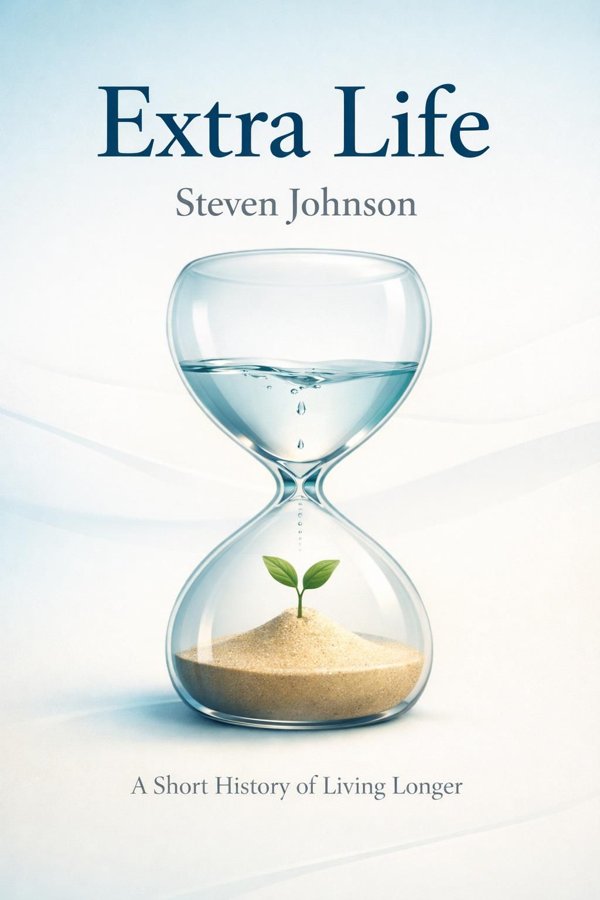
Extra Life: A Short History of Living Longer: Summary & Key Insights
 10 min12 chaptersAudio available
What Is Extra Life: A Short History of Living Longer About?
Extra Life: A Short History of Living Longer by Steven Johnson is a popular_sci book spanning 12 pages. Extra Life: A Short History of Living Longer explores how advances in science, medicine, and public health have dramatically increased human life expectancy over the past few centuries. Steven Johnson traces key innovations—from vaccines and antibiotics to data analysis and public health campaigns—that have collectively added decades to the average human lifespan. The book combines historical storytelling with scientific insight, showing how collaboration, policy, and innovation have shaped modern survival.
This FizzRead summary covers all 12 key chapters of Extra Life: A Short History of Living Longer in approximately 10 minutes, distilling the most important ideas, arguments, and takeaways from Steven Johnson's work. Also available as an audio summary and Key Quotes Podcast.
Extra Life: A Short History of Living Longer
Extra Life: A Short History of Living Longer explores how advances in science, medicine, and public health have dramatically increased human life expectancy over the past few centuries. Steven Johnson traces key innovations—from vaccines and antibiotics to data analysis and public health campaigns—that have collectively added decades to the average human lifespan. The book combines historical storytelling with scientific insight, showing how collaboration, policy, and innovation have shaped modern survival.
Who Should Read Extra Life: A Short History of Living Longer?
This book is perfect for anyone interested in popular_sci and looking to gain actionable insights in a short read. Whether you're a student, professional, or lifelong learner, the key ideas from Extra Life: A Short History of Living Longer by Steven Johnson will help you think differently.
- ✓Readers who enjoy popular_sci and want practical takeaways
- ✓Professionals looking to apply new ideas to their work and life
- ✓Anyone who wants the core insights of Extra Life: A Short History of Living Longer in just 10 minutes
Want the full summary?
Get instant access to this book summary and 100K+ more with Fizz Moment.
Get Free SummaryAvailable on App Store • Free to download
Key Chapters
Before the modern age, human life was dominated by the tyranny of infectious disease. In cities like London and Paris, half of all children died before reaching adulthood. Sanitation was primitive, diets were poor, and even basic medical theory operated within the now-defunct realm of humors and miasmas. People did not die because the world was entirely hostile, but because their understanding of it was deeply limited.
In tracing this pre-modern world, I wanted readers to glimpse the fragility of human survival before the idea of public health even existed. Plagues rolled through cities with terrifying regularity—cholera in one generation, typhus or smallpox in the next. Without knowledge of germs or modes of transmission, responses were desperate improvisations: quarantines, mass burnings of possessions, migrations into the countryside. Yet within this environment of fear lay the seeds of the empirical mindset that would later save billions. Each wave of disease forced humankind to observe, compare, and remember. Mortality itself became data long before it was organized statistically. Mothers passed along folk wisdom about hygiene, midwives recorded survival patterns, and monasteries tracked outbreaks in their chronicles. A primitive but essential form of epidemiology had begun.
If there is one moment when humanity first grasped the idea that disease could be deliberately prevented, it was the invention of vaccination. The story begins with smallpox, a scourge that once killed or disfigured countless millions. Long before Edward Jenner’s experiments in the 1790s, various cultures—from China to the Ottoman Empire—had already toyed with inoculation by exposing healthy individuals to mild cases of the disease. Jenner’s critical insight—that cowpox infection could confer immunity without the deadly risk of smallpox itself—was transformative. His 1796 vaccination of young James Phipps marked the dawn of a new era.
In telling this story, I wanted to highlight not just Jenner’s genius, but the social bravery it demanded. Vaccination depended on trust—trust in science, in community, in strangers daring to interfere with the body for its own protection. Over time, that act of trust grew into one of humanity’s largest cooperative endeavors. By the twentieth century, public vaccination campaigns were eliminating diseases that had ravaged humanity for millennia. The eradication of smallpox in 1980 stands as perhaps the greatest collective triumph in human history, and the direct ancestor of the global health systems that keep us safe today.
+ 10 more chapters — available in the FizzRead app
All Chapters in Extra Life: A Short History of Living Longer
About the Author
Steven Johnson is an American author and media theorist known for his works on the intersection of science, technology, and personal experience. He has written several bestselling books, including 'How We Got to Now' and 'Where Good Ideas Come From', and has hosted PBS and BBC television series based on his works.
Get This Summary in Your Preferred Format
Read or listen to the Extra Life: A Short History of Living Longer summary by Steven Johnson anytime, anywhere. FizzRead offers multiple formats so you can learn on your terms — all free.
Available formats: App · Audio · PDF · EPUB — All included free with FizzRead
Download Extra Life: A Short History of Living Longer PDF and EPUB Summary
Key Quotes from Extra Life: A Short History of Living Longer
“Before the modern age, human life was dominated by the tyranny of infectious disease.”
“If there is one moment when humanity first grasped the idea that disease could be deliberately prevented, it was the invention of vaccination.”
Frequently Asked Questions about Extra Life: A Short History of Living Longer
Extra Life: A Short History of Living Longer by Steven Johnson is a popular_sci book that explores key ideas across 12 chapters. Extra Life: A Short History of Living Longer explores how advances in science, medicine, and public health have dramatically increased human life expectancy over the past few centuries. Steven Johnson traces key innovations—from vaccines and antibiotics to data analysis and public health campaigns—that have collectively added decades to the average human lifespan. The book combines historical storytelling with scientific insight, showing how collaboration, policy, and innovation have shaped modern survival.
More by Steven Johnson
How We Got to Now: Six Innovations That Made the Modern World
Steven Johnson
10 min
Where Good Ideas Come From: The Natural History of Innovation
Steven Johnson
10 min
The Ghost Map: The Story of London's Most Terrifying Epidemic – and How It Changed Science, Cities, and the Modern World
Steven Johnson
10 min
The Innovator’s Cookbook: Essentials for Inventing What Is Next
Steven Johnson
10 minYou Might Also Like

Structures: Or Why Things Don"t Fall Down
J.E. Gordon
10 min
The Road to Wigan Pier
George Orwell
10 min
Bonk: The Curious Coupling of Science and Sex
Mary Roach
10 min
First Bite: How We Learn to Eat
Bee Wilson
10 min
In Pursuit Of The Unknown: 17 Equations That Changed The World
Ian Stewart
10 min
Napoleon's Buttons: 17 Molecules That Changed History
Penny Le Couteur and Jay Burreson
10 minBrowse by Category
Ready to read Extra Life: A Short History of Living Longer?
Get the full summary and 100K+ more books with Fizz Moment.