
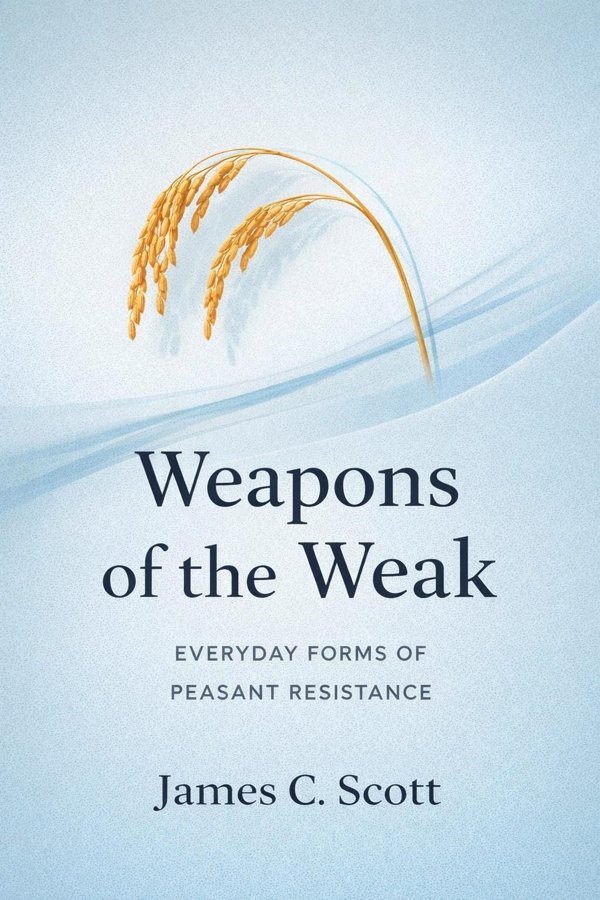
Weapons of the Weak: Everyday Forms of Peasant Resistance: Summary & Key Insights
 10 min7 chaptersAudio available
What Is Weapons of the Weak: Everyday Forms of Peasant Resistance About?
Weapons of the Weak: Everyday Forms of Peasant Resistance by James C. Scott is a sociology book spanning 7 pages. This influential work by political scientist James C. Scott examines the subtle, everyday forms of resistance employed by peasants in a Malaysian village against economic and social domination. Rather than overt rebellion, Scott explores how small acts—foot-dragging, evasion, and feigned ignorance—constitute a hidden transcript of defiance that challenges power structures from below.
This FizzRead summary covers all 7 key chapters of Weapons of the Weak: Everyday Forms of Peasant Resistance in approximately 10 minutes, distilling the most important ideas, arguments, and takeaways from James C. Scott's work. Also available as an audio summary and Key Quotes Podcast.
Weapons of the Weak: Everyday Forms of Peasant Resistance
This influential work by political scientist James C. Scott examines the subtle, everyday forms of resistance employed by peasants in a Malaysian village against economic and social domination. Rather than overt rebellion, Scott explores how small acts—foot-dragging, evasion, and feigned ignorance—constitute a hidden transcript of defiance that challenges power structures from below.
Who Should Read Weapons of the Weak: Everyday Forms of Peasant Resistance?
This book is perfect for anyone interested in sociology and looking to gain actionable insights in a short read. Whether you're a student, professional, or lifelong learner, the key ideas from Weapons of the Weak: Everyday Forms of Peasant Resistance by James C. Scott will help you think differently.
- ✓Readers who enjoy sociology and want practical takeaways
- ✓Professionals looking to apply new ideas to their work and life
- ✓Anyone who wants the core insights of Weapons of the Weak: Everyday Forms of Peasant Resistance in just 10 minutes
Want the full summary?
Get instant access to this book summary and 100K+ more with Fizz Moment.
Get Free SummaryAvailable on App Store • Free to download
Key Chapters
In much of social science, resistance has often been imagined as dramatic—peasants rising in revolt, revolutions overturning regimes, strikes sweeping industries. Yet in Sedaka, what I discovered was the opposite of spectacle: the slow, steady undercurrent of noncompliance and subversion that courses through daily life. I came to define these as the everyday forms of resistance—small acts such as foot-dragging, theft, manipulation of output, feigned ignorance, and subtle sabotage.
These practices, I found, were not haphazard. They arose from a shared understanding among the poor that open confrontation was both dangerous and self-defeating. In a social order where landlords hold not only economic but moral authority, the costs of rebellion are extraordinarily high. The result is a political economy of caution—where every gesture of dissent must disguise itself under plausible deniability.
But make no mistake: such acts have political meaning. Everyday resistance constitutes a moral dialogue about exploitation and fairness. It communicates disapproval without overt challenge. When a worker deliberately misrepresents his productivity, he is, in effect, denying the legitimacy of his employer’s dominance. When villagers gossip about the stinginess of the rich, they craft narratives of justice that undermine elite moral authority.
The heart of this theoretical frame lies in recognizing that politics is not confined to moments of formal mobilization. It pervades the quotidian, emerging in rice fields, in households, in exchanges of labor and debt. What appears as apathy is often strategic concealment; what looks like acquiescence may hide profound discontent.
These forms of resistance are weapons precisely because they rely on the weak’s ability to navigate the powerful terrain of domination without incurring retribution. Their effectiveness depends on ambiguity—nothing overt enough for punishment, but persistent enough to erode compliance and expose cracks in the system. They represent a dispersed, low-profile form of struggle that blurs the distinction between political and personal behavior.
The village of Sedaka offers a microcosm of the transformations that swept through Southeast Asia during the Green Revolution. Where once social relations were anchored in a subsistence ethic emphasizing reciprocity and shared labor, modernization introduced mechanization and market dependency. Tractors replaced communal work groups, and land became a site not of social solidarity but of capital investment.
As richer peasants embraced machinery and new agricultural technologies, their productivity soared. Poor peasants, however, could not afford such equipment; their wages stagnated, and with the shifting ecology of farming, many lost their traditional livelihoods. The communal bonds that once sustained mutual assistance began to fracture under the pressure of profit and efficiency.
The economic divide reinforced existing hierarchies: landlords and largeholders gained not only wealth but increasing control over the means of production, while poorer villagers became marginal laborers or tenants. Publicly, this transformation was described as progress. Privately, it was experienced as dispossession.
Against this backdrop, everyday resistance took root. The poorer farmers did not organize rebellions, but their sense of injustice was acute. They practiced small acts of sabotage—overusing fuel, underperforming tasks, or delaying work schedules—to reclaim agency within an unequal system. They also deployed narratives, stories, and moral judgments to counter the ideology of modernization. Through quiet resistance, they contested not only economic inequality but the cultural values that legitimized it.
Understanding Sedaka’s modernization is therefore essential to grasping the texture of its resistance. The villagers’ actions were not irrational reactions to change but adaptive strategies within the constraints imposed by technology and class transformation. Their politics were rooted in the rhythms of their everyday struggles for survival, hidden beneath the rhetoric of agricultural progress.
+ 5 more chapters — available in the FizzRead app
All Chapters in Weapons of the Weak: Everyday Forms of Peasant Resistance
About the Author
James C. Scott is an American political scientist and anthropologist, known for his studies of agrarian societies, resistance, and state power. He is Sterling Professor of Political Science and Anthropology at Yale University and author of several landmark works on peasant politics and state formation.
Get This Summary in Your Preferred Format
Read or listen to the Weapons of the Weak: Everyday Forms of Peasant Resistance summary by James C. Scott anytime, anywhere. FizzRead offers multiple formats so you can learn on your terms — all free.
Available formats: App · Audio · PDF · EPUB — All included free with FizzRead
Download Weapons of the Weak: Everyday Forms of Peasant Resistance PDF and EPUB Summary
Key Quotes from Weapons of the Weak: Everyday Forms of Peasant Resistance
“In much of social science, resistance has often been imagined as dramatic—peasants rising in revolt, revolutions overturning regimes, strikes sweeping industries.”
“The village of Sedaka offers a microcosm of the transformations that swept through Southeast Asia during the Green Revolution.”
Frequently Asked Questions about Weapons of the Weak: Everyday Forms of Peasant Resistance
Weapons of the Weak: Everyday Forms of Peasant Resistance by James C. Scott is a sociology book that explores key ideas across 7 chapters. This influential work by political scientist James C. Scott examines the subtle, everyday forms of resistance employed by peasants in a Malaysian village against economic and social domination. Rather than overt rebellion, Scott explores how small acts—foot-dragging, evasion, and feigned ignorance—constitute a hidden transcript of defiance that challenges power structures from below.
More by James C. Scott
You Might Also Like

Between the World and Me
Ta-Nehisi Coates
10 min
Half the Sky
Nicholas D. Kristof, Sheryl WuDunn
10 min
Men Explain Things To Me
Rebecca Solnit
10 min
Rational Ritual
Michael Suk-Young Chwe
10 min
The New Jim Crow
Michelle Alexander
10 min
Beyond Culture
Edward T. Hall
10 minBrowse by Category
Ready to read Weapons of the Weak: Everyday Forms of Peasant Resistance?
Get the full summary and 100K+ more books with Fizz Moment.