
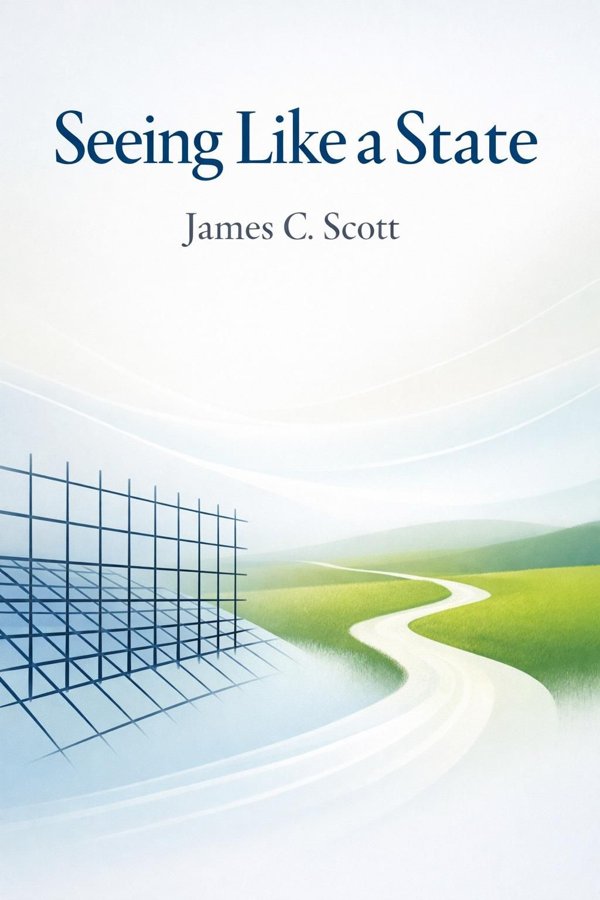
Seeing Like a State: How Certain Schemes to Improve the Human Condition Have Failed: Summary & Key Insights
 10 min8 chaptersAudio available
What Is Seeing Like a State: How Certain Schemes to Improve the Human Condition Have Failed About?
Seeing Like a State: How Certain Schemes to Improve the Human Condition Have Failed by James C. Scott is a politics book spanning 8 pages. This influential work by political scientist James C. Scott examines how modern states attempt to impose order and legibility on complex societies. Through historical and anthropological case studies, Scott argues that large-scale social engineering projects—such as collectivized agriculture, urban planning, and bureaucratic standardization—often fail because they ignore local knowledge and human adaptability. The book explores the tension between centralized authority and the practical wisdom of everyday life, offering a critique of technocratic governance and the limits of rational planning.
This FizzRead summary covers all 8 key chapters of Seeing Like a State: How Certain Schemes to Improve the Human Condition Have Failed in approximately 10 minutes, distilling the most important ideas, arguments, and takeaways from James C. Scott's work. Also available as an audio summary and Key Quotes Podcast.
Seeing Like a State: How Certain Schemes to Improve the Human Condition Have Failed
This influential work by political scientist James C. Scott examines how modern states attempt to impose order and legibility on complex societies. Through historical and anthropological case studies, Scott argues that large-scale social engineering projects—such as collectivized agriculture, urban planning, and bureaucratic standardization—often fail because they ignore local knowledge and human adaptability. The book explores the tension between centralized authority and the practical wisdom of everyday life, offering a critique of technocratic governance and the limits of rational planning.
Who Should Read Seeing Like a State: How Certain Schemes to Improve the Human Condition Have Failed?
This book is perfect for anyone interested in politics and looking to gain actionable insights in a short read. Whether you're a student, professional, or lifelong learner, the key ideas from Seeing Like a State: How Certain Schemes to Improve the Human Condition Have Failed by James C. Scott will help you think differently.
- ✓Readers who enjoy politics and want practical takeaways
- ✓Professionals looking to apply new ideas to their work and life
- ✓Anyone who wants the core insights of Seeing Like a State: How Certain Schemes to Improve the Human Condition Have Failed in just 10 minutes
Want the full summary?
Get instant access to this book summary and 100K+ more with Fizz Moment.
Get Free SummaryAvailable on App Store • Free to download
Key Chapters
High modernism, as I employ the term, names an extraordinary faith in scientific and technical progress—a conviction that reason and expertise could reconstruct society itself from first principles. It was not simply an intellectual movement but an ethos of certainty. Its heroes were the planners, engineers, and architects of a new age who saw in messy, traditional life only chaos in need of rationalization.
This ideology reached its most potent form in the twentieth century, when the scars of war and the promises of industrial growth inspired a willingness to rebuild entire worlds. The conviction was that social order could be redesigned as cleanly as a machine: that the cluttered irregularities of peasant landholdings, the crooked alleys of medieval cities, even the instinctive habits of family and faith could yield to a purified order. What united these diverse projects—from Le Corbusier’s radiant city to Lenin’s collectivized countryside—was a desire for clarity, efficiency, and progress through top-down design.
But this clarity was deceptive. To plan a forest as a grid of identical trees or a city as a matrix of functions is to privilege what is measurable over what is meaningful. High modernism’s tragedy lies in its disregard for the subtleties of social life. Under its logic, complexity becomes a flaw to be eliminated, and diversity a form of ignorance. The very unpredictability that gives human communities resilience is perceived as an obstacle to control. I do not deny the fertility of modern science; rather, I warn of what happens when its triumphalist spirit leaves no room for the wisdom of experience.
This faith in rational design required not just optimism but power—the authority to act on conviction without the hindrance of dissent. Thus, high modernism often flourished in alliance with authoritarianism. Bureaucratic ambition and political coercion joined hands, producing grand schemes whose human costs were rationalized as necessary sacrifices. The promise of reason, divorced from humility, paved roads to both utopia and ruin.
To understand why states embrace simplification, one must imagine the problem from the ruler’s point of view. The sovereign, whether monarch or minister, peers across a domain of subjects, fields, and villages that are largely opaque. Local customs, dialects, and inheritances scramble understanding. Taxes cannot be collected, conscripts cannot be counted, and resources cannot be managed without first translating this complexity into something legible. The state’s pursuit of vision begins here.
Administrative tools such as cadastral maps, censuses, and standardized surnames were not neutral instruments; they were technologies of visibility. When a family receives a fixed surname or a piece of land receives mapped boundaries, they are inscribed into a system of knowledge that serves governance. Every act of measurement or classification simplifies a world of nuance into an abstract formula. A community becomes a set of numbers; a landscape becomes a resource inventory. The gain in control is offset by a loss of understanding.
These simplifications make possible the exercise of power on a national scale, but they also create blind spots. What is legible to the state may be alien to its citizens. When tax categories ignore local ecosystems or censuses misclassify identities, they impose distortions that can prove fatal in policy. The act of making society legible is inseparable from the act of making society governable, and both rely on the same partial vision. To know as a state knows is to see selectively, in clean lines and averages, to overlook the dirt and improvisation that sustain ordinary life.
The lesson is not that states should abdicate knowledge, but that the map is never the territory. Every simplification hides a moral choice about what—and who—counts.
+ 6 more chapters — available in the FizzRead app
All Chapters in Seeing Like a State: How Certain Schemes to Improve the Human Condition Have Failed
About the Author
James C. Scott is an American political scientist and anthropologist, and Sterling Professor of Political Science at Yale University. His research focuses on political economy, peasant resistance, and state formation. Scott is widely known for his works on power, domination, and the ways ordinary people resist authority, including 'Weapons of the Weak' and 'The Art of Not Being Governed'.
Get This Summary in Your Preferred Format
Read or listen to the Seeing Like a State: How Certain Schemes to Improve the Human Condition Have Failed summary by James C. Scott anytime, anywhere. FizzRead offers multiple formats so you can learn on your terms — all free.
Available formats: App · Audio · PDF · EPUB — All included free with FizzRead
Download Seeing Like a State: How Certain Schemes to Improve the Human Condition Have Failed PDF and EPUB Summary
Key Quotes from Seeing Like a State: How Certain Schemes to Improve the Human Condition Have Failed
“High modernism, as I employ the term, names an extraordinary faith in scientific and technical progress—a conviction that reason and expertise could reconstruct society itself from first principles.”
“To understand why states embrace simplification, one must imagine the problem from the ruler’s point of view.”
Frequently Asked Questions about Seeing Like a State: How Certain Schemes to Improve the Human Condition Have Failed
Seeing Like a State: How Certain Schemes to Improve the Human Condition Have Failed by James C. Scott is a politics book that explores key ideas across 8 chapters. This influential work by political scientist James C. Scott examines how modern states attempt to impose order and legibility on complex societies. Through historical and anthropological case studies, Scott argues that large-scale social engineering projects—such as collectivized agriculture, urban planning, and bureaucratic standardization—often fail because they ignore local knowledge and human adaptability. The book explores the tension between centralized authority and the practical wisdom of everyday life, offering a critique of technocratic governance and the limits of rational planning.
More by James C. Scott

You Might Also Like

Antifa: The Anti-Fascist Handbook
Mark Bray
10 min
Attack from Within: How Disinformation Is Sabotaging America
Barbara McQuade
10 min
Coercion, Capital, and European States, AD 990–1992
Charles Tilly
10 min
Digital Democracy: Concepts, Methodologies, Tools, and Applications
Various Authors
10 min
Fascism
Stanley G. Payne
10 min
Fire And Fury: Inside The Trump White House
Michael Wolff
10 minBrowse by Category
Ready to read Seeing Like a State: How Certain Schemes to Improve the Human Condition Have Failed?
Get the full summary and 100K+ more books with Fizz Moment.