
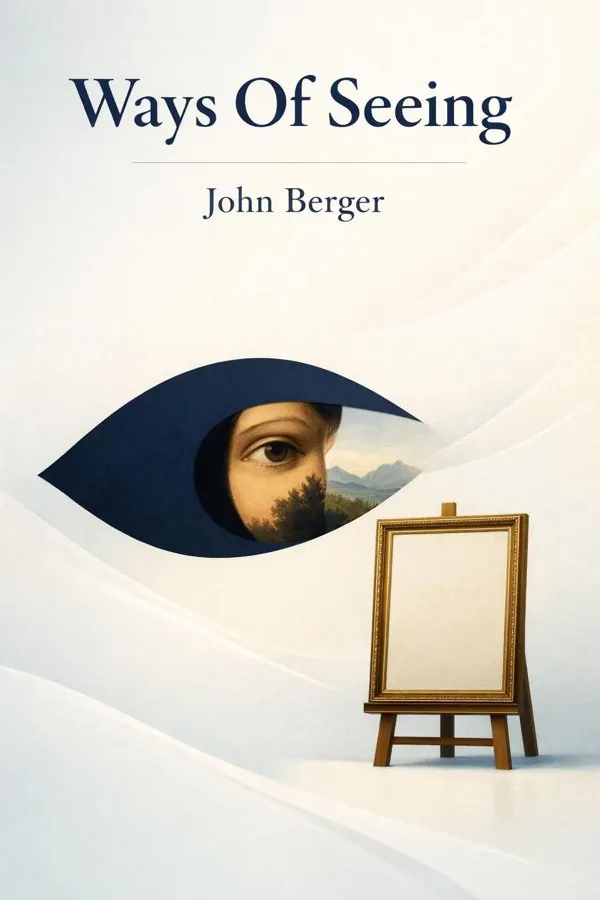
Ways Of Seeing: Summary & Key Insights
by John Berger
 10 min9 chaptersAudio available
Key Takeaways from Ways Of Seeing
Before we learn to explain the world, we first encounter it through sight.
An artwork changes when it can be endlessly copied.
Images often appear immediate and self-evident, which is precisely why they can exercise such subtle power.
One of Berger’s most famous and enduring arguments is that in Western visual culture, men act and women appear.
To be naked is simply to be oneself without clothes.
What Is Ways Of Seeing About?
Ways Of Seeing by John Berger is a art book spanning 8 pages. John Berger’s Ways Of Seeing is one of the most influential books ever written about art, images, and visual culture. First published in 1972 and adapted from his landmark BBC television series, the book challenges a deeply rooted assumption: that seeing is natural, innocent, and objective. Berger argues the opposite. We do not simply look at images; we interpret them through the lenses of history, class, gender, politics, and desire. What we see is shaped by what we know, what we believe, and the society we live in. Drawing on art history, Marxist criticism, media analysis, and sharp cultural observation, Berger reexamines the Western artistic tradition and reveals how paintings, advertisements, and photographs encode power. He shows how oil painting celebrated ownership, how reproduction changed the meaning of art, and how women in visual culture were trained to see themselves through the eyes of men. Despite its brevity, the book is radical, readable, and enduringly relevant. In an age dominated by screens, curated identities, and nonstop imagery, Berger’s insights feel even more urgent. Ways Of Seeing does not just teach you how to interpret art—it changes how you look at the world.
This FizzRead summary covers all 9 key chapters of Ways Of Seeing in approximately 10 minutes, distilling the most important ideas, arguments, and takeaways from John Berger's work. Also available as an audio summary and Key Quotes Podcast.
Ways Of Seeing
John Berger’s Ways Of Seeing is one of the most influential books ever written about art, images, and visual culture. First published in 1972 and adapted from his landmark BBC television series, the book challenges a deeply rooted assumption: that seeing is natural, innocent, and objective. Berger argues the opposite. We do not simply look at images; we interpret them through the lenses of history, class, gender, politics, and desire. What we see is shaped by what we know, what we believe, and the society we live in.
Drawing on art history, Marxist criticism, media analysis, and sharp cultural observation, Berger reexamines the Western artistic tradition and reveals how paintings, advertisements, and photographs encode power. He shows how oil painting celebrated ownership, how reproduction changed the meaning of art, and how women in visual culture were trained to see themselves through the eyes of men. Despite its brevity, the book is radical, readable, and enduringly relevant. In an age dominated by screens, curated identities, and nonstop imagery, Berger’s insights feel even more urgent. Ways Of Seeing does not just teach you how to interpret art—it changes how you look at the world.
Who Should Read Ways Of Seeing?
This book is perfect for anyone interested in art and looking to gain actionable insights in a short read. Whether you're a student, professional, or lifelong learner, the key ideas from Ways Of Seeing by John Berger will help you think differently.
- ✓Readers who enjoy art and want practical takeaways
- ✓Professionals looking to apply new ideas to their work and life
- ✓Anyone who wants the core insights of Ways Of Seeing in just 10 minutes
Want the full summary?
Get instant access to this book summary and 100K+ more with Fizz Moment.
Get Free SummaryAvailable on App Store • Free to download
Key Chapters
Before we learn to explain the world, we first encounter it through sight. Berger begins with this deceptively simple insight to show that vision is not a passive act but the foundation of how we orient ourselves in reality. We see before we speak, and because of that, images often shape our assumptions more deeply than language does. Yet seeing is never purely natural. Every act of looking is influenced by memory, culture, education, and desire. Two people can look at the same painting and notice entirely different things because they bring different histories to it.
This matters because many institutions—museums, schools, media, and advertising—present images as if their meaning were fixed. Berger dismantles that illusion. He argues that what we see is always affected by what we know and what we have been taught to value. A religious painting looks different to a believer than to a secular museum visitor. A family photograph means one thing to strangers and another to those inside the memory. Looking is always tied to context.
In everyday life, this idea has enormous power. Consider social media: an image of luxury may look glamorous to one viewer and manipulative to another. A news photograph may appear factual, yet framing, captioning, and distribution shape its meaning. Berger teaches us to ask not only “What am I looking at?” but also “How have I been trained to look?”
The practical lesson is clear: slow down your gaze. When you encounter an image—whether in a gallery, on a billboard, or on your phone—pause and ask what assumptions it invites. Notice your reaction before accepting the image’s message. Seeing more consciously is the first step toward thinking more freely.
An artwork changes when it can be endlessly copied. Berger argues that the invention of photography and mechanical reproduction transformed art not only by making images more accessible, but by changing what they mean. A painting once existed in a specific place and carried the unique presence of that setting. To see it, you had to go to it. Reproduction removed that exclusivity. Once an image can appear in books, films, postcards, websites, and classrooms, it no longer belongs only to its original location.
This shift has both democratic and disruptive consequences. On one hand, reproduction liberates art from elite spaces. People who may never enter the Louvre can still encounter Leonardo or Caravaggio. On the other hand, reproductions detach works from scale, texture, setting, and ritual. A painting becomes an image among other images, often cropped, captioned, and repurposed. Its meaning can be altered by the company it keeps. A masterpiece in a museum invites reverence; the same image in an advertisement may sell prestige or sophistication.
Berger also shows how reproduction allows authorities to control interpretation. Once art appears in textbooks or documentaries, institutions can package it with commentary that guides viewers toward approved meanings. This is still true today when algorithms, influencers, and platform design shape how we encounter visual culture.
A practical example is viewing Vincent van Gogh’s Starry Night online. You may know its swirls and colors intimately, yet still have no sense of its actual size, paint thickness, or emotional force in person. The digital image informs you, but it also flattens the encounter.
The actionable takeaway: whenever you see a reproduced artwork, remember that you are not seeing the whole experience. Ask what has been lost, what has been added, and who controls the frame through which you encounter it.
One of Berger’s most famous and enduring arguments is that in Western visual culture, men act and women appear. He is describing more than old paintings; he is identifying a social pattern in which women are trained to see themselves as objects of inspection. A woman, in this framework, does not simply exist in the world—she also watches herself being looked at. Her gestures, expressions, posture, and even self-image become shaped by an imagined observer, usually male.
Berger’s point is not merely about individual behavior. It is about power. If one group is positioned as the viewer and another as the viewed, then representation helps reinforce inequality. This is why so many paintings, films, advertisements, and now social media images present women less as full agents and more as spectacles. Their value is tied to how they appear, not what they do.
This idea remains startlingly relevant. On platforms like Instagram or TikTok, self-presentation is often rewarded through visibility and approval. Many users, especially women, are encouraged to cultivate an image that is polished, attractive, and legible to outside judgment. The pressure to be watchable becomes internalized. Berger helps explain why this feels exhausting: it splits the self into observer and observed.
His argument also offers a language for media literacy. When watching a film or browsing fashion campaigns, ask who has agency in the image. Who is doing something, and who is being displayed? Who looks, and who is looked at?
The takeaway is to examine images for patterns of power, not just beauty. Whenever you encounter representation of gender, ask whether the subject is being shown as a person with intention or as an object arranged for approval. That question alone can transform how you read visual culture.
To be naked is simply to be oneself without clothes. To be nude, Berger argues, is something different: it is to be displayed. This distinction is one of the book’s most elegant insights. In much of European oil painting, the female nude was not presented as an autonomous person inhabiting her body, but as a body arranged for the spectator’s pleasure. The nude is less a human condition than a cultural performance shaped by convention, style, and power.
Berger shows that many supposedly timeless images of beauty are in fact highly coded. Mirrors, reclining poses, smooth skin, averted resistance, and direct yet passive gazes all help construct a body meant to be judged. The woman in such paintings is often aware of being seen. She is not simply existing naked; she is cooperating in her own display. This turns personhood into spectacle.
The distinction remains useful today. In fashion photography, cinema, and influencer culture, images may appear bold, liberating, or sensual, yet still be organized around external approval. Berger does not claim all depictions of the body are oppressive. Rather, he asks us to notice whether the image allows bodily presence or reduces it to appearance. A portrait of intimacy may reveal vulnerability and selfhood; a staged glamour shot may invite only evaluation.
This concept can sharpen how we consume media. When an image of the body appears, ask: does this person seem to inhabit themselves, or are they arranged for someone else’s gaze? Is the body expressing life, or merely offering surface?
The actionable takeaway is to look beyond the presence of skin and examine the structure of attention. Not all exposure is objectification, but when the body is detached from agency and made into a display, Berger would urge us to name that difference clearly.
Berger argues that traditional European oil painting did more than depict the world—it taught viewers how to value it. The medium became especially suited to rendering textures, surfaces, and material abundance: silk, silver, fruit, fur, land, jewels, and flesh. In doing so, it often translated the visible world into a vision of possession. To paint something beautifully was frequently to show that it could be owned.
This is one of Berger’s most original contributions. He links artistic style to economic ideology. Oil painting flourished alongside rising mercantile and property-based societies, and many of its subjects reflect that world. Portraits announced status. Landscapes confirmed territorial control. Still lifes displayed luxury. Even mythological or religious scenes could function as demonstrations of wealth and cultivated taste. The collector did not just buy a painting; the painting often represented a way of owning reality itself.
A modern parallel is lifestyle media. Real-estate photography, luxury magazines, and aspirational interiors all rely on the same visual logic: the world becomes desirable because it appears available for acquisition. Visual pleasure merges with economic power. What Berger helps us see is that images of beauty are often also images of class.
This does not mean all oil paintings are crude status symbols. Many exceed the ideology of their time. But Berger insists that if we ignore the relationship between art and property, we miss a central dimension of Western visual culture.
To apply this insight, look at paintings and photographs with an economic eye. Ask what is being displayed, who could afford it, and what kind of world the image normalizes. The takeaway: whenever an image dazzles you with richness or detail, consider whether it is also inviting admiration for ownership itself.
Advertising does not merely sell products; it sells futures. Berger’s analysis of publicity is among the most prophetic parts of the book. He argues that modern advertising works by creating a feeling of personal inadequacy and then offering consumption as the cure. Publicity tells you that your life, as it is, is not enough. But if you buy the right perfume, car, watch, vacation, or skincare product, you can become enviable. The real commodity is not the object—it is a transformed version of the self.
This logic depends on comparison. Publicity shows idealized bodies, elegant settings, and scenes of effortless success not because most people live that way, but because most do not. It thrives on the gap between ordinary life and imagined glamour. Berger links this to capitalism’s need to keep desire permanently active. Satisfaction would end the cycle; envy keeps it moving.
Today, this mechanism is everywhere. Social media influencers, luxury branding, self-optimization content, and even wellness marketing all often operate through the same structure. You are invited to compare your current self with a curated ideal and then consume your way toward it. Publicity colonizes not only what you want, but how you imagine your identity.
A practical example is the language of “aspirational living.” A simple coffee machine is not sold as a tool but as a lifestyle upgrade. A pair of shoes becomes confidence, status, and attractiveness. The image asks you to buy not utility but possibility.
The takeaway is to interrupt the emotional script of advertising. When an ad makes you feel lacking, ask what fantasy it is offering and what insecurity it is exploiting. Once you can see the mechanism, its power weakens. Berger’s lesson is not to reject all products, but to resist letting images define your worth.
What a society repeatedly shows in its images reveals what it wants to normalize. Berger’s broader argument is that visual culture is inseparable from ideology. Paintings, photographs, advertisements, and films do not float above politics; they participate in the values of their time. They can reinforce class hierarchy, gender roles, nationalism, consumerism, and ideas about beauty and success. Even when images seem decorative or entertaining, they may still be teaching viewers how to perceive reality.
This is why Berger treats art criticism as a political act. To interpret images is not simply to identify style or symbolism, but to ask whose interests are being served. Why are some lives made visible and others ignored? Why are some forms of beauty celebrated and others excluded? Why are wealth and desirability so often linked? Visual culture helps answer these questions because it helps produce the common sense of a society.
This framework is especially useful today, when people consume thousands of images a week. Consider how certain professions are glamorized while care work remains invisible, or how news photography can frame protests as either democratic courage or public disorder depending on editorial intent. The image is never innocent.
Berger does not suggest that viewers are helpless. On the contrary, he believes critical awareness can break the spell of ideology. Once we learn to ask who benefits from a representation, we become less likely to absorb it passively.
The practical takeaway is to make ideology visible in ordinary viewing. Each time an image feels natural, desirable, or obvious, ask what social values it is carrying. The more you identify recurring patterns, the more freedom you gain from them. Berger’s deepest lesson is that criticism begins the moment we stop confusing familiarity with truth.
Images do not possess a single permanent meaning waiting to be extracted. Berger insists that the viewer plays an active role in interpretation. Context changes what we see, and our own experiences change it further. A painting in a church, a textbook, a living room, or a meme page will not mean the same thing in each setting. Meaning arises in the encounter between image and viewer, not from the object alone.
This is a radical democratizing claim. It pushes back against the idea that only experts can determine what art means. Berger certainly values history, but he resists turning art into a sealed code accessible only to specialists. The ordinary viewer matters. Personal associations, emotional reactions, and social position all shape interpretation. Someone who has experienced poverty may read a banquet painting differently from someone raised in privilege. Someone conscious of racial exclusion may notice absences in museum collections that others overlook.
This does not mean all interpretations are equally persuasive. Evidence, context, and careful looking still matter. But Berger opens space for a more alive and participatory relationship with images. He invites viewers to be responsible interpreters rather than passive recipients.
In practical terms, this can transform how you engage with visual media. Instead of asking, “What am I supposed to think?” ask, “What is this image doing to me, and why?” In classrooms, book clubs, or museum visits, comparing interpretations often reveals how social experience shapes perception.
The takeaway is simple: claim your role as a viewer. Bring curiosity, context, and skepticism to every image. You do not need to abandon expertise, but you should not surrender your own seeing. Berger’s enduring gift is the confidence to look actively rather than obediently.
All Chapters in Ways Of Seeing
About the Author
John Berger (1926–2017) was a British writer, critic, novelist, painter, and one of the most influential cultural thinkers of the twentieth century. He began his career as an artist and art critic, later becoming widely known for bringing politics, class, and everyday life into conversations about visual culture. Berger believed that art could not be separated from the social world that produced it, and his writing consistently explored the links between images, labor, power, and human experience. He achieved international recognition with Ways Of Seeing, first created as a BBC television series and then published as a book in 1972. The same year, he won the Booker Prize for his novel G. Throughout his career, Berger wrote essays, fiction, and criticism marked by clarity, moral seriousness, and deep compassion.
Get This Summary in Your Preferred Format
Read or listen to the Ways Of Seeing summary by John Berger anytime, anywhere. FizzRead offers multiple formats so you can learn on your terms — all free.
Available formats: App · Audio · PDF · EPUB — All included free with FizzRead
Download Ways Of Seeing PDF and EPUB Summary
Key Quotes from Ways Of Seeing
“Before we learn to explain the world, we first encounter it through sight.”
“An artwork changes when it can be endlessly copied.”
“Images often appear immediate and self-evident, which is precisely why they can exercise such subtle power.”
“One of Berger’s most famous and enduring arguments is that in Western visual culture, men act and women appear.”
“To be naked is simply to be oneself without clothes.”
Frequently Asked Questions about Ways Of Seeing
Ways Of Seeing by John Berger is a art book that explores key ideas across 9 chapters. John Berger’s Ways Of Seeing is one of the most influential books ever written about art, images, and visual culture. First published in 1972 and adapted from his landmark BBC television series, the book challenges a deeply rooted assumption: that seeing is natural, innocent, and objective. Berger argues the opposite. We do not simply look at images; we interpret them through the lenses of history, class, gender, politics, and desire. What we see is shaped by what we know, what we believe, and the society we live in. Drawing on art history, Marxist criticism, media analysis, and sharp cultural observation, Berger reexamines the Western artistic tradition and reveals how paintings, advertisements, and photographs encode power. He shows how oil painting celebrated ownership, how reproduction changed the meaning of art, and how women in visual culture were trained to see themselves through the eyes of men. Despite its brevity, the book is radical, readable, and enduringly relevant. In an age dominated by screens, curated identities, and nonstop imagery, Berger’s insights feel even more urgent. Ways Of Seeing does not just teach you how to interpret art—it changes how you look at the world.
More by John Berger

You Might Also Like
Alla Prima: Everything I Know About Painting
Richard Schmid
10 min
The Art Spirit
Robert Henri
10 min
The Artist’s Reality: Philosophies of Art
Mark Rothko
10 min
The Complete Guide to Anatomy for Artists & Illustrators
Gottfried Bammes
10 min
The Shape of Content
Ben Shahn
10 min
The Value of Art
Michael Findlay
10 minBrowse by Category
Ready to read Ways Of Seeing?
Get the full summary and 100K+ more books with Fizz Moment.