
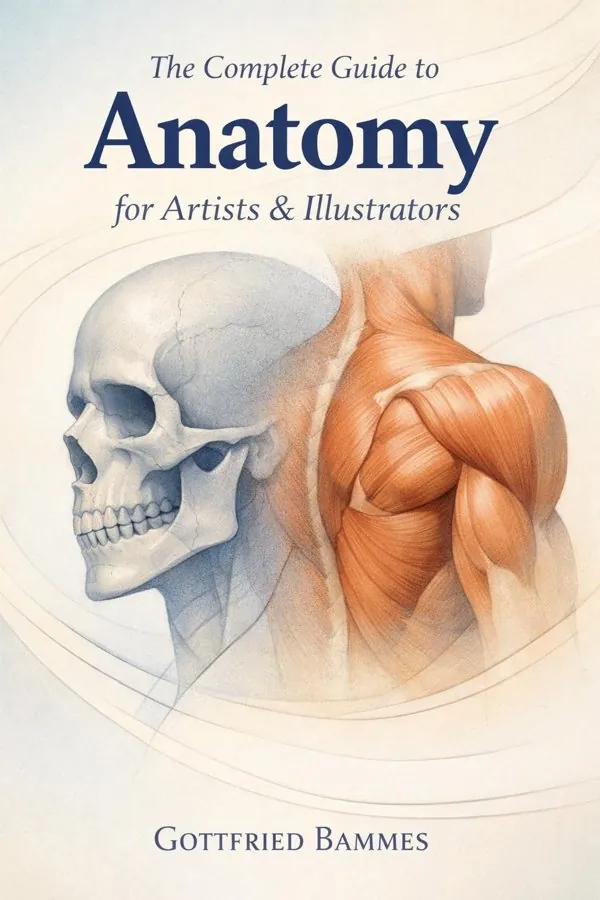
The Complete Guide to Anatomy for Artists & Illustrators: Summary & Key Insights
 10 min9 chaptersAudio available
Key Takeaways from The Complete Guide to Anatomy for Artists & Illustrators
Most drawing problems begin not in the hand, but in the eye.
A convincing figure stands on an invisible scaffold.
What gives the body its living surface is not anatomy in the abstract, but tension made visible.
The head is not merely a portrait feature; it is the body’s most concentrated statement of structure, identity, and expression.
If the limbs provide action, the torso provides authority.
What Is The Complete Guide to Anatomy for Artists & Illustrators About?
The Complete Guide to Anatomy for Artists & Illustrators by Gottfried Bammes is a art book spanning 7 pages. The Complete Guide to Anatomy for Artists & Illustrators is a masterclass in seeing the human body as both structure and expression. In this landmark reference, Gottfried Bammes bridges the gap between scientific anatomy and artistic practice, showing how bones, muscles, proportions, and movement shape everything an artist puts on the page. Rather than treating anatomy as dry information to memorize, he presents it as a living system that explains why the figure looks, balances, and moves the way it does. What makes this book so valuable is its balance of rigor and usability. Bammes does not ask artists to become doctors; he teaches them to recognize the underlying forms that make drawing convincing. His clear explanations, analytical diagrams, and abundant figure studies help readers understand not only what to draw, but how to think while drawing. That makes the book useful for illustrators, painters, sculptors, animators, and anyone serious about figure work. Bammes wrote from deep authority. As a respected artist, teacher, and professor of artistic anatomy, he spent decades helping students connect observation with structural knowledge. The result is a classic guide that strengthens accuracy, confidence, and expressive power.
This FizzRead summary covers all 9 key chapters of The Complete Guide to Anatomy for Artists & Illustrators in approximately 10 minutes, distilling the most important ideas, arguments, and takeaways from Gottfried Bammes's work. Also available as an audio summary and Key Quotes Podcast.
The Complete Guide to Anatomy for Artists & Illustrators
The Complete Guide to Anatomy for Artists & Illustrators is a masterclass in seeing the human body as both structure and expression. In this landmark reference, Gottfried Bammes bridges the gap between scientific anatomy and artistic practice, showing how bones, muscles, proportions, and movement shape everything an artist puts on the page. Rather than treating anatomy as dry information to memorize, he presents it as a living system that explains why the figure looks, balances, and moves the way it does.
What makes this book so valuable is its balance of rigor and usability. Bammes does not ask artists to become doctors; he teaches them to recognize the underlying forms that make drawing convincing. His clear explanations, analytical diagrams, and abundant figure studies help readers understand not only what to draw, but how to think while drawing. That makes the book useful for illustrators, painters, sculptors, animators, and anyone serious about figure work.
Bammes wrote from deep authority. As a respected artist, teacher, and professor of artistic anatomy, he spent decades helping students connect observation with structural knowledge. The result is a classic guide that strengthens accuracy, confidence, and expressive power.
Who Should Read The Complete Guide to Anatomy for Artists & Illustrators?
This book is perfect for anyone interested in art and looking to gain actionable insights in a short read. Whether you're a student, professional, or lifelong learner, the key ideas from The Complete Guide to Anatomy for Artists & Illustrators by Gottfried Bammes will help you think differently.
- ✓Readers who enjoy art and want practical takeaways
- ✓Professionals looking to apply new ideas to their work and life
- ✓Anyone who wants the core insights of The Complete Guide to Anatomy for Artists & Illustrators in just 10 minutes
Want the full summary?
Get instant access to this book summary and 100K+ more with Fizz Moment.
Get Free SummaryAvailable on App Store • Free to download
Key Chapters
Most drawing problems begin not in the hand, but in the eye. Artists often believe they are looking carefully at the model, when in fact they are only recording surface impressions: an outline, a shadow, a pleasing contour. Bammes argues that genuine observation is structural. To draw the human body convincingly, you must learn to see beneath the skin and understand why visible forms appear as they do.
This idea changes figure drawing from copying to interpretation. A shoulder is not just a curved mass; it is the result of clavicle, scapula, humerus, and layered muscles interacting. A bent leg is not merely a change in silhouette; it reflects a mechanical relationship between pelvis, femur, knee joint, and weight distribution. When the artist observes with anatomical awareness, every contour gains logic. This prevents the common mistake of drawing figures that look plausible in parts but incoherent as a whole.
Bammes teaches observation as a disciplined habit. He encourages artists to compare visible forms with structural landmarks: the rib cage beneath the chest, the pelvis beneath the abdomen, the joints that interrupt continuity and create direction. In practice, this means studying the figure in layers. First, note the overall action and balance. Then identify the large masses. Then look for skeletal points and muscular rhythms. Only after that should surface detail be refined.
For example, when sketching from life, an artist can begin by locating the head, rib cage, and pelvis as simple volumes before addressing arms, breasts, or facial features. This produces drawings with stronger unity and fewer distortions. It also improves memory drawing, because the artist is remembering systems rather than isolated shapes.
Actionable takeaway: In every figure study, identify at least three underlying structural causes for the visible surface before refining contours.
A convincing figure stands on an invisible scaffold. Bammes treats the skeleton as the body’s architecture: the framework that determines proportion, stability, leverage, and limitation. Without some understanding of skeletal construction, artists tend to invent soft, shapeless bodies that lack weight and mechanical credibility.
Each major bony structure contributes to visual truth. The skull establishes the head’s basic volume and planes. The spine organizes posture and movement through its flexible yet ordered curves. The rib cage protects vital organs but also creates a barrel-like mass that influences the torso’s perspective. The pelvis serves as the key weight-bearing basin from which the legs descend and the spine rises. Limbs derive their proportions and motion from the lengths, angles, and joints of their bones.
For artists, skeletal study is not an academic detour; it is a practical tool. Bony landmarks such as the clavicles, acromion, iliac crest, patella, tibia, and malleoli are often visible or palpable on the surface. These landmarks anchor the figure and help the artist orient forms in space. They are especially useful when drawing lean bodies, foreshortened poses, or dynamic action where soft tissue may obscure simple contours.
Bammes also emphasizes that bones are shaped by function. The pelvis is broad and stable because it bears weight. The femur angles inward to support balanced walking. The spine curves to absorb shock and distribute load. Understanding these functional relationships allows artists to judge whether a pose feels stable or strained. If the center of gravity is unsupported by the skeleton, the drawing will seem wrong even if the contour is attractive.
Actionable takeaway: Before detailing a figure, map the skull, rib cage, pelvis, spine, and major limb joints as a skeletal framework to test balance and proportion.
What gives the body its living surface is not anatomy in the abstract, but tension made visible. Bammes shows that muscles are the agents of movement and the makers of form. They pull on bone, produce action, and create the bulges, depressions, transitions, and rhythms that artists see on the body’s exterior.
For artistic purposes, muscles matter less as a list of names than as a network of functional masses. The deltoid caps the shoulder and bridges torso to arm. The pectorals shape the chest and influence arm movement. The abdominal group supports flexion and compresses the torso. The gluteal muscles stabilize the pelvis and define the buttocks. The quadriceps, hamstrings, and calf muscles establish the leg’s power and silhouette. By understanding these groups, the artist can explain why a surface swells in one area, stretches in another, and sharpens near a tendon or bone.
Bammes is especially useful in showing that muscles change appearance with action. A relaxed arm and a gripping arm do not display the same forms. A standing leg differs visually from a stepping leg because one bears weight while the other releases it. This is critical for expressive drawing. Artists who memorize muscle diagrams without studying their behavior often produce figures that look overrendered but lifeless. Muscles should be understood as active forms, not static labels.
A practical application appears in gesture drawing. Instead of tracing the outer edge of a torso, an artist can think in muscular flows: from neck into shoulder, from rib cage into abdominal wall, from pelvis into thigh. This approach helps unify the body and avoid stiff compartmentalization.
Actionable takeaway: Study muscles by function and change—draw the same body part in rest, contraction, and stretch to understand how living form appears on the surface.
The head is not merely a portrait feature; it is the body’s most concentrated statement of structure, identity, and expression. Bammes approaches the head and neck as a union of anatomy and psychology. For the artist, this means learning not only the proportions of the skull and face, but also the mechanical basis of expression, orientation, and individuality.
The skull provides the primary architecture. Its cranial mass, jaw structure, cheekbones, brow ridges, and facial planes determine the head’s overall shape. Over this foundation lie the facial muscles, which produce expression by altering the mouth, eyes, brows, and cheeks. The neck, meanwhile, is not a passive cylinder. It supports the head, transmits movement to the torso, and contributes strongly to gesture through the sternocleidomastoid, trapezius, and related forms.
Bammes teaches artists to simplify the head into directional planes and major masses before refining features. This is essential because many portrait and figure errors come from drawing eyes, nose, and mouth as separate symbols rather than as elements attached to a turning form. A face viewed from below, in profile, or in three-quarter view must still obey the logic of the skull. Likewise, the neck must connect credibly to the rib cage and shoulders; otherwise the head appears pasted on.
This anatomical approach also deepens expressive ability. Understanding how the jaw opens, how the brow compresses, or how the neck tenses in effort allows artists to portray emotion and action more convincingly. In illustration, animation, and sculpture, this prevents exaggerated expressions from becoming structurally false.
Actionable takeaway: Construct every head from skull mass, facial planes, and neck connection before adding features, so expression grows from structure rather than from symbols.
If the limbs provide action, the torso provides authority. Bammes treats the torso as the body’s central mass: the core that contains the rib cage, spine, and pelvis, and that governs balance, breathing, and the major directional forces of the figure. For artists, understanding the torso is vital because most figure drawing errors begin in a weak relationship between these large forms.
The torso is not one block. It is a dynamic relationship between the rib cage and pelvis, connected by the flexible spine and wrapped in muscular and soft-tissue systems. The rib cage expands and contracts with breath, tilts and rotates with movement, and establishes the upper body’s volume. The pelvis anchors the body to the legs and often moves in counterpoint to the rib cage, creating the twists and compressions that make poses lively. The spine links them with rhythmic continuity.
Bammes helps artists see how surface anatomy reflects these deeper masses. The sternum, costal arch, iliac crest, and sacral area are not random details; they are landmarks that reveal how the torso is turning, bending, or bearing weight. This is especially important in contrapposto, seated poses, and athletic action, where the opposition between rib cage and pelvis generates energy.
A useful artistic method is to block the torso as two interrelated volumes: an egg-like rib cage and a basin-like pelvis. Once these are established in perspective, the artist can connect them with the abdominal wall and spine, then place limbs in relation to them. This creates stronger cohesion than beginning with outlines or isolated body parts.
Actionable takeaway: In every torso study, first define the rib cage and pelvis as separate masses, then show how tilt, twist, and compression connect them through the spine.
Arms and legs are not attachments; they are instruments of intention. Bammes shows that the upper and lower limbs combine mechanics, leverage, and expressive gesture. They reach, support, pull, strike, balance, and propel. For the artist, drawing limbs well means understanding both their structural construction and their role in the body’s larger action.
The arm begins at the shoulder girdle, whose mobility allows a wide range of movement. The humerus, radius, and ulna create the mechanics of bending, rotation, and extension, while muscle groups define visible form. The hand is especially significant because it concentrates articulation and character. A hand can communicate tension, delicacy, labor, fear, authority, or rest. Similarly, the leg is built for support and locomotion. The femur, knee joint, lower leg bones, and foot organize weight transfer, stance, and movement through space.
Bammes emphasizes that artists must distinguish between form in action and form at rest. A supporting leg straightens and locks with a different visual logic than a free leg that bends and swings. An arm that pushes compresses masses differently from an arm that hangs or reaches. The hand gripping a tool is anatomically and expressively unlike the hand touching a face.
Practical study can focus on action categories rather than isolated anatomy. Draw several arms lifting, pulling, and pointing. Draw several legs walking, kneeling, and jumping. Study the hand in grasping, splaying, and relaxed states. This builds a vocabulary of functional forms and prevents generic limb drawing.
Actionable takeaway: Practice limbs in specific actions—supporting, reaching, gripping, stepping—so anatomy becomes tied to purpose rather than memorized as static parts.
A figure can be anatomically correct and still feel dead. Bammes insists that anatomy must ultimately serve movement. The body is a coordinated whole in which no part acts alone. Weight shifts through the skeleton, muscles respond in chains, and the major masses of head, torso, and limbs align into a single gesture. To draw life, the artist must understand this total organization.
Movement begins with balance. Whether a figure stands, walks, crouches, or leaps, its mass must relate to gravity. The center of weight shifts, supporting limbs adjust, and the spine and pelvis respond. This is why static copying often fails: it records appearances without grasping the forces holding the body together. Bammes encourages artists to think in lines of action, axes of tilt, and opposing rhythms. These dynamic relationships reveal how the body moves through space.
Proportion also belongs to movement. Ideal measurements are useful, but they must bend to perspective, posture, and individuality. A raised shoulder shortens the neck on one side. A bent leg changes apparent length. Foreshortening transforms familiar proportions into visual compression. Artists who cling rigidly to formula often distort motion; those who understand structural proportion can adapt it to any pose.
In practical drawing, this means beginning with the action before the anatomy. A quick gestural line can establish thrust, balance, and direction. Then the major masses are added, followed by structural landmarks and only later by muscular detail. This sequence preserves vitality while ensuring accuracy.
Actionable takeaway: Start each figure with a clear line of action and balance check, then build anatomy around movement instead of adding movement after the form is already fixed.
Proportion is often taught as measurement, but Bammes treats it as something richer: a meeting point of canon, individuality, and visual perspective. The artist needs proportional systems, yet must never become enslaved to them. Human bodies vary by age, sex, build, ethnicity, and expressive type, and even the same body changes appearance depending on pose and viewpoint.
Traditional canons, such as measuring the body in head lengths, provide a useful starting framework. They help artists compare the relation of torso to legs, arm length to body mass, and the placement of major joints. Bammes values these systems because they train the eye to recognize major proportional errors. However, he also shows that a canon is not a template for all figures. A child, an athlete, an elderly person, and a fashion illustration model all depart from the same standard in meaningful ways.
Perception complicates proportion further. Foreshortening alters visual length. A torso leaning forward may appear shorter; an arm extending toward the viewer may appear unusually broad or compressed. Surface flesh can also disguise underlying structural proportion. Skilled artists therefore learn to cross-check visible shape against anatomical logic.
A practical example is figure invention. If an illustrator designs a heroic character, longer legs, broader shoulders, and a narrower pelvis may create a particular effect. If they design a grounded laborer, thicker trunk proportions and powerful forearms may communicate strength. Anatomy allows stylization because it gives the artist control over what is being altered and why.
Actionable takeaway: Use proportional canons as measuring tools, then compare them against the model’s individuality and the pose’s perspective before committing to final forms.
Knowledge that stays in the book does not improve drawing. One of Bammes’s enduring lessons is that anatomy must be absorbed through repeated visual practice until it becomes part of the artist’s way of seeing. Memorizing terms, copying diagrams, or reading explanations is only the beginning. The real aim is fluency: the ability to recognize structure quickly in life, imagination, and design work.
This requires a method of study. Bammes’s material supports an iterative process: observe, simplify, analyze, draw, compare, and correct. An artist might first sketch a live pose for gesture, then redraw it as skeletal masses, then identify major muscle groups, and finally return to the full figure with improved understanding. Over time, this layered approach trains both perception and invention.
The book is especially valuable because it supports many kinds of art. Fine artists can use it to strengthen life drawing and painting. Illustrators can build more believable characters. Sculptors can better understand three-dimensional mass. Animators and comic artists can design motion with greater structural coherence. Even stylized work benefits, because exaggeration is most convincing when rooted in real mechanics.
Importantly, Bammes never suggests that anatomical precision should replace expression. Instead, structure liberates expression. When artists understand what the body is doing, they can simplify, distort, or dramatize it with confidence. This is why artistic anatomy remains relevant in classical realism, concept art, visual storytelling, and contemporary design.
Actionable takeaway: Create a weekly anatomy routine that combines life drawing, structural breakdowns, and memory sketches so anatomical knowledge turns into instinctive artistic judgment.
All Chapters in The Complete Guide to Anatomy for Artists & Illustrators
About the Author
Gottfried Bammes (1920–2007) was a German artist, art educator, and one of the most influential teachers of artistic anatomy in the twentieth century. He taught at the Dresden Academy of Fine Arts, where he served as a professor of anatomy and artistic design, helping generations of students connect scientific understanding with visual practice. Bammes specialized in making the structure of the human body accessible to artists, emphasizing proportion, movement, skeletal form, and muscular function as tools for stronger drawing and sculpture. His books became enduring studio references because they balance rigorous analysis with practical application. Revered in both academic and professional art circles, Bammes left a lasting legacy as a teacher who showed artists how to see the body not just as appearance, but as living structure.
Get This Summary in Your Preferred Format
Read or listen to the The Complete Guide to Anatomy for Artists & Illustrators summary by Gottfried Bammes anytime, anywhere. FizzRead offers multiple formats so you can learn on your terms — all free.
Available formats: App · Audio · PDF · EPUB — All included free with FizzRead
Download The Complete Guide to Anatomy for Artists & Illustrators PDF and EPUB Summary
Key Quotes from The Complete Guide to Anatomy for Artists & Illustrators
“Most drawing problems begin not in the hand, but in the eye.”
“A convincing figure stands on an invisible scaffold.”
“What gives the body its living surface is not anatomy in the abstract, but tension made visible.”
“The head is not merely a portrait feature; it is the body’s most concentrated statement of structure, identity, and expression.”
“If the limbs provide action, the torso provides authority.”
Frequently Asked Questions about The Complete Guide to Anatomy for Artists & Illustrators
The Complete Guide to Anatomy for Artists & Illustrators by Gottfried Bammes is a art book that explores key ideas across 9 chapters. The Complete Guide to Anatomy for Artists & Illustrators is a masterclass in seeing the human body as both structure and expression. In this landmark reference, Gottfried Bammes bridges the gap between scientific anatomy and artistic practice, showing how bones, muscles, proportions, and movement shape everything an artist puts on the page. Rather than treating anatomy as dry information to memorize, he presents it as a living system that explains why the figure looks, balances, and moves the way it does. What makes this book so valuable is its balance of rigor and usability. Bammes does not ask artists to become doctors; he teaches them to recognize the underlying forms that make drawing convincing. His clear explanations, analytical diagrams, and abundant figure studies help readers understand not only what to draw, but how to think while drawing. That makes the book useful for illustrators, painters, sculptors, animators, and anyone serious about figure work. Bammes wrote from deep authority. As a respected artist, teacher, and professor of artistic anatomy, he spent decades helping students connect observation with structural knowledge. The result is a classic guide that strengthens accuracy, confidence, and expressive power.
You Might Also Like





Browse by Category
Ready to read The Complete Guide to Anatomy for Artists & Illustrators?
Get the full summary and 100K+ more books with Fizz Moment.