
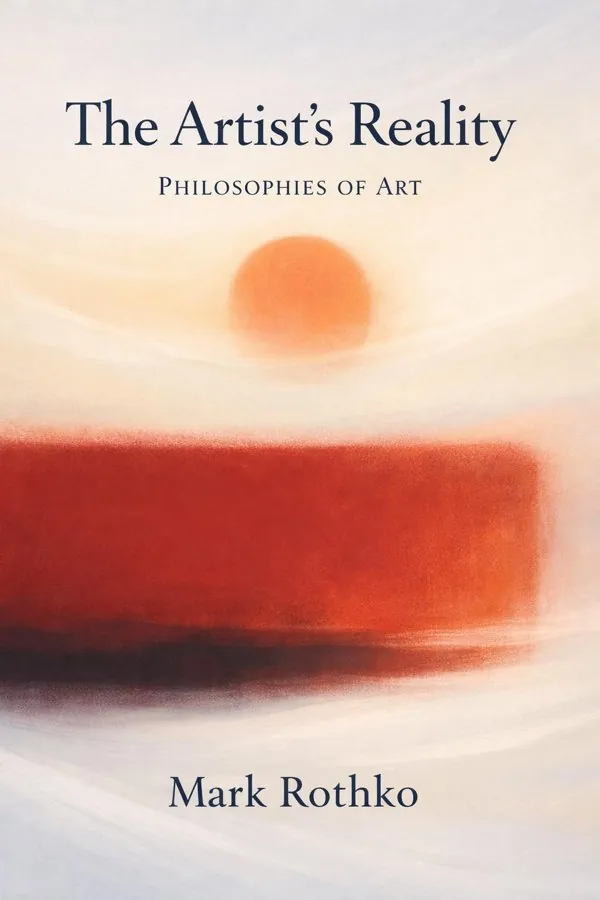
The Artist’s Reality: Philosophies of Art: Summary & Key Insights
by Mark Rothko
 10 min9 chaptersAudio available
Key Takeaways from The Artist’s Reality: Philosophies of Art
The most important mistake people make about art, Rothko suggests, is assuming that its purpose is simply to copy the visible world.
Rothko sees the artist not as an entertainer or decorator, but as a mediator between visible life and invisible meaning.
One of Rothko’s most challenging claims is that beauty cannot be reduced to prettiness, harmony, or decorative pleasure.
Rothko believed myth is not an outdated set of stories but one of art’s most powerful tools for expressing permanent human realities.
People often assume that the importance of an artwork lies in its subject matter: what scene it shows, what event it references, or what objects it contains.
What Is The Artist’s Reality: Philosophies of Art About?
The Artist’s Reality: Philosophies of Art by Mark Rothko is a art book spanning 9 pages. The Artist’s Reality: Philosophies of Art opens a rare window into the mind of Mark Rothko before he became famous for the luminous color-field paintings that transformed modern art. Drawn from unpublished writings composed largely in the 1940s and released after his death, the book gathers his reflections on what art is, why it matters, and what responsibility the artist bears in a fractured modern world. Rather than offering a technical manual or academic theory, Rothko builds a passionate philosophy of art rooted in human feeling, myth, beauty, and spiritual necessity. What makes this book so compelling is that it reveals Rothko not only as a painter but as a serious thinker. He argues that art is not decoration, imitation, or style for its own sake. It is a profound attempt to give form to inner experience and to reconnect people with truths modern life often suppresses. His ideas remain strikingly relevant in an age saturated with images but hungry for meaning. For artists, students, and anyone interested in creativity, this book offers a powerful reminder that great art begins where surface appearance ends.
This FizzRead summary covers all 9 key chapters of The Artist’s Reality: Philosophies of Art in approximately 10 minutes, distilling the most important ideas, arguments, and takeaways from Mark Rothko's work. Also available as an audio summary and Key Quotes Podcast.
The Artist’s Reality: Philosophies of Art
The Artist’s Reality: Philosophies of Art opens a rare window into the mind of Mark Rothko before he became famous for the luminous color-field paintings that transformed modern art. Drawn from unpublished writings composed largely in the 1940s and released after his death, the book gathers his reflections on what art is, why it matters, and what responsibility the artist bears in a fractured modern world. Rather than offering a technical manual or academic theory, Rothko builds a passionate philosophy of art rooted in human feeling, myth, beauty, and spiritual necessity.
What makes this book so compelling is that it reveals Rothko not only as a painter but as a serious thinker. He argues that art is not decoration, imitation, or style for its own sake. It is a profound attempt to give form to inner experience and to reconnect people with truths modern life often suppresses. His ideas remain strikingly relevant in an age saturated with images but hungry for meaning. For artists, students, and anyone interested in creativity, this book offers a powerful reminder that great art begins where surface appearance ends.
Who Should Read The Artist’s Reality: Philosophies of Art?
This book is perfect for anyone interested in art and looking to gain actionable insights in a short read. Whether you're a student, professional, or lifelong learner, the key ideas from The Artist’s Reality: Philosophies of Art by Mark Rothko will help you think differently.
- ✓Readers who enjoy art and want practical takeaways
- ✓Professionals looking to apply new ideas to their work and life
- ✓Anyone who wants the core insights of The Artist’s Reality: Philosophies of Art in just 10 minutes
Want the full summary?
Get instant access to this book summary and 100K+ more with Fizz Moment.
Get Free SummaryAvailable on App Store • Free to download
Key Chapters
The most important mistake people make about art, Rothko suggests, is assuming that its purpose is simply to copy the visible world. A painting may contain recognizable objects, technical skill, or pleasing composition, but these alone do not make it art in the deepest sense. For Rothko, true art begins when the artist is driven by an inner necessity to express something fundamental about human existence. Representation and craftsmanship are only outer vehicles; the real substance lies in what the work reveals emotionally, spiritually, and psychologically.
This idea helps explain why art cannot be judged only by realism or polish. A perfectly rendered image may feel empty, while a simplified or abstract work can feel overwhelming because it carries genuine inner urgency. Rothko is asking us to move from asking, “What does it depict?” to “What experience does it embody?” That shift transforms how we look at paintings, music, literature, and even design. In practice, this means an artist should not start by wondering what style is fashionable, but by asking what truth must be brought into form.
A practical example can be found in creative work of all kinds. A photographer can produce technically flawless images that say nothing, while another captures a raw scene that communicates loneliness, dignity, or awe. A writer may describe events accurately yet fail to create meaning; another may bend realism to uncover emotional truth. The difference is not simply skill but necessity.
Actionable takeaway: when making or evaluating art, look past accuracy and technique and ask what inner reality the work is trying to make visible.
Rothko sees the artist not as an entertainer or decorator, but as a mediator between visible life and invisible meaning. This does not mean the artist is morally superior or mystical in a grandiose sense. It means the artist performs a difficult human task: translating deep, often inexpressible experience into forms others can encounter. The artist gives shape to anxiety, ecstasy, tragedy, wonder, and transcendence before such states harden into ordinary language.
This view gives artistic work both dignity and burden. If the artist is merely producing commodities, then the job is technical. But if the artist is revealing hidden dimensions of existence, then the task requires honesty, seriousness, and courage. Rothko believed that art must speak to the essential dramas of being alive. The artist’s role is to remain sensitive to those dramas even when society becomes distracted by utility, speed, and spectacle.
This idea has practical implications beyond painting. A filmmaker, teacher, songwriter, architect, or designer can also act as a mediator by creating experiences that help people perceive more than they noticed before. Consider a memorial designed not simply to inform but to evoke loss and reflection. Or a novel that helps readers recognize unspoken grief in their own lives. In each case, the creator becomes a conduit between private feeling and shared understanding.
Rothko’s argument also implies that artists must protect their integrity. When creators work only to satisfy trends, branding demands, or external approval, mediation becomes distortion. The work may still attract attention, but it loses depth.
Actionable takeaway: treat creative work as an act of translation from inner life to shared experience, and protect the seriousness of that task from distraction and compromise.
One of Rothko’s most challenging claims is that beauty cannot be reduced to prettiness, harmony, or decorative pleasure. Conventional aesthetics often treats beauty as what is agreeable to the senses. Rothko pushes further. Beauty in art emerges when a work achieves necessity, intensity, and truth. It may contain serenity, but it may also involve terror, solemnity, ambiguity, or grief. A beautiful work is not one that comforts us superficially; it is one that brings us into contact with something essential.
This idea matters because it rescues art from becoming mere ornament. If beauty is only about pleasing surfaces, then difficult art appears defective. But if beauty includes emotional and spiritual depth, then a tragic painting, dissonant piece of music, or austere sculpture may be beautiful precisely because it reveals reality with power. Rothko’s own mature paintings illustrate this. Their beauty is not illustrative or decorative. It arises from proportion, luminosity, tension, and silence working together to generate feeling.
In everyday life, we often encounter the difference between prettiness and true beauty. A carefully staged room may look attractive but feel lifeless, while a simple space filled with light and stillness feels profound. Likewise, a polished advertisement may be visually pleasing but emotionally empty, whereas a modest artwork can stop us because it carries presence.
For creators, this means beauty should not be pursued as a cosmetic effect. It should emerge from integrity of form and depth of purpose. For viewers, it means learning to stay with difficult works long enough for their beauty to disclose itself.
Actionable takeaway: when something in art feels unsettling yet deeply alive, resist dismissing it; ask whether you are encountering a richer form of beauty than mere pleasantness.
Rothko believed myth is not an outdated set of stories but one of art’s most powerful tools for expressing permanent human realities. Myths endure because they dramatize recurring experiences: creation and destruction, sacrifice and renewal, fate and freedom, loneliness and communion. For Rothko, the artist turns to myth not to escape the present but to reach dimensions of experience that ordinary modern language often fails to hold.
This explains why ancient symbols and archetypes continue to resonate even in secular societies. Myth does not require literal belief to be meaningful. Its value lies in its structure of feeling. When artists use mythic forms, they connect individual experience with collective human memory. A personal loss becomes part of a larger tragic pattern. A private crisis becomes recognizable as a descent, trial, or transformation. Art gains breadth when it taps these patterns.
Rothko developed this view partly in reaction to a modern world he saw as fragmented and spiritually diminished. Myth offered a way to restore seriousness and communal significance to art. Even abstract art, in his view, could preserve mythic force if it evoked the emotional weight of ritual, mystery, and transcendence.
Today, we can see this principle across media. Films that borrow from mythic journeys often resonate globally. Novels use archetypal figures to make intimate stories feel universal. Visual artists may not depict gods or heroes directly, yet still create ritualized spaces of encounter through scale, repetition, and symbolic tension.
Actionable takeaway: whether creating or interpreting art, look for the larger human pattern beneath the personal story; that mythic layer is often what gives a work lasting power.
People often assume that the importance of an artwork lies in its subject matter: what scene it shows, what event it references, or what objects it contains. Rothko challenges this assumption. Subject matter matters, but only as a starting point. The deeper issue is what the artist does with that material. A painting of a person, landscape, or myth is not significant because of the topic alone, but because of the emotional, symbolic, and formal life infused into it.
This view helps explain the transition from figurative to modern and abstract art. If the truth of art does not depend solely on recognizable subjects, then art remains meaningful even when images become simplified, distorted, or nonrepresentational. What matters is whether the work creates a compelling reality of experience. Subject matter is a vehicle, not the destination.
This can be applied widely. Two novels may both address war, but one merely reports events while the other reveals fear, absurdity, moral conflict, and endurance. Two paintings may both show a human figure, yet one is academic description and the other feels charged with mortal vulnerability. The difference lies in transformation, not topic.
Rothko is not arguing that content is irrelevant. Rather, he insists that artistic meaning arises from the relation between content and form. A weak work cannot be rescued by an important theme, and a strong work can elevate humble material into something unforgettable.
For creators, this is liberating. You do not need grand subject matter to make serious art. For audiences, it is clarifying. You can stop equating a work’s significance with the obviousness of its theme.
Actionable takeaway: judge art less by what it is about on the surface and more by how deeply it transforms its subject into lived emotional experience.
Rothko writes from a modern world marked by war, industrialization, mass culture, and spiritual dislocation. In such conditions, the artist faces a difficult challenge: how to create work of depth in a society that increasingly values speed, utility, novelty, and consumption. Serious art asks for contemplation, vulnerability, and inward attention, yet modern life often trains people away from those very capacities.
This tension makes the artist’s role both more difficult and more necessary. Rothko does not romanticize alienation, but he recognizes that a culture dominated by distraction can trivialize artistic purpose. Art gets reduced to entertainment, prestige, investment, or decoration. When that happens, its deepest function is forgotten: to restore contact with the fundamental conditions of being human.
The relevance of this idea has only grown. Social media rewards immediate impact over sustained encounter. Algorithms privilege familiarity or provocation. Cultural production can become trapped in cycles of branding and reaction. Rothko’s philosophy offers a counterpoint. He invites us to defend spaces where experience is not optimized for speed but opened for reflection.
This is not only a concern for painters. Musicians, writers, curators, educators, and audiences all participate in the conditions that either support or weaken serious art. A museum can encourage quick consumption or slow looking. A classroom can teach students to hunt for test answers or to dwell with ambiguity. A creator can chase visibility or build work with lasting inner pressure.
Actionable takeaway: create and seek out environments that slow perception and deepen attention, because serious art can survive only where people are willing to experience more than instant stimulation.
Rothko’s understanding of art gives an important place to the unconscious. He does not mean that artists should surrender reason entirely or celebrate randomness. Rather, he argues that many of the deepest sources of artistic power come from levels of feeling and thought that exist before clear articulation. The unconscious stores fears, desires, memories, symbols, and emotional tensions that can become the raw material of art.
This perspective aligns with his broader belief that art reveals realities hidden beneath everyday surfaces. Often, an artist senses the importance of an image, rhythm, or form before fully understanding it intellectually. A recurring shape in a painting, a line in a poem, or a musical phrase may carry more psychic truth than deliberate explanation could provide. The artist’s task is to remain receptive enough to discover these materials, then disciplined enough to give them coherent form.
In practical terms, this suggests that creativity is not purely a matter of planning. Free sketching, improvisation, journaling, dream notes, collage, and exploratory drafts can all help bring unconscious material into awareness. Many creators recognize the feeling of making something that seems to arrive from beyond deliberate intention, only later realizing what it expressed.
At the same time, Rothko would not support self-indulgence disguised as depth. The unconscious becomes artistically meaningful only when shaped. Raw expression is not yet art. Art requires the transformation of private material into a communicable experience.
Actionable takeaway: build practices that allow intuition and hidden feeling to emerge, then revise with rigor so that what begins privately can speak powerfully to others.
Rothko rejects the idea that artistic styles develop simply as a sequence of fashionable external changes. Styles are not meaningful because they are new; they matter when they arise from new necessities of feeling, perception, and thought. An artistic language evolves when older forms can no longer adequately express the reality an artist or a culture needs to confront.
This is a crucial way to understand modernism. Movements such as abstraction did not emerge merely to rebel against tradition for the sake of novelty. They emerged because many artists felt inherited methods had become insufficient for expressing the fractured, uncertain, and psychologically complex realities of modern life. Form changed because consciousness changed. To Rothko, style without necessity is empty mannerism; innovation grounded in inner need is genuine evolution.
This idea can help both creators and audiences navigate contemporary culture. We are often encouraged to equate originality with visible difference. But Rothko would ask a harder question: what experience demanded this form? A new style is justified only if it enables a deeper or truer articulation of reality.
In everyday creative practice, this means not forcing yourself into a recognizable brand too early. A writer may begin with strict realism and later move into fragmented narrative because memory itself is fragmented. A painter may reduce imagery over time because simplification reveals emotional structure more directly. Evolution then becomes an honest response, not a marketing strategy.
For viewers, it also means engaging unfamiliar styles with historical and psychological curiosity rather than instant resistance.
Actionable takeaway: let your creative form change only when your inner questions require it, and evaluate artistic innovation by the depth of need behind it rather than by novelty alone.
At the heart of the book is Rothko’s conviction that art does not merely reflect reality; it creates a new reality of its own. This is the meaning of the book’s title. A powerful artwork is not just a comment on life or a copy of appearances. It becomes an event, a presence, an environment of feeling and thought that the viewer enters. In that encounter, art is real in its own right.
This idea clarifies why formal elements matter so much. Scale, color, rhythm, space, proportion, and silence are not decorative additions to meaning; they generate the reality of the work. In a great painting, the arrangement of forms can create tension, repose, dread, exaltation, or intimacy as directly as narrative can. The artwork becomes a structure of experience rather than a statement about experience.
Rothko’s own paintings exemplify this principle. Their large fields of color do not describe external scenes, yet they create enveloping states of encounter. Viewers do not simply look at them as illustrations; they stand before them and feel addressed by them. That is the artist’s reality: a realm made through form that is capable of affecting consciousness.
This has practical relevance far beyond fine art. A building can create civic dignity or alienation. A piece of music can establish a world of tension and release. A digital interface can shape whether an interaction feels humane or mechanical. Wherever form conditions experience, a reality is being made.
Actionable takeaway: approach every artwork by asking not what it represents first, but what kind of reality it creates for the person who enters it.
All Chapters in The Artist’s Reality: Philosophies of Art
About the Author
Mark Rothko (1903–1970) was a Latvian-born American painter and one of the central figures of modern art. After emigrating to the United States as a child, he developed a career that moved from figurative and myth-inspired imagery toward the luminous, large-scale color fields for which he became famous. Although often associated with Abstract Expressionism, Rothko resisted simple labels and saw his work as an attempt to express fundamental human emotions such as tragedy, ecstasy, doom, and transcendence. He believed painting could create a direct, almost spiritual encounter between artwork and viewer. Beyond his visual achievements, Rothko was a deeply thoughtful writer on aesthetics, culture, and artistic responsibility. The Artist’s Reality reveals the philosophical foundations behind his art and confirms his stature not only as a painter, but also as a major thinker about art.
Get This Summary in Your Preferred Format
Read or listen to the The Artist’s Reality: Philosophies of Art summary by Mark Rothko anytime, anywhere. FizzRead offers multiple formats so you can learn on your terms — all free.
Available formats: App · Audio · PDF · EPUB — All included free with FizzRead
Download The Artist’s Reality: Philosophies of Art PDF and EPUB Summary
Key Quotes from The Artist’s Reality: Philosophies of Art
“The most important mistake people make about art, Rothko suggests, is assuming that its purpose is simply to copy the visible world.”
“Rothko sees the artist not as an entertainer or decorator, but as a mediator between visible life and invisible meaning.”
“One of Rothko’s most challenging claims is that beauty cannot be reduced to prettiness, harmony, or decorative pleasure.”
“Rothko believed myth is not an outdated set of stories but one of art’s most powerful tools for expressing permanent human realities.”
“People often assume that the importance of an artwork lies in its subject matter: what scene it shows, what event it references, or what objects it contains.”
Frequently Asked Questions about The Artist’s Reality: Philosophies of Art
The Artist’s Reality: Philosophies of Art by Mark Rothko is a art book that explores key ideas across 9 chapters. The Artist’s Reality: Philosophies of Art opens a rare window into the mind of Mark Rothko before he became famous for the luminous color-field paintings that transformed modern art. Drawn from unpublished writings composed largely in the 1940s and released after his death, the book gathers his reflections on what art is, why it matters, and what responsibility the artist bears in a fractured modern world. Rather than offering a technical manual or academic theory, Rothko builds a passionate philosophy of art rooted in human feeling, myth, beauty, and spiritual necessity. What makes this book so compelling is that it reveals Rothko not only as a painter but as a serious thinker. He argues that art is not decoration, imitation, or style for its own sake. It is a profound attempt to give form to inner experience and to reconnect people with truths modern life often suppresses. His ideas remain strikingly relevant in an age saturated with images but hungry for meaning. For artists, students, and anyone interested in creativity, this book offers a powerful reminder that great art begins where surface appearance ends.
You Might Also Like
Browse by Category
Ready to read The Artist’s Reality: Philosophies of Art?
Get the full summary and 100K+ more books with Fizz Moment.