
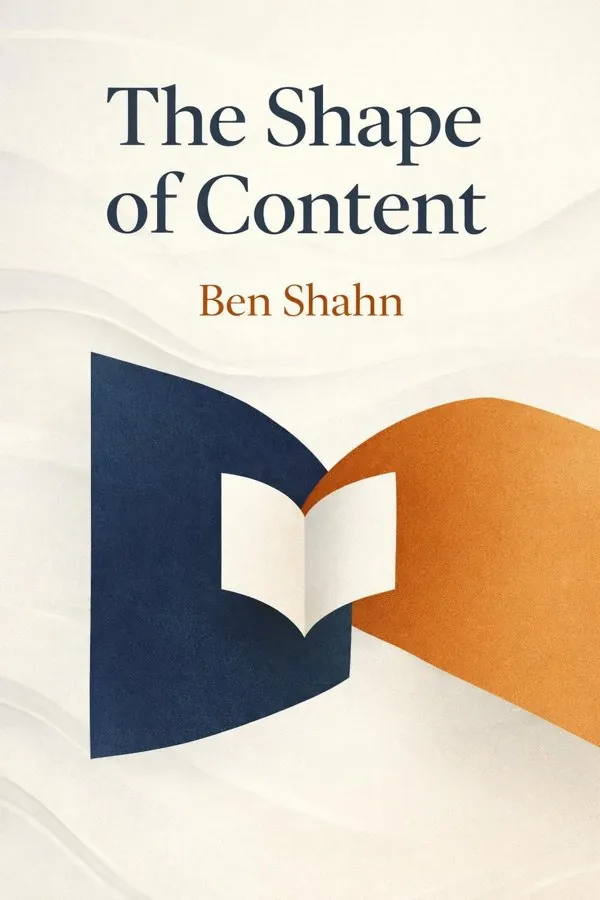
The Shape of Content: Summary & Key Insights
by Ben Shahn
 10 min8 chaptersAudio available
What Is The Shape of Content About?
The Shape of Content by Ben Shahn is a art book spanning 8 pages. A collection of essays by artist Ben Shahn exploring the relationship between art, form, and meaning. Originally delivered as the Charles Eliot Norton Lectures at Harvard University in 1956–1957, the book reflects on the artist’s role in society, the creative process, and the moral responsibilities of art. Shahn argues for authenticity and humanism in artistic expression, emphasizing that form must serve content rather than dominate it.
This FizzRead summary covers all 8 key chapters of The Shape of Content in approximately 10 minutes, distilling the most important ideas, arguments, and takeaways from Ben Shahn's work. Also available as an audio summary and Key Quotes Podcast.
The Shape of Content
A collection of essays by artist Ben Shahn exploring the relationship between art, form, and meaning. Originally delivered as the Charles Eliot Norton Lectures at Harvard University in 1956–1957, the book reflects on the artist’s role in society, the creative process, and the moral responsibilities of art. Shahn argues for authenticity and humanism in artistic expression, emphasizing that form must serve content rather than dominate it.
Who Should Read The Shape of Content?
This book is perfect for anyone interested in art and looking to gain actionable insights in a short read. Whether you're a student, professional, or lifelong learner, the key ideas from The Shape of Content by Ben Shahn will help you think differently.
- ✓Readers who enjoy art and want practical takeaways
- ✓Professionals looking to apply new ideas to their work and life
- ✓Anyone who wants the core insights of The Shape of Content in just 10 minutes
Want the full summary?
Get instant access to this book summary and 100K+ more with Fizz Moment.
Get Free SummaryAvailable on App Store • Free to download
Key Chapters
The artist is often misconceived as a decorator of experience, a technician who beautifies the world through skillful manipulation of form. I see him differently. The artist’s role is essentially communicative. He translates the depth of human consciousness into images that others may recognize as their own. Every act of creating is a dialogue—a reaching out from one human being to another through the medium of form.
The true artist does not create merely to impress, but to reveal. He seeks clarity, not cleverness. Words like originality and novelty can sometimes obscure the larger truth: that art arises from the need to say something that matters. When the painter, the sculptor, the designer, the writer ceases to ask, ‘What do I mean by this?’ and begins instead to ask, ‘Will they think it’s modern enough?’ he loses his true path. For what gives art its endurance is not its conformity to the fashions of its time, but its fidelity to human feeling.
During my own life as an artist, I have seen how social concern, moral reflection, and personal emotion intertwine in creative work. The artist who is aware of his world—who feels its inequities and its hopes—is the one whose art has force. Art can awaken conscience and enlarge sympathy; it can show us our own face, or make visible what is hidden. To be an artist is to take responsibility for one’s vision, to remember that creative freedom means also creative obligation—to truth, to understanding, to human dignity.
The relationship between form and content is at the very heart of art. There is a dangerous tendency in modern aesthetics to treat form as an autonomous entity, to sever it from meaning. We hear of paintings praised for their purity of abstraction, of works admired for their structure alone. But to me, form must be the living vessel of content, not a detached system of lines or surfaces.
Content is the impulse—the emotion, the idea, the experience—that demands expression. Form is the means through which that demand takes shape. The two are inseparable. To focus on form alone is to mistake the container for the essence. Yet to ignore form is equally fatal, for without form, content remains mute. The deepest art finds a natural equilibrium between these two forces, an organic unity in which form grows from content as fruit from seed.
When I paint, I do not begin with a compositional diagram. I begin with a feeling, an image charged with human significance. The form follows, as inevitably as the words of a poem follow its rhythm. To impose form from without is to falsify the experience. Art that is formalistic without being sincere may glitter on the surface but lacks substance underneath. The purpose is not to reject form—it is to make form serve meaning. When content is genuine, it summons its own proper form.
+ 6 more chapters — available in the FizzRead app
All Chapters in The Shape of Content
About the Author
Ben Shahn (1898–1969) was a Lithuanian-born American artist known for his social realism and political engagement. His work spanned painting, photography, and graphic design, often addressing themes of justice, labor, and human dignity. Shahn also wrote and lectured extensively on art and its social purpose.
Get This Summary in Your Preferred Format
Read or listen to the The Shape of Content summary by Ben Shahn anytime, anywhere. FizzRead offers multiple formats so you can learn on your terms — all free.
Available formats: App · Audio · PDF · EPUB — All included free with FizzRead
Download The Shape of Content PDF and EPUB Summary
Key Quotes from The Shape of Content
“The artist is often misconceived as a decorator of experience, a technician who beautifies the world through skillful manipulation of form.”
“The relationship between form and content is at the very heart of art.”
Frequently Asked Questions about The Shape of Content
The Shape of Content by Ben Shahn is a art book that explores key ideas across 8 chapters. A collection of essays by artist Ben Shahn exploring the relationship between art, form, and meaning. Originally delivered as the Charles Eliot Norton Lectures at Harvard University in 1956–1957, the book reflects on the artist’s role in society, the creative process, and the moral responsibilities of art. Shahn argues for authenticity and humanism in artistic expression, emphasizing that form must serve content rather than dominate it.
You Might Also Like
Alla Prima: Everything I Know About Painting
Richard Schmid
10 min
The Art Spirit
Robert Henri
10 min
The Artist’s Reality: Philosophies of Art
Mark Rothko
10 min
The Complete Guide to Anatomy for Artists & Illustrators
Gottfried Bammes
10 min
The Value of Art
Michael Findlay
10 min
Together
Luke Adam Hawker
10 minBrowse by Category
Ready to read The Shape of Content?
Get the full summary and 100K+ more books with Fizz Moment.