
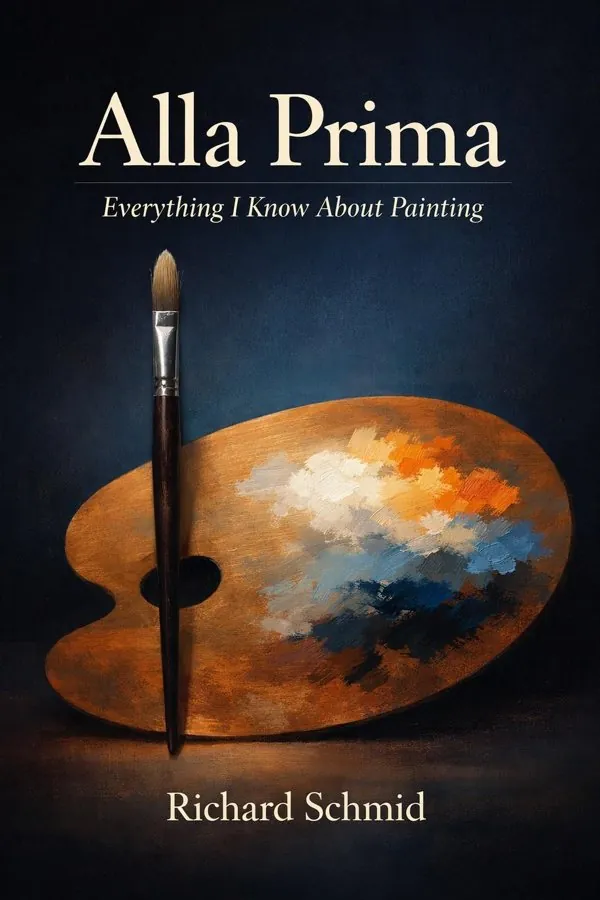
Alla Prima: Everything I Know About Painting: Summary & Key Insights
 10 min9 chaptersAudio available
Key Takeaways from Alla Prima: Everything I Know About Painting
Great painting begins before the brush touches the canvas: it begins when the artist stops naming things and starts observing relationships.
Materials do not make the painter, but they can either support clarity or create unnecessary struggle.
Color feels mysterious until you realize that most color problems are really relationship problems.
If color is seductive, value is structural.
A painting is not just a record of what was seen; it is an arrangement of what matters.
What Is Alla Prima: Everything I Know About Painting About?
Alla Prima: Everything I Know About Painting by Richard Schmid is a art book spanning 12 pages. Richard Schmid’s Alla Prima: Everything I Know About Painting is far more than a technical manual on wet-into-wet painting. It is a master class in how to see, judge, simplify, and translate life into paint with honesty and conviction. Built around the alla prima approach—completing a painting directly, often in one session—the book covers materials, color, value, edges, drawing, composition, and the mental discipline required to paint from observation. But its real strength lies in Schmid’s ability to connect craft with perception. He does not treat painting as a collection of tricks. He treats it as a lifelong practice of learning how light shapes form, how relationships create harmony, and how decisions reveal artistic maturity. That perspective matters because Schmid wrote from decades of professional experience as one of America’s most respected realist painters and teachers. Whether you paint portraits, still life, landscapes, or interiors, this book offers practical instruction anchored in deep visual intelligence. It remains essential reading for artists who want not only better technique, but a clearer understanding of what it actually means to paint well.
This FizzRead summary covers all 9 key chapters of Alla Prima: Everything I Know About Painting in approximately 10 minutes, distilling the most important ideas, arguments, and takeaways from Richard Schmid's work. Also available as an audio summary and Key Quotes Podcast.
Alla Prima: Everything I Know About Painting
Richard Schmid’s Alla Prima: Everything I Know About Painting is far more than a technical manual on wet-into-wet painting. It is a master class in how to see, judge, simplify, and translate life into paint with honesty and conviction. Built around the alla prima approach—completing a painting directly, often in one session—the book covers materials, color, value, edges, drawing, composition, and the mental discipline required to paint from observation. But its real strength lies in Schmid’s ability to connect craft with perception. He does not treat painting as a collection of tricks. He treats it as a lifelong practice of learning how light shapes form, how relationships create harmony, and how decisions reveal artistic maturity. That perspective matters because Schmid wrote from decades of professional experience as one of America’s most respected realist painters and teachers. Whether you paint portraits, still life, landscapes, or interiors, this book offers practical instruction anchored in deep visual intelligence. It remains essential reading for artists who want not only better technique, but a clearer understanding of what it actually means to paint well.
Who Should Read Alla Prima: Everything I Know About Painting?
This book is perfect for anyone interested in art and looking to gain actionable insights in a short read. Whether you're a student, professional, or lifelong learner, the key ideas from Alla Prima: Everything I Know About Painting by Richard Schmid will help you think differently.
- ✓Readers who enjoy art and want practical takeaways
- ✓Professionals looking to apply new ideas to their work and life
- ✓Anyone who wants the core insights of Alla Prima: Everything I Know About Painting in just 10 minutes
Want the full summary?
Get instant access to this book summary and 100K+ more with Fizz Moment.
Get Free SummaryAvailable on App Store • Free to download
Key Chapters
Great painting begins before the brush touches the canvas: it begins when the artist stops naming things and starts observing relationships. One of Schmid’s central lessons is that painters often fail because they paint what they think an object is rather than what it actually looks like under a specific light. A face is not “an eye, a nose, and a mouth.” A vase is not “blue ceramic.” Everything is a set of interlocking shapes, values, temperatures, and edges influenced by the environment around it.
This shift in seeing is foundational to painting from life. Instead of outlining objects from memory, Schmid urges artists to compare one area to another. Is this shadow warmer or cooler than the one beside it? Is the cheek darker than the forehead? Does the tabletop recede because of perspective, value shift, or edge softness? Observation becomes a disciplined act of comparison. That is what allows a painter to capture volume, light, and atmosphere convincingly.
In practice, this means slowing down and training your eye before committing paint. A still life setup, for example, should be studied as a whole pattern rather than as separate items. The cast shadow, background, and reflective surfaces all influence each other. If you paint the apple as “red” without noticing the cool skylight on top and the warm bounce light below, it will look symbolic rather than alive.
Schmid’s broader point is that realism is not copying details. It is perceiving truthfully. The artist who learns to see relationships paints with more unity and less stiffness. Actionable takeaway: before every painting session, spend five quiet minutes identifying value, color, and edge relationships across the entire subject instead of naming individual objects.
Materials do not make the painter, but they can either support clarity or create unnecessary struggle. Schmid treats brushes, paints, mediums, and surfaces as a practical language. Every choice affects handling, speed, texture, and control, especially in alla prima, where decisions happen quickly and layers remain wet.
He emphasizes that artists should understand what each tool does rather than accumulate supplies blindly. A bristle brush can lay in broad, decisive masses and create broken texture; a softer brush can blend gently and place more delicate passages. A rigid painting knife can scrape, sharpen, or restate large shapes cleanly. Surface choice matters too: a slick panel invites one kind of stroke, while a more absorbent canvas changes drag and edge quality. Even the organization of the palette influences thinking. If colors are arranged consistently, mixing becomes faster and judgment becomes more intuitive.
Schmid also encourages economy. Too many tools can distract from seeing. The aim is not to own everything but to build a dependable working setup. For instance, a limited but versatile palette can produce greater harmony than an overcrowded one. A few well-understood brushes often outperform a jar full of random shapes. Likewise, clean tools and thoughtful studio habits reduce accidental mud, confusion, and hesitation.
The deeper lesson is that craftsmanship supports freedom. Painters become expressive not by ignoring materials, but by knowing them so well that they stop getting in the way. Actionable takeaway: simplify your kit to a core set of brushes, a manageable palette, and one preferred surface, then practice with that setup consistently until your handling becomes second nature.
Color feels mysterious until you realize that most color problems are really relationship problems. Schmid teaches that painters should not chase local color in isolation. Instead, they must judge hue, value, and temperature in context. A gray can appear luminous beside a darker note. A muted green can feel brilliant if everything around it is quieter. Harmony emerges when colors belong to the same visual world.
This is why Schmid places so much importance on palette discipline and comparative mixing. When painting from life, the artist should ask not “What color is this object?” but “How does this note differ from the one next to it?” A white cloth in warm indoor light may need violet-gray shadows, yellow highlights, and reflected cool notes from nearby objects. None of those colors would make sense if selected from memory, but they become obvious when seen relationally.
He also warns against overstatement. Beginners often intensify every color because they want the painting to look vivid. Ironically, this destroys vibrancy. If every passage is saturated, nothing sings. Controlled neutrals are what make strong color believable. In a portrait, for example, a restrained range of flesh notes allows a small accent in the lips or cheek to carry real power. In a landscape, a distant hill gains atmosphere through reduced contrast and muted temperature shifts.
Schmid’s approach to color is both practical and poetic: mix what the painting needs, not what the tube promises. Color should express light, not advertise pigment. Actionable takeaway: when mixing any color, compare it directly to at least two neighboring passages and adjust for value and temperature before judging the hue as finished.
If color is seductive, value is structural. Schmid repeatedly returns to the idea that convincing form depends first on correct value relationships. A painting can survive imperfect color if the values are sound, but it rarely succeeds when lights and darks are confused. Value organizes light, reveals turning form, and creates depth long before small details matter.
For Schmid, this means squinting often and simplifying relentlessly. Squinting reduces distractions and helps the painter see major masses of light and shadow. Instead of chasing eyelashes, lace, or leaf patterns too early, the artist should establish the big statement: where the light family ends, where the shadow family begins, and how strong the contrast really is. Once those large value relationships are stable, details can be added without destroying unity.
This principle is easy to apply across genres. In portraiture, the planes of the head become believable when the forehead, cheek, jaw, and neck are organized by light, not line. In landscape, spatial recession depends heavily on value compression in the distance. In still life, a reflective object like silver only looks metallic when the value pattern is carefully observed, not when highlights are exaggerated randomly.
Schmid is especially good at reminding painters that detail does not create realism by itself. Form emerges from value transitions, edge changes, and strategic accents. The eye reads a coherent whole before it reads specifics. Actionable takeaway: begin each painting with a simple value map of no more than three or four major groupings, and do not move to refinement until those masses clearly describe the subject’s light and structure.
A painting is not just a record of what was seen; it is an arrangement of what matters. Schmid treats composition as the art of directing attention through shape, rhythm, contrast, placement, and omission. This is crucial because nature offers abundance, not design. The artist must edit reality into a coherent statement.
He encourages painters to think beyond centered subjects and accidental cropping. Strong design begins with identifying the motive: what drew you to the scene in the first place? Was it the angle of light across a figure, the quiet geometry of bottles on a table, the sweep of a distant field, or the mood of an interior? Once that motive is clear, every compositional decision should reinforce it. Background shapes, negative spaces, intervals, and edge control all become part of a visual hierarchy.
Schmid also values balance without symmetry. A composition needs movement and stability at once. A dominant shape may be offset by smaller echoes. A bright focal area may require quieter passages elsewhere. Repetition can create rhythm, but too much regularity becomes dull. For example, in a floral still life, stems, petals, vase, and surrounding space should not compete equally. The painter can subordinate some forms, soften some edges, and simplify some colors so the main idea stands out.
Importantly, composition is not a decorative afterthought added later. It starts with setup, viewpoint, and cropping, and it continues through every brushstroke. Actionable takeaway: before painting, define your main visual motive in one sentence and remove or subordinate any element that does not strengthen that central idea.
Beginners often think accuracy lives in outline, but Schmid shows that life in painting often lives at the edge. Hard, soft, lost, and found edges tell the viewer where to look, how forms turn, and how the atmosphere behaves. If every contour is equally sharp, the painting becomes mechanical. If all edges are blurred, it becomes vague. Good edge control creates both clarity and mystery.
Edges are shaped by many factors: the turning of form, the intensity of light, the surrounding values, the focus of the eye, and the painter’s intention. A cheek may dissolve gently into shadow while the eyelid remains more decisive. A distant tree line may soften into the sky, while a foreground branch cuts sharply across a lighter passage. In still life, a glass edge may disappear where values merge and reappear where reflections create contrast. These variations make a painting feel observed rather than diagrammed.
Schmid’s handling of edges also relates to timing in alla prima. Because paint remains wet, the artist can merge transitions beautifully or restate them decisively with a loaded stroke. This requires restraint. Not every edge should be fixed. Some of the most convincing passages are those that allow the eye to complete what the brush only suggests.
The larger lesson is expressive control. Edges are one of the painter’s strongest tools for creating emphasis and atmosphere without adding more detail. Actionable takeaway: in your next painting, deliberately categorize edges into focal, supporting, and background areas, then vary sharpness so only your most important passage receives the strongest definition.
Even in a painterly, direct approach, drawing remains essential. Schmid does not separate painting from drawing; he sees them as interdependent. Good drawing is not merely contour accuracy. It includes proportion, gesture, structure, perspective, and the ability to understand how forms occupy space. Without that underlying order, brushwork may look lively up close but collapse as a whole.
He encourages artists to draw with the brush as well as with pencil or charcoal. In alla prima, placement matters immediately. The angle of a shoulder, the tilt of a vase, the width of a jaw, the alignment of eyes, the perspective of a tabletop—these must be judged clearly from the beginning. But Schmid also warns against over-reliance on linear thinking. Drawn structure should support mass and light, not trap the painting in outlines.
This is especially important when painting complex subjects. In portraiture, knowledge of skull structure and facial planes prevents likeness from drifting. In flowers, understanding growth patterns prevents petals from becoming decorative confusion. In landscape, perspective and landform structure keep space believable even when brushwork is loose. The artist who understands the underlying architecture can simplify boldly without losing truth.
Schmid’s view is practical: drawing gives freedom. When you know where forms sit and how they turn, you can paint more economically, adjust more confidently, and avoid endless correction. Actionable takeaway: strengthen each painting session by beginning with a brief structural block-in focused on proportion, angle, and major perspective before you start refining color and surface effects.
No rule can paint the picture for you. One of Schmid’s most valuable contributions is his insistence that artistic judgment outranks recipe-based instruction. Technical principles matter, but painting is ultimately a chain of decisions made in response to a specific subject under specific conditions. The mature artist learns when to simplify, when to restate, when to stop, and when to sacrifice accuracy for unity.
Schmid teaches principles without turning them into rigid laws. Yes, values should be organized, edges should vary, and color should relate harmoniously. But the exact solution depends on intent. A portrait may need stronger drawing and restraint in color; a flower study may benefit from bolder chroma and selective softness; a moody landscape may call for compressed contrast and atmospheric simplification. Good painting is not mechanical compliance with rules but intelligent adaptation.
This is why experience matters so much in his teaching. Over time, artists develop taste: the ability to sense when a passage is overworked, when a note is too loud, or when a composition needs more breathing room. That kind of judgment cannot be memorized from charts alone. It is built through observation, mistakes, critique, and repetition.
Schmid’s philosophy is liberating because it moves artists away from anxiety about doing everything “right” and toward responsibility for making meaningful choices. Actionable takeaway: after each painting session, identify three major decisions you made well and one you would change, so you train your judgment rather than merely assess the finished result.
The deepest message in Alla Prima is that painting is not a one-time skill to be mastered, but a lifelong discipline of attention, humility, and growth. Schmid writes as a master, yet his tone consistently suggests that the artist’s job is to keep learning from nature. Every subject presents fresh problems. Every painting reveals blind spots. Progress comes not from ego, but from sustained curiosity.
He places great importance on mindset. Frustration, self-consciousness, and the desire to impress can all interfere with honest work. So can rushing toward finish before understanding the subject. Schmid instead advocates seriousness without rigidity. Practice should be disciplined, but also alive. Painters should study from life regularly, critique themselves truthfully, and remain open to adjustment. The goal is not perfection on every canvas; it is increasing sensitivity and command over time.
This perspective helps artists endure the uneven nature of creative development. Some paintings fail. Some sessions feel clumsy. Yet these are not signs to stop; they are part of the learning process. A failed landscape may teach more about atmosphere than a comfortable success. A difficult portrait may expose weaknesses in drawing that lead to major growth later. Schmid makes clear that critique, repetition, and patience are not separate from artistry; they are its foundation.
Ultimately, he presents painting as both craft and character formation. To paint well, you must learn to look honestly, decide clearly, and continue working. Actionable takeaway: build a regular practice that includes painting from life, reviewing your own work critically, and revisiting recurring weaknesses as deliberate study topics.
All Chapters in Alla Prima: Everything I Know About Painting
About the Author
Richard Schmid (1934–2021) was an American realist painter, teacher, and writer celebrated for his mastery of direct painting and his extraordinary sensitivity to light, color, and atmosphere. Trained by William Mosby, who carried forward principles rooted in classical European instruction, Schmid developed a style that combined technical rigor with painterly freedom. His work included portraits, figures, landscapes, interiors, and still lifes, and he became especially admired for his alla prima approach. Beyond his own paintings, Schmid had a profound influence as an educator through workshops, demonstrations, and his writing. Alla Prima: Everything I Know About Painting became one of the most respected books in contemporary representational art, valued for both its practical instruction and its deeper wisdom about seeing, judgment, and lifelong artistic growth.
Get This Summary in Your Preferred Format
Read or listen to the Alla Prima: Everything I Know About Painting summary by Richard Schmid anytime, anywhere. FizzRead offers multiple formats so you can learn on your terms — all free.
Available formats: App · Audio · PDF · EPUB — All included free with FizzRead
Download Alla Prima: Everything I Know About Painting PDF and EPUB Summary
Key Quotes from Alla Prima: Everything I Know About Painting
“Great painting begins before the brush touches the canvas: it begins when the artist stops naming things and starts observing relationships.”
“Materials do not make the painter, but they can either support clarity or create unnecessary struggle.”
“Color feels mysterious until you realize that most color problems are really relationship problems.”
“If color is seductive, value is structural.”
“A painting is not just a record of what was seen; it is an arrangement of what matters.”
Frequently Asked Questions about Alla Prima: Everything I Know About Painting
Alla Prima: Everything I Know About Painting by Richard Schmid is a art book that explores key ideas across 9 chapters. Richard Schmid’s Alla Prima: Everything I Know About Painting is far more than a technical manual on wet-into-wet painting. It is a master class in how to see, judge, simplify, and translate life into paint with honesty and conviction. Built around the alla prima approach—completing a painting directly, often in one session—the book covers materials, color, value, edges, drawing, composition, and the mental discipline required to paint from observation. But its real strength lies in Schmid’s ability to connect craft with perception. He does not treat painting as a collection of tricks. He treats it as a lifelong practice of learning how light shapes form, how relationships create harmony, and how decisions reveal artistic maturity. That perspective matters because Schmid wrote from decades of professional experience as one of America’s most respected realist painters and teachers. Whether you paint portraits, still life, landscapes, or interiors, this book offers practical instruction anchored in deep visual intelligence. It remains essential reading for artists who want not only better technique, but a clearer understanding of what it actually means to paint well.
You Might Also Like



Featured In
Browse by Category
Ready to read Alla Prima: Everything I Know About Painting?
Get the full summary and 100K+ more books with Fizz Moment.