
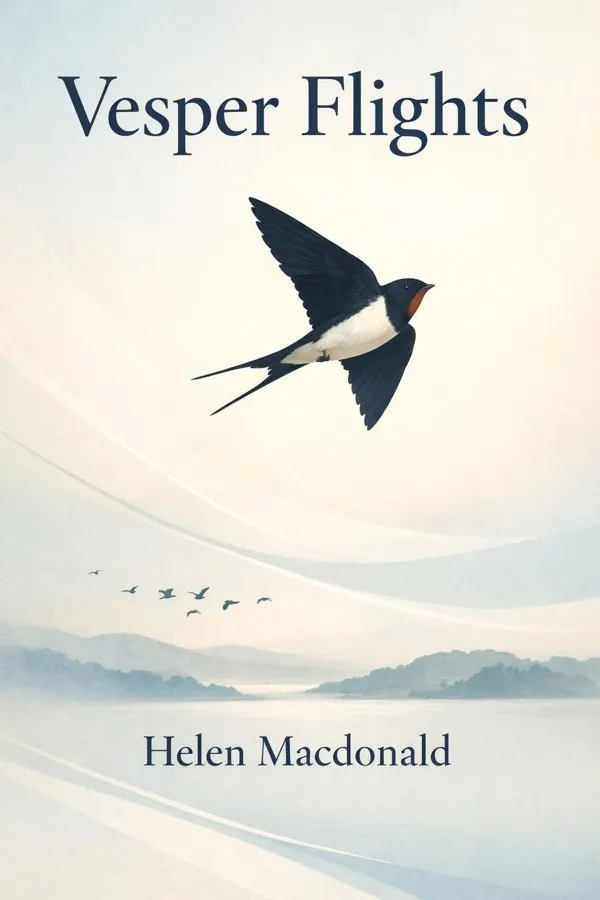
Vesper Flights: Summary & Key Insights
 10 min10 chaptersAudio available
Key Takeaways from Vesper Flights
Migration is one of nature’s clearest proofs that borders are human inventions.
We often call captivity care when it is really a complicated mixture of love, fear, admiration, and possession.
The line between human life and nature is far less solid than modern culture often assumes.
In an age of distraction, careful observation can feel almost radical.
Cities are often treated as the opposite of nature, but Macdonald shows that urban spaces are ecological dramas in their own right.
What Is Vesper Flights About?
Vesper Flights by Helen Macdonald is a environment book spanning 11 pages. Vesper Flights is a luminous collection of essays in which Helen Macdonald examines how human lives are entangled with animals, landscapes, weather, memory, and loss. Moving from migratory birds and urban wildlife to captivity, extinction, and the emotional force of close observation, the book resists the idea that nature is something distant, decorative, or separate from everyday life. Instead, Macdonald shows that the natural world is all around us and within us, shaping the way we feel, think, grieve, and imagine freedom. What makes this book especially powerful is its ability to combine literary grace with scientific curiosity and moral seriousness. Macdonald writes as a naturalist, historian of science, and deeply attentive witness, someone equally at home with field observation, cultural history, and personal reflection. Best known for H Is for Hawk, she brings the same precision, intelligence, and emotional depth to these essays. Vesper Flights matters because it offers more than nature writing: it is a meditation on attention, responsibility, and wonder in an era of ecological crisis, reminding readers that to notice the living world is already a form of care.
This FizzRead summary covers all 10 key chapters of Vesper Flights in approximately 10 minutes, distilling the most important ideas, arguments, and takeaways from Helen Macdonald's work. Also available as an audio summary and Key Quotes Podcast.
Vesper Flights
Vesper Flights is a luminous collection of essays in which Helen Macdonald examines how human lives are entangled with animals, landscapes, weather, memory, and loss. Moving from migratory birds and urban wildlife to captivity, extinction, and the emotional force of close observation, the book resists the idea that nature is something distant, decorative, or separate from everyday life. Instead, Macdonald shows that the natural world is all around us and within us, shaping the way we feel, think, grieve, and imagine freedom. What makes this book especially powerful is its ability to combine literary grace with scientific curiosity and moral seriousness. Macdonald writes as a naturalist, historian of science, and deeply attentive witness, someone equally at home with field observation, cultural history, and personal reflection. Best known for H Is for Hawk, she brings the same precision, intelligence, and emotional depth to these essays. Vesper Flights matters because it offers more than nature writing: it is a meditation on attention, responsibility, and wonder in an era of ecological crisis, reminding readers that to notice the living world is already a form of care.
Who Should Read Vesper Flights?
This book is perfect for anyone interested in environment and looking to gain actionable insights in a short read. Whether you're a student, professional, or lifelong learner, the key ideas from Vesper Flights by Helen Macdonald will help you think differently.
- ✓Readers who enjoy environment and want practical takeaways
- ✓Professionals looking to apply new ideas to their work and life
- ✓Anyone who wants the core insights of Vesper Flights in just 10 minutes
Want the full summary?
Get instant access to this book summary and 100K+ more with Fizz Moment.
Get Free SummaryAvailable on App Store • Free to download
Key Chapters
Migration is one of nature’s clearest proofs that borders are human inventions. In Vesper Flights, Helen Macdonald treats the movement of birds not merely as a biological phenomenon but as a deeply moving image of connection, vulnerability, and endurance. Birds cross seas, weather systems, and continents guided by instincts that remain partly mysterious to us. Their journeys reveal a world stitched together by invisible routes of dependence: breeding grounds, resting sites, coastlines, wetlands, and skies shared across nations. Macdonald also draws a subtle parallel between avian migration and human displacement, travel, and searching. Without forcing a simple equivalence, she shows that movement often arises from need, danger, season, and hope.
What makes this idea powerful is that migration becomes both ecological fact and moral lesson. To protect migratory species, we cannot think locally alone. A bird safe in one country may perish in another where habitat has been lost. In practical terms, this teaches readers to think in systems rather than isolated scenes. A city park, a marsh, a flyway, and a climate pattern all belong to the same story. It also encourages empathy: the annual return of swifts, geese, or warblers can make us more alert to how fragile movement is for every living thing.
A useful application is to begin noticing the seasonal travelers in your own area. Learn which species pass through, when they arrive, and what habitats they depend on. Supporting wetland conservation, reducing glass strikes, and participating in local bird counts are small but meaningful ways to act. The takeaway is simple: when you honor migration, you learn to see the planet as an interdependent home rather than a collection of separate territories.
We often call captivity care when it is really a complicated mixture of love, fear, admiration, and possession. Macdonald returns to enclosed animals to explore a difficult truth: humans are drawn to the wild, yet we frequently want that wildness made manageable. Zoos, aviaries, cages, and domestic arrangements can emerge from genuine concern, conservation goals, or fascination, but they also reveal our discomfort with freedom that does not answer to us. Her essays resist easy judgment. Instead of declaring all captivity cruel or all conservation breeding noble, she asks readers to sit with the moral tension.
This is one of the book’s most important insights because it broadens the question beyond animals. Captivity becomes a way of thinking about how people relate to anything they value. We often try to preserve beauty by containing it. We seek closeness while diminishing autonomy. The result is an ethical challenge: can we appreciate living beings without needing to master them? Macdonald’s reflections invite readers to examine the emotional stories we tell ourselves about rescue, stewardship, and ownership.
In everyday life, this can apply to how we interact with pets, garden wildlife, and even curated experiences of nature. Do we create environments where other creatures can thrive on their own terms, or only where they are visible and convenient to us? Supporting sanctuaries with strong welfare standards, avoiding exploitative wildlife tourism, and learning about species-specific needs are practical responses. The actionable takeaway is to ask, before intervening in the life of any wild creature: am I helping it live more freely, or making it easier for me to feel in control?
The line between human life and nature is far less solid than modern culture often assumes. Macdonald repeatedly undermines the fantasy that the natural world exists somewhere outside our homes, cities, technologies, and emotions. Humans are animals shaped by ecosystems, weather, disease, memory, and other species. At the same time, our roads, agriculture, architecture, and industry reshape habitats in return. Vesper Flights explores this reciprocity with unusual subtlety, showing that the boundary between “us” and “it” is constantly crossed.
This idea matters because many environmental problems begin with a false separation. If nature is imagined as scenery over there, then damage appears remote and concern becomes optional. Macdonald’s essays correct that mistake by demonstrating that the ecological world runs through ordinary experience: birds nesting near train stations, foxes in suburbs, pollution in the air we breathe, grief soothed by landscapes, and scientific knowledge entangled with cultural myths. She does not romanticize unity; coexistence can be beautiful, disruptive, dangerous, or uneasy. But she insists that denial of connection leads to blindness.
Readers can apply this insight by changing their frame of attention. Instead of asking where to “go” to find nature, ask how it is already present in daily routines. Notice the trees on your street, insects around lights, fungal growth after rain, or the effect of heat on urban spaces. Schools, offices, and neighborhoods can become sites of ecological literacy. The takeaway is to replace separation with participation: once you understand that you are inside nature, environmental responsibility stops being a hobby and becomes part of how you live.
In an age of distraction, careful observation can feel almost radical. One of Macdonald’s deepest convictions is that to watch closely is not passive; it is a way of entering into relationship with the world. Her essays model a patient, disciplined attentiveness to birds, weather, textures of landscape, and fleeting animal behavior. This attention is never merely technical, though it is informed by science. It is also emotional and ethical. To observe well is to admit that another life exists beyond your assumptions and deserves to be encountered on its own terms.
Macdonald suggests that wonder is not something we wait to feel spontaneously. It is often the reward of sustained looking. A swift’s flight, a mushroom’s appearance, a rabbit in roadside grass, or the changing light over a field becomes meaningful when the observer slows down enough to perceive detail. This has practical value beyond nature writing. Attention sharpens memory, increases humility, and counters the numbing effect of speed and constant media consumption. It can also improve conservation, because what people notice they are more likely to value.
A practical application is to build a small ritual of observation into your week. Spend ten minutes in the same outdoor place and record what changes: sounds, species, temperature, wind, human activity. Over time, patterns emerge that casual glances miss. Families can do this with children; communities can turn it into citizen science. The actionable takeaway is to treat attention as practice rather than mood: if you want to feel more connected to the living world, begin by looking longer, more often, and with fewer expectations.
Cities are often treated as the opposite of nature, but Macdonald shows that urban spaces are ecological dramas in their own right. Peregrines nest on towers, foxes patrol alleyways, gulls adapt to new food sources, and insects find niches in cracks, gutters, and neglected lots. Urban nature is not an inferior version of wilderness; it is a living record of adaptation, pressure, improvisation, and coexistence. By paying attention to the creatures that thrive beside human density, Macdonald reveals that wildness does not vanish when concrete appears. It changes form.
This reframing is important because many people assume environmental appreciation requires remote landscapes. If so, those who live in cities may feel excluded from meaningful contact with the natural world. Macdonald’s essays challenge that assumption. The city becomes a place where ecological awareness can start immediately. Urban wildlife also forces difficult questions. Which species are welcomed, and which are called pests? Why do some animals become symbols of resilience while others provoke fear or disgust? These reactions expose cultural biases as much as ecological realities.
Practically, this idea invites readers to see neighborhoods as habitats. Planting native species on balconies, reducing pesticide use, creating pollinator-friendly spaces, and supporting bird-safe building design can improve urban biodiversity. Even simply learning the common birds, trees, and insects in your area can change your sense of place. The takeaway is to stop waiting for perfect wilderness. If you want a richer relationship with nature, begin where you are: the nearest street, rooftop, canal, vacant lot, or city park may already be full of life worth noticing and protecting.
Extinction can seem abstract until a vanished species leaves a silence where life once was. Macdonald writes with acute awareness of environmental loss, but her treatment of extinction is never reduced to statistics alone. She understands that disappearance is both scientific reality and emotional event. Habitats shrink gradually, populations decline quietly, and then a creature that had once been ordinary becomes rare, memorialized, or gone. One of the book’s strongest contributions is to show that extinction often advances through normalized inattention. We adapt to diminished abundance and call it ordinary.
This idea matters because conservation is not only about saving charismatic animals after crisis becomes visible. It is also about resisting the slow lowering of expectations. If each generation accepts a thinner, quieter world as normal, loss becomes culturally invisible. Macdonald’s essays help readers recognize grief as a valid response to ecological decline, but she does not stop there. Grief can sharpen responsibility. To care about extinction is to care about habitats, migration routes, policy choices, scientific research, and public imagination.
In practical terms, readers can support local conservation groups, habitat restoration, and policies that protect biodiversity before species reach the brink. Paying attention to common species is as important as mourning rare ones. Gardens, schoolyards, shorelines, and waterways can all become sites of intervention. The actionable takeaway is this: do not wait until something is almost gone to value it. Learn what still lives around you now, and support the conditions that allow it to remain abundant.
Places are never only physical locations; they are containers of memory, emotion, and identity. In Vesper Flights, Macdonald often links landscapes with personal history, showing how fields, coastlines, forests, and seasonal weather become saturated with what we have loved, lost, or survived. This does not make nature merely a backdrop for human feeling. Rather, it reveals a reciprocal process: we shape places with memory, and places shape the stories we tell about ourselves. A path walked in grief is different from the same path walked in joy, and yet the land holds both experiences.
This insight gives the book much of its emotional depth. Environmental writing can become abstract when it focuses only on ecosystems or policy. Macdonald reminds us that conservation also depends on attachment. People protect what feels meaningful, and meaning often grows from repeated encounters over time. Childhood landscapes, bird calls associated with a loved one, or a familiar seasonal pattern can become anchors of selfhood. When such places are damaged, the loss is ecological and personal at once.
Readers can apply this idea by becoming more conscious of the landscapes woven into their own memories. Revisit a meaningful local place and ask what has changed in you and in the environment. Keep a journal that connects seasonal observations with life events. Communities can preserve shared memory through oral histories linked to parks, rivers, or coastlines. The takeaway is to let memory deepen responsibility: when you understand that landscapes help hold your life together, protecting them stops being an abstract duty and becomes an act of gratitude.
Explanation does not destroy mystery; often it enlarges it. Macdonald’s essays refuse the tired opposition between scientific knowledge and poetic wonder. She writes as someone informed by natural history, behavior, taxonomy, and ecological research, yet her prose remains alive to astonishment. Knowing how migration works, how predators hunt, or how ecosystems function does not make the world less magical. Instead, it provides a richer, more accurate basis for awe. Wonder without knowledge can slip into sentimentality; knowledge without wonder can become sterile. Macdonald insists on both.
This balance is one reason the book feels so trustworthy. She neither romanticizes animals nor flattens them into data points. Science becomes a tool for intimacy, allowing us to perceive details we would otherwise miss, while wonder keeps us ethically open to the strangeness of other lives. This has broad cultural significance in an era when expertise is often mistrusted and emotional connection is often manipulated. Macdonald shows that rigorous understanding and emotional responsiveness can strengthen one another.
Practically, readers can put this into action by pairing observation with learning. If you notice a bird, insect, or plant, look up its habits, range, and ecological role. Visit natural history museums, read field guides, or join local walks led by experts. Parents and teachers can help children ask both factual and imaginative questions: what is it, and what does it make you feel? The actionable takeaway is to reject the false choice between intellect and enchantment. Learn more about the living world, and let that knowledge deepen, not diminish, your sense of wonder.
When humans look at animals, we rarely see only the animal. We project stories, fears, ideals, and moral meanings onto them. Macdonald is acutely aware of this tendency and examines it with both sympathy and skepticism. Animals become symbols of freedom, cruelty, innocence, intelligence, wildness, or doom depending on what we need them to represent. Yet the real creature remains stubbornly other, resisting full translation into human terms. This tension runs throughout Vesper Flights and gives the essays philosophical force.
The idea matters because projection can be both a bridge and a distortion. Seeing ourselves in animals may awaken empathy and motivate care, but it can also erase the particular reality of a species. A hawk is not noble in a human sense, nor is a fox cunning in a moral sense. Such labels reveal our cultural imagination more than animal truth. Macdonald invites readers to become aware of these habits without abandoning emotional connection. The goal is not to stop finding meaning in animals, but to do so more honestly.
In daily life, this can change how we talk about wildlife, pets, and even conservation campaigns. Instead of relying only on human-like narratives, we can ask what an animal actually needs to flourish. Educators, writers, and parents can encourage curiosity about animal behavior rather than simplistic symbolism. The actionable takeaway is to notice your projections. The next time an animal moves you, ask two questions: what am I seeing in it, and what might this creature be like apart from my story?
The seasons remind us that life is structured by rhythms larger than personal schedules and human ambition. Macdonald attends carefully to shifts in light, temperature, migration, flowering, decay, and return, showing how seasonal change shapes mood and perception. In modern life, climate control, artificial light, and digital routines can dull awareness of these cycles, making time feel uniform and detached from the living world. Vesper Flights restores a sense of seasonal texture. Autumn departures, winter scarcity, spring urgency, and summer abundance each carry ecological and emotional meanings.
This idea is especially important because seasonal attention reconnects people to change that is both ordinary and profound. It teaches patience, because not everything can happen at once. It teaches acceptance, because endings are part of renewal. And in the context of climate disruption, it teaches vigilance: when the expected sequence of seasonal events shifts, ecological stress becomes visible. Noticing the first swallow, delayed frost, early blossom, or absent insect hatch is not quaint nostalgia. It is environmental literacy.
A practical way to use this idea is to keep a seasonal calendar for your region. Record first flowers, bird arrivals, leaf fall, rainfall patterns, or insect activity. Over years, these observations can become personally meaningful and scientifically useful. They also help anchor mental life in recurring patterns outside the pressure of productivity. The actionable takeaway is to let the seasons educate you. Pay attention to what arrives, what departs, and what no longer appears when it should. In doing so, you cultivate both humility and belonging.
All Chapters in Vesper Flights
About the Author
Helen Macdonald is a British writer, naturalist, poet, and historian of science whose work is celebrated for its rare blend of literary elegance, emotional intelligence, and close attention to the natural world. She gained international recognition with H Is for Hawk, the award-winning memoir that combines grief, falconry, and psychological insight. Educated at Cambridge, where she also worked in research and teaching, Macdonald has written across genres, including memoir, essays, cultural criticism, and natural history. Her work frequently explores the shifting boundaries between humans and animals, science and feeling, memory and place. In Vesper Flights, she brings all of these strengths together, offering essays that are informed, lyrical, and ethically alert. Macdonald is widely regarded as one of the most distinctive contemporary voices in environmental and literary nonfiction.
Get This Summary in Your Preferred Format
Read or listen to the Vesper Flights summary by Helen Macdonald anytime, anywhere. FizzRead offers multiple formats so you can learn on your terms — all free.
Available formats: App · Audio · PDF · EPUB — All included free with FizzRead
Download Vesper Flights PDF and EPUB Summary
Key Quotes from Vesper Flights
“Migration is one of nature’s clearest proofs that borders are human inventions.”
“We often call captivity care when it is really a complicated mixture of love, fear, admiration, and possession.”
“The line between human life and nature is far less solid than modern culture often assumes.”
“In an age of distraction, careful observation can feel almost radical.”
“Cities are often treated as the opposite of nature, but Macdonald shows that urban spaces are ecological dramas in their own right.”
Frequently Asked Questions about Vesper Flights
Vesper Flights by Helen Macdonald is a environment book that explores key ideas across 10 chapters. Vesper Flights is a luminous collection of essays in which Helen Macdonald examines how human lives are entangled with animals, landscapes, weather, memory, and loss. Moving from migratory birds and urban wildlife to captivity, extinction, and the emotional force of close observation, the book resists the idea that nature is something distant, decorative, or separate from everyday life. Instead, Macdonald shows that the natural world is all around us and within us, shaping the way we feel, think, grieve, and imagine freedom. What makes this book especially powerful is its ability to combine literary grace with scientific curiosity and moral seriousness. Macdonald writes as a naturalist, historian of science, and deeply attentive witness, someone equally at home with field observation, cultural history, and personal reflection. Best known for H Is for Hawk, she brings the same precision, intelligence, and emotional depth to these essays. Vesper Flights matters because it offers more than nature writing: it is a meditation on attention, responsibility, and wonder in an era of ecological crisis, reminding readers that to notice the living world is already a form of care.
More by Helen Macdonald
You Might Also Like
A Life on Our Planet: My Witness Statement and a Vision for the Future
David Attenborough
10 min
A Sky Full Of Birds
Matt Merritt
10 min
Carbon Zero: Imagining Cities That Can Save the Planet
Alex Steffen
10 min
Eaarth: Making a Life on a Tough New Planet
Bill McKibben
10 min
The Social Contract and Environmental Governance
Various Editors
10 min
The Wild Places
Robert Macfarlane
10 minBrowse by Category
Ready to read Vesper Flights?
Get the full summary and 100K+ more books with Fizz Moment.