
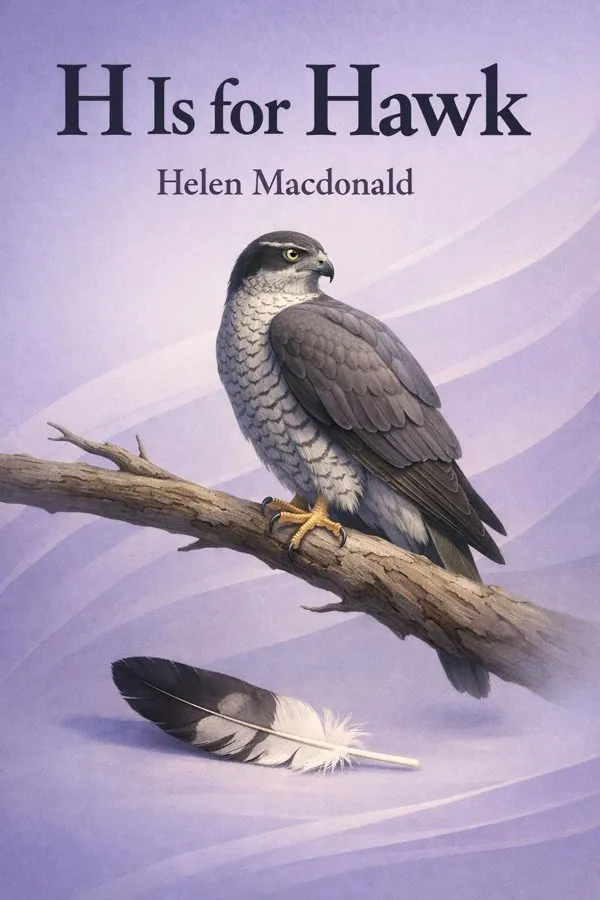
H Is for Hawk: Summary & Key Insights
 10 min9 chaptersAudio available
Key Takeaways from H Is for Hawk
Loss does not simply break life apart; it can also strip away illusions and force a person into a frighteningly honest encounter with reality.
To come close to the wild, you must give up the fantasy of control.
Retreat can feel like refuge, but it can also become a hiding place.
Recovery is not the disappearance of pain; it is the gradual ability to live alongside it.
One of the book’s most bracing insights is that nature is not automatically kind, redemptive, or morally improving.
What Is H Is for Hawk About?
H Is for Hawk by Helen Macdonald is a biographies book spanning 4 pages. H Is for Hawk is a singular memoir that begins in personal catastrophe and opens into something far larger: a meditation on grief, wildness, memory, and the uneasy ways humans seek healing. After the sudden death of her father, Helen Macdonald buys and trains a young goshawk named Mabel, hoping that the fierce discipline of falconry might give shape to her devastation. What follows is not a neat recovery story, but a searching, intelligent account of what it means to disappear into sorrow, into nature, and into another creature’s alien life. Alongside her own experience, Macdonald threads in the life and writings of T. H. White, whose troubled attempt to train a goshawk becomes a dark counterpoint to her own journey. The result is part memoir, part nature writing, part literary reflection, and entirely original. The book matters because it refuses easy consolations: it shows grief as disorienting, obsessive, and transforming. Macdonald writes with rare authority as a falconer, historian of science, and gifted literary stylist, making H Is for Hawk both emotionally devastating and intellectually rich.
This FizzRead summary covers all 9 key chapters of H Is for Hawk in approximately 10 minutes, distilling the most important ideas, arguments, and takeaways from Helen Macdonald's work. Also available as an audio summary and Key Quotes Podcast.
H Is for Hawk
H Is for Hawk is a singular memoir that begins in personal catastrophe and opens into something far larger: a meditation on grief, wildness, memory, and the uneasy ways humans seek healing. After the sudden death of her father, Helen Macdonald buys and trains a young goshawk named Mabel, hoping that the fierce discipline of falconry might give shape to her devastation. What follows is not a neat recovery story, but a searching, intelligent account of what it means to disappear into sorrow, into nature, and into another creature’s alien life. Alongside her own experience, Macdonald threads in the life and writings of T. H. White, whose troubled attempt to train a goshawk becomes a dark counterpoint to her own journey. The result is part memoir, part nature writing, part literary reflection, and entirely original. The book matters because it refuses easy consolations: it shows grief as disorienting, obsessive, and transforming. Macdonald writes with rare authority as a falconer, historian of science, and gifted literary stylist, making H Is for Hawk both emotionally devastating and intellectually rich.
Who Should Read H Is for Hawk?
This book is perfect for anyone interested in biographies and looking to gain actionable insights in a short read. Whether you're a student, professional, or lifelong learner, the key ideas from H Is for Hawk by Helen Macdonald will help you think differently.
- ✓Readers who enjoy biographies and want practical takeaways
- ✓Professionals looking to apply new ideas to their work and life
- ✓Anyone who wants the core insights of H Is for Hawk in just 10 minutes
Want the full summary?
Get instant access to this book summary and 100K+ more with Fizz Moment.
Get Free SummaryAvailable on App Store • Free to download
Key Chapters
Loss does not simply break life apart; it can also strip away illusions and force a person into a frighteningly honest encounter with reality. H Is for Hawk begins with the sudden death of Helen Macdonald’s father, an event that leaves her stunned, dislocated, and unable to move through the world in familiar ways. Her grief is not gentle or symbolic. It is physical, bewildering, and consuming. Instead of treating mourning as a process with tidy stages, Macdonald shows it as a state of altered consciousness, where ordinary language fails and ordinary routines become almost impossible.
In that vacuum, she turns to something ancient and demanding: falconry. Buying a goshawk is not a random act of distraction. It is a response to grief’s intensity. She seeks a creature wild enough to match the violence of what she feels inside. Mabel becomes both a focus and a structure. Feeding, observing, carrying, and training the bird provide a rhythm when the rest of life has become unbearable. Grief, in this sense, becomes a beginning not because it is noble, but because it destroys the old self and creates the conditions for another way of being.
Many readers recognize this pattern in their own lives. After bereavement, divorce, illness, or failure, people often reach for difficult, concrete practices: gardening, long-distance running, caring for an animal, restoring a house, learning a craft. These activities do not erase pain, but they create a place where pain can exist without total chaos.
The lesson is not to romanticize suffering. It is to understand that after rupture, meaningful attention can become a lifeline. When life collapses, choose one real, demanding practice that gives your grief a form and your days a shape.
To come close to the wild, you must give up the fantasy of control. One of the most powerful sections of H Is for Hawk follows Macdonald’s painstaking early work with Mabel. A goshawk is not a pet and cannot be handled through affection alone. It is a predator shaped by instinct, fear, speed, and fierce independence. Training Mabel requires Macdonald to alter her own body, pace, and expectations. She must learn to move slowly, read minute signals, and build trust through consistency rather than force.
This is what makes the book so compelling: falconry becomes a lesson in humility. Macdonald cannot simply impose her will. She has to attend. She watches how Mabel reacts to light, sound, movement, hunger, and proximity. She calibrates each interaction, understanding that progress comes from patience and trust rather than domination. In doing so, she also rediscovers a mode of deep attention that modern life rarely rewards.
There is a practical application here beyond birds and falconry. Relationships, teaching, leadership, parenting, and even self-change often fail when approached as problems to be solved through pressure. Wildness exists in people too: fear, defensiveness, instinct, unpredictability. Trust grows when we make room for gradual adaptation. A new employee, a grieving friend, a frightened child, or even our own anxious minds often respond better to steadiness than to demand.
Macdonald’s bond with Mabel develops because she respects the bird’s nature instead of trying to erase it. That is a profound insight: real connection does not come from making others more like us, but from learning how to meet them as they are.
Actionable takeaway: when facing something resistant or unfamiliar, slow down, observe before acting, and replace the urge to control with the discipline of patient attention.
Retreat can feel like refuge, but it can also become a hiding place. As Macdonald trains Mabel, she increasingly withdraws from ordinary social life. The rituals of falconry and the intense presence of the hawk offer relief from the unbearable demands of human grief. In the company of Mabel, she finds a world stripped to essentials: weather, fields, hunger, flight, pursuit. This solitude is deeply attractive because it quiets thought and suspends the social performances that loss can make intolerable.
Yet H Is for Hawk does not celebrate isolation uncritically. Macdonald shows how easy it is to disappear into wildness, to use immersion in another world as protection against having to reenter one’s own. Mabel becomes not only a companion but a mirror and a shield. The more completely Macdonald lives through the hawk’s instincts, the more she risks severing herself from the human bonds and reflective capacities that make healing possible.
This tension makes the memoir psychologically rich. Solitude can be medicinal when it helps us hear what is true beneath noise and obligation. It becomes dangerous when it locks grief in place, allowing us to avoid the vulnerability of being seen by others. Many readers will recognize this dynamic in less dramatic forms: burying oneself in work, fitness, travel, nature, gaming, spirituality, or caretaking to avoid pain that still needs language and relationship.
Macdonald ultimately suggests that solitude is useful when it clarifies rather than replaces life. Time alone can regulate the nervous system, sharpen perception, and restore perspective. But healing usually requires return: to memory, to conversation, to community, to the imperfect human world.
Actionable takeaway: use solitude intentionally as a space for reflection and recovery, but ask regularly whether your retreat is helping you heal or helping you avoid what still needs to be felt and shared.
Recovery is not the disappearance of pain; it is the gradual ability to live alongside it. By the later stages of H Is for Hawk, Macdonald begins to understand that however sustaining her bond with Mabel has been, she cannot remain suspended forever in the hawk’s world. The sharpness of falconry, the exhilaration of flight, and the intense discipline of care have given her structure, but they are not substitutes for human life. The book’s movement is therefore not from grief to happiness, but from total immersion in loss to a more inhabitable form of being.
What changes is not that her father becomes less important, but that memory becomes less annihilating. She starts to recognize beauty again without feeling disloyal to sorrow. She can see that love for the dead does not require permanent self-erasure. This insight matters because many mourners unconsciously fear that healing is a betrayal. Macdonald refuses that false choice. To keep living is not to forget; it is to carry the dead forward in a changed life.
In practical terms, this return often happens through modest acts rather than dramatic revelations. One answers messages. One attends a gathering. One resumes work with a different seriousness. One notices seasons changing. One speaks the loved one’s name without collapsing. These moments do not look heroic, but they are the architecture of renewal.
Macdonald’s return to the living world is not triumphant or sentimental. It is tentative, clear-eyed, and therefore more convincing. She emerges not cured, but reconnected to the human realm of language, memory, and relationship.
Actionable takeaway: if grief has isolated you, begin reentry through small, repeatable acts of connection—one conversation, one routine, one shared experience at a time.
One of the book’s most bracing insights is that nature is not automatically kind, redemptive, or morally improving. Mabel is beautiful, but she is also lethal. The landscapes Macdonald enters are rich and alive, yet they are not arranged for human healing. This matters because H Is for Hawk resists a common temptation in nature writing: using the natural world as a soft metaphor for peace, wisdom, or balance. Instead, Macdonald portrays wildness as genuinely other. It contains terror, appetite, indifference, and beauty at once.
This honesty is part of what gives the memoir its force. The goshawk does not console Macdonald in any sentimental sense. The bird offers no comforting philosophy. What Mabel provides is contact with a form of life that is immediate, unsentimental, and intensely present. That contact is helpful precisely because it interrupts the self-enclosed loops of grief. The hawk draws Macdonald out of abstraction and into embodied attention.
There is a wider application here. People often seek relief in nature because it seems pure or restorative, but the deepest benefit may come not from comfort but from correction. The natural world reminds us that we are not the center of everything. Weather changes. Animals hunt. Forests decay and regenerate. Life goes on without consulting our preferences. Paradoxically, this decentering can be liberating. It reduces the pressure to make every experience meaningful in purely human terms.
To engage nature well, then, is not to demand serenity from it. It is to let it challenge our assumptions and enlarge our scale of awareness. Watching birds, walking in difficult weather, learning local ecologies, or simply noticing seasonal shifts can all cultivate this kind of attention.
Actionable takeaway: spend time in nature without asking it to soothe you; instead, practice observing it on its own terms and let that perspective widen your sense of life.
Grief is never only about the present death; it activates earlier attachments, identities, and long-stored ways of seeing the world. Macdonald’s relationship with her father is central to H Is for Hawk, but so is her childhood love of birds, her deep knowledge of falconry, and her lifelong fascination with wild creatures. When her father dies, she does not choose a random path through mourning. She returns to an obsession rooted in childhood, as though the older self who loved hawks is the one best equipped to survive the shock.
This is psychologically astute. In moments of rupture, people often revert to foundational stories and practices. A musician plays again after years away. A person returns to family recipes, religious rituals, old landscapes, or adolescent reading. These returns are not signs of regression. They can be attempts to recover continuity when identity has fractured. Macdonald’s memoir shows how the past can function as emotional infrastructure: not a place to remain forever, but a set of meanings and skills that make endurance possible.
The book also suggests that our relationships with the dead are shaped by memory in ongoing, dynamic ways. Macdonald’s father remains present not as a static image but as a living influence in perception, habit, and imagination. Grief, then, is partly the work of learning what remains after a person is gone.
Readers can apply this by becoming more curious about the resources buried in their own histories. What practices once made you feel attentive, alive, or capable? What books, places, disciplines, or communities formed you before life became complicated? Revisiting them may reveal tools you still possess.
Actionable takeaway: when facing upheaval, look backward with purpose and identify one formative practice, place, or skill from your past that can help stabilize and guide you now.
Sometimes another person’s failure helps us understand our own struggle. Interwoven with Macdonald’s story is the life of T. H. White, author of The Once and Future King, who also wrote about attempting to train a goshawk. His account is anxious, painful, and marked by misunderstanding. Where Macdonald seeks contact with wildness, White often seems trapped by fear, loneliness, and a desperate need to master what he cannot truly meet. His story becomes a kind of counter-melody throughout the memoir.
This parallel structure deepens the book in several ways. First, it prevents Macdonald’s experience from becoming purely private. By placing her grief beside White’s troubled falconry, she broadens the memoir into a reflection on literature, masculinity, repression, and the human desire to escape oneself. Second, White’s failures throw Macdonald’s own methods into relief. She succeeds with Mabel not because she is more forceful, but because she is more attentive, less self-deceived, and more willing to see the hawk as a hawk.
White’s presence also demonstrates how books can accompany us across time. We do not read only for information; we read to find distorted doubles, warnings, companions, and unfinished conversations. Macdonald’s engagement with White shows how another writer’s vulnerability can illuminate our own hidden patterns.
In everyday life, this has a practical implication: biographies and memoirs are not just stories about others. They are tools for self-recognition. Reading about someone else’s blind spots, compulsions, or suffering can help us identify what we are missing in ourselves. Used wisely, literature becomes a mirror with historical depth.
Actionable takeaway: choose one memoir or biography that speaks to your current struggle and read it not for inspiration alone, but for contrast, warning, and self-understanding.
In times of emotional chaos, attention can be more useful than explanation. Throughout H Is for Hawk, Macdonald repeatedly demonstrates that close observation is not merely a literary skill or a naturalist’s habit; it is a way of surviving. Training Mabel demands exact noticing: weight, posture, glance, feather movement, timing, terrain, prey behavior. This mode of attention pulls Macdonald out of mental fog and into direct encounter with the world.
What makes this powerful is that attention becomes an antidote to dissociation. Grief often narrows thought into obsessive loops: replaying the loss, imagining alternatives, fearing the future, resisting the present. Careful observation interrupts this cycle. It requires the mind to engage with what is actually here. Macdonald does not cure grief by understanding it intellectually. She lives through it by apprenticing herself to reality, moment by moment.
This idea has broad relevance. Many stabilizing practices work because they train attention: cooking carefully, drawing, birdwatching, knitting, martial arts, gardening, woodworking, meditation, photography. These activities create an external focus that gently reorganizes inner disorder. They also cultivate respect for detail, which can restore a sense of agency when life feels uncontrollable.
Importantly, disciplined attention is not avoidance if it remains connected to truth. Macdonald is not pretending her father did not die. She is learning how to stay alive in the aftermath by caring precisely for something real. In a distracted age, this is a serious lesson. We often seek relief through numbing stimulation; Macdonald finds it through sharpened perception.
Actionable takeaway: establish a daily practice that demands close observation for at least 15 minutes, and use it as a way to return your mind from abstraction to direct, grounding contact with the world.
The deepest relationships are not built on possession, but on reverence for what cannot be owned. Macdonald’s bond with Mabel is intimate, intense, and transformative, yet the bird never becomes fully humanized. Mabel remains irreducibly herself: a goshawk with instincts and perceptions alien to human life. This is one of the memoir’s central ethical insights. Real love does not collapse difference. It learns how to remain close without erasing the other’s nature.
This matters because grief itself can involve a distorted version of possession. We want the lost person back, unchanged and available. We want life to submit to our need. The hawk teaches a harder wisdom. Connection can be profound even when it is incomplete, asymmetrical, and fleeting. Macdonald can care for Mabel, fly her, read her moods, and be altered by her presence, but she cannot fully know or contain her. That limit is not a failure. It is part of what makes the relationship real.
The same principle applies widely. In friendship, partnership, parenting, leadership, and care work, trouble often begins when love becomes control or projection. We stop seeing the person in front of us and start relating to our idea of them. Respecting otherness means remaining curious, allowing autonomy, and recognizing that intimacy does not grant total access.
Macdonald’s writing offers a model of loving attention without sentimental simplification. She neither romanticizes Mabel nor reduces her to symbol. In doing so, she suggests a more mature form of attachment—one that can hold wonder, responsibility, and limits together.
Actionable takeaway: in one important relationship, replace one assumption with a question this week, and practice honoring the other person’s distinct nature rather than treating them as an extension of your needs.
All Chapters in H Is for Hawk
About the Author
Helen Macdonald is a British writer, naturalist, historian of science, and falconer whose work is celebrated for blending literary insight with close attention to the natural world. She has held research and teaching roles associated with the University of Cambridge and has written across memoir, essays, and cultural criticism. Macdonald is especially admired for exploring the intersection of human emotion, animals, ecology, and literature with unusual depth and precision. Her breakthrough book, H Is for Hawk, won major awards and brought her international recognition for its moving account of grief and falconry. Across her writing, she combines scholarly intelligence, field experience, and lyrical prose, making her one of the most distinctive contemporary voices in nature writing and reflective nonfiction.
Get This Summary in Your Preferred Format
Read or listen to the H Is for Hawk summary by Helen Macdonald anytime, anywhere. FizzRead offers multiple formats so you can learn on your terms — all free.
Available formats: App · Audio · PDF · EPUB — All included free with FizzRead
Download H Is for Hawk PDF and EPUB Summary
Key Quotes from H Is for Hawk
“Loss does not simply break life apart; it can also strip away illusions and force a person into a frighteningly honest encounter with reality.”
“To come close to the wild, you must give up the fantasy of control.”
“Retreat can feel like refuge, but it can also become a hiding place.”
“Recovery is not the disappearance of pain; it is the gradual ability to live alongside it.”
“One of the book’s most bracing insights is that nature is not automatically kind, redemptive, or morally improving.”
Frequently Asked Questions about H Is for Hawk
H Is for Hawk by Helen Macdonald is a biographies book that explores key ideas across 9 chapters. H Is for Hawk is a singular memoir that begins in personal catastrophe and opens into something far larger: a meditation on grief, wildness, memory, and the uneasy ways humans seek healing. After the sudden death of her father, Helen Macdonald buys and trains a young goshawk named Mabel, hoping that the fierce discipline of falconry might give shape to her devastation. What follows is not a neat recovery story, but a searching, intelligent account of what it means to disappear into sorrow, into nature, and into another creature’s alien life. Alongside her own experience, Macdonald threads in the life and writings of T. H. White, whose troubled attempt to train a goshawk becomes a dark counterpoint to her own journey. The result is part memoir, part nature writing, part literary reflection, and entirely original. The book matters because it refuses easy consolations: it shows grief as disorienting, obsessive, and transforming. Macdonald writes with rare authority as a falconer, historian of science, and gifted literary stylist, making H Is for Hawk both emotionally devastating and intellectually rich.
More by Helen Macdonald
You Might Also Like

An American Marriage
Tayari Jones
10 min
Benjamin Franklin: An American Life
Walter Isaacson
10 min
I Know Why The Caged Bird Sings
Maya Angelou
10 min
Long Walk to Freedom
Nelson Mandela
10 min
Persepolis
Marjane Satrapi
10 min
Surely You're Joking, Mr. Feynman!
Richard P. Feynman
10 minBrowse by Category
Ready to read H Is for Hawk?
Get the full summary and 100K+ more books with Fizz Moment.