
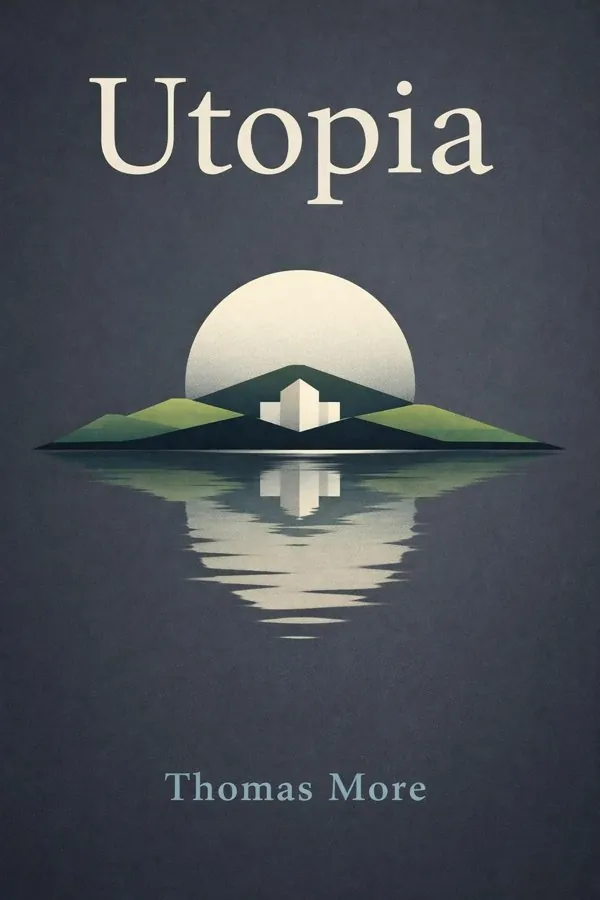
Utopia: Summary & Key Insights
by Thomas More
 10 min9 chaptersAudio available
Key Takeaways from Utopia
Sometimes the clearest view of a society comes from someone who stands outside it.
A society reveals its moral priorities by the suffering it tolerates.
Good ideas do little good if they never reach the rooms where decisions are made.
The shape of a society is never accidental; institutions teach people what to value.
Nothing in Utopia is more radical than its attack on private property.
What Is Utopia About?
Utopia by Thomas More is a civilization book spanning 11 pages. First published in 1516, Thomas More’s Utopia is one of the foundational texts of political philosophy, social criticism, and speculative fiction. Framed as a conversation between More himself and the seasoned traveler Raphael Hythloday, the book describes an imagined island commonwealth where private property is abolished, labor is shared, religion is broadly tolerated, and public life is organized around reason rather than greed. Yet Utopia is far more than a blueprint for a perfect society. It is also a sharp critique of the Europe More knew: a world marked by enclosure, poverty, harsh punishments, political vanity, and endless war. What makes the book endure is its ambiguity. More invites readers to admire Utopia’s fairness while also questioning whether any society can truly eliminate pride, conflict, or coercion. That tension gives the work its power. More wrote not only as a literary humanist but as a lawyer, diplomat, and statesman deeply familiar with the realities of government. His authority comes from that double vision: he understands political ideals and political compromise. Utopia remains essential reading because it asks a timeless question: how should human beings organize society if justice, dignity, and the common good truly mattered?
This FizzRead summary covers all 9 key chapters of Utopia in approximately 10 minutes, distilling the most important ideas, arguments, and takeaways from Thomas More's work. Also available as an audio summary and Key Quotes Podcast.
Utopia
First published in 1516, Thomas More’s Utopia is one of the foundational texts of political philosophy, social criticism, and speculative fiction. Framed as a conversation between More himself and the seasoned traveler Raphael Hythloday, the book describes an imagined island commonwealth where private property is abolished, labor is shared, religion is broadly tolerated, and public life is organized around reason rather than greed. Yet Utopia is far more than a blueprint for a perfect society. It is also a sharp critique of the Europe More knew: a world marked by enclosure, poverty, harsh punishments, political vanity, and endless war.
What makes the book endure is its ambiguity. More invites readers to admire Utopia’s fairness while also questioning whether any society can truly eliminate pride, conflict, or coercion. That tension gives the work its power. More wrote not only as a literary humanist but as a lawyer, diplomat, and statesman deeply familiar with the realities of government. His authority comes from that double vision: he understands political ideals and political compromise. Utopia remains essential reading because it asks a timeless question: how should human beings organize society if justice, dignity, and the common good truly mattered?
Who Should Read Utopia?
This book is perfect for anyone interested in civilization and looking to gain actionable insights in a short read. Whether you're a student, professional, or lifelong learner, the key ideas from Utopia by Thomas More will help you think differently.
- ✓Readers who enjoy civilization and want practical takeaways
- ✓Professionals looking to apply new ideas to their work and life
- ✓Anyone who wants the core insights of Utopia in just 10 minutes
Want the full summary?
Get instant access to this book summary and 100K+ more with Fizz Moment.
Get Free SummaryAvailable on App Store • Free to download
Key Chapters
Sometimes the clearest view of a society comes from someone who stands outside it. Raphael Hythloday is not merely a narrator in Utopia; he is More’s device for testing political assumptions that most people accept without question. A widely traveled philosopher-sailor, reportedly companion to Amerigo Vespucci, Hythloday represents the educated observer who has seen alternatives to European customs and therefore refuses to mistake habit for wisdom.
His very name hints at ambiguity: he may be a dispenser of profound truths, but he may also be a speaker of lofty nonsense. That uncertainty matters. More wants readers to listen seriously to Hythloday’s criticisms while also remaining alert to exaggeration and idealization. Hythloday condemns greed, courtly flattery, and punitive justice with unusual boldness because he is free from dependence on kings or patrons. At the same time, his refusal to enter political service raises a central question: is it better to preserve intellectual purity outside power, or to risk compromise in order to improve institutions from within?
In practical terms, Hythloday resembles the modern whistleblower, public intellectual, or policy critic who exposes systemic problems but resists joining the system. Think of economists criticizing inequality, former diplomats exposing policy failures, or civic thinkers proposing alternative models of education and work. Their distance gives them honesty, but it can also limit their influence.
The lesson is to value informed outsiders without assuming they are automatically correct. Seek perspectives from those who have encountered different systems, especially when evaluating your own workplace, community, or government. Actionable takeaway: regularly question the customs you treat as natural by asking what a thoughtful outsider would see as irrational, unjust, or needlessly cruel.
A society reveals its moral priorities by the suffering it tolerates. Before describing Utopia itself, Hythloday offers a blistering critique of sixteenth-century Europe, especially England. He attacks enclosure, the process by which common lands were converted into private pastures, displacing peasants and creating desperation. His famous complaint that sheep “devour men” captures the absurdity of an economy that values profit more than human survival. He also condemns the spectacle of a society that first impoverishes people and then hangs them for theft.
More’s critique is not only economic but political. He targets idle nobles, corrupt advisers, vain monarchs, and a ruling culture obsessed with war and display rather than public welfare. Wealth concentrates at the top while ordinary people bear the costs. Punishment is severe, but prevention is neglected. The poor are blamed for conditions created by policy.
This analysis still feels modern. Today, we can see similar dynamics when housing becomes unaffordable, wages stagnate, social safety nets weaken, and public anger is redirected toward the victims rather than the structures producing insecurity. A government may speak of order while ignoring the root causes of disorder. More’s satire forces readers to ask whether legal systems punish symptoms instead of causes.
The practical application is straightforward: when facing crime, instability, or social decline, look upstream. Ask what economic incentives, labor arrangements, and property rules are shaping behavior. Better policy often begins with better diagnosis. Actionable takeaway: when judging any social problem, resist the temptation to moralize first; investigate what conditions the system itself has created and who benefits from them.
Good ideas do little good if they never reach the rooms where decisions are made. One of Utopia’s most important debates is whether a wise person should enter public service. More, appearing as a character, argues for practical engagement: advisers should work within flawed governments, offering the best counsel circumstances allow. Hythloday disagrees. Courts, he says, are dominated by ambition, flattery, and self-interest; anyone who speaks too frankly will either be ignored or corrupted.
This disagreement gives Utopia much of its realism. More understands politics as the art of partial improvement, not the achievement of perfection. Hythloday fears that compromise slowly turns reformers into servants of the very system they hoped to change. Neither position fully wins. Instead, the book presents a permanent tension between idealism and pragmatism.
The debate applies everywhere modern people face institutions: government agencies, universities, corporations, nonprofits, even families. Should you join an imperfect organization to improve it from within, or stay outside and preserve your independence? The insider may gain influence but lose candor. The outsider may keep integrity but sacrifice impact. Effective reform often requires both roles: critics who articulate the ideal and practitioners who translate it into achievable steps.
More’s deeper insight is that political wisdom includes rhetorical judgment. Telling the whole truth in the wrong setting may achieve less than advancing part of the truth in a form others can hear. Actionable takeaway: before rejecting or joining an institution, decide what matters more in your situation—purity, influence, or gradual improvement—and choose your role deliberately rather than drifting into either cynicism or compromise.
The shape of a society is never accidental; institutions teach people what to value. More gives Utopia a carefully ordered geography and civic structure to show that justice depends not only on laws but on design. The island contains fifty-four similar cities, each organized according to shared principles. Towns are planned, agriculture is distributed, and citizens rotate between urban and rural life. Even the island’s separation from the mainland suggests a symbolic break from inherited corruption.
This geographic description may seem decorative, but it serves a philosophical purpose. Utopia’s physical arrangement supports equality, stability, and mutual dependence. Cities are alike enough to discourage status competition. Households exchange homes periodically, reducing possessiveness. Agricultural service ensures that all citizens understand the labor required to sustain society. Order is spatial as well as moral.
Modern readers can see parallels in urban planning, school zoning, public transportation, and access to green space. Design choices influence whether communities become inclusive or segregated, healthy or isolated, cooperative or atomized. A city built around public squares encourages shared life; one built only around private cars and gated neighborhoods can deepen division. More anticipates the idea that architecture and policy together shape civic character.
Of course, Utopia’s uniformity also raises concerns. Standardization may reduce inequality, but it can also limit spontaneity and local variation. More leaves room for that discomfort. The point is not that one perfect layout exists, but that social arrangements are constructed and therefore can be reconstructed.
Actionable takeaway: examine how your environment influences behavior. Whether at home, work, or in your community, redesign spaces and routines to support cooperation, fairness, and shared responsibility rather than pure convenience or status.
No political order can endure if it ignores how character is formed at home. Utopia pays close attention to family structure, child-rearing, education, and daily discipline because More knows that institutions depend on habits. Households are the basic units of social organization, led by elders and integrated into broader civic life. Marriage is treated seriously, sexuality is regulated, and domestic life is expected to contribute to social stability rather than private indulgence alone.
Education occupies a central place. Utopians value learning not as ornament but as preparation for good judgment. Citizens use free time for study, and intellectual cultivation is open far more broadly than in most European societies of More’s day. Practical skills, moral reflection, and philosophical inquiry belong together. The result is a culture in which leisure is not wasted but directed toward self-improvement and public usefulness.
For modern readers, the key insight is that education cannot be reduced to job training. A healthy society needs citizens capable of reasoning about ethics, law, religion, and the common good. At the same time, family and school environments transmit expectations long before formal politics begins. Communities that neglect reading, conversation, and responsibility should not be surprised when civic life deteriorates.
Yet More’s vision is not entirely comfortable. Utopia’s domestic order can feel strict, even intrusive, by contemporary standards. That tension is instructive. Every society balances freedom and formation differently, and the line between guidance and control is never simple.
Actionable takeaway: treat education and family culture as civic issues. Create regular practices—reading, discussion, shared work, thoughtful use of leisure—that strengthen judgment and responsibility rather than leaving character to chance.
A punishment system reveals whether a society seeks revenge or restoration. More’s critique of criminal justice is among the most enduring parts of Utopia. He rejects the routine use of death for theft, arguing that it is both disproportionate and ineffective. If petty theft and murder carry the same penalty, a desperate criminal has little reason not to commit greater violence. More’s point is practical as well as moral: cruel punishments often fail even on their own terms.
In Utopia, punishment aims more at reform and social protection than theatrical brutality. Slavery, though troubling to modern readers, is presented as an alternative to execution and as a way to preserve labor while marking serious wrongdoing. The arrangement is far from humane by contemporary standards, but within More’s context it signals a significant move away from blood-soaked justice toward calibrated consequence.
More also insists that crime must be understood socially. A state that creates poverty and then punishes theft without addressing deprivation is not simply enforcing order; it is complicit in the behavior it condemns. This insight resonates strongly today in debates over incarceration, rehabilitation, drug policy, juvenile justice, and recidivism. Systems that neglect education, addiction treatment, housing, and employment opportunities often recycle the very harms they claim to oppose.
The challenge for readers is to think beyond punishment as moral display. The real question is what response best reduces harm and restores functioning communities.
Actionable takeaway: when evaluating rules at any scale—parenting, workplace policy, school discipline, or law—ask not only whether a penalty feels deserved, but whether it addresses causes, prevents repetition, and leaves room for genuine reform.
Nations often call violence honorable when what they really mean is profitable or vain. Utopia takes a skeptical view of war, treating it as a necessary evil rather than a stage for heroism. The Utopians prefer peace, avoid military conflict when possible, and use diplomacy, alliances, and strategic incentives before resorting to battle. They may hire mercenaries or seek to destabilize hostile rulers rather than exposing their own citizens to unnecessary bloodshed. Their goal is not martial glory but security.
This approach sharply contrasts with the culture More criticizes in Europe, where rulers pursue war for reputation, inheritance claims, or personal ambition while ordinary people suffer the consequences. Utopia asks readers to reconsider the values wrapped around military action. Is victory admirable in itself, or only insofar as it protects justice and minimizes suffering? More strips war of romance and judges it by outcomes.
The idea applies beyond the battlefield. In organizations and personal life, people often escalate conflict for pride rather than principle. Leaders defend losing strategies to avoid embarrassment. Teams compete internally for status instead of solving problems cooperatively. More’s anti-glory mindset encourages strategic restraint.
At the same time, Utopia is not pacifist. It accepts force when self-defense, liberation of the oppressed, or fulfillment of obligations require it. The moral emphasis is proportionality, necessity, and prudence.
Actionable takeaway: before entering any conflict, ask three questions: Is it necessary? Have better alternatives been tried? What will success actually cost? Replace the desire to win dramatically with the discipline to resolve wisely.
All Chapters in Utopia
About the Author
Thomas More (1478–1535) was an English humanist, lawyer, statesman, and author whose life joined scholarship with public service. Educated in the classical tradition, he became one of the leading intellectual figures of Renaissance England and built a distinguished legal and political career. More served in Parliament, acted as a royal diplomat and counselor, and eventually became Lord Chancellor under Henry VIII. His most famous work, Utopia, published in 1516, established him as a major voice in political philosophy and social criticism. Deeply committed to his Catholic faith, More refused to endorse Henry VIII’s break with Rome and would not accept the king’s supremacy over the Church of England. For that resistance, he was imprisoned and executed in 1535. He was later canonized by the Catholic Church and remains an enduring symbol of conscience, integrity, and intellectual seriousness.
Get This Summary in Your Preferred Format
Read or listen to the Utopia summary by Thomas More anytime, anywhere. FizzRead offers multiple formats so you can learn on your terms — all free.
Available formats: App · Audio · PDF · EPUB — All included free with FizzRead
Download Utopia PDF and EPUB Summary
Key Quotes from Utopia
“Sometimes the clearest view of a society comes from someone who stands outside it.”
“A society reveals its moral priorities by the suffering it tolerates.”
“Good ideas do little good if they never reach the rooms where decisions are made.”
“The shape of a society is never accidental; institutions teach people what to value.”
“Nothing in Utopia is more radical than its attack on private property.”
Frequently Asked Questions about Utopia
Utopia by Thomas More is a civilization book that explores key ideas across 9 chapters. First published in 1516, Thomas More’s Utopia is one of the foundational texts of political philosophy, social criticism, and speculative fiction. Framed as a conversation between More himself and the seasoned traveler Raphael Hythloday, the book describes an imagined island commonwealth where private property is abolished, labor is shared, religion is broadly tolerated, and public life is organized around reason rather than greed. Yet Utopia is far more than a blueprint for a perfect society. It is also a sharp critique of the Europe More knew: a world marked by enclosure, poverty, harsh punishments, political vanity, and endless war. What makes the book endure is its ambiguity. More invites readers to admire Utopia’s fairness while also questioning whether any society can truly eliminate pride, conflict, or coercion. That tension gives the work its power. More wrote not only as a literary humanist but as a lawyer, diplomat, and statesman deeply familiar with the realities of government. His authority comes from that double vision: he understands political ideals and political compromise. Utopia remains essential reading because it asks a timeless question: how should human beings organize society if justice, dignity, and the common good truly mattered?
You Might Also Like
The Structure of Scientific Revolutions
Thomas S. Kuhn
10 min
Genius
Harold Bloom
10 min
A Cultural History of the Medieval Age
Various Editors
10 min
A History of God: The 4,000-Year Quest of Judaism, Christianity and Islam
Karen Armstrong
10 min
A History of the World in 10½ Chapters
Julian Barnes
10 min
A Short History of Progress
Ronald Wright
10 minBrowse by Category
Ready to read Utopia?
Get the full summary and 100K+ more books with Fizz Moment.