
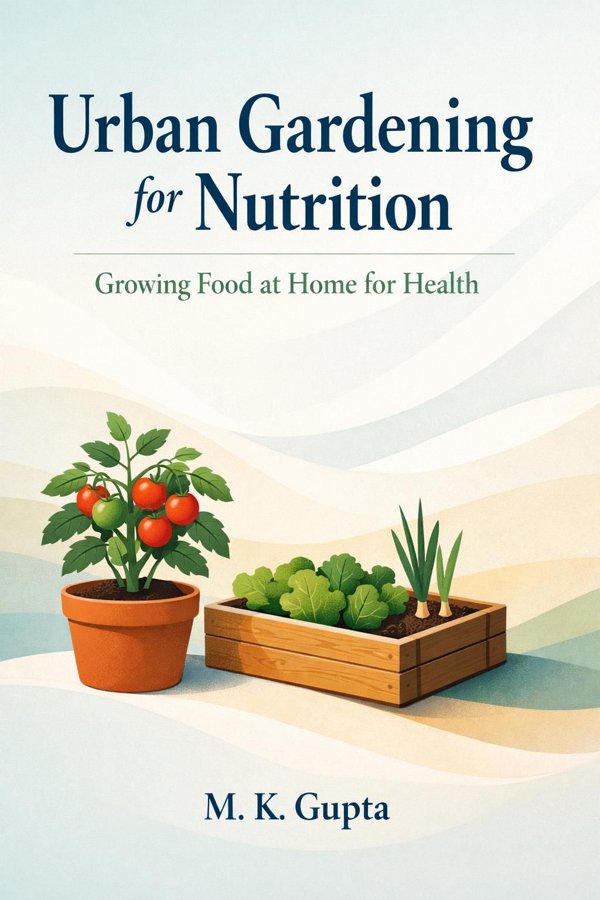
Urban Gardening for Nutrition: Growing Food at Home for Health: A Practical Guide to Home Food Production for Better Nutrition: Summary & Key Insights
by M. K. Gupta
 10 min9 chaptersAudio available
Key Takeaways from Urban Gardening for Nutrition: Growing Food at Home for Health: A Practical Guide to Home Food Production for Better Nutrition
The freshest food is often the most nourishing, and that simple truth sits at the heart of Gupta’s argument.
Lack of land is not the same as lack of opportunity.
Healthy plants begin below the surface, and Gupta repeatedly reminds readers that soil is not just a medium that holds roots in place.
When horizontal space is limited, productivity depends on design.
What households throw away often contains the beginning of tomorrow’s harvest.
What Is Urban Gardening for Nutrition: Growing Food at Home for Health: A Practical Guide to Home Food Production for Better Nutrition About?
Urban Gardening for Nutrition: Growing Food at Home for Health: A Practical Guide to Home Food Production for Better Nutrition by M. K. Gupta is a nutrition book spanning 8 pages. Urban life often creates the illusion that good nutrition begins at the supermarket, but M. K. Gupta argues that it can begin much closer to home: on a balcony, windowsill, terrace, courtyard, or rooftop. Urban Gardening for Nutrition is a practical guide to producing fresh, nutrient-rich food in limited spaces, showing readers how to grow vegetables, herbs, and fruits even in crowded cities. Rather than treating gardening as a hobby alone, the book frames it as a health practice, a household economy strategy, and a path toward greater self-reliance. What makes this book especially valuable is its combination of horticultural know-how and nutritional purpose. Gupta explains not only how to prepare soil, choose containers, compost kitchen waste, and manage pests sustainably, but also why these actions matter for the quality of the food we eat. His approach is rooted in the belief that freshness, soil health, and local food production can significantly improve household nutrition. As a horticulturist and advocate for sustainable food systems, Gupta brings practical authority to a subject that is increasingly urgent in a world of rising food costs, shrinking green space, and growing concern about food quality.
This FizzRead summary covers all 9 key chapters of Urban Gardening for Nutrition: Growing Food at Home for Health: A Practical Guide to Home Food Production for Better Nutrition in approximately 10 minutes, distilling the most important ideas, arguments, and takeaways from M. K. Gupta's work. Also available as an audio summary and Key Quotes Podcast.
Urban Gardening for Nutrition: Growing Food at Home for Health: A Practical Guide to Home Food Production for Better Nutrition
Urban life often creates the illusion that good nutrition begins at the supermarket, but M. K. Gupta argues that it can begin much closer to home: on a balcony, windowsill, terrace, courtyard, or rooftop. Urban Gardening for Nutrition is a practical guide to producing fresh, nutrient-rich food in limited spaces, showing readers how to grow vegetables, herbs, and fruits even in crowded cities. Rather than treating gardening as a hobby alone, the book frames it as a health practice, a household economy strategy, and a path toward greater self-reliance.
What makes this book especially valuable is its combination of horticultural know-how and nutritional purpose. Gupta explains not only how to prepare soil, choose containers, compost kitchen waste, and manage pests sustainably, but also why these actions matter for the quality of the food we eat. His approach is rooted in the belief that freshness, soil health, and local food production can significantly improve household nutrition. As a horticulturist and advocate for sustainable food systems, Gupta brings practical authority to a subject that is increasingly urgent in a world of rising food costs, shrinking green space, and growing concern about food quality.
Who Should Read Urban Gardening for Nutrition: Growing Food at Home for Health: A Practical Guide to Home Food Production for Better Nutrition?
This book is perfect for anyone interested in nutrition and looking to gain actionable insights in a short read. Whether you're a student, professional, or lifelong learner, the key ideas from Urban Gardening for Nutrition: Growing Food at Home for Health: A Practical Guide to Home Food Production for Better Nutrition by M. K. Gupta will help you think differently.
- ✓Readers who enjoy nutrition and want practical takeaways
- ✓Professionals looking to apply new ideas to their work and life
- ✓Anyone who wants the core insights of Urban Gardening for Nutrition: Growing Food at Home for Health: A Practical Guide to Home Food Production for Better Nutrition in just 10 minutes
Want the full summary?
Get instant access to this book summary and 100K+ more with Fizz Moment.
Get Free SummaryAvailable on App Store • Free to download
Key Chapters
The freshest food is often the most nourishing, and that simple truth sits at the heart of Gupta’s argument. He begins by challenging the assumption that food bought in markets is automatically good enough for health. Commercial produce is often selected for shelf life, uniform appearance, and transport durability rather than nutrient density or flavor. By the time it reaches the kitchen, it may have lost part of its freshness and vitality. Home-grown food, by contrast, can be harvested at peak maturity and eaten within minutes or hours, preserving both taste and nutritional value.
Gupta treats gardening as more than food production; he presents it as a direct nutritional intervention. Leafy greens, herbs, tomatoes, chilies, and seasonal vegetables grown at home allow families to add more micronutrient-rich foods to everyday meals. Even a few pots of spinach, coriander, mint, fenugreek, or cherry tomatoes can increase the regular intake of vitamins, minerals, and fiber. This is especially important in urban households where dependence on processed food and irregular access to fresh produce can weaken dietary quality.
He also notes the psychological and behavioral effects of growing food. People tend to eat more vegetables when they have grown them themselves. Children become more curious about plants and more willing to eat fresh greens. Adults become more attentive to seasonality and food waste. Gardening therefore improves nutrition not only through what is harvested, but through changed habits and greater food awareness.
A practical example is a household that grows salad leaves and herbs in shallow trays. Instead of buying small, expensive bundles that wilt quickly, the family can snip only what it needs for soups, salads, or garnishes. This reduces waste while improving meal quality.
Actionable takeaway: Start with three nutrient-dense crops you use weekly, such as spinach, mint, and tomatoes, and build your home garden around foods that naturally fit your diet.
Lack of land is not the same as lack of opportunity. One of Gupta’s most encouraging insights is that urban gardening begins with observation, not acreage. Many people dismiss the idea of growing food because they imagine a traditional garden plot, but the book shows that productive growing can happen in very small areas if space is assessed intelligently. A balcony with four hours of sunlight, a rooftop corner, a sunny staircase landing, a courtyard wall, or even windows with good light can become food-producing zones.
Gupta encourages readers to study their homes as micro-farms. Where does the morning sun fall? Which spaces remain shaded? Where can water be accessed easily? Which surfaces can support pots safely? This kind of mapping helps determine what can be grown successfully. Leafy greens and herbs may thrive in partial light, while tomatoes, peppers, and brinjals need stronger sun. Climbers such as beans or gourds can be trained upward on railings, trellises, or walls, converting vertical surfaces into productive assets.
He also addresses practical urban constraints. Rooftops may need lightweight containers. Apartment dwellers may need to manage runoff and keep setups tidy. Shared spaces may require cooperation with neighbors or building managers. By focusing on adaptability, Gupta replaces the myth of “not enough room” with a more empowering question: “How can this space be used well?”
For example, a family in a small apartment might place herbs on a kitchen windowsill, grow lettuce and spinach in balcony troughs, and train cucumbers on a vertical net. Each area serves a specific purpose based on light and access.
Actionable takeaway: Spend one week tracking sunlight in your home’s available spaces, then assign crops according to light levels before buying containers or seeds.
Healthy plants begin below the surface, and Gupta repeatedly reminds readers that soil is not just a medium that holds roots in place. It is a living system that determines vigor, resilience, and nutritional quality. In urban gardening, where plants often grow in containers instead of open ground, soil preparation becomes even more important because the plant’s entire world is limited to a small volume of growing mix.
The book explains that good growing media must balance structure, fertility, drainage, and moisture retention. Soil that is too compact suffocates roots and traps water. Soil that is too sandy dries too quickly and fails to hold nutrients. Gupta recommends enriching garden soil with compost, leaf mold, cocopeat, or other organic matter to create a loose, fertile medium that roots can easily penetrate. He emphasizes that nutrient management should be steady and organic where possible, not dependent on heavy chemical inputs that may create short-term growth but weaken long-term soil life.
One of his strongest points is that nutrition starts with nutrient cycling. Plants absorb minerals from the soil, so depleted growing media will eventually produce weak crops. Regular addition of compost, diluted organic liquid feeds, and mulch can sustain fertility over time. He also advises gardeners to pay attention to pH, drainage holes, and signs of deficiency such as yellowing leaves or poor flowering.
A practical application would be preparing a container mix using garden soil, compost, and a lightening material like sand or cocopeat. This creates an environment suitable for vegetables such as chilies, okra, and beans while reducing the risk of root rot.
Actionable takeaway: Before planting anything, prepare a nutrient-rich potting mix and commit to replenishing containers with compost at regular intervals rather than waiting for plants to decline.
When horizontal space is limited, productivity depends on design. Gupta shows that container gardening and vertical planting are not second-best alternatives to traditional farming; they are smart urban strategies that can produce impressive amounts of food from tiny footprints. The key is selecting the right containers, arranging them wisely, and matching crops to depth, weight, and support needs.
The book explains that almost any safe vessel can become a growing container if drainage is managed properly: clay pots, plastic tubs, wooden boxes, recycled buckets, grow bags, and troughs. Shallow-rooted crops such as coriander, lettuce, fenugreek, and radish greens do well in low trays, while deeper pots are better for tomatoes, eggplants, or root crops. Gupta encourages readers to think in layers: low trays for greens, mid-height containers for compact vegetables, and vertical structures for climbers.
Vertical gardening receives special attention because it turns walls, railings, fences, and poles into productive spaces. Beans, cucumbers, gourds, peas, and even some squashes can be trained upward, improving air circulation and reducing disease pressure while making harvesting easier. Tiered stands and hanging baskets can further increase output without crowding the floor.
This chapter is especially useful because Gupta blends creativity with practicality. He warns against overloading weak balconies, placing large containers where drainage causes damage, or grouping plants without considering sunlight competition. Efficiency, in his view, comes from thoughtful planning rather than simply adding more pots.
For instance, a rooftop gardener might place heavy fruiting plants in sturdy containers along the sunniest edge, keep herbs in portable pots near the kitchen door, and suspend trailing greens from a rack. The result is a compact but diverse edible garden.
Actionable takeaway: Choose containers based on crop root depth and create at least one vertical growing feature to increase production without needing more floor space.
What households throw away often contains the beginning of tomorrow’s harvest. Gupta makes composting one of the most practical and transformative parts of urban food production because it closes the loop between kitchen waste and soil health. Instead of sending vegetable peels, fruit scraps, dried leaves, and garden trimmings to the trash, urban gardeners can convert them into rich organic matter that feeds future crops.
The book explains composting in approachable terms, reducing the fear that it is messy or technically difficult. Gupta shows that even in limited spaces, small compost bins, buckets, or covered pits can process biodegradable waste if managed with the right balance of green materials, dry matter, moisture, and air. He highlights common mistakes such as making the pile too wet, adding cooked oily food, or neglecting aeration, all of which can cause odor and slow decomposition.
Beyond waste reduction, composting serves a deeper purpose in the book’s nutritional framework. Compost improves soil texture, enhances moisture retention, supports beneficial microorganisms, and gradually releases nutrients. In container gardens, where fertility can quickly decline, homemade compost becomes an affordable and sustainable resource. Gupta also emphasizes the environmental value of this practice: less organic waste enters municipal systems, and households become more conscious of consumption patterns.
A simple example is using a two-bin system in an apartment. One container receives daily kitchen scraps layered with dry leaves or shredded paper, while the second holds maturing compost. After several weeks, the finished material can be mixed into planters for leafy greens or fruiting vegetables.
Composting also teaches patience and observation. Gardeners learn that decay is not loss but renewal. What appears useless becomes the basis of food and health.
Actionable takeaway: Set up a small home compost system using daily vegetable scraps and dry carbon material, and use the finished compost to refresh containers every planting cycle.
A successful garden is not built by planting everything; it is built by planting wisely. Gupta argues that crop selection should reflect household diet, local climate, available sunlight, and the gardener’s time and skill level. Many urban beginners fail because they choose glamorous or difficult crops rather than reliable, high-use plants that match their conditions. The smarter approach is to grow what the family actually eats and what the space can realistically support.
The book recommends beginning with fast-growing, frequently used crops such as spinach, coriander, mint, amaranth, chili, tomatoes, okra, and beans. These offer quick rewards, visible growth, and repeated harvests. Gupta also encourages staggered sowing so that all produce does not mature at once. By sowing small batches of greens every two weeks, households can maintain continuous supply rather than facing feast-and-famine cycles.
Seasonality is another major factor. Cool-season vegetables like peas, cabbage, and certain leafy greens differ from warm-season crops like gourds, okra, and eggplant. Gupta teaches readers to work with the climate rather than against it. He also discusses maintenance needs: climbers may require staking, fruiting crops often need more feeding, and herbs benefit from frequent trimming to stay productive.
Practical planning might involve dividing the garden into categories: daily-use herbs, weekly-use greens, and longer-term vegetables. A family could keep basil, mint, and coriander near the kitchen; grow spinach and fenugreek in succession; and dedicate larger containers to tomatoes and chilies.
This chapter reinforces an important mindset: urban gardening should reduce stress, not create it. Choosing adaptable crops builds confidence, lowers cost, and increases the chance that fresh produce becomes a regular part of meals.
Actionable takeaway: Make a list of the ten vegetables and herbs you use most often, then start by growing the easiest five that match your season and sunlight conditions.
Every garden attracts life, and not all of it will be welcome. Gupta approaches pests and plant disease with a balanced philosophy: prevention is better than reaction, and ecology is better than heavy chemical dependence. Since the book is centered on better nutrition and healthier home food production, it places special emphasis on low-toxicity, environmentally responsible pest management.
Rather than treating insects as isolated enemies, Gupta encourages readers to see pests as signals. Weak plants, poor airflow, excess moisture, overcrowding, and nutrient imbalance often create the conditions for infestations. Aphids, caterpillars, fungal spots, and mites can become severe when the growing environment is neglected. Good hygiene, correct spacing, regular inspection, and healthy soil are therefore the first lines of defense.
The book also describes practical home-based solutions such as hand-picking pests, pruning infected leaves, using soap sprays or neem-based preparations, and rotating crops to interrupt recurring problems. Mixed planting can also help. Strong-smelling herbs and flowers may deter some pests or attract beneficial insects. Vertical supports improve airflow around climbers, reducing fungal issues. Watering at the base rather than over leaves can limit disease spread.
Gupta’s broader point is that food grown for health should not be protected in ways that undermine that very purpose. While he does not deny that severe outbreaks may require stronger intervention, he clearly favors methods that preserve soil life, reduce household exposure to residues, and keep the garden ecosystem in balance.
A practical routine might include checking the undersides of leaves every morning, removing affected plant parts early, and applying neem spray only when needed. Such consistent observation prevents minor issues from becoming destructive outbreaks.
Actionable takeaway: Build a weekly garden inspection habit and rely first on preventive care, sanitation, and mild organic controls before considering stronger pest treatments.
A productive garden is not just planted; it is scheduled. Gupta shows that one of the biggest differences between casual gardening and meaningful household food production is seasonal planning. Without a calendar, gardeners often sow at the wrong time, neglect crop succession, or end up with empty containers between harvests. With planning, even a small urban space can yield food for much of the year.
The book explains that each crop has its own preferred temperature, daylight pattern, and growth rhythm. Greens may bolt in excessive heat, while fruiting vegetables may fail in cool conditions. Gupta therefore urges readers to organize planting around local seasons. He also recommends rotating crops through the same containers to keep the garden active. Once a quick crop like leafy greens is harvested, the soil can be refreshed and replanted with herbs or legumes. This continuous-use approach increases output and maintains momentum.
Seasonal planning also helps with workload management. Seed starting, transplanting, mulching, fertilizing, and pest monitoring can be spread across the year instead of becoming chaotic. Households can align garden production with expected dietary needs, festive cooking, or school schedules. During hotter periods, shade management and watering become priorities; in rainy periods, drainage and disease prevention matter more.
A good example is using a rooftop garden to sequence crops: coriander and spinach in cooler weeks, tomatoes and chilies in warm months, then beans or gourds when trellises can be fully used. This kind of rolling plan prevents idle space and supports more regular kitchen use.
The chapter ultimately encourages gardeners to think like stewards rather than occasional planters. Planning gives purpose to each container and turns scattered effort into a resilient food system.
Actionable takeaway: Create a simple seasonal sowing chart for your local climate so that as one crop finishes, another is ready to take its place.
Food resilience grows faster when people grow together. While much of the book focuses on the household garden, Gupta broadens the conversation by showing how community gardening can multiply nutritional, social, and environmental benefits. In dense cities, not every family has ideal growing space, but many neighborhoods contain underused rooftops, vacant lots, school grounds, temple courtyards, or shared housing areas that can be turned into collective food gardens.
Gupta sees community gardening as a practical answer to urban limitations. Shared gardens spread costs for tools, water systems, composting infrastructure, and seeds. They also spread knowledge. Experienced growers can guide beginners, children can learn where food comes from, and older residents can pass on cultivation wisdom that modern urban life often neglects. This creates not only food but social cohesion.
Nutritionally, shared systems can expand variety beyond what one household can manage alone. A community plot may include greens, legumes, roots, herbs, and fruiting vegetables, allowing participants to access more diverse fresh produce. Composting can also become easier at scale, with neighborhood organic waste transformed into fertile soil amendment. In times of rising food costs, such gardens may offer meaningful supplementary produce.
The book does not romanticize collective work. Gupta notes the need for clear responsibilities, fair access, crop planning, and regular maintenance. Without organization, shared gardens can decline. But with structure, they become living examples of local self-reliance.
A practical model is a housing complex where one group manages composting, another handles seedling production, and families share harvests according to participation. The garden then becomes both a nutrition resource and a social commons.
Actionable takeaway: If your home space is limited, identify one shared neighborhood area and start a conversation about a small collective garden with clear roles and simple crop goals.
All Chapters in Urban Gardening for Nutrition: Growing Food at Home for Health: A Practical Guide to Home Food Production for Better Nutrition
About the Author
M. K. Gupta is an Indian horticulturist and nutrition advocate recognized for promoting urban agriculture, home gardening, and sustainable food practices. His work focuses on helping ordinary households grow fresh food in limited spaces, with particular emphasis on the connection between cultivation and better health. Rather than treating gardening as a specialized rural activity, Gupta presents it as an accessible urban solution to problems of food quality, rising costs, and poor nutrition. He has written on home gardening, organic cultivation, and practical methods for producing vegetables, herbs, and fruits in containers and small plots. His writing is valued for its clarity, usefulness, and strong public-health perspective. Through books like Urban Gardening for Nutrition, Gupta encourages readers to see food growing as both a personal skill and a meaningful step toward healthier, more self-reliant living.
Get This Summary in Your Preferred Format
Read or listen to the Urban Gardening for Nutrition: Growing Food at Home for Health: A Practical Guide to Home Food Production for Better Nutrition summary by M. K. Gupta anytime, anywhere. FizzRead offers multiple formats so you can learn on your terms — all free.
Available formats: App · Audio · PDF · EPUB — All included free with FizzRead
Download Urban Gardening for Nutrition: Growing Food at Home for Health: A Practical Guide to Home Food Production for Better Nutrition PDF and EPUB Summary
Key Quotes from Urban Gardening for Nutrition: Growing Food at Home for Health: A Practical Guide to Home Food Production for Better Nutrition
“The freshest food is often the most nourishing, and that simple truth sits at the heart of Gupta’s argument.”
“Lack of land is not the same as lack of opportunity.”
“Healthy plants begin below the surface, and Gupta repeatedly reminds readers that soil is not just a medium that holds roots in place.”
“When horizontal space is limited, productivity depends on design.”
“What households throw away often contains the beginning of tomorrow’s harvest.”
Frequently Asked Questions about Urban Gardening for Nutrition: Growing Food at Home for Health: A Practical Guide to Home Food Production for Better Nutrition
Urban Gardening for Nutrition: Growing Food at Home for Health: A Practical Guide to Home Food Production for Better Nutrition by M. K. Gupta is a nutrition book that explores key ideas across 9 chapters. Urban life often creates the illusion that good nutrition begins at the supermarket, but M. K. Gupta argues that it can begin much closer to home: on a balcony, windowsill, terrace, courtyard, or rooftop. Urban Gardening for Nutrition is a practical guide to producing fresh, nutrient-rich food in limited spaces, showing readers how to grow vegetables, herbs, and fruits even in crowded cities. Rather than treating gardening as a hobby alone, the book frames it as a health practice, a household economy strategy, and a path toward greater self-reliance. What makes this book especially valuable is its combination of horticultural know-how and nutritional purpose. Gupta explains not only how to prepare soil, choose containers, compost kitchen waste, and manage pests sustainably, but also why these actions matter for the quality of the food we eat. His approach is rooted in the belief that freshness, soil health, and local food production can significantly improve household nutrition. As a horticulturist and advocate for sustainable food systems, Gupta brings practical authority to a subject that is increasingly urgent in a world of rising food costs, shrinking green space, and growing concern about food quality.
You Might Also Like

Eating by the Seasons Cookbook: Seasonal Produce-Focused Recipes
Clare Foster
10 min
From Crook to Cook: Platinum Recipes from Tha Boss Dogg's Kitchen
Snoop Dogg with Ryan Ford
10 min
Juicing for Beginners: The Essential Guide to Juicing Recipes and Juicing for Weight Loss
Rockridge Press
10 min
The Food Therapist: Break Bad Habits, Eat with Intention, and Indulge Without Worry
Shira Lenchewski
10 min
The Mediterranean Diet Meal Plan: A 4-Week Meal Plan for Optimal Health and Weight Loss
Various Contributors
10 min
The Well Plated Cookbook: Simple, Wholesome Recipes for Everyday Meals
Erin Clarke
10 minBrowse by Category
Ready to read Urban Gardening for Nutrition: Growing Food at Home for Health: A Practical Guide to Home Food Production for Better Nutrition?
Get the full summary and 100K+ more books with Fizz Moment.